TL;DR
- More than 80 percent of AI projects fail to deliver business value, and MIT found 95 percent of generative AI pilots return nothing. MIT Project NANDA found only 5 percent of pilots reached production in a way that actually moved the numbers.
- Pilots succeed because they’re built to avoid the exact data conditions production forces them to face. A pilot dataset is typically a few thousand hand-cleaned records from one system, while production spans dozens of undocumented legacy pipelines at 10 to 100 times the volume.
- Governance and data readiness answer different questions, and fixing one doesn’t fix the other. Deloitte found 72 percent of leaders lack unified, accessible data even when a governance committee is fully staffed and documented.
- Agentic AI raises the stakes because an agent acts on bad data instead of just answering with it. A chatbot serving stale data produces a bad answer a person can catch before acting; an agent executes the decision before anyone notices.
- Legacyleap treats data modernization as a gate the AI program has to clear, not a parallel workstream. Its Assessment and Documentation agents map dependencies and reconstruct pipeline logic in 3 to 5 days, and the QA Agent validates parity before a modernized pipeline ever feeds a production AI system.
Why AI Pilots Fail on Legacy Data Foundations
More than 80 percent of AI projects fail to deliver their intended business value [1]. A separate study from MIT Project NANDA found that 95 percent of generative AI pilots produced no measurable financial return, with only 5 percent reaching production in a way that moved the numbers [2].
Coverage of this pattern usually stops at governance. Poor executive sponsorship, unclear decision rights, and weak change management get most of the blame. Those causes are real. They are also not the whole story.
AI pilots fail to reach production because the data they need to run on in production rarely resembles the data they were built and demoed against. A pilot runs on a small, curated dataset chosen because it already works. Production runs on the real data estate, meaning undocumented legacy applications, batch-only ETL pipelines, and databases nobody has fully mapped.
A 2026 Deloitte survey of 501 senior U.S. leaders found 72 percent lack unified, accessible data, and only 42 percent consider their data foundation actually prepared for AI agents [3]. Governance can be executed well and a pilot will still fail at that handoff, because there is nothing trustworthy underneath it to govern.
Why AI Pilots Fail at the Production Stage, Not the Pilot Stage
A pilot’s dataset is not representative of anything except itself. It is usually assembled by one or two people, cleaned by hand, and sized to prove a concept rather than run a business process. That is not a criticism of how pilots get built. It is simply what a pilot is for.
Production is a different problem. An AI system running in production has to reach data that lives across dozens of systems, most of which were never built with AI consumption in mind. Enterprise data still sits inside legacy ETL platforms such as Ab Initio, SSIS, and Informatica, inside application databases with no maintained schema, and inside data warehouses accumulated over a decade or more of point-to-point integrations.
Nobody owns the full picture of what is actually there, and closing the execution gap between legacy pipelines and AI-ready infrastructure is a different discipline than running a pilot.
The Deloitte AI Agents Readiness Gap survey put a number on this pattern in 2026 [3]. Of 501 senior manager-to-C-suite respondents across five U.S. industries, 72 percent said they lack unified, accessible data, and only 42 percent said their data foundation was actually prepared for AI agents. A separate 2025 IBM CEO study found that half of surveyed CEOs acknowledged that the pace of recent AI investment left their organization with disconnected, piecemeal technology [4].
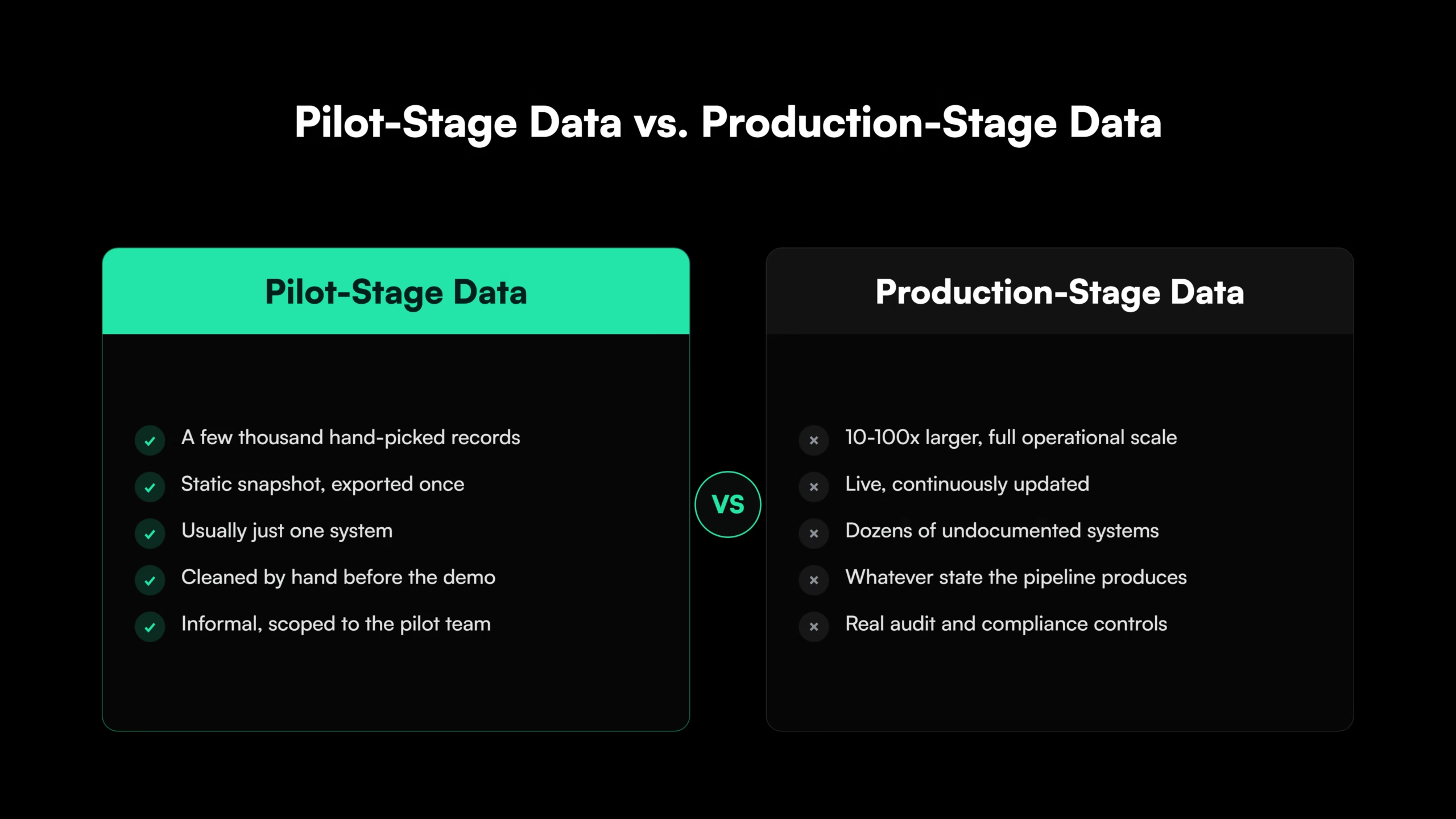
| Dimension | Pilot-Stage Data | Production-Stage Data |
| Volume | A few thousand records, hand-selected | Full operational scale, often 10 to 100 times larger |
| Freshness | Static snapshot, exported once | Live, continuously updated across systems |
| Source count | Usually one system | Dozens of systems, often undocumented |
| Curation | Cleaned manually before the demo | Whatever state the legacy pipeline actually produces |
| Governance | Informal, scoped to the pilot team | Subject to real access, audit, and compliance controls |
None of these differences are edge cases. They are the default condition of enterprise data, and a pilot is built specifically to avoid that condition. The pilot succeeded because it never had to face it.
Governance Alone Does Not Fix an Unmodernized Data Foundation
Governance is the explanation most existing coverage lands on. Gartner projects that more than 40 percent of agentic AI projects will be canceled by the end of 2027, naming escalating costs, unclear business value, and inadequate risk controls as the three primary reasons [5]. Enterprise AI failure rate research consistently points to similar causes, including unclear ownership, no defined approval criteria, and pilots that were never scoped against a specific business outcome.
These are real failure modes. An organization that ignores them will fail regardless of how modern its data layer is. But governance answers a different question than data readiness does. Governance determines who approves an AI system’s outputs, who gets notified when it errs, and what happens when it fails. It does not make an undocumented ETL job machine-readable, tell a team what business logic a fifteen-year-old pipeline is actually encoding, or prove that a dataset feeding an AI system is complete, current, and trustworthy.
| Question | Governance Answers It | Data Readiness Answers It |
| Who approves this AI system’s outputs? | Yes | No |
| Is the underlying data complete and current? | No | Yes |
| What happens when the AI system fails? | Yes | No |
| Can an agent trust this data enough to act on it? | No | Yes |
An organization can answer every governance question correctly and still watch a pilot fail at the production handoff. Staffing a steering committee and defining escalation paths does not modernize the data underneath them. The two problems are sequential. Data readiness has to be assessed and addressed before governance can do its job, because governance without trustworthy data to govern is a committee reviewing outputs it cannot actually verify.
Why do enterprise AI pilots fail even when the org chart looks right and the approval process is fully documented? The answer sits one layer down, in whether the data those approvals depend on was ever built to be governed in the first place.
Why Agentic AI Pilots Fail More Often Than Generic AI Pilots
A chatbot pilot has to answer a question. An agent has to act on one. That distinction is the entire reason agentic AI pilots fail to reach production at a higher rate than the single-turn generative AI pilots that came before them.
A chatbot pilot can run on a static, curated context window, the same narrow dataset described above. An agent cannot. Checking inventory, updating a record, or routing an approval requires live, governed, cross-system access to data the agent never had to touch during the pilot demo.
This raises the bar on data quality specifically for agentic deployments in a way earlier generations of generative AI never faced. A chatbot that retrieves stale or incomplete data produces a bad answer a person can catch before acting on it. An agent that acts on stale or incomplete data executes a decision based on it, and by the time anyone notices, the action has already happened.
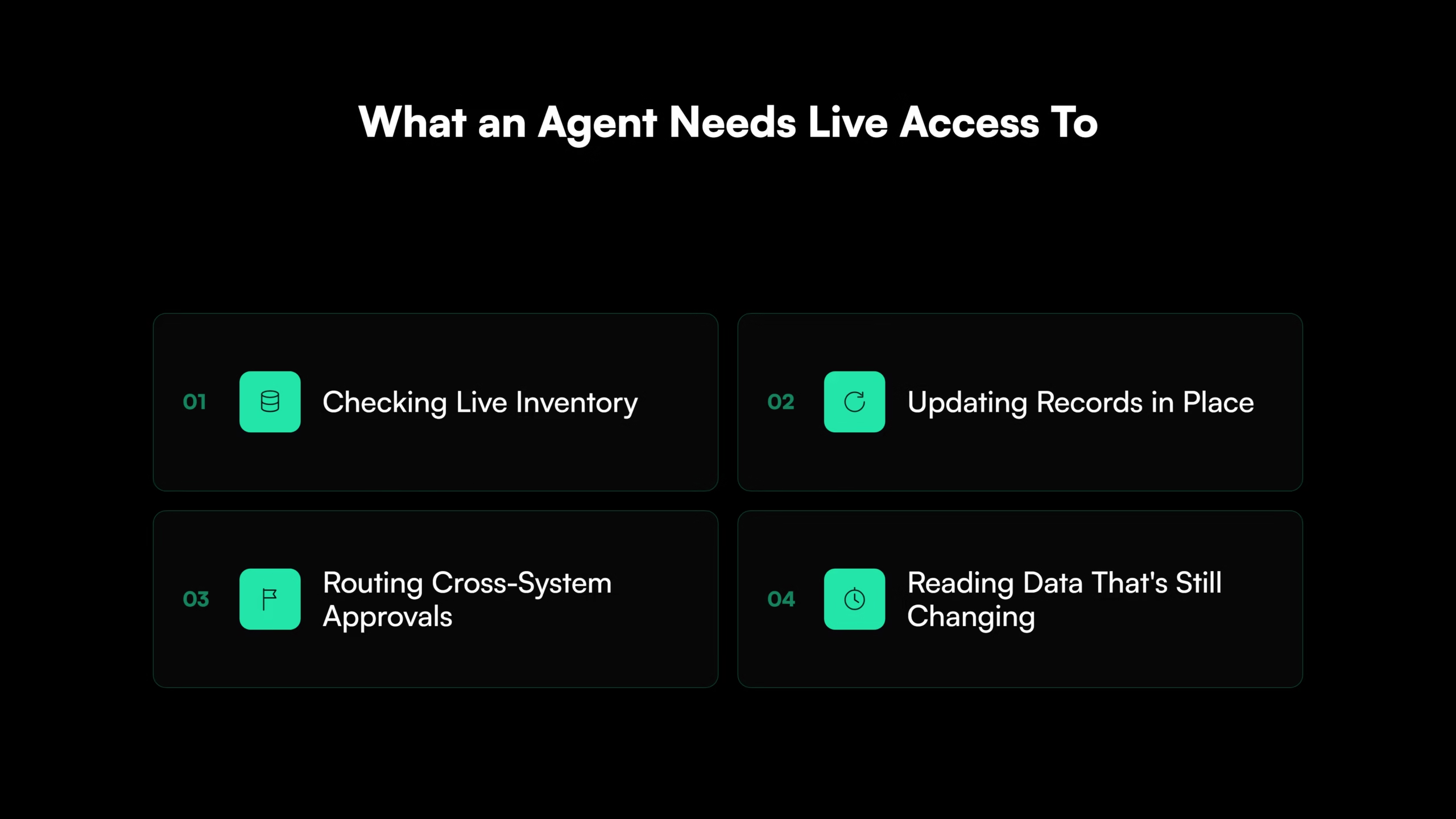
Gartner’s cancellation forecast for agentic AI names cost, unclear value, and risk controls as the reasons executives give [5]. Underneath those reasons, in most of the projects that get canceled, sits a data layer that was never built to give an agent the kind of access acting on a decision requires. The fix is not a better prompt or a newer model. It is the same legacy modernization work described above, applied with more urgency, because agentic AI has far less tolerance for the gap than a chatbot pilot ever did.



What a Production-Ready Data Foundation Requires
Closing the gap described above is not a matter of better governance or a newer model. It is a sequencing problem, and the sequence has five steps.
- Assess the real state of the legacy data estate, not the state assumed in a planning document. This means identifying every pipeline, warehouse, and application database an AI initiative will actually depend on, and what condition each one is really in.
- Comprehend the business logic trapped inside pipelines nobody has touched in years, before modifying anything. A pipeline that has run unexamined for a decade is encoding decisions nobody currently at the company made.
- Modernize the pipeline into a governed layer an AI system can actually consume, live, cross-system, and machine-readable rather than a static export.
- Validate that the modernized layer did not silently change what it feeds downstream. A pipeline that produces different numbers after modernization is not modernized. It is broken in a new way.
- Deploy for genuine production use, not pilot-adjacent testing that quietly becomes the permanent state.
The costliest mistake in an AI program is treating steps one through four as a parallel workstream to run alongside pilot development, rather than a prerequisite phase that has to complete first. A pilot cannot inherit a data foundation that does not yet exist, and the data debt that a clean pilot dataset never has to confront does not go away just because the pilot succeeded.
How Legacyleap Builds a Data Foundation AI Pilots Can Scale On
Legacyleap is a Gen AI-powered legacy application modernization platform built on multi-agent orchestration, and the same five-stage sequence above is what its agents execute directly against the pipelines behind a stalled pilot.
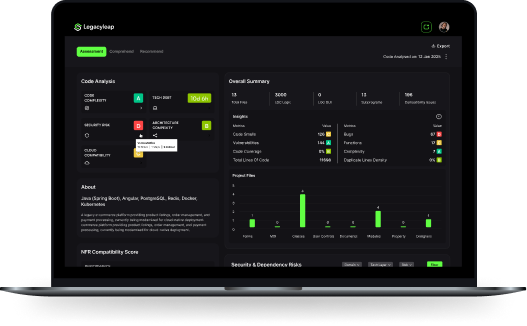
The Assessment Agent produces a dependency map, risk indicators, and a migration effort estimate for the legacy ETL platforms and application databases an AI initiative actually depends on. These are the same systems described earlier as unmapped in most enterprises. The Documentation Agent reconstructs the business logic buried inside those pipelines directly from the code itself, turning institutional knowledge that exists only in a retiring specialist’s head into structured documentation a team can act on.
The Modernization Agent then executes the transformation into a governed, AI-consumable layer through diff-based pull requests that a human reviews before anything merges. Legacyleap’s agents do not merge, deploy, or execute code autonomously. Every change stays under engineering control.
The step most existing coverage of this problem skips is validation. The QA Agent runs parity checks against the legacy baseline before cutover. That lets a team confirm the modernized pipeline produces the same outputs the legacy version did, rather than a silently different set of numbers feeding whatever AI system depends on it.
A global credit-scoring leader modernized more than 1.5 million lines of Ab Initio ETL to Apache Spark and Airflow, with more than 80 percent of the migration automated. The result was a 55 percent reduction in total cost of ownership, 60 percent faster time-to-market, and zero data loss.
The $0 Modernization Assessment referenced earlier is where this starts. It runs entirely inside a company’s own environment, producing a dependency map, risk heatmap, and modernization plan for the pipelines behind a specific stalled pilot, at no cost. For the broader strategic case, the data foundation your AI strategy actually depends on is worth the closer look once this diagnosis lands.
Signs Your AI Pilot Is About to Hit a Legacy Data Wall
A pilot approaching this wall usually shows the same handful of signs before the production handoff fails.
- The dataset behind the pilot was assembled or cleaned by one or two people rather than pulled live from source systems.
- Nobody on the team can name the system of record for a field the pilot depends on.
- Production data volume is an order of magnitude larger than anything the demo touched.
- The data team cannot explain lineage for a table the pilot reads from.
- The pipeline feeding the pilot is a point-to-point integration nobody has documented.
- Governance sign-off exists, but nobody has validated the underlying data against a modernized baseline.
Any one of these signs on its own is manageable. Two or more together mean the pilot is about to leave the one dataset that was ever going to make it look good.
Fixing the Data Foundation Before the Next AI Pilot
AI pilots do not fail because the underlying models are not capable enough. They fail because the data those models have to run on in production was never built for this, and no amount of governance fixes that on its own.
The organizations reaching production are not the ones with the most impressive pilot demo. They are the ones that treat the legacy data foundation underneath the pilot as a prerequisite to solve first. They assess it honestly, comprehend it before touching it, modernize it deliberately, and validate it before anything ships.
A $0 Modernization Assessment maps that foundation in 3 to 5 days, at no cost, entirely inside your own environment, before the next pilot runs into the same wall. A Technical Demo is available for a closer look at how the platform executes this directly.
FAQ
Proof-of-concept data is small and hand-curated. Production data lives across undocumented legacy systems the pilot was never tested against, so the failure shows up at the handoff, not in the demo.
Estimates vary by study. MIT Project NANDA found only 5 percent of generative AI pilots reach production with measurable financial return.
A demo needs a static, curated dataset. A production agent needs live, governed, cross-system access to data it can act on, not just read from.
Yes. An agent that acts on stale, incomplete, or unmapped legacy data will fail at production scale regardless of how well governed the AI program is.
References
[1] RAND Corporation. Why AI Projects Fail
[2] MIT Project NANDA, “State of AI in Business 2025.” Coverage: MIT report: 95% of generative AI pilots at companies are failing
[3] Deloitte. AI Agents Are Only the Beginning: Deloitte Survey Examines the AI Readiness Gap
[4] IBM Institute for Business Value. IBM Study: CEOs Double Down on AI While Navigating Enterprise Hurdles
[5] Gartner. Gartner Predicts Over 40% of Agentic AI Projects Will Be Canceled by End of 2027