Migrate Angular to React or Next.js
50–70% Faster with Gen AI
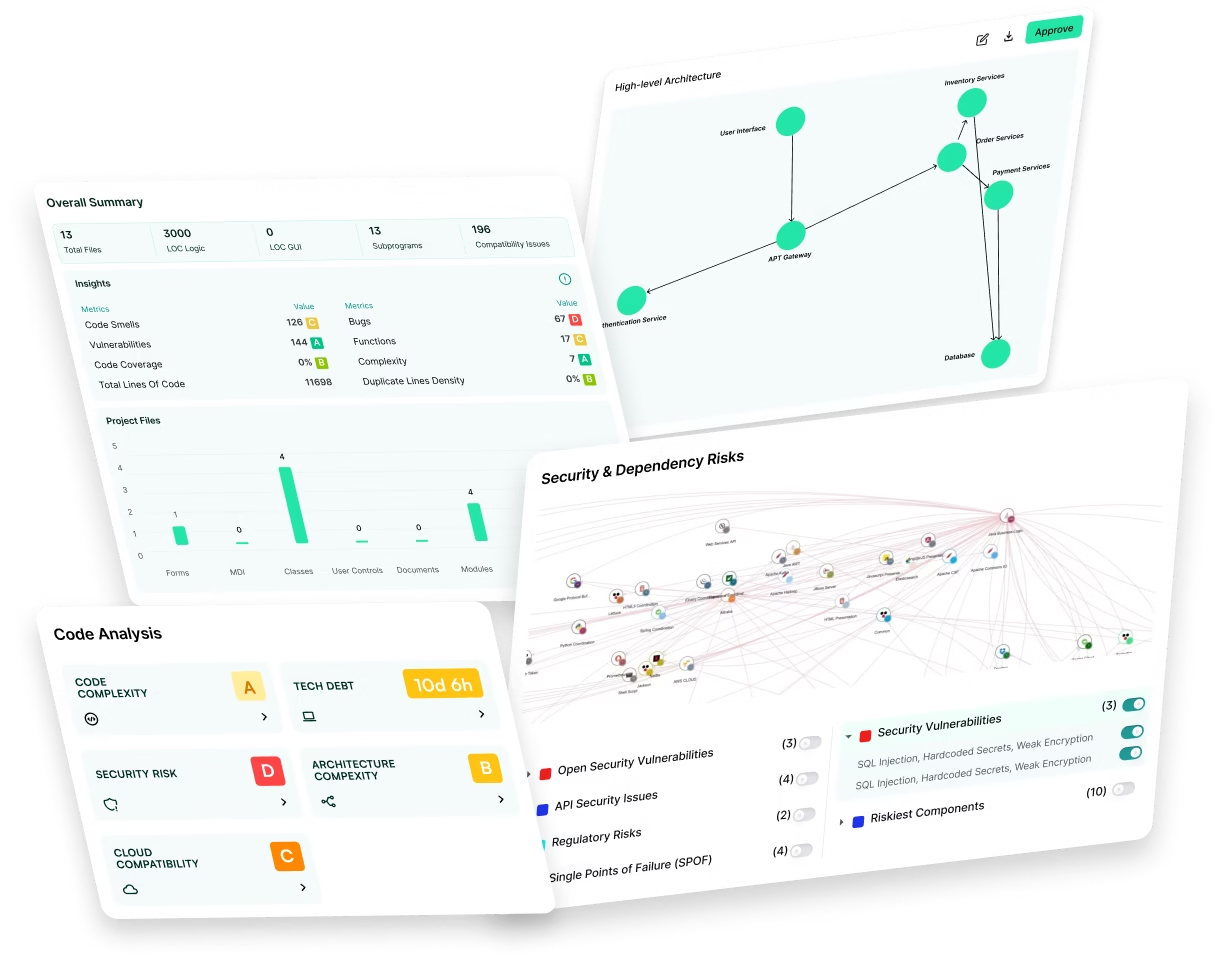
Legacyleap's AI agents map, plan, convert, and test your move from Angular to React or Next.js, with 100% functional parity throughout.
Angular to React Migration Benchmarks with Legacyleap
How Gen AI changes the time and effort an Angular migration takes.





2-5 days
to assess your full Angular application and produce its documentation
~70%
of migration work handled
by Gen AI
2x
the speed of vendor-led or in-
house migration
100%
functional parity, validated and compliance-ready before release
Why Legacyleap
Why Legacyleap for Angular to React Migration
Angular spreads application logic across components, injected services, and RxJS streams. Converting your application file by file breaks that logic, so Legacyleap works from the whole system.
Whole-application understanding
Legacyleap maps your full dependency graph before converting anything. Each component moves to React with everything it relies on.
Phased migration without downtime
Shared services and state move first, in dependency order. Your application stays in production while Angular and React run side by side.
Parity validated before release
The QA Agent builds tests from your Angular application’s behavior, including async timing, form validation, and route access rules. Your React version ships only after it matches.
Every change reviewed by your engineers
Each conversion arrives as a pull request with a gap report. AI cannot merge or deploy code.
Your code stays in your environment
Legacyleap runs inside your infrastructure. No source code leaves it, and no outbound API calls are required.
Engagement
How an Angular to React Migration Runs with Legacyleap
Your migration moves through five stages. Each stage is led by a Legacyleap agent and reviewed by your engineers.
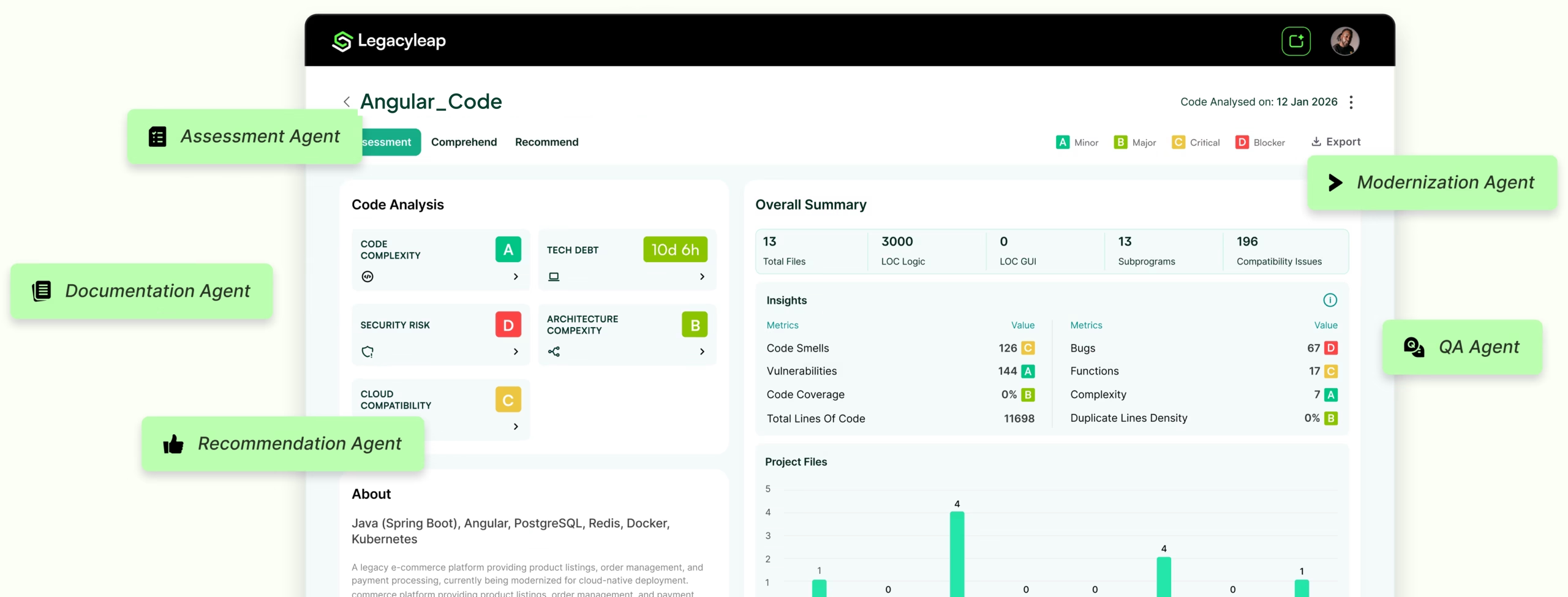
Assessment and Documentation Agents
Assess and document
2–5 days
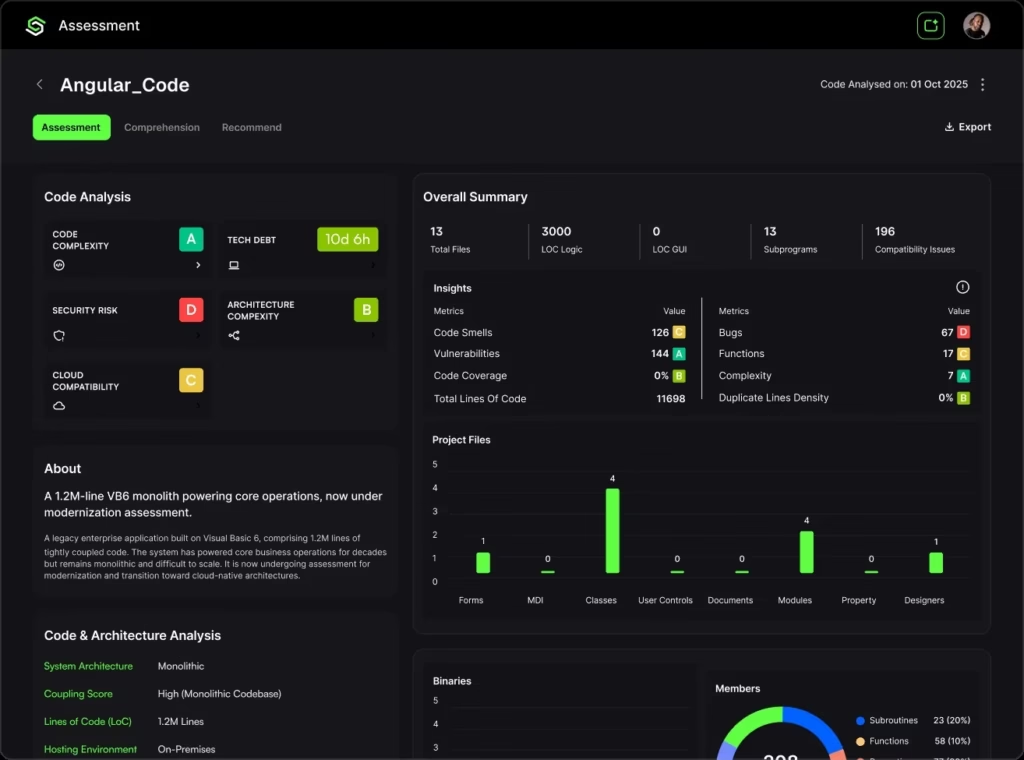
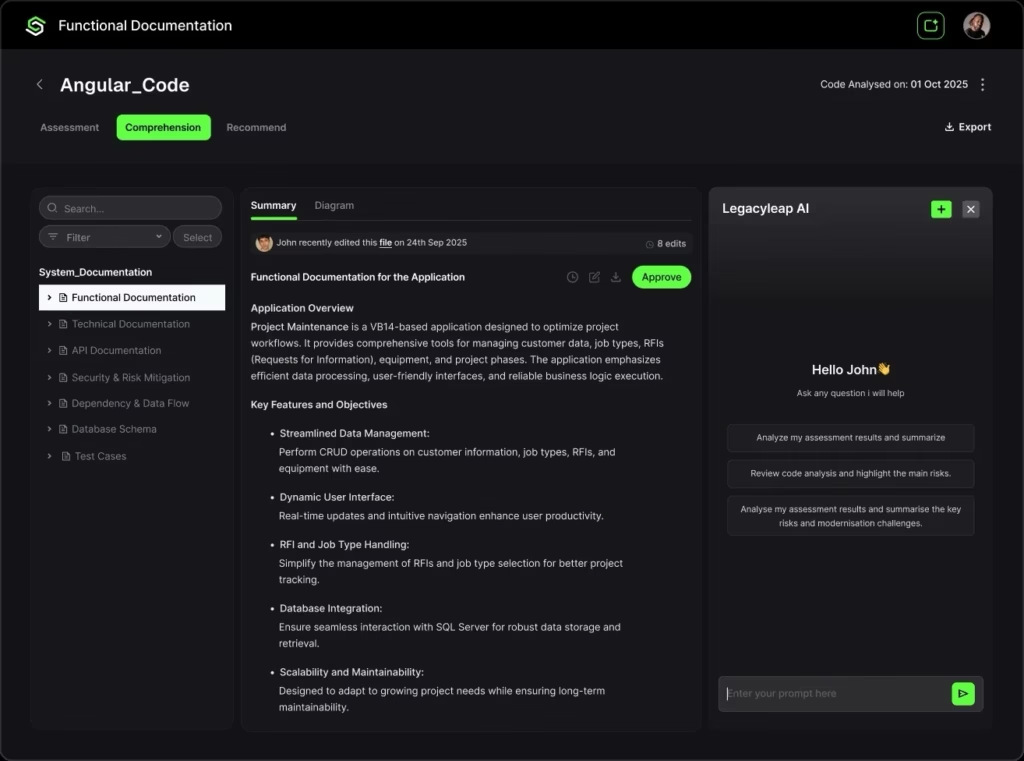
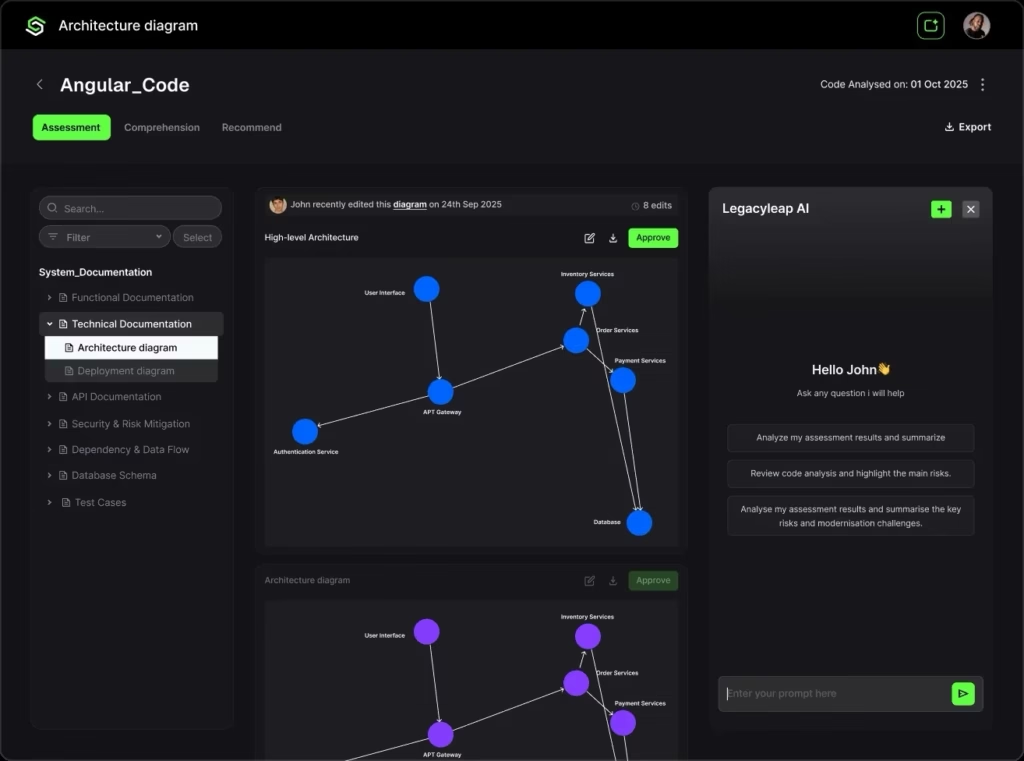
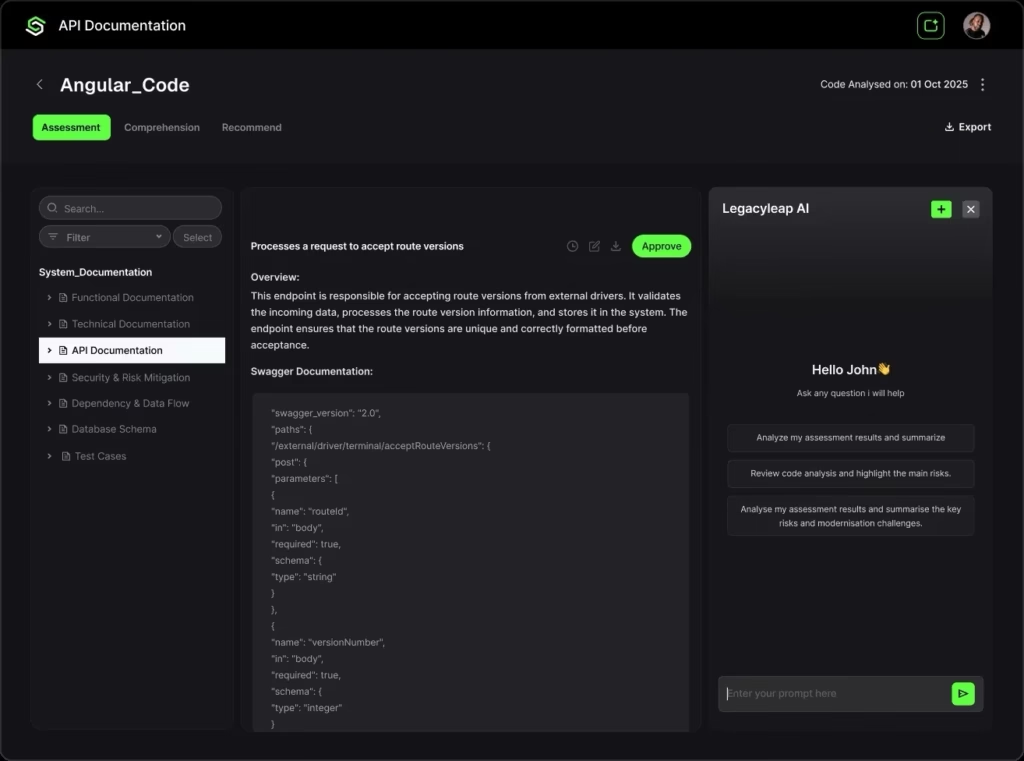
Legacyleap maps your modules, components, services, routes, and dependencies. It then generates functional and technical documentation from your code.
You receive
Dependency map, technical debt report, system documentation, and an effort estimate.
Recommendation Agent
Plan the migration
Legacyleap recommends React or Next.js for each application and sets the order your modules move in. The plan also defines how both frameworks run during the transition.
You receive
An ordered migration plan with module-level effort and risk scoring.
Modernization Agent
Convert in phases
~70% automated
Your modules move to React one at a time while the application stays in production. Each conversion arrives as a pull request.
You receive
Converted code, pull requests, and gap reports.
QA Agent
Validate
~2× faster test creation
Legacyleap generates unit, integration, regression, API, and functional tests. It then confirms your React version behaves the same as the Angular original.
You receive
Test suites and parity validation reports.
Your team with Legacyleap
Cut over and retire Angular
Once every module passes parity validation, the Angular shell is removed. Your application ships through your existing CI/CD pipeline.
You receive
Deployment-ready artifacts.
Try Legacyleap
Get Free Documentation of Your Angular Codebase with a $0 Assessment
Share a portion of your Angular codebase. Within 3–5 days, you receive functional and technical documentation, architecture maps, dependency graphs, and a technical debt analysis, all ready to export. There’s no cost and no commitment.
Migration Paths
Angular Application Migration Paths Supported by Legacyleap
Legacyleap reviews your Angular codebase, recommends the right target,
and carries the migration through to release.

Current application


Angular to React Migration
For Angular applications where teams are consolidating onto one frontend stack or hiring for React.
Components, services, and state move to React one module at a time, so your team can review each phase before the next.

Angular to Next.js Migration
For Angular applications that need server-side rendering, faster page loads, or stronger search visibility.
This path moves your application to React with server rendering and routing built in, so public pages load faster and are easier for search engines to index.
Choose How Legacyleap Delivers Your Angular Migration
Hand the migration to Legacyleap’s team, or run it yourself on the platform.
Both options use the same agents and parity validation.
You bring the system. We bring the outcome.
Angular Migration Services
Legacyleap’s engineers own your Angular migration end to end, backed by the platform.
- Begins with a $0 Assessment of your Angular codebase
- Legacyleap's team runs the migration, with every step traceable
- Built for undocumented or fragile Angular applications
- Test generation and rollout planning run in parallel
- Delivery managed through validation checkpoints
- Production-ready React code from the first module
Leverage your internal or SI teams with our platform.
Platform Licensing
Run Legacyleap inside your environment and migrate on your own schedule, with the tools and support your team needs.
- Studio access through the web UI, IDE, and CLI
- Agent copilots built for Angular and other legacy codebases
- One license reused across teams and programs
- Architecture maps and test harnesses for your application
- Human-in-the-loop controls on every change
- Enterprise pricing set to the size of your program
Legacyleap in action
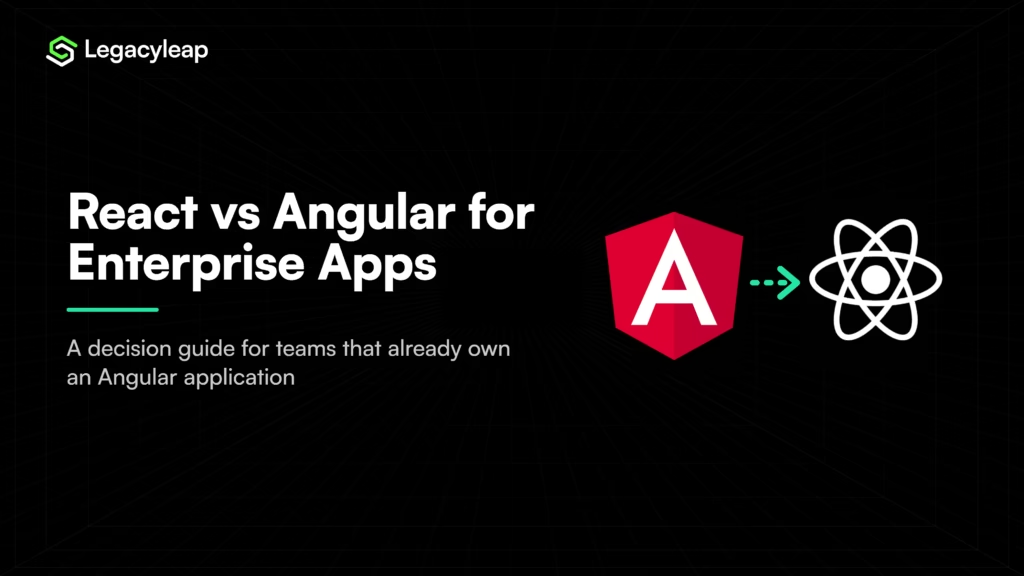
Further Reading on React vs Angular
Book a demo
Book a Live
Legacyleap Demo
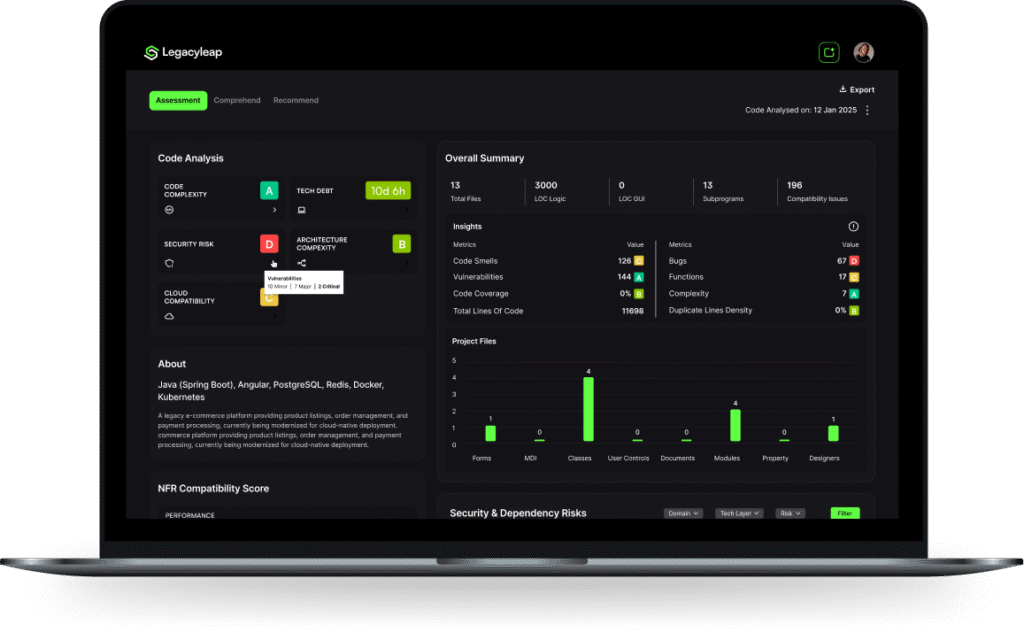
Discovery on a legacy application can take years and put millions at risk. This live demo shows how Legacyleap generates the artifacts, plans, and code changes that turn months of manual effort into days.
In the demo
Your architecture visualized in real time
Automated SBOM generation
Code comprehension powered by AI
Drift detection and other platform capabilities
Why do enterprises migrate from Angular to React?
Teams usually move to consolidate several frontend stacks onto one, to hire from a larger React talent pool, and to reduce the effort of keeping up with Angular major-version upgrades.
Teams that also need server-side rendering or better search visibility often move to Next.js. The $0 Assessment shows what the move involves for your application before you commit.
Can Angular and React run side by side during migration?
Yes. Legacyleap supports phased execution, so modules move incrementally while the application stays in production.
The Recommendation Agent sets the migration order based on dependencies, so shared services and state are handled before the components that rely on them.
Should we migrate to React or Next.js?
It depends on how the application is rendered and used. React fits client-rendered internal applications such as dashboards and line-of-business tools.
Next.js fits applications that need server-side rendering, faster initial loads, or search visibility. The Recommendation Agent evaluates this per application as part of the migration plan.
How long does an Angular to React migration take?
Timelines depend on application size, module coupling, and how much state is managed through services and RxJS.
Assessment and documentation take 2–5 days. About 70% of the code migration is automated, and full modernization cycles run at 2× the speed of traditional approaches. A realistic timeline is provided after the $0 Assessment.
Can Legacyleap handle large enterprise Angular applications?
Yes. The platform is built for large, multi-module applications and runs entirely inside your infrastructure, so no source code leaves your environment.
Every change arrives as a pull request for human review. AI cannot merge, deploy, or execute code autonomously, and every AI action is captured in an audit trail.