Why Data Platform Modernization Programs Stall Between Assessment and Production
Data platform modernization is the process of migrating legacy data infrastructure (ETL pipelines, data warehouses, orchestration layers, and the governance frameworks connecting them) to modern, cloud-native architectures capable of supporting analytics, real-time processing, and AI workloads at enterprise scale.
The urgency is real. Only 7% of enterprises report their data is completely ready for AI adoption [1], and nearly 80% say their AI and analytics initiatives are constrained by limited data access across environments [2].
Every major enterprise AI program depends on high-quality, well-governed, accessible data as a prerequisite infrastructure. Organizations building AI on top of legacy batch-ETL architectures are discovering that the binding constraint is not the model. It is the data layer beneath it.
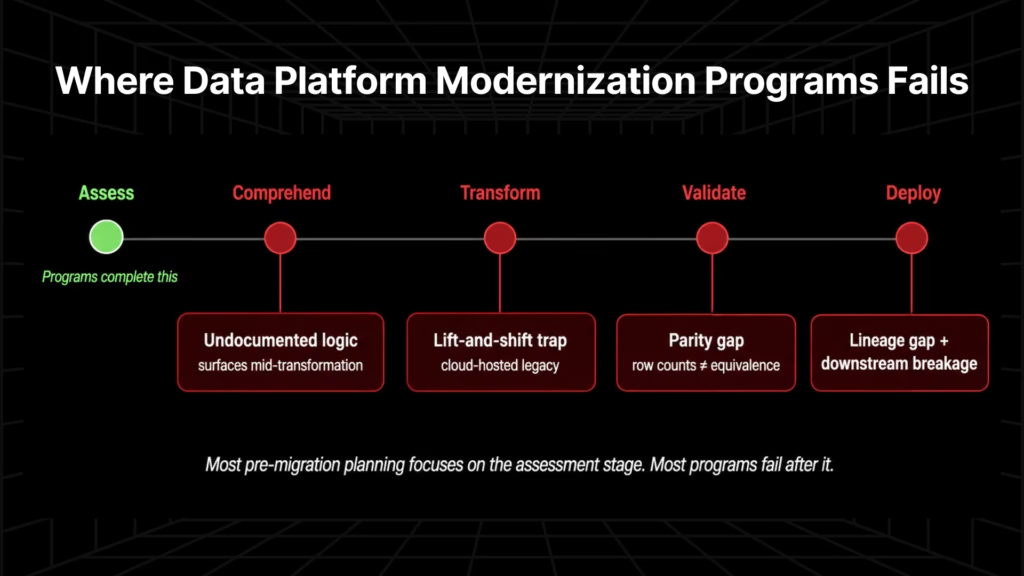
The harder question is why so many programs stall between assessment and production. Organizations complete inventories, select target architectures, and engage implementation teams. Then the program slows, overruns, or reaches cutover with regressions that require rolling back to the legacy system.
The cause is consistent. Programs hit the business logic embedded in legacy ETL pipelines, find it undocumented and impossible to validate rigorously against the new stack, and discover the execution model they planned does not account for any of it.
The safe path runs through comprehension of legacy pipeline logic first, governed transformation second, and behavioral parity validation as a non-negotiable gate before cutover.
Legacy ETL and Data Warehouse Stacks Driving Modernization in US Enterprises
Data platform modernization encompasses more than the warehouse layer.
Data warehouse modernization addresses schema migration, query optimization, and warehouse-layer governance. Data platform modernization includes that layer plus the ETL pipelines feeding it, orchestration frameworks, downstream consumers, and the governance infrastructure required to demonstrate transformation correctness across all of them.
Teams that scope only the warehouse layer and discover mid-program that the pipeline layer carries the majority of complexity are the ones that overrun.
The Dominant Legacy Stacks
- Ab Initio. The dominant high-volume batch ETL platform in US financial services. Banks, credit scoring firms, and insurers run credit risk calculations, regulatory reporting, and data quality workflows on Ab Initio graphs. Enterprises running it at scale typically pay $4–6 million or more annually in licensing, compared to approximately $1.5 million in steady-state costs on managed Spark infrastructure [3].
- SSIS and Informatica PowerCenter. The most broadly deployed batch ETL platforms across industries. Both were architected for scheduled batch processing on on-premises infrastructure with no native path to real-time streaming or cloud-native execution.
- IBM DataStage. Concentrated in financial services and telecom. DataStage environments frequently contain transformation logic developed and patched over 15–20 years, often by engineers no longer with the organization.
- Teradata and Oracle data warehouses. Anchor the analytical reporting layer at large enterprises. Oracle Enterprise Edition with Real Application Clusters runs at $50,000 or more per processor core per year, with annual licensing increases of 5–8% regardless of usage [3]. Both platforms were built for vertical scaling on fixed hardware and do not support the elastic compute models that AI workloads require.
- Hadoop clusters. Most enterprise Hadoop environments are now migrating to unified lakehouse platforms: Databricks Delta Lake, Snowflake, or BigQuery. These consolidate storage, compute, analytics, and ML workloads under manageable operational overhead.
Why the Decision Has Changed
Three forcing functions have converged that make continued deferral untenable:
- AI readiness. Batch-only ETL cannot support ML feature stores, sub-second inference pipelines, retrieval-augmented generation on proprietary data, or continuous model retraining. IDC reports that 70% of AI initiatives fail due to data readiness issues [4]. Organizations with AI programs are hitting this constraint directly.
- Licensing economics. The Oracle and Ab Initio licensing calculations are no longer close. The total cost of ownership gap between proprietary legacy platforms and open compute alternatives on cloud infrastructure is now large enough that the financial case for modernization is straightforward without factoring in capability gains.
- Compliance requirements. GDPR, CCPA, HIPAA, SOX, and BCBS 239 all require demonstrable data lineage: the ability to trace every data element from origin through every transformation and prove correctness. Legacy ETL systems, including Informatica 9.x, DataStage, and SSIS packages, do not produce lineage metadata automatically. Modern platforms do. For organizations subject to these frameworks, the platform gap creates data lineage and regulatory compliance requirements for legacy ETL modernization programs that cannot be addressed without modernizing the platform.
| Platform | Typical Use Context | Core Limitation | Compliance Gap | Licensing Exposure |
| Ab Initio | Large-scale batch ETL, financial services | Proprietary execution; no cloud-native path | No automatic lineage output | $4–6M+/year at scale |
| SSIS / Informatica | Enterprise batch pipelines, broad industry | Batch-only; on-prem dependent | No lineage metadata (legacy versions) | Escalating licensing and maintenance |
| IBM DataStage | Financial services, telecom, risk reporting | Proprietary; complex dependency management | No automatic lineage | Rising support costs; vendor lock-in |
| Teradata / Oracle DW | Analytical reporting, large enterprise | Vertical scaling only; AI-incompatible | Limited lineage tooling | Oracle: $50K+/core/year; 5–8% annual increases |
| Hadoop (legacy) | Big data storage and batch processing | Operational complexity; fragmented governance | Fragmented metadata | Infrastructure and ops cost |
Where Legacy Data Platform Modernization Programs Break Down
Most data platform modernization programs do not fail at assessment. They fail between assessment and production, where legacy pipeline complexity surfaces and the planned approach does not account for it. Five failure modes account for the majority of stalled or overrun programs.
1. Undocumented Pipeline Logic Surfaces After Assessment
Legacy ETL environments built over 10 to 20 years contain business rules that exist only in the code: transformation rules in Ab Initio .mp files, custom logic in Informatica XML mappings, conditional branching in SSIS packages, stored procedures in Oracle or Teradata.
The documentation, where it exists, describes design intent from the initial build. It does not reflect operational behavior after 15 years of patches and undocumented changes.
The actual execution behavior of a legacy ETL environment is often not visible from within the ETL tool itself. It is encoded in shell scripts, job schedulers, and parameter files that govern sequencing and failure handling. Inventory counts (pipeline count, table count, approximate line count) do not capture this.
Programs that scope based on inventory and begin transformation without reconstructing the logic consistently discover it mid-program, when rework is expensive, and timeline pressure is highest.
2. Lift-and-Shift Moves the Debt, Not the Problem
Moving on-premises ETL infrastructure to cloud hosting without refactoring pipeline logic is the most common response to timeline and budget pressure. It is also the most reliable way to produce a cloud-hosted legacy.
SSIS packages moved to Azure Data Factory without logic refactoring, run the same batch transformations on cloud infrastructure. Informatica workflows migrated without redesign execute the same sequential patterns. Teradata schemas moved to Snowflake without rearchitecting query patterns exhibit the same performance characteristics. The batch-window constraints remain.
The inability to support real-time streaming remains. The incompatibility with ML feature stores remains. The infrastructure is now billed monthly, which makes the total cost higher.
The diagnostic is simple: if the modernized platform still requires batch-window scheduling for analytical queries and cannot serve ML feature stores with sub-hour freshness, the lift-and-shift trap has been triggered regardless of which cloud platform the workloads run on.
3. Parity Validation Is Deferred Until It Is Too Late
The default validation approach is row count reconciliation at cutover. Row count checks do not catch silent data corruption. They do not confirm transformation logic equivalence across edge cases. They do not detect output drift in downstream calculations caused by type handling differences between platforms.
The structural problem is timing. Rigorous parity validation requires running legacy and modern stacks in parallel and comparing outputs systematically. That process is expensive to sustain and creates pressure to cut short.
When that pressure wins, validation compresses into a cutover event. Regressions caught at week six of parallel operation are instead discovered in production at week two post-cutover, after the legacy system has been decommissioned and rollback is no longer practical.
Poor data quality costs organizations an average of $12.9 million annually [5]. For organizations migrating without rigorous parity validation, that figure is a floor, not a ceiling. The migration itself introduces new correctness uncertainty on top of existing data quality debt.
4. The Lineage Gap Creates Compliance Exposure After Migration
The new platform is running. Pipelines are producing outputs. No one can demonstrate transformation correctness end-to-end because lineage documentation was not produced as a migration output.
For organizations under SOX, BCBS 239, or HIPAA, this is an audit finding in waiting. SOX requires auditable transformation chains for financial reporting data. BCBS 239 requires demonstrable risk data lineage from source through every transformation to the regulatory report. HIPAA requires data provenance for protected health information.
Manual reconstruction after the fact (tracing transformation logic through deprecated pipeline code) is neither reliable nor audit-ready. The migration solved the technical modernization problem and created a compliance one.
For detailed treatment of data lineage and regulatory compliance requirements for legacy ETL modernization programs, the compliance dimensions warrant their own analysis.
5. Schema Migration Breaks Downstream Consumers Silently
ETL pipelines feed BI tools, reporting systems, ML feature stores, and downstream applications. Schema changes during migration (renamed fields, type conversions, dropped columns) create breakage that does not surface as an immediate error.
The downstream system continues to run and produce results. Those results are wrong. This is discovered at 30, 60, or 90 days post-migration when a business team notices that a report has been producing incorrect numbers since cutover.
Before your data platform migration hits these failure points, a $0 Assessment maps the business logic, pipeline dependencies, and transformation risk across your legacy ETL environment. Delivered in 3–5 days. No code leaves your environment.
A Comprehension-First Execution Model for Legacy Data Platform Modernization
The five failure modes are connected consequences of a single execution error: beginning transformation before establishing a complete, code-level understanding of what the legacy pipelines actually do. The governed execution model that avoids them follows a fixed sequence (Assess, Comprehend, Transform, Validate, Deploy) with each stage producing the inputs the next stage requires.
Assess
A rigorous assessment produces a prioritized migration backlog with workload classification by type (OLTP, OLAP, streaming, ML feature store, reporting), scheduling dependency documentation, downstream consumer mapping, and complexity and risk scoring at the workload level.
An assessment that produces only an inventory count has not produced a migration backlog. It has produced a list. It’s useful in its own right, but not for the program as a whole.
Workload classification determines target architecture:
- OLTP to PostgreSQL or Aurora
- OLAP to Snowflake or Redshift
- Streaming to Kafka or Kinesis
- ML feature stores to Databricks Feature Store or Vertex AI.
A thorough assessment of an enterprise data estate typically requires four to eight weeks to produce a backlog with genuine risk scoring.
Comprehend
Comprehension means parsing the actual pipeline code: .mp files and ETL graphs for Ab Initio; XML transformation mappings and workflow definitions for Informatica; SSIS package structures and control flow logic; stored procedures and BTEQ scripts for Teradata and Oracle DW environments.
The output is a code-derived specification of what each pipeline actually does: transformation rules, dependency chains, conditional branching logic, scheduling relationships, and behavioral edge cases.
This specification is the ground truth that governs transformation. Transformation decisions made without it are guesses. This stage cannot be abbreviated without reintroducing failure mode 1.
Transform: ETL to ELT
Governed transformation executes against the comprehension output. The architectural shift from ETL to ELT (transforming data within the warehouse rather than before loading it) is what enables cloud-native analytics, real-time processing, and AI workload support.
Target selection by workload class:
- SSIS and Informatica batch pipelines to Azure Data Factory, Databricks, or Apache Spark
- Ab Initio environments to Apache Spark and Airflow, reproducing Ab Initio’s parallel processing and scheduling model on open infrastructure
- Teradata and Oracle DW workloads to Snowflake or Databricks Delta Lake, depending on query patterns and BI tool compatibility
For target selection decisions and migration patterns for SSIS and Informatica specifically, migrating SSIS and Informatica pipelines to modern ELT architectures covers the details. Transformation changes should be diff-based and human-reviewed. Engineers approve every change before it proceeds.
Validate
Parity validation runs alongside transformation, not at cutover. The standard is behavioral equivalence: transformed pipelines must produce demonstrably equivalent outputs across the full range of input conditions, including edge cases and conditional logic branches.
Parallel execution against the same inputs, with hash comparisons and differential output analysis, catches the silent data corruption and edge-case divergence that row counts miss.
The parity validation report is both the confidence gate before cutover and the compliance artifact that demonstrates transformation correctness for regulatory review. 100% parity before decommissioning is not optional.
Deploy
Production-ready deployment requires CI/CD integration, lineage documentation available from day one, rollback plans tested before cutover, and downstream consumer validation complete before decommissioning.
Total enterprise migration timelines typically run six to eighteen months depending on estate size and complexity.
| Dimension | Lift-and-Shift | Comprehension-First Governed Modernization |
| Business logic handling | Carried forward without analysis | Reconstructed from source code before transformation begins |
| Parity validation approach | Row counts at cutover | Behavioral comparison running alongside transformation |
| Compliance lineage produced | Not produced | Generated as a migration output from day one |
| AI workload readiness post-migration | Batch-only constraints persist | Real-time, streaming, and ML workloads supported |
| Downstream consumer impact | Discovered post-cutover | Mapped and validated before decommissioning |
| Typical program outcome | Cloud-hosted legacy; second modernization required | Production-ready, AI-capable, compliance-documented |
How Gen AI Multi-Agent Orchestration Addresses the Execution Gap
Point-automation tools (purpose-built conversion engines for specific stack transitions such as SSIS to PySpark or Informatica to Databricks) address code conversion volume. They parse legacy code and generate target-platform equivalents at speed. For well-documented, structurally uniform pipeline estates, they accelerate the transformation stage.
What they do not address is the comprehension gap. Point-automation tools convert what they can read: the code as written. They do not reconstruct the business logic that exists in the relationship between pipeline code, scheduling systems, parameter files, and the operational context that governs production behavior.
When that logic is undocumented or distributed across system layers, point-automation converts what is visible and leaves the rest for engineers to discover later.
Multi-agent orchestration addresses this structurally. The lifecycle is broken into discrete stages handled by specialized agents, with each agent’s output grounding the inputs for the next stage.
Comprehension is not optional because transformation depends on it. Validation is not a separate phase because it runs alongside transformation as part of the workflow.
Three capabilities separate the multi-agent model from point-automation in the data platform context:
- Full-codebase grounding. The comprehension stage parses the entire legacy pipeline environment to reconstruct business logic at scale. The model reasons about behavior and dependencies, not just syntax. That is what makes it possible to produce a specification of what pipelines actually do across a 1.5-million-line Ab Initio environment or a 500-package SSIS estate.
- Diff-based, human-reviewed transformation. Engineers see exactly what changed between legacy and modern implementations before any change proceeds. Approximately 70% of transformation is automated; human review governs the remainder. The AI does not merge, deploy, or execute pipeline changes autonomously.
- Behavioral parity validation. Auto-generated test cases compare legacy and modern pipeline outputs across the full transformation logic, not just output counts. The parity validation report is both the cutover gate and the compliance artifact for SOX, BCBS 239, and HIPAA requirements.
The value of the multi-agent model for data platform modernization is structural enforcement of execution discipline.
- Comprehension before transformation is enforced because the transformation agent operates on the comprehension output.
- Validation before cutover is enforced because the QA agent runs alongside the transformation.
- Lineage documentation is produced as a migration output because the validation process generates it.
How Legacyleap’s Gen AI Platform Handles Legacy Data Platform Modernization
Legacyleap is a Gen AI-powered legacy application modernization platform built on multi-agent orchestration. The five-agent system executes the full Assess → Comprehend → Modernize → Validate → Deploy lifecycle as a governed, sequential workflow.
Each agent’s output is grounded in the actual source code of the legacy environment. No transformation proceeds without the comprehension output that precedes it.
For data platform modernization, the agents operate as follows:
| Agent | Role in Data Platform Modernization | Key Outputs |
| Assessment Agent | Maps the full ETL estate: pipeline inventory, scheduling dependencies, downstream consumer relationships, risk concentration, and migration complexity scoring | Prioritized migration backlog with risk and effort scoring across ETL pipelines, warehouse workloads, and downstream consumers |
| Documentation Agent | Parses legacy pipeline code (Ab Initio .mp files and ETL graphs, Informatica XML mappings, SSIS package structures, Oracle and Teradata stored procedures and BTEQ scripts) and reconstructs actual business logic | Code-derived transformation specs, dependency chains, conditional logic, and behavioral edge cases that serve as the ground truth for transformation |
| Recommendation Agent | Determines modernization path per workload class based on complexity, business criticality, and target architecture fit | Ab Initio to Spark and Airflow; SSIS and Informatica to ADF, Databricks, or Spark; Teradata and Oracle DW to Snowflake or Databricks Delta Lake; ordered migration sequence by risk and downstream dependency |
| Modernization Agent | Executes governed, diff-based transformations against the Documentation Agent’s comprehension output | Pull requests with full change visibility; gap reports; transformation summaries; approximately 70% of transformation automated with human review at every step |
| QA Agent | Runs behavioral parity validation alongside transformation, not after it | Auto-generated test suites; differential output comparison across legacy and modern stacks; parity validation report before cutover; lineage documentation as a compliance artifact |
This produces:
- ~50–70% faster modernization versus manual approaches
- ~70% of transformation automated
- 100% functional parity validated before deployment
- assessment and documentation delivered in 2–5 days.
The Ab Initio migration economics and execution model covers the licensing calculations, risk profile, and compliance considerations for US financial services environments. The case study below shows what execution looks like at scale.
A global credit scoring leader running 1.5M+ lines of Ab Initio ETL code (credit risk calculations, regulatory reporting transformations, and data quality workflows) migrated to Apache Spark and Apache Airflow using Legacyleap’s multi-agent platform.
Results: 55% reduction in total cost of ownership, 80%+ automation in code transformation, 60% faster time-to-market for new credit products, 50–60% faster data processing post-migration, and zero data loss with full business logic preservation across all migrated pipelines.
Read the full case study.
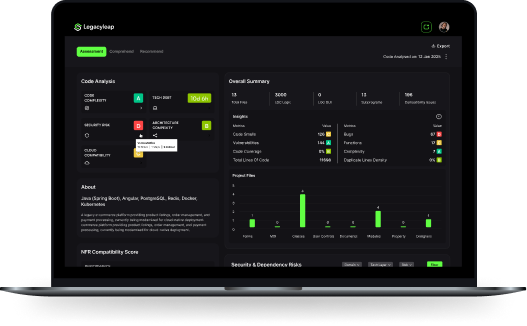
The $0 Modernization Assessment provides a concrete starting point at any program stage. Legacyleap scans a representative portion of the legacy pipeline environment and returns (in 3–5 days, entirely within the client’s infrastructure):
- A pipeline inventory,
- Dependency maps,
- Business logic documentation,
- Risk and complexity heatmap, and
- A migration plan with timelines.
No source code leaves the environment.
Data Platform Modernization That Reaches Production
Programs fail in the execution gap, not at assessment. Undocumented pipeline logic surfaces mid-transformation. Lift-and-shift moves the debt to a more expensive environment. Parity validation gets compressed into a cutover event. Lineage documentation is not produced. Downstream consumers break silently.
The programs that reach production establish a fixed sequence: comprehension before transformation, behavioral parity validation before cutover, lineage documentation produced as a migration output. The enterprises building AI-ready data infrastructure in 2026 are the ones executing that sequence rather than assuming it will sort itself out after the infrastructure moves.
Claim a $0 Modernization Assessment. Share a representative portion of your legacy ETL environment. Legacyleap returns a pipeline inventory, dependency maps, business logic documentation, risk heatmap, and a migration plan with timelines in 3–5 days, entirely within your infrastructure. No source code leaves your environment.
Book a Technical Demo. See the five agents running against a real legacy pipeline environment (architecture visualization, business logic extraction, and transformation workflows) before sharing any code.
FAQs
Migration sequencing should be determined by a combination of business criticality, downstream consumer dependency count, transformation complexity, and licensing cost concentration. Pipelines with the highest licensing exposure and the lowest complexity should move early. They generate quick ROI and build team confidence in the validation process. High-complexity pipelines feeding multiple downstream consumers should move later, after the team has established parity validation discipline on simpler workloads. Migrating the highest-risk pipelines first, because they are the most important, is a reliable way to stall a program in its opening phase.
Data mesh and data fabric are architectural and governance models that describe how data ownership, access, and discovery should be organized across an enterprise. Data platform modernization is the execution program that replaces the underlying infrastructure on which those models run. An organization can adopt a data mesh ownership structure while still running pipelines on Informatica and its warehouse on Teradata, since the model and the infrastructure are independent decisions. Modernizing the platform is the prerequisite that makes operating at data mesh or data fabric scale technically viable.
References
[1] Cloudera and Harvard Business Review Analytic Services. Taming the Complexity of AI Data Readiness. March 2026. https://www.cloudera.com/about/news-and-blogs/press-releases/2026-03-05-only-7-percent-of-enterprises-say-their-data-is-completely-ready-for-ai-according-to-new-report-from-cloudera-and-harvard-business-review-analytic-services-reveals.html
[2] Cloudera. Nearly 80% of Enterprises Say AI Is Held Back by Data Access Challenges. April 2026. https://www.cloudera.com/about/news-and-blogs/press-releases/2026-04-14-nearly-80-percent-of-enterprises-say-ai-is-held-back-by-data-access-challenges-cloudera-report-finds.html
[3] Modernization Intel. Data Modernization: Research, Cost Benchmarks and Migration Strategies. February 2026. https://softwaremodernizationservices.com/data-modernization/
[4] IDC, cited in Techment. Enterprise Data Platform Modernization Frameworks: A Strategic Blueprint for 2026. May 2026. https://www.techment.com/blogs/enterprise-data-platform-modernization-frameworks/
[5] Gartner, cited in Techment. Enterprise Data Platform Modernization Frameworks: A Strategic Blueprint for 2026. May 2026. https://www.techment.com/blogs/enterprise-data-platform-modernization-frameworks/