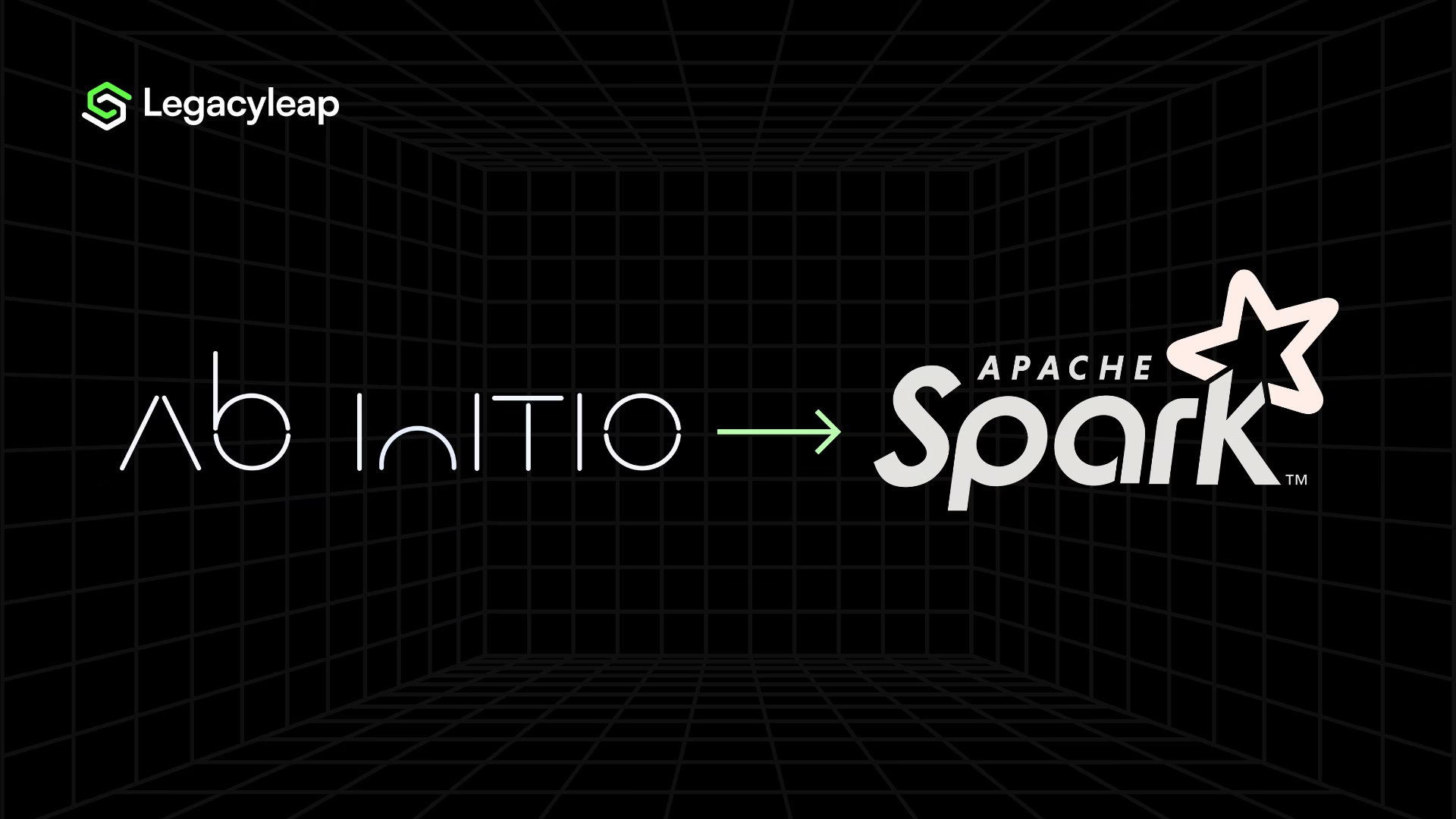
Ab Initio to Apache Spark Migration: The Financial Case Is Clear. The Execution Is Not.
Ab Initio to Apache Spark migration appears on most large data engineering roadmaps at US financial services, insurance, and telecom organizations. The licensing economics are straightforward. Enterprises running Ab Initio at scale typically pay $4 to $6 million or more annually, compared to approximately $1.5 million in Spark steady-state costs on managed infrastructure. That gap is well understood by anyone who has been through a vendor renewal.
For US financial services organizations operating under SOX or BCBS 239, the migration decision carries additional weight. Risk data lineage and financial transformation audit trails must be demonstrably preserved through the transition. This reframes the internal approval conversation from cost reduction to risk-managed modernization with documented equivalence, and it means parity validation is a compliance requirement built into the program from the start.
What keeps enterprises on Ab Initio for 15 to 20 years is rational risk avoidance. The pipelines running on Ab Initio contain credit scoring models, regulatory reporting transformations, and risk calculation routines accumulated over decades.
These routines exist nowhere outside the pipeline graphs. Moving them without a structured approach to comprehension and validation means migrating business logic that is undocumented, in a format no standard tool can ingest, to a runtime model that operates differently at every layer.
This guide covers the full migration lifecycle: assessment, graph parsing and comprehension, code conversion via an Intermediate Representation, orchestration migration from Conduct>It to Airflow, and parity validation. Each phase has distinct requirements. Underweighting any one of them is the most consistent reason migrations stall after the first 70% of conversion.
Ab Initio vs. Apache Spark: The Architecture Gap That Defines Migration Complexity
The difference between Ab Initio and Spark is not a technology generation gap. It is a difference in design philosophy at every layer. Understanding that gap precisely is the prerequisite for scoping an approach that will actually work.
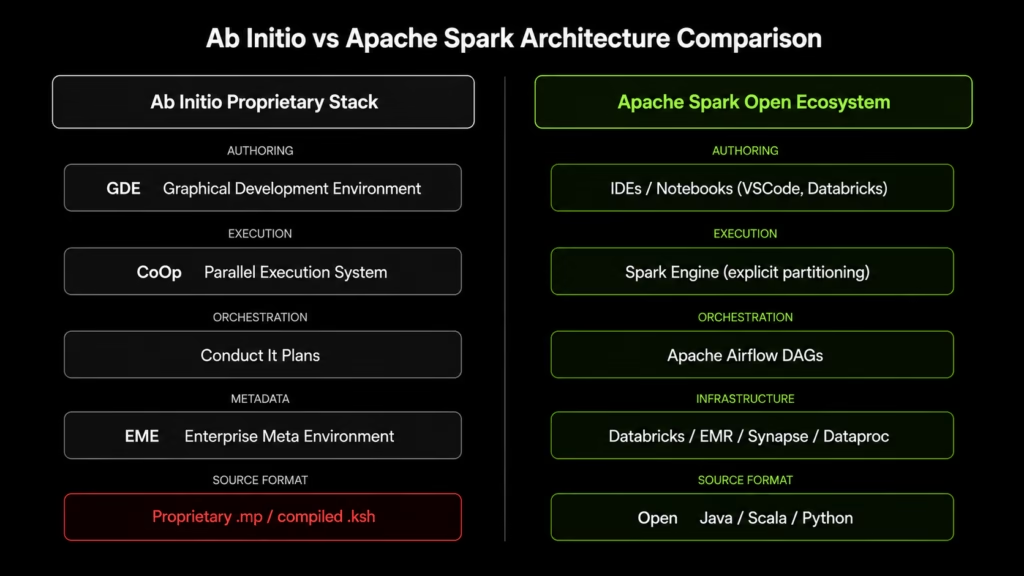
| Dimension | Ab Initio | Apache Spark | Migration Implication | Phase Where It Concentrates |
| Execution model | Co>Op manages parallelism automatically at runtime | Explicit partition model; developer-defined | Partition logic must be reconstructed from scratch; silent errors surface at production volumes, not during testing | Phases 2 and 3 |
| Graph source format | Proprietary GDE .mp format, compiled to .ksh shell scripts | Open; code in Java, Scala, or Python | .mp must be ingested directly; .ksh is a compiled artifact and cannot reliably reconstruct source logic | Phase 2 |
| Orchestration | Conduct>It Plans with dependency trees, conditional branching, and checkpoint-restart | Apache Airflow DAGs defined in Python | A separate migration workstream; most tools do not address this phase | Phase 4 |
| Schema and transformation language | Ab Initio DML, proprietary | Spark StructType schemas and DataFrame API | Complex nested financial records require comprehension before re-expression | Phases 2 and 3 |
| Licensing model | Proprietary, per-component pricing | Open-source; pay for managed infrastructure only | $4 to $6M+ annually versus approximately $1.5M in steady state | Business driver |
| Cloud and ecosystem fit | Closed; limited native cloud integration | Cloud-native; runs on Databricks, EMR, Synapse, GCP Dataproc | Target platform selection is a downstream recommendation decision | Phase 3 |
| Talent availability | Declining; institutional knowledge concentrated in senior engineers nearing retirement | Deep open-source talent pool across the US | The window for knowledge-assisted migration is narrowing | Planning constraint |
The Four Gaps That Concentrate Migration Complexity
- Co>Op vs. Spark partitioning. Ab Initio’s Co>Operating System manages parallelism automatically, determining how data is partitioned across processing nodes at runtime based on graph configuration and system load. Spark’s partition model is explicit: the developer specifies partition keys, counts, and strategies. Co>Op’s partitioning decisions are not recorded in a form that maps cleanly to Spark equivalents. Errors here do not always produce job failures. Incorrect partition logic generates skewed output and performance degradation that may not surface until the first full-scale production test.
- GDE .mp graph format. The Ab Initio Graphical Development Environment stores pipeline definitions in .mp files, a proprietary format that the GDE compiles to .ksh shell scripts for execution. Most migration tools that claim to parse Ab Initio workflows are parsing .ksh, the compiled output rather than the source graph. Reconstructing pipeline logic, field lineage, and transformation semantics from compiled shell scripts is comparable to reverse-engineering compiled bytecode. Reliable comprehension requires ingesting .mp files directly.
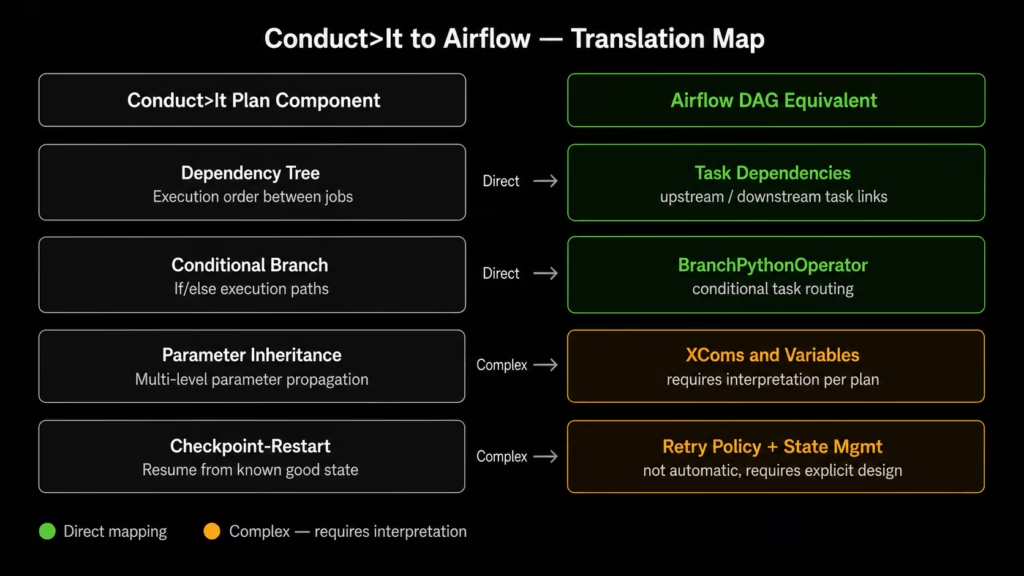
- Conduct>It Plans to Airflow DAGs. Conduct>It is Ab Initio’s orchestration layer. Plans define execution order, inter-job dependencies, conditional branching, multi-level parameter inheritance, and failure-restart behavior at checkpoint granularity. The mapping to Airflow DAGs is not mechanical. It requires understanding how each Plan’s dependency tree resolves, how parameters propagate across nested plans, and how restart-from-checkpoint logic maps to Airflow’s retry and state management model. Academic research on Ab Initio-to-Spark migration frameworks identifies orchestration migration as an open problem that point-in-lifecycle tools have not solved [3].
- Ab Initio DML re-expression. Ab Initio uses a proprietary schema and transformation language for defining record structures and field-level transformations. Spark uses StructType schemas and the DataFrame API. For standard financial records, the mapping is tractable. For complex nested structures such as hierarchical trade records, multi-level risk aggregations, or regulatory reporting schemas, re-expression requires schema comprehension and transformation logic review before conversion can proceed reliably.
The Financial Case: When Migration Pays for Itself
The cost arithmetic is direct.
- Ab Initio licensing at enterprise scale: $4 to $6 million or more annually
- Spark steady-state cost on managed infrastructure: approximately $1.5 million
- Annual delta: approximately $4.5 million [2]
A migration that costs less than one year’s licensing savings is straightforwardly justified. Whether a specific migration meets that threshold depends almost entirely on the automation rate, which is determined by the composition of the estate, not by a benchmark applied from the outside.
The manual migration rate provides the concrete stakes. At one medium-complexity workflow per two engineers over two weeks [2], an estate of 1,500 workflows in the complex tail represents approximately 3,000 engineer-weeks of manual effort.
Tooling that automates the majority of those tail changes the program’s financial profile entirely. Tooling that stalls at 70% and requires manual remediation for the rest can push migration costs past a year’s licensing savings before the program closes.
The published TCO reduction from a completed enterprise migration of this type was 55%, achieved through automated transformation across a 1.5 million line Ab Initio estate.
The Assessment tells you your automation rate, what converts with tooling and where the complex tail sits, before you commit to a timeline or a budget.
The Ab Initio to Spark Migration Lifecycle
A migration that covers only code conversion is not a complete migration. The assessment, orchestration work, and parity validation that frame the conversion phase are where programs either close or stall. Each phase below has distinct inputs, distinct outputs, and distinct failure modes.
Phase 1: Assessment
Before any conversion begins, the full Ab Initio installation must be inventoried:
- Graph count and dependency structure
- Component classification: standard GDE components versus custom components with embedded logic
- DML schema catalog
- Conduct>It Plan complexity
- Initial estimate of workflows in the automatable majority versus the complex tail
This is the phase most teams underinvest in. It is also the phase that determines whether the rest of the migration is predictable or reactive. Any timeline estimate produced before the assessment is speculative.
An enterprise running 5,000 workflows with a high proportion of custom components will have a materially different migration profile than one running the same volume on standard constructs. The automation rate for a specific installation can only be determined after the inventory is complete.
For a closer look at how phased planning reduces risk across large-scale programs, see our guide to incremental modernization.
Phase 2: Graph Parsing and Comprehension
Reliable comprehension requires ingesting Ab Initio .mp graph files directly at the source level. The compiled .ksh output does not preserve the graph structure, field-level annotations, or transformation semantics needed to reconstruct pipeline logic accurately. A purpose-built .mp parser is the prerequisite for this phase. A standard code reader is not a substitute.
The comprehension output is an Intermediate Representation (IR) that captures:
- Transformation semantics and field lineage
- Data dependencies and flow structure
- Co>Op partition configurations
- Embedded business rules from the complex tail
The IR decouples comprehension from conversion. Pipeline logic is fully captured and reviewable before any Spark code is written, making it auditable, platform-independent, and suitable as a pre-migration documentation record for regulatory purposes.
The 70/30 Problem: What Automates and What Does Not
Understanding where automation applies and where it does not is the most important scoping decision in any Ab Initio migration program.
The automatable 70% covers pipelines built on standard GDE components with clean data flows and documented transformation logic:
- Reformat, join, rollup, sort, merge, and dedup components
- Pipelines with straightforward field mappings
- Workflows where the transformation logic is represented accurately in the graph structure
Well-built tooling handles this segment with high automation rates. The conversion patterns are predictable and repeatable.
The complex 30% is structurally different:
- Custom components with business logic embedded inside the component rather than represented in the graph
- Co>Op runtime dependencies that are not visible in the graph structure
- Undocumented pipelines built 10 to 15 years ago by engineers who have since retired
This tail contains the pipelines that matter most to the business: credit scoring models, regulatory reporting transformations, and risk calculation routines. It consumes approximately 80% of total migration effort [2].
At a manual migration rate of one medium-complexity workflow per two engineers over two weeks [2], an estate of 1,500 workflows in the complex tail represents approximately 3,000 engineer-weeks of manual effort. Approaches that skip dedicated comprehension for this segment reach 70 to 80% conversion and stall. The remainder comes back as manual remediation with no clear completion path.
Before committing to a migration approach, knowing how your Ab Initio installation maps against each of these phases, including workflow inventory, component classification, and automation rate estimate, is the prerequisite. Legacyleap’s $0 Modernization Assessment produces that map before any conversion work begins.
Phase 3: Code Conversion
All code transformations in this phase should be diff-based and human-reviewed before acceptance. Autonomous code generation without review gates introduces errors that accumulate and are difficult to detect until late in the validation phase.
Because the IR is decoupled from any specific target, the same IR generates:
- Java Spark
- PySpark
- Databricks notebooks
- Amazon EMR jobs
- Azure Synapse pipelines
Target architecture decisions become a recommendation problem downstream of the IR. Platform selection does not constrain how comprehension is conducted.
Phase 4: Orchestration Migration
Converting the graphs addresses the compute layer. The Conduct>It Plans must be addressed as a separate workstream.
Conduct>It to Apache Airflow: What the Translation Requires
Plans define execution order, inter-job dependencies, conditional branching, multi-level parameter inheritance, and checkpoint-restart behavior. These are not metadata. They are execution logic that determines whether production pipelines run correctly.
Translating a Plan to an Airflow DAG requires:
- Mapping each Plan’s dependency tree to Airflow task dependencies
- Converting conditional branching to Airflow’s BranchPythonOperator or equivalent constructs
- Re-expressing parameter inheritance as Airflow Variables or XComs
- Mapping checkpoint-restart logic to Airflow’s retry and state management mechanisms
Automated DAG generation from Conduct>It Plans is technically achievable but requires parsing at the Plan level, not the graph level. It is also the capability most Ab Initio migration tools do not address [3].
Phase 5: Parity Validation
Functional equivalence testing between Ab Initio output and Spark output at production data volumes closes the migration lifecycle.
For US financial services organizations under SOX or BCBS 239, this is a compliance requirement. Risk data must be traceable end-to-end. Financial transformation audit trails must be preserved. A migration that produces equivalent output but cannot document that equivalence through structured testing does not satisfy these obligations.
Parity validation covers three layers:
- Unit tests: Validate individual converted functions against their Ab Initio equivalents
- Regression mapping: Cover edge cases and boundary conditions specific to the pipeline’s business logic
- Data reconciliation: Confirm zero data loss at production volumes, including record counts, field-level checksums, and aggregate totals for financial reporting outputs
Migration Phase Summary
| Phase | Primary Challenge | Failure Mode If Skipped | Required Output for Next Phase |
| 1. Assessment | Mapping custom components and Co>Op dependencies across the full installation | Unreliable estimates; reactive migration | Graph inventory, component classification, automation rate estimate |
| 2. Graph parsing and comprehension | Ingesting .mp directly; reconstructing embedded logic in the complex tail | 70 to 80% conversion, stalled remediation, no completion path | IR capturing semantics, field lineage, partition configurations |
| 3. Code conversion | Partition logic reconstruction; diff-reviewed output at each step | Skewed output and silent performance errors at production volumes | Target Spark code across the chosen platform |
| 4. Orchestration migration | Plan-level DAG generation; parameter inheritance and restart logic mapping | Incomplete migration; production pipelines run with incorrect ordering | Airflow DAGs replacing all Conduct>It Plans |
| 5. Parity validation | Full-volume reconciliation satisfying SOX and BCBS 239 | Migration cannot be demonstrated equivalent; compliance exposure | Unit tests, regression mappings, data reconciliation report |
Migration Timeline: Lighthouse to Full Decommission
A migration program structured around three stages keeps complexity manageable and gives the business visibility at each phase before committing to the next.
Months 1 to 4: Lighthouse MVP
Select 5 to 10% of the workload: standard components, clean data flows, well-documented logic. Assign 10 to 15 engineers. The goal at this stage is not volume. It is establishing conversion patterns, validating IR output against Ab Initio behavior, and confirming parity methodology before scale commitment. Decisions made in the Lighthouse stage, on target platform, review process, and validation approach, govern the rest of the program.
Months 5 to 12: Structured Rollout by Domain
Migrate wave by wave, validating parity per wave before moving to the next domain. Begin Conduct>It to Airflow translation as a parallel workstream during this phase rather than deferring it to the end. Orchestration translation that runs alongside code conversion keeps the migration on a predictable close date.
Months 12 to 18: Tail Migration and Decommission
Complex-tail workflows requiring dedicated comprehension. Custom component resolution. This is the phase where the IR and the Assessment Agent’s classification output are most valuable, because this segment cannot be converted without the business rules reconstruction that comprehension provides. Final Ab Initio license termination follows once parity validation is complete across the full estate.
How Legacyleap Migrates Ab Initio to Java Spark
When US enterprises evaluate migration vendors, service partners, and modernization companies for Ab Initio to Spark programs, the question that separates credible options from everything else is whether the engagement addresses the full lifecycle or only conversion.
A completed enterprise migration delivered by Legacyleap for a global credit scoring leader produced a 55% TCO reduction, 80%+ automated transformation, 60% faster time-to-market, and zero data loss across 1.5 million lines of Ab Initio ETL code.
Those outcomes map directly to the five-phase lifecycle: each agent in Legacyleap’s platform covers a distinct phase, and the Intermediate Representation connects them into a single traceable workflow.
Assessment Agent
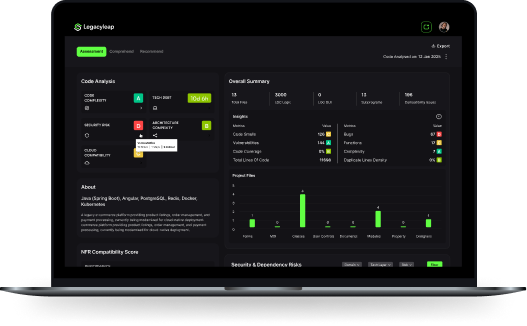
The Assessment Agent maps the full Ab Initio installation before any conversion commitment: graph inventory, dependency structure, component classification, Conduct>It Plan complexity, and DML schema catalog.
The output is a modernization readiness view and an automation rate estimate specific to that installation. This is what the $0 Modernization Assessment delivers: the information required to scope the migration accurately before work begins.
Documentation Agent and Proprietary .mp Parser
Legacyleap’s in-house .mp parser ingests Ab Initio graph files at the source level, not the compiled .ksh output. This is the architectural distinction that determines whether comprehension produces reliable results or approximations.
The original graph structure, field-level annotations, and transformation semantics present in the .mp source are not fully recoverable from the compiled shell scripts.
The Documentation Agent uses the parser to reconstruct pipeline logic, field lineage, transformation semantics, and embedded business rules. The output is the IR, the single source of truth for all downstream conversion work.
For US enterprises with SOX or BCBS 239 obligations, the IR functions as the auditable pre-migration documentation record against which post-migration output is validated.
Recommendation Agent
The Recommendation Agent takes the IR and assessment output and surfaces target architecture options with effort and feasibility analysis for each. Supported targets include Java Spark, PySpark, Databricks, Amazon EMR, and Azure Synapse.
Because the IR is decoupled from any specific execution environment, the recommendation is based on the client’s infrastructure, compliance posture, and operational model.
Platform-agnostic comprehension enables genuinely platform-agnostic recommendations, which matters when an enterprise’s cloud strategy is still in motion.
Modernization Agent
The Modernization Agent executes diff-based, human-reviewable code transformations from the IR. All changes require engineering approval before acceptance. The platform does not merge, deploy, or execute code autonomously. Every transformation is reviewable at the diff level before it enters the codebase, which is what makes the output verifiable rather than assumed.
The Modernization Agent also handles Airflow DAG generation from Conduct>It Plans. Dependency trees, conditional branching, parameter inheritance, and checkpoint-restart logic are translated into modular Airflow task pipelines.
In the completed enterprise migration referenced above, Airflow DAG generation was automated alongside code conversion, delivering orchestration as part of the migration rather than as a follow-on effort.
QA Agent
The QA Agent generates unit tests, regression mappings, and data reconciliation checks for each converted pipeline. Functional parity is validated at production data volumes, not at sample scale. Zero data loss is a verified output of parity validation run against the full production dataset, not a projected estimate.
For US financial services organizations under SOX and BCBS 239, the QA Agent’s parity validation report and the IR together constitute the auditable pre- and post-migration record. The compliance requirement is satisfied through the platform’s built-in validation workflow.
| Agent | Lifecycle Phase | Published Outcome |
| Assessment Agent | Phase 1: Installation mapping, component classification, automation rate estimate | Full dependency map before any conversion commitment |
| Documentation Agent and .mp parser | Phase 2: Source-level .mp ingestion, IR generation, complex-tail business rules extraction | 1.5M+ lines of Ab Initio ETL code comprehended and captured in IR |
| Recommendation Agent | Phase 3 input: Target platform selection across Java Spark, PySpark, Databricks, EMR, and Synapse | Platform-agnostic recommendations based on client infrastructure and compliance posture |
| Modernization Agent | Phases 3 and 4: Diff-reviewed code conversion; Conduct>It to Airflow DAG generation | 80%+ automated transformation; 60% faster time-to-market; orchestration layer delivered |
| QA Agent | Phase 5: Unit tests, regression mapping, production-volume data reconciliation | Zero data loss; 50 to 60% faster data processing; full audit record for SOX and BCBS 239 |
For a broader look at how Legacyleap approaches ROI across modernization programs, see our guide to application modernization ROI.
What a Complete Ab Initio to Spark Migration Actually Requires
The financial case for migration is not what stalls Ab Initio programs at US enterprises. The execution risk is specific: a proprietary graph format that standard tools cannot ingest, a parallelism model with no automatic Spark equivalent, orchestration logic that most vendors do not address, and business rules that exist nowhere outside the pipelines. Each of these is a solvable problem. None of them is solved by conversion tooling alone.
Approaches that cover only code conversion address the tractable majority. The complex tail, which contains the credit scoring models, regulatory reporting routines, and risk calculations that matter most to the business, requires comprehension, orchestration, migration, and validated parity before it can close. That is where migrations stall.
There is also a talent constraint that compounds the execution risk. The practitioners who built these pipelines are at or approaching retirement. The institutional knowledge required to navigate the complex tail, to understand what a custom component was designed to do, and reconstruct the logic inside an undocumented graph, is leaving on a predictable timeline. For enterprises that want knowledge-assisted migration, that window is open now.
Legacyleap’s $0 Modernization Assessment maps your Ab Initio installation, including workflow inventory, component classification, automation rate estimate, and target architecture options, before you commit to an approach or a budget.
To see the full lifecycle in action, from Assessment Agent through QA Agent parity validation with the IR as the audit record, book a demo.