TL;DR
- Federal agencies spend over $100 billion a year on IT, and 80 percent of it just keeps old systems running. GAO’s review identified 69 federal legacy systems, including one at the Department of Defense that has been in service for 60 years.
- Only 3 of the 11 most critical federal systems had a fully documented modernization plan. Six had an incomplete plan and two had none at all, per GAO’s latest review, a bigger risk factor than the systems’ age alone.
- Technical debt costs the US economy an estimated $2.41 trillion a year, more than 10 percent of GDP. CISQ traced roughly $1.52 trillion of that 2022 figure specifically to accumulated technical debt, a number no one has independently re-measured since.
- The average US data breach now costs $11.5 million, more than double the global average. IT professionals separately rank security vulnerabilities as their top legacy-software concern, four points ahead of incompatibility with modern systems.
- Legacy debt is now blocking the AI initiatives boards have already funded, not just running up maintenance bills. 72 percent of senior leaders say their organization lacks unified, accessible data, and only 42 percent consider their data foundation ready for AI agents.
Legacy system statistics circulate widely, and a large share of the numbers in circulation are undated, unsourced, or drawn from a report about a different country entirely. What follows is US-specific, current as of 2026, and every figure below is tied to a named source.
How Much of the IT Budget Goes to Legacy System Maintenance
US federal agencies spend more than $100 billion on IT every year, and roughly 80 percent of that goes to operating and maintaining systems that already exist rather than building new ones [1]. The most recent GAO review identified 69 federal legacy systems, with 11 flagged as most critical across 10 agencies. Some of those systems have been running for decades: the oldest, at the Department of Defense, has been in service for 60 years, and systems at Treasury, Health and Human Services, and the Environmental Protection Agency range from 51 to 59 years old [1].
Modernization planning is the more consequential finding here, ahead of age alone. Of the 11 most critical federal systems, only 3 had a fully documented modernization plan at the time of GAO’s review, 6 had an incomplete plan, and 2 had none at all [1].
Private-Sector Reliance Tells the Same Story
The federal government sits at the extreme end of this pattern rather than outside it. In the private sector, 62 percent of US organizations still rely on legacy software systems in daily operation [2], and technical debt tracks even higher: 92 percent of US business and technology leaders report their organization carries some form of it today [3].
| Where legacy-system spend concentrates | Figure | Source |
| Share of federal IT budget spent on operations and maintenance | ~80% of $100B+ annually | GAO, 2025 [1] |
| Age of the oldest critical federal systems still in service | Up to 60 years | GAO, 2025 [1] |
| US organizations still running legacy software in production | 62% | Saritasa, 2025 [2] |
| US leaders reporting some form of technical debt | 92% | Morning Consult / Unqork, 2024 [3] |
That reliance carries a measurable operating cost well beyond the maintenance line item itself. 80 percent of the leaders surveyed by Morning Consult said their organization experienced a delayed or canceled business-critical project in the past 12 months as a direct result of technical debt. 85 percent said legacy systems actively impair their ability to launch new solutions, and 79 percent cited higher software development and management costs tied to the same cause [3].
The Economic Cost of Legacy Technical Debt in the US
The Consortium for Information and Software Quality estimated the total cost of poor software quality across the US economy at $2.41 trillion in 2022, with roughly $1.52 trillion of that attributable to accumulated technical debt specifically [4]. The same report grouped the remainder into two other categories: rising cybercrime losses tied directly to software vulnerabilities, and growing exposure from software supply chain issues in third-party and open-source components [4].
This estimate has not been independently repeated since 2022. It remains the most-cited figure of its kind, appearing across nearly every competing analysis of this topic.
For scale, $2.41 trillion represented more than 10 percent of that year’s US GDP. The same report counted roughly 300,000 unfilled IT jobs at the time.
Why the CIO-Level Data Confirms the Pattern
The pattern holds at the individual-company level too. 32 percent of CIOs at Fortune 1000 and large private US companies name the state of current systems and processes, including legacy technical debt, as a top-3 organizational challenge, and 82 percent say they struggle to realize value from technology investment generally [5]. A related figure from the same survey: 47 percent of these CIOs prioritize data platform transformation specifically to drive business growth, ahead of most front-office technology categories [5]. Both figures come from a smaller, 2023-vintage sample of 92 CIOs and are used here as directional confirmation, not a standalone headline number.
The technical debt sitting inside these applications rarely appears as a single line item in any budget, a large part of why it persists unaddressed. The true cost of maintaining these systems typically runs two to three times larger than the visible maintenance budget once talent, productivity, and risk are added in.
Security and Breach Risk From Aging Legacy Systems
The average cost of a US data breach reached $11.5 million in 2026, more than double the $4.99 million global average [6]. That figure is a general US breach-cost benchmark, drawn from breaches across every cause, not a legacy-specific finding on its own.
The legacy-specific risk signal comes from a separate source. Asked what concerns them most about the legacy software they currently run, US IT professionals ranked security vulnerabilities highest, ahead of every other operational concern the same survey measured [2].
| What worries US IT professionals about their legacy software | Share citing it |
| Security vulnerabilities | 43% |
| Incompatibility with modern systems | 41% |
| Scalability limits | 40% |
| High maintenance and support costs | 39% |
| Lack of vendor support | 32% |
Security vulnerability leads that ranking by a wide margin: four points ahead of the next concern and eleven ahead of the fourth.



Legacy System Statistics by Industry: Insurance, Healthcare, and Banking
The pattern above repeats at the industry level, with its own figures in each case.
Insurance
Legacy insurance software costs some US carriers up to $5 million annually in combined hidden operational costs [7]. IT support and downtime alone account for nearly 900 hours of lost productivity a year, worth an estimated $450,000, and manual policy workflows add another $475,000 to $1.1 million.
72 percent of insurers still rely on Excel or internally built tools for at least part of core policy workflows, and more than half of all policy workflows across the industry require manual intervention [7].
On the implementation side, one-third of insurers spend more than $500,000 to implement a single core system, and average implementation costs approach $1 million. Most insurers run two to three of these systems concurrently, putting total exposure as high as $3 million before ongoing maintenance is even counted [7].
Nearly 45 percent report implementation cycles exceeding 18 months, and the industry’s average implementation experience scores below what the survey itself treats as a passing grade [7].
Healthcare
In the US specifically, 37 percent of frontline healthcare professionals say their organization’s clinical systems are not modern, and 27 percent report a technology-driven error happening daily, with another 26 percent seeing one a few times a week and 22 percent about once a week [8]. Combined, more than half of frontline healthcare professionals, 53 percent, see a technology-driven error at least once a week [8].
Banking
The American Bankers Association’s 2024 Core Platform Survey found only 53 percent of US bankers extremely or somewhat satisfied with their core banking platform, against a 35 percent dissatisfaction rate, for an average satisfaction score of 3.19 out of 5 [9].
Satisfaction declines the longer a bank stays on its current platform, falling to its lowest point as contract renewal approaches.
Despite that, only 19 percent say they are likely to switch providers at renewal, versus 69 percent likely to stay, a pattern more consistent with switching cost and vendor lock-in than with satisfaction [9]. The same survey surfaced a stark perception gap: core providers rate their own service effectiveness at 4.31 out of 5, while the banks using that service rate it at 2.78 [9].
| Industry snapshot | Insurance | Healthcare | Banking |
| Annual cost or satisfaction exposure | Up to $5M (some carriers) | Not separately quantified in source | 3.19/5 average platform satisfaction |
| Share reporting systems as outdated or unmodernized | 72% rely on Excel/manual tools | 37% say clinical systems aren’t modern | 35% dissatisfied with core platform |
| Top friction point | Manual policy workflows (50%+ of all workflows) | Daily technology-driven errors (27%) | Only 19% likely to switch despite low satisfaction |
The ERP Deadline in Manufacturing and Distribution
Enterprise resource planning carries its own version of this deadline pressure across manufacturing, distribution, and other core-system-heavy industries. SAP’s ECC platform, still in wide production use, reaches the end of standard maintenance in 2027, a fixed date rather than a projection. Legacy ERP modernization is the same underlying problem described throughout this section, running on a shorter clock.
Why Legacy Systems Are Now an AI-Readiness Problem
The traditional framing for this data has been cost and risk. A newer, 2026-specific framing has emerged alongside it: legacy debt as the thing standing between an enterprise and the AI initiatives its board has already funded.
72 percent of senior US leaders say their organization lacks unified, accessible data, and only 42 percent consider their data foundation actually prepared for AI agents [10]. The same survey found 67 percent of leaders describe integration as too costly and complex to support broader agentic AI adoption, and only 48 percent feel technologically prepared for it at all [10].
What Full AI Readiness Actually Requires
Preparedness drops further once the question moves past infrastructure into what running an AI program actually requires operationally:
| What agentic AI readiness requires | Leaders who feel prepared |
| Overall technical infrastructure | 48% |
| Data foundation | 42% |
| Risk, security, and governance frameworks | 39% |
| Ecosystem partnerships | 34% |
| Workforce transformation and upskilling | 25% |
| Business process redesign | 21% |
The data foundation an AI-ready enterprise actually needs and the data debt compounding inside it both trace back to the same legacy applications and pipelines quantified throughout this article.
Want to see how an AI initiative’s data layer actually gets modernized?
A Technical Demo shows how Legacyleap’s five-agent lifecycle assesses and modernizes the data layer your initiative depends on, before it stalls at the production handoff.
The IT Talent Market Is Shifting Toward Modernization Roles
The US tech workforce is projected to reach nearly 9.8 million workers in 2026, representing 8.7 percent of the US economy, roughly $2.3 trillion in direct value across nearly 706,000 tech business establishments [11]. Growth inside that workforce is uneven by design. Cybersecurity analyst and engineering roles are projected to grow 346 percent over the next decade and software development roles 188 percent, both well ahead of overall US employment growth over the same period [11]. Software quality assurance and testing roles, directly relevant to the validation work a modernization program requires, are projected to grow 110 percent over the same decade [11]. Some of the fastest state-level job growth for 2026 is concentrated in Texas, projected to add over 32,000 tech jobs, with Dallas alone accounting for more than 11,000 of them [11].
The median tech occupation salary sits at $112,805, more than double the median wage across all US occupations. Four sectors account for roughly 94 percent of where tech workers are actually employed: technology companies, professional and scientific and technical services, finance and insurance, and the public sector [11].
As of January 2026, more than 275,000 active US job postings referenced AI skills specifically, spanning both dedicated AI roles and AI fluency layered onto existing ones [11].
Who Actually Maintains the Legacy Estate Today
68 percent of US organizations rely on their internal IT department for legacy software maintenance, 20 percent use dedicated legacy software specialists, 7 percent outsource to external vendors, and 5 percent admit no regular maintenance occurs at all [2].
Why Enterprises Delay Modernization Despite the Data
None of the figures above are hidden from the people who would need to act on them. A large share of CIOs and architects can already estimate the scale of the problem inside their own organization. The specific reasons modernization still gets deferred are worth taking at face value, not dismissed as excuse-making.
The most commonly cited reason, from 50 percent of US IT professionals, is that the current system still works [2]. Budget limitations follow at 44 percent, fear of operational disruption at 38 percent, data migration concerns at 35 percent, lack of internal support at 30 percent, and unclear ROI at 25 percent [2].
Each of these is a legitimate operating constraint. A system that still works is a defensible reason to be cautious before touching it, and fear of disruption is a rational response to a genuinely high-stakes change to a production system.
What Practitioners Want Instead
Asked what a modern system needs to deliver, US IT professionals ranked improved performance and speed highest (48%), followed by cloud-based or remote access (45%), greater scalability (44%), integration with modern tools (44%), and enhanced security (42%) [2].
How Legacyleap Turns This Data Into a Modernization Program
Legacyleap is a Gen AI-powered legacy application modernization platform built on multi-agent orchestration, addressing the data above across the full Assess, Comprehend, Modernize, Validate, and Deploy lifecycle.
What the Assessment and Documentation Agents Produce
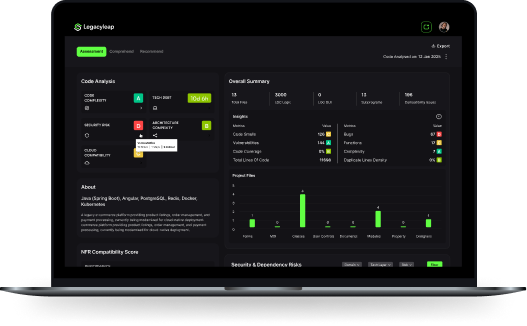
The budget and technical-debt figures in the first two sections describe a cost that accumulates because no single team holds a complete, current picture of what a legacy estate actually contains or costs. The Assessment Agent and Documentation Agent close that gap directly, producing, in 2 to 5 days:
- A dependency and module map of the application
- Risk indicators and identified security vulnerabilities
- Architecture diagrams and reconstructed business logic
- A migration effort and timeline estimate
The Recommendation Agent then defines the target architecture and an ordered migration plan, the decision point most organizations otherwise reach only after months of manual assessment. The underlying platform has processed and transformed more than 10 million lines of legacy code to date. The $0 Modernization Assessment behind the deliverables above has been completed for more than 150 organizations, work that would otherwise cost an estimated $15,000 to $25,000 and four to eight weeks of manual comprehension effort.
Built-In Guardrails Against Disruption
Every transformation the Modernization Agent produces is a diff-based pull request that a human reviews before it merges, with roughly 70 percent of the resulting code changes automated. The QA Agent validates functional parity against the legacy baseline before cutover, auto-generating 70 to 80 percent of the test cases that validation requires. Both agents run inside a deliberate 20 to 25 percent human-in-the-loop design, rising to roughly 30 percent on the most complex codebases, and neither merges, deploys, or executes code autonomously at any point in the process.
A global credit-scoring leader modernized more than 1.5 million lines of Ab Initio ETL to Apache Spark and Airflow, with more than 80 percent of the migration automated. The result was a 55 percent reduction in total cost of ownership, 60 percent faster time-to-market, and zero data loss.
For an enterprise weighing its own legacy estate against the figures in this article, evaluating application modernization platforms and providers is a reasonable next step, and the broader business case for application modernization walks through how to build that internal case using data of exactly this kind.
Next Steps for Acting on the Legacy System Data
Federal, private-sector, industry, and workforce data all point in the same direction: legacy-system cost and risk are large, current, and concentrated in categories a documentation exercise or a single point fix will not resolve. Closing the gap runs through the full lifecycle, from assessment through validated deployment.
A $0 Modernization Assessment maps a specific legacy estate against these figures in 2 to 5 days, at no cost, entirely inside an organization’s own environment. A Technical Demo is available for a closer look at how the five-agent lifecycle executes this directly.
FAQ
A legacy system is software or infrastructure still in production use that is outdated relative to current standards, often undocumented, difficult to change safely, and past the point where its original vendor or development team reliably supports it.
62 percent of US organizations report still relying on legacy software systems in daily operation, and 92 percent carry some form of technical debt as a result.
The most recent US-wide estimate puts the total cost of poor software quality, driven largely by technical debt, at $2.41 trillion, measured in 2022 and not independently re-measured since.
The data points toward standing still carrying the larger risk. Technical debt and maintenance costs compound every additional year a system goes unaddressed, while a modernization program is a bounded, finite cost with a defined endpoint.
References
[1] US Government Accountability Office. Information Technology: Agencies Need to Plan for Modernizing Critical Decades-Old Legacy Systems (GAO-25-107795)
[2] Saritasa. Legacy Software Modernization in 2025: Survey of 500+ U.S. IT Pros
[3] Morning Consult, commissioned by Unqork. 2024 Morning Consult + Unqork Survey: Technical Debt Stifles Innovation at 80% of Enterprises Surveyed
[4] Consortium for Information & Software Quality (CISQ). The Cost of Poor Software Quality in the US: A 2022 Report
[5] PwC. Pulse Survey: Technology Leader Insights
[6] IBM. Cost of a Data Breach Report 2026
[7] RSM US LLP, commissioned by INTX Insurance Software. The Cost of Legacy Insurance Software Systems: Wasted Time & Money
[8] Presidio. Unlocking Healthcare’s AI Potential
[9] American Bankers Association. Core Platform Survey 2025
[10] Deloitte. AI Agents Are Only the Beginning: Deloitte Survey Examines the AI Readiness Gap
[11] CompTIA. State of the Tech Workforce 2026