
TL;DR
- Most modernization business cases fail because they lead with architecture instead of outcomes. The fix is to speak in ROI, risk mitigation, and speed instead of refactoring, containers, or cloud-native platforms.
- The clearest warning sign is a maintenance-to-innovation imbalance. When 70% of engineering effort goes into maintaining old systems, there’s no capacity left to ship what’s next.
- A CFO-ready case rests on five financial levers: cost efficiency, developer productivity, innovation velocity, risk reduction, and revenue enablement. Each one has to be translated from a technical outcome into a financial one, since ‘reduced tech debt’ alone won’t move a budget conversation.
- Building the case takes three concrete steps: inventory and prioritize, choose the right strategy, then model the ROI. Applications get scored on business criticality and technical debt, then routed to refactor, replatform, replace, or retire before costs are modeled with TCO and time-to-value.
- Four repeatable pitfalls sink otherwise solid business cases. Underestimating the cost of inaction, building an overengineered slide deck, anchoring to sunk cost, and assuming ROI must be an 18-month story all undercut the pitch.
Introduction: Stop Selling Modernization as a Tech Problem
Most application modernization business cases fail for the same reason: they lead with architecture instead of outcomes.
Talk about refactoring, containers, or cloud-native platforms, and eyes glaze over. But frame modernization in terms of faster delivery, reduced OpEx, or accelerated revenue, and suddenly, the room listens.
CIOs don’t need to justify modernization as a technology upgrade. They need to justify it as a business decision. That means speaking in the language of ROI, risk mitigation, and speed.
This guide breaks down how to do just that with theory, structure and numbers that actually resonate.
Let’s get right in!
What Triggers a Modernization Business Case Today
You don’t build a business case in a vacuum. The strongest ones are triggered by visible pressure, the kind that hits roadmaps, budgets, or customer experience.
Here are the inflection points where boards start listening:
- Platform Risk: When core systems run on unsupported, unstable, or prohibitively expensive tech and vendor exit plans or compliance gaps force a decision.
- M&A-Driven System Consolidation: Merged entities can’t scale on redundant, disconnected platforms. Integration mandates modernization.
- Business Model Shifts: Moving from product to platform, B2B to D2C, or subscription to usage-based pricing? Your legacy stack wasn’t built for it, and it shows.
- Innovation Bottlenecks: Release delays, data locked in silos, rising developer attrition — all signs that technical debt is now a delivery blocker.
- Maintenance-to-Innovation Imbalance: When 70% of engineering effort goes into maintaining old systems, there’s no room left to build what’s next.
These triggers don’t always show up on architecture diagrams. But they show up in planning meetings, missed launches, and rising operational drag.
The Modernization Value Framework: Thinking Like a CFO
A business case lives or dies by the numbers. But “reduced tech debt” isn’t a metric your CFO cares about. The real question: what levers does modernization actually move?
Here’s how to translate technical outcomes into financial ones:
- Cost Efficiency: Shrink infrastructure, licensing, and support overhead by moving off legacy platforms. (Think: mainframe licensing, proprietary middleware, aging data centers.)
- Developer Productivity: Modern systems reduce build times, test cycles, and incident remediation, giving teams more time to ship features, not fight fires.
- Innovation Velocity: Faster iteration = faster monetization. If new ideas take 6 months to hit production, you’re already behind.
- Risk Reduction: Every unsupported system is a security and compliance risk. Every undocumented dependency is an outage waiting to happen.
- Revenue Enablement: Modernization isn’t just about savings. It creates the foundation to launch new services, products, or integrations that actually drive top-line growth.
Why this matters:
You’re not selling a system upgrade. You’re pitching a shift in business capability. Frame it like one.
How to Build the Modernization Business Case: A Structured Approach
Modernization leaders don’t get buy-in by pitching a vision. They get it by showing the math, the trade-offs, and a path that minimizes risk.
Here’s a practical way to build the case one step at a time.
Step 1: Inventory and Prioritize
Start with what you have. Then decide what matters.
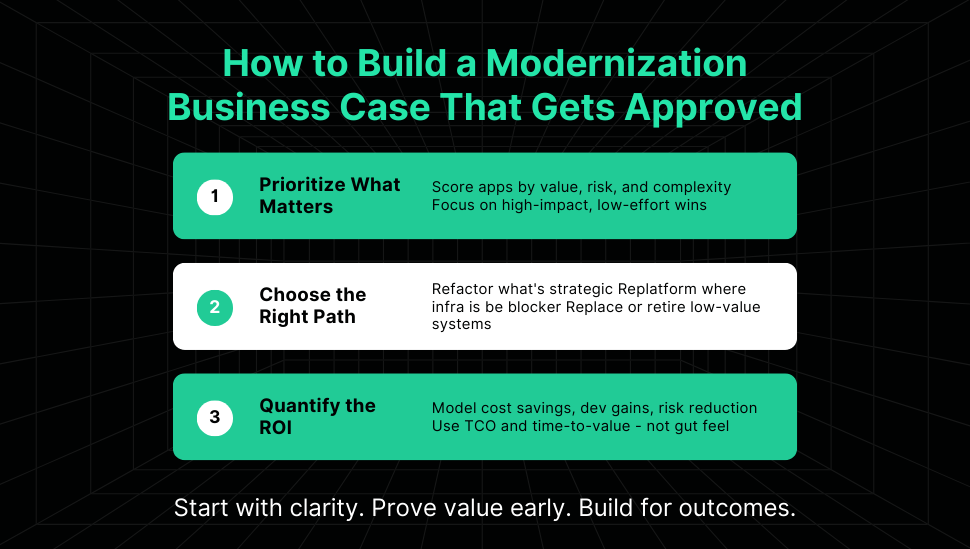
- Score each application based on:
- Business criticality
- Technical debt
- Integration complexity
- Use an effort vs. value matrix to focus on high-impact, low-friction candidates. Use the quadrant below as a guide for mapping your application portfolio against modernization impact and complexity.
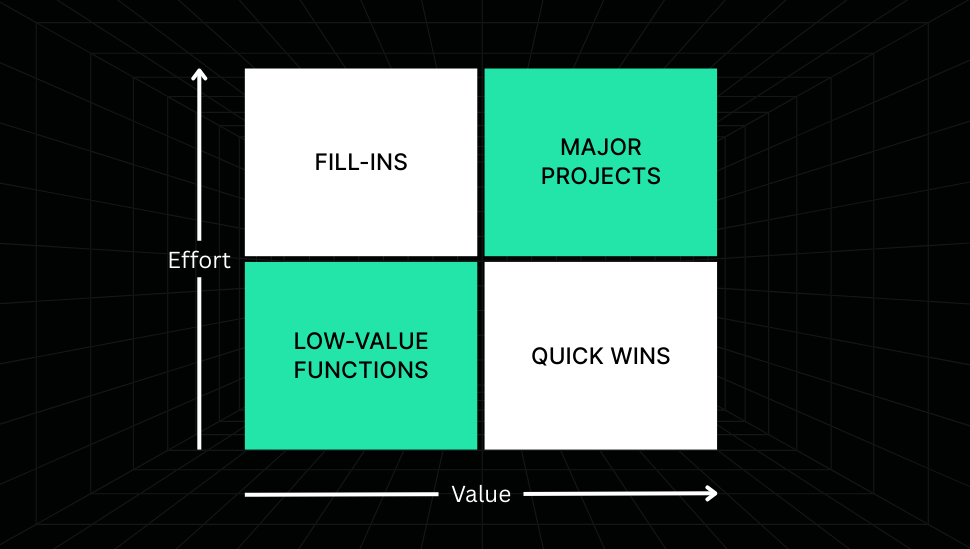
Don’t aim for 100% coverage. The goal is to find where modernization creates the most leverage, fast.
Step 2: Choose the Right Strategy
Avoid the “default to refactor” trap. Not everything needs to be rebuilt.
- Refactor components with long-term strategic value
- Replatform those blocked by infra cost or performance
- Replace low-value or commodity functions with off-the-shelf tools
- Retire anything duplicative or unused
Every system doesn’t need a future. Make that part of the case.
If you’re deciding between refactoring and replatforming, this breakdown of both strategies can help clarify where each approach makes sense — read it here.
Step 3: Model the ROI
This is where your case becomes real.
- Estimate cost reductions (infra, licensing, headcount)
- Quantify productivity gains (dev hours saved, incidents avoided)
- Forecast revenue impact from faster releases or new features
- Align with finance’s view using TCO and time-to-value models
For complex portfolios, use scenario modeling:
Example → “Refactor core ordering service, replatform analytics layer, and retire 3 legacy front-ends.”
A business case isn’t a slide deck. It’s a decision map. Build it like one.
Presenting to Stakeholders: What They Actually Care About
Even the best business case will fall flat if it’s pitched to the wrong priorities.
Tailor your story. Every stakeholder has a different lens. Speak their language, not yours.
| Stakeholder | What to Emphasize |
| CFO | OpEx reduction, licensing cost savings, TCO comparisons, return on invested capital |
| CEO/COO | Time-to-market acceleration, impact on growth, operational risk, customer outcomes |
| CISO | Risk posture, legacy vulnerabilities, compliance readiness, audit trail improvements |
| Engineering | Dev experience, test automation, system stability, reduced firefighting + rework |
Quick wins help. Back your story with metrics from small pilots, not just models. A single modernization track that cuts release time in half is more compelling than a three-year roadmap.
Modernization may start with tech, but buy-in lives in finance, operations, and outcomes. Map your case accordingly.
Avoiding the Usual Pitfalls
Most business cases fail because they’re misaligned, mistimed, or overcomplicated.
Here’s what to watch for:
- Underestimating the Cost of Inaction: Waiting feels safe until support ends, teams churn, or you miss a market shift. Delaying modernization has a real, compounding cost.
- Overengineering the Case: A 40-slide deck won’t get you buy-in. Lead with outcomes, not technical architecture. If you need details, have them ready, but don’t start there.
- Ignoring Sunk Cost Bias: Just because something took 2 years and 3 vendors doesn’t mean it’s worth keeping. Anchor decisions to future value, not past spend.
- Assuming ROI Must Be Long-Term: You don’t need to wait 18 months to prove value. Highlight short-term gains: reduced release effort, faster onboarding, or even one decommissioned server.
The strongest business cases are often backed by a small, well-scoped modernization pilot with measurable outcomes, not a 3-year vision slide.
Final Thoughts: Modernization Without Justification Will Never Cut It
Modernization doesn’t get approved because it sounds visionary. It gets approved because it’s anchored in measurable, near-term outcomes, and makes a clear case for why now.
The job of a modernization leader isn’t just to pick the right strategy. It’s to prove the business case in language that speaks to the board, the CFO, and the teams who have to deliver.
Whether you’re planning a system-wide rearchitecture or targeting a few high-friction services, start with clarity. Show what’s holding you back, what you gain, and how fast you can prove it.
That’s exactly what we help teams do at Legacyleap.
Our $0 modernization assessment isn’t just a code scan. It’s a structured, Gen AI-powered way to surface bottlenecks, map modernization options, and build a business case backed by actual system data, not estimates.
Ready to turn your case into a yes? Let’s get you started.Book your $0 modernization assessment today!