TL;DR
- A $3 million, two-year Oracle TMS implementation still could not replace the legacy system’s LTL rating logic. The commercial platform could not replicate 15 years of carrier-lane rate logic and customer-specific pricing overrides, so the legacy system kept running LTL rating in parallel.
- Dispatcher judgment calls are business logic that exists nowhere in the code or the database. When a commercial TMS goes live, undocumented exception handling surfaces as disputes and manual overrides in the first 60 days after cutover, exactly when the implementation team has declared success and moved on.
- Batch EDI cycles are the specific reason legacy TMS platforms cannot support AI decisioning. EDI transaction sets like the 204, 210, 214, and 997 run on 4-to-24-hour batch cycles, while dynamic carrier selection and real-time freight audit need sub-minute data.
- Wrapping a legacy TMS in a REST API is a deferral strategy, not modernization. The rate engine and settlement logic stay on the original architecture, so technical debt and fragility persist even after the new API layer is added.
- A San Jose transport technology company’s EJB 3 logistics system was modernized 50% faster by mapping dependencies before touching any code. Legacyleap used Amazon Neptune for dependency mapping and Amazon SageMaker for AI-driven risk assessment before any transformation began, on a system with no existing documentation.
Why Logistics Companies Are Stuck Between Replacing and Staying on Legacy TMS
U.S. logistics costs reached $2.58 trillion in 2024, 8.8% of GDP, and the technology running most of that freight is legacy software that predates smartphones.
For logistics companies operating custom or heavily modified TMS platforms, the system contains 15 years of carrier-lane rate logic, accessorial schedules, customer-specific pricing overrides, and exception workflows the business depends on. It also blocks real-time visibility, AI decisioning, and API-first carrier integration.
The obvious answer is replacement. One enterprise logistics company tried exactly that: a $3M Oracle TMS implementation, two years of execution, and at the end of it, the legacy system was still running LTL rating because the commercial platform could not replicate the carrier contract complexity.
That outcome is not exceptional, but it is representative of what happens when the comprehension gap is ignored.
There is a third path: a governed, incremental approach to TMS migration and modernization that preserves embedded freight intelligence while systematically exposing it to modern infrastructure.
This article explains what it requires, where the conventional approaches fail, and what the methodology looks like when it is executed with the precision the rate engine demands.
Why TMS Modernization Is Harder Than Other Enterprise Application Modernization
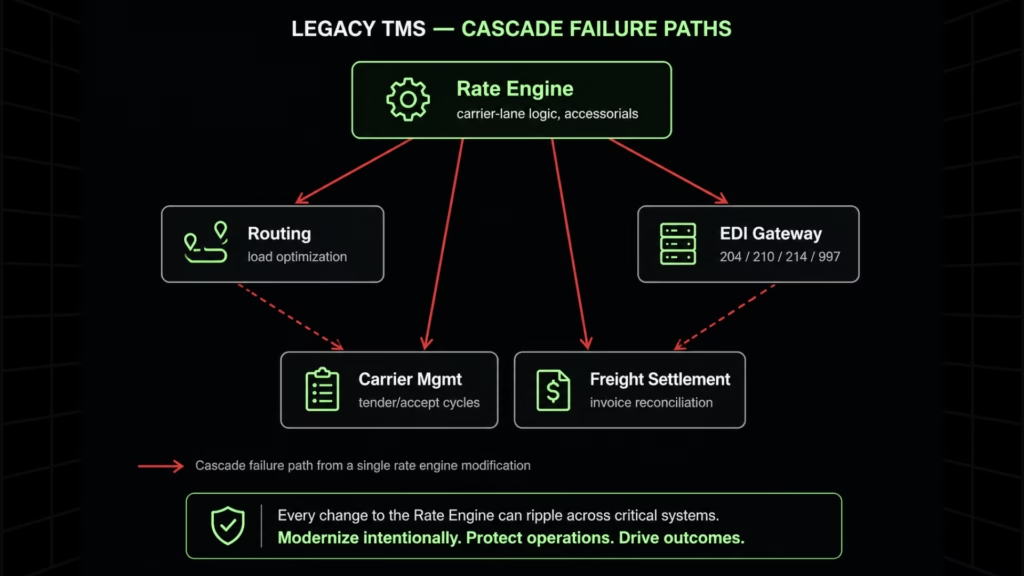
A TMS is among the most tightly coupled enterprise systems in logistics. Rate engine, routing logic, carrier management, freight settlement, and EDI gateway are deeply interdependent. A change in rating logic can cascade failures into settlement. A modification to the routing module can break carrier connectivity. There is no clean seam to cut.
The Rate Engine Problem
The rate engine is where TMS modernization most consistently fails. LTL pricing alone involves thousands of carrier-lane combinations, class-based pricing structures, accessorial schedules, fuel surcharge indices, and customer-specific overrides, all built iteratively across carrier contract cycles and almost none of it documented.
Emily White, CSM at Carrier Logistics Inc., described the structural reality precisely: shippers and motor carriers have developed “a very extensive and elaborate set of contract terms” that makes calculating LTL shipment prices genuinely difficult to codify [1].
Mike Zupon, VP Technology at Ward Transport & Logistics, is equally direct: “Accurate rating is mission critical for LTL carriers” [2]. When rate logic lives inside undocumented legacy code rather than documented business rules, it cannot be safely migrated without first being fully understood.
The Carrier Knowledge That Lives Nowhere in Your Code
Dispatchers have built carrier relationship logic, exception handling, and routing decisions into their daily workflows across years of operation. This knowledge is not in the database and not in the code.
It exists entirely in operational behavior:
- In the judgment calls made when a carrier misses a pickup window,
- When a lane rate does not match the contract,
- When an accessorial exception needs to be cleared manually before a shipment moves.
When a commercial TMS replacement goes live, this knowledge does not transfer. The new system handles the documented rules. The undocumented ones surface as exceptions, disputes, and manual overrides within the first 60 days of cutover, exactly the period when the implementation team has declared success and moved on.
Capturing dispatcher logic is a comprehension prerequisite, not a training task. It belongs in the assessment phase alongside rate engine extraction, not in the change management workstream after implementation begins. Any modernization methodology that treats this as a post-cutover problem has misclassified the risk.
24/7 Operational Dependency
TMS failure at cutover is not a reporting problem. It breaks carrier connectivity and tender/accept cycles immediately. There is no tolerance window for a freight system managing active shipments. This operational reality eliminates big-bang migration as a viable path for most carriers and 3PLs operating at volume.
EDI as the AI Blocker
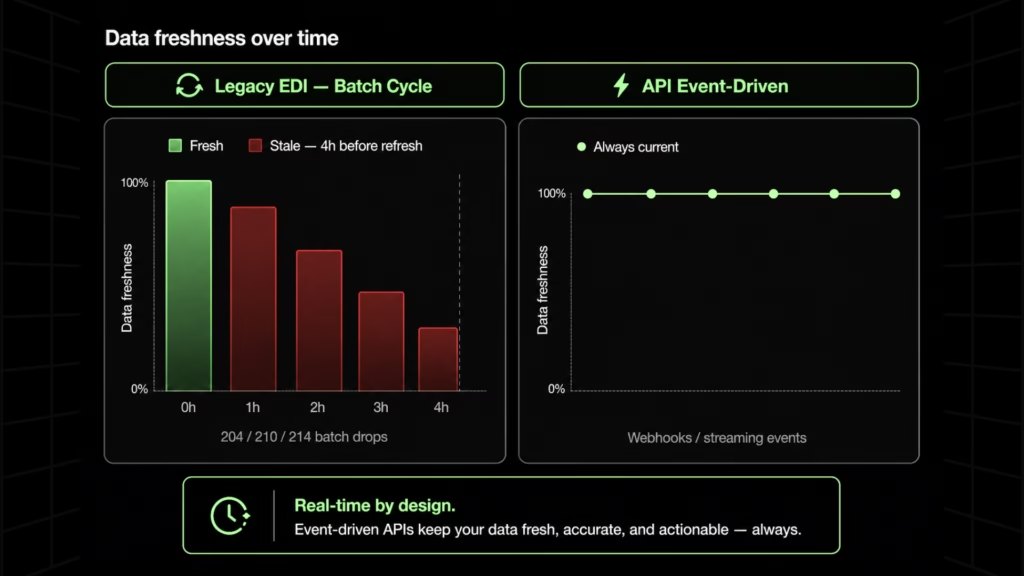
Legacy TMS platforms batch-communicate via EDI on cycles ranging from 4 to 24 hours. AI decisioning (dynamic carrier selection, real-time freight audit, predictive load optimization) requires sub-minute data feeds.
That architectural gap cannot be patched with middleware. Modernization must address the data architecture, not just the application layer. The EDI integration question is a primary reason the “can legacy TMS support AI?” answer is consistently no, until the modernization is done correctly.
TMS Migration and Modernization: Three Paths, Real Costs, and When Each One Works
Every logistics company with a legacy TMS is evaluating some version of the same three options. The table below states what each path actually costs, how long it actually takes, and where it actually fails.
| Path | Cost Range | Timeline | Works When | Fails When |
| Commercial Replacement (Oracle TMS, SAP TM, Blue Yonder, Manhattan Associates) | $500K–$5M+ | Oracle TMS: 6–18 months. SAP TM: 12–24 months [3]. | Rate logic is standard. Carrier mix is manageable. Exception workflows map to out-of-box configuration. | The legacy system contains carrier contract logic the commercial platform cannot replicate. Migration stalls. Legacy runs in parallel indefinitely. |
| Lift-and-Shift / API Wrapping | Low upfront — high ongoing maintenance. | Weeks to deploy, months to stabilize. | Short-term regulatory or integration pressure requires immediate relief. | Treated as modernization. Rate engine and settlement logic remain unchanged. Technical debt compounds. |
| Governed Incremental Modernization | Scope-dependent — significantly lower than commercial replacement when properly assessed. | Phased by module — rate engine, routing, settlement in sequence. | Legacy system contains irreplaceable freight intelligence. Business requires zero-downtime transition. Behavior parity is non-negotiable. | Executed without full comprehension of legacy logic first. Transformation begins before the rate engine catalog is complete. |
The Failure Condition That Applies to All Three Paths
Every path in the table above shares one failure mode, and that is committing to execution before knowing what the legacy system actually contains.
Logistics companies that skip the comprehension phase consistently surface undocumented carrier rate agreements, accessorial rule sets, and exception workflows only after implementation has begun. At this point, the cost of every path increases and the timeline extends regardless of which option was chosen.
The equally common shortcut of wrapping a legacy TMS monolith in a REST API is not modernization. The rate engine and settlement logic remain on the original architecture. The wrapper creates a new integration surface without resolving the underlying fragility.
For TMS modernization ROI to materialize in freight cost reduction, carrier performance, and on-time delivery improvement, the rate engine must be modernized, not abstracted.



EDI to API: The Integration Gap That Blocks Real-Time Freight Operations
The EDI transaction sets running inside a legacy TMS are not abstractions. They are specific, named message types operating on fixed batch cycles.
The 204 (motor carrier load tender), 210 (freight invoice), 214 (shipment status), and 997 (functional acknowledgment) are the core sets that govern carrier communication in most legacy environments.
All of them run on batch schedules. None of them supports the sub-minute data exchange that real-time freight operations require.
The operational consequence of batch latency is straightforward. A 4-hour EDI cycle means carrier acceptance status, shipment location, and freight invoice data are all running on stale information at any given moment.
Dynamic carrier selection requires knowing which carriers are available and at what rate right now, not four hours ago. Real-time freight audit requires invoice data that reflects the current shipment status. Predictive load optimization requires a continuous data feed, not a scheduled file drop.
The gap between what batch EDI provides and what AI-enabled operations require is architectural, not a configuration issue that middleware can bridge.
The EDI-to-API migration path has three non-negotiable requirements.
- First, every existing EDI transaction set must be mapped to a REST or event-driven API equivalent before the transition begins, not during it.
- Second, carrier connectivity must be validated continuously throughout the transition; any break in tender/accept cycles during cutover creates operational exposure that compounds quickly at volume.
- Third, the mapping process must confirm that no rating or settlement logic is altered in translation. EDI-to-API is a connectivity migration, not a logic migration.
Conflating the two is how rate errors enter the modernized system undetected. None of this can be executed safely without a dependency map in place before the first transaction set is touched.
How Legacyleap Governs Legacy TMS Modernization: From Comprehension to Validated Transformation
Executing governed incremental modernization manually at enterprise scale is what causes most programs to stall. The methodology is sound; the execution tooling is not. Incremental modernization is what logistics industry experts consistently recommend over big-bang replacement.
The challenge is operationalizing it without losing control of rate logic fidelity, settlement accuracy, or carrier connectivity at any point in the process. Legacyleap is built specifically to do that.
Here is what the comprehension phase looks like for a 3PL operating a custom TMS with 8,000 carrier-lane combinations and no existing documentation.
The Assessment Agent starts with the full codebase. It maps every carrier-lane combination, every rate table, every accessorial rule, and every dependency chain between the rate engine, routing logic, and settlement layer.
The output is a structured inventory that answers the question the organization has never been able to answer cleanly: what does this system actually contain? No transformation begins until that inventory is complete.
The Documentation Agent takes that inventory and reconstructs it as human-verifiable artifacts. A rate engine catalog, an accessorial rule set, or an exception workflow map. These are not auto-generated summaries. They are structured documents that a logistics engineer can read, verify, and sign off on.
This is where dispatcher knowledge that was never in the code gets formalized: the exception workflows surface during rule reconstruction, and the gaps between what the code says and what operations actually do become visible for the first time.
The Modernization Agent executes transformation in diffs, discrete, human-reviewed, reversible changes. Every modification to rate calculation logic, routing rules, or settlement processing is visible before it is applied.
Every change can be reversed. There is no silent alteration of carrier pricing or accessorial logic. The 24/7 operational dependency constraint is addressed not by working faster but by maintaining rollback control at every step of the sequence.
The QA Agent validates behavior parity before cutover, per carrier, per lane, and per accessorial scenario. Does the modernized system produce the same rate as the legacy for Carrier A on Lane 47 with a fuel surcharge and a liftgate accessorial? That question is answered programmatically for every combination in the inventory, not assumed.
The difference between a clean cutover and a carrier dispute crisis in the first 60 days is whether parity was validated at this level of specificity or treated as a checkbox.
Proof Point: Transport Technology Company, San Jose
A San Jose-based transport technology company operating a mission-critical EJB 3 logistics system engaged Legacyleap under two constraints most logistics modernization programs share: no existing documentation, and zero tolerance for downtime.
Legacyleap delivered 50% faster code comprehension and 50% faster business logic extraction compared to manual analysis, with full dependency mapping via Amazon Neptune and AI-driven risk assessment via Amazon SageMaker completed before any transformation began.
That comprehension phase, the part most modernization programs skip or compress, is precisely what made the transformation controllable. The rate logic was inventoried. The dependencies were mapped. The risk was quantified. Transformation followed from a known baseline, not an assumed one.
The $0 Modernization Assessment
The entry point into Legacyleap’s process is a $0 Modernization Assessment that produces a rate engine scope, routing logic inventory, carrier configuration map, module dependency graph, risk indicators, and a modernization blueprint, before any budget is committed to execution.
For TMS modernization specifically, this assessment answers the question every CTO should require answered before approving a path: how many carrier rate agreements does the legacy system actually contain, and what are the interdependencies?
Legacyleap clients see a 40–50% reduction in overall modernization effort, reaching up to 70% depending on stack complexity and scope.
Conclusion: What TMS Modernization Requires in 2026
The logistics companies making measurable progress on TMS modernization in 2026 are not the ones that replaced their platform. They are the ones that preserved embedded freight intelligence while systematically exposing it to real-time data feeds and AI-capable infrastructure. The difference is whether modernization started with comprehension or skipped it.
On the AI question specifically, Gartner’s Brock Johns has noted that while AI adoption inside TMS platforms surged in 2025, organizations are still working out where it genuinely drives operational value [4].
The prerequisite for TMS AI enablement is not a better AI feature, but a data architecture that supports real-time decisioning. That architecture cannot be built on top of a batch-EDI legacy system. It requires the kind of structural modernization this article describes, and it starts by understanding what the legacy system contains.
Request a $0 Assessment: Map your rate engine, carrier configurations, and module dependencies before committing to a path.
Book a Demo: See how Legacyleap governs TMS modernization at the system level.
FAQs
TMS migration refers to moving freight operations from one system to another, typically from a legacy platform to a commercial TMS or cloud environment. TMS modernization refers to transforming the existing system’s architecture while preserving its embedded freight logic. Migration is a destination change. Modernization is a structural change. In practice, most logistics companies need elements of both: the architecture must modernize, but the carrier rate logic and exception workflows that make the system operationally accurate cannot be discarded in the process.
Rate table migration requires a complete inventory of every carrier-lane combination, accessorial schedule, and pricing override before any data is moved. The migration must then be followed by programmatic parity validation, confirming that the modernized system produces identical output to the legacy for every rate scenario in the inventory. Any approach that skips the inventory phase and validates only a sample of scenarios will introduce pricing discrepancies that surface as carrier disputes and margin leakage after cutover.
The decision turns on one question: does the legacy system contain carrier contract logic, rate engine customizations, or exception workflows that no commercial platform can replicate out of the box? If yes, replacement will require either accepting reduced capability or running the legacy in parallel indefinitely, both of which are more expensive than modernization over time. If the legacy system’s configuration is largely standard, commercial replacement is the faster path. The only way to answer that question with confidence is a formal comprehension assessment before a path is selected.
The carrier contract complexity problem is fundamentally a comprehension problem. The contracts, rate tables, and accessorial logic exist in the legacy system — the issue is that they are encoded in application logic rather than documented as business rules. The correct approach is to extract and catalog that logic during a structured assessment phase, producing a carrier rule inventory that can then be modernized in place. Attempting to replicate undocumented legacy logic inside a commercial platform without first extracting it from the source is the primary mechanism behind TMS replacement failures.
API wrapping adds a modern integration surface to a legacy system without changing its underlying architecture. It addresses connectivity. Other systems can now communicate with the TMS via REST rather than EDI batch files, but the rate engine, routing logic, and settlement layer remain on the original codebase. The technical debt, batch-cycle latency, and operational fragility are all still present. Actual modernization transforms the underlying architecture, replaces batch EDI with event-driven API communication, and exposes the system’s freight intelligence to real-time data flows. API wrapping is a deferral strategy, not a modernization strategy.
Behavior parity validation must be executed per carrier, per lane, and per accessorial scenario. The modernized system should be run in parallel against the legacy for a defined period, with automated comparison of rate outputs across the full carrier-lane inventory. Any discrepancy triggers a root-cause investigation before cutover proceeds. The validation scope must cover the full rate scenario inventory produced during the comprehension phase, not a representative sample. Sampling-based validation is how rate errors enter production undetected.
References
[1] Emily White, CSM, Carrier Logistics Inc. — LTL carrier automates shipment pricing with AI-based software, Trucking Dive, November 17, 2025
[2] Mike Zupon, VP Technology, Ward Transport & Logistics — LTL carrier automates shipment pricing with AI-based software, Trucking Dive, November 17, 2025
[3] GoFreight — TMS Software Compared: 10 Platforms by Use Case (2026) — Oracle TMS 6–18 month and SAP TM 12–24 month implementation timelines
[4] Brock Johns, Director Analyst, Gartner — TMS 2026: 9 trends that define the next phase of transportation tech, Logistics Management, January 2026