TL;DR
- Know which CMS-0057-F provisions already apply. Prior authorization decision timeframes, specific denial reasons and public prior authorization metrics have applied since 2026. The four FHIR APIs are due January 1, 2027.
- Map each API to the system that feeds it. Claims platforms, utilization management (UM) systems, policy and benefits configuration, provider data and enrollment each supply a different API. A FHIR layer inherits their data latency and gaps.
- Expect real-time prior authorization to depend on coverage rules. In legacy UM and benefits applications, those rules sit in code and stored procedures that the Prior Authorization API cannot call.
- Plan for CMS-0062-P before it is final. The April 2026 proposed rule would put drug prior authorization on the same APIs by October 1, 2027 and retire current standard versions on January 1, 2028.
CMS-0057-F Requirements and Deadlines for Payers
CMS-0057-F is the CMS Interoperability and Prior Authorization Final Rule, released January 17, 2024. It changes how health plans share member data and handle prior authorization. Its largest technical requirement, a set of four FHIR APIs, comes due on January 1, 2027.
For payers whose claims, utilization management (UM) and policy administration systems were built long before FHIR, those APIs are the hardest part of the rule. CAQH’s 2025 Index, which surveyed health plans in summer 2025, found 63% of medical plans still developing FHIR-based electronic prior authorization. Health plans in the same survey named technology and system integration among their top barriers.
CMS-0057-F requires impacted payers to run four FHIR APIs by January 1, 2027, covering Patient Access, Provider Access, Payer-to-Payer and Prior Authorization. For payers on legacy claims and UM systems, a FHIR layer in front of those systems is the practical route to that date. The compliance of each API still depends on the data and rules held in the systems behind it.
Impacted payers are Medicare Advantage organizations, state Medicaid and CHIP fee-for-service programs, Medicaid managed care plans, CHIP managed care entities and Qualified Health Plan (QHP) issuers on the Federally-facilitated Exchanges. The table shows the status of each CMS-0057-F provision as of November 2026, based on CMS’s fact sheet and rule page:
| Provision | Applies to | Date | Status |
| Prior authorization decisions within 72 hours (expedited) and 7 calendar days (standard) | Impacted payers except QHP issuers on the FFEs | January 1, 2026 | In force |
| Specific reason for every denied prior authorization, excluding drugs | All impacted payers | January 1, 2026 | In force |
| Public prior authorization metrics, posted annually | All impacted payers | First set by March 31, 2026 | In force |
| Patient Access API usage metrics reported to CMS | All impacted payers | Annually from 2026 | In force |
| Patient Access, Provider Access, Payer-to-Payer and Prior Authorization APIs | All impacted payers | January 1, 2027 | Due |
CMS’s rule page, last updated in October 2026, still gives the API date as primarily January 1, 2027. CMS has published no delay.
Legacy Payer Systems Behind Each CMS-0057-F API
The CMS-0057-F APIs expose data that payers already hold, spread across several applications. A payer’s claims history, prior authorization records, coverage rules and provider attribution usually sit in separate applications, many built on .NET Framework, Java EE or VB6 with Oracle or SQL Server back ends. The table maps each API to its source systems:
| API | What it must serve | Source systems | Common legacy failure |
| Patient Access API | Claims, encounter and clinical data, plus prior authorization requests and decisions (excluding drugs) | Claims platform, UM system | Prior authorization status lives in the UM system and reaches the claims store through a nightly batch |
| Provider Access API | The same data for in-network providers with a treatment relationship, with patient opt-out | Claims platform, provider data, attribution logic | Attribution rules and provider records are split across systems with different provider identifiers |
| Payer-to-Payer API | Claims and encounter data, USCDI data and prior authorization information with dates of service within five years, with patient opt-in | Current and retired claims platforms, enrollment | Five years of history spans platforms that were migrated, acquired or archived |
| Prior Authorization API | Covered items and services, documentation requirements, requests and responses with a decision and reason | UM system, policy administration and benefits configuration | Coverage rules are written into application code and stored procedures |
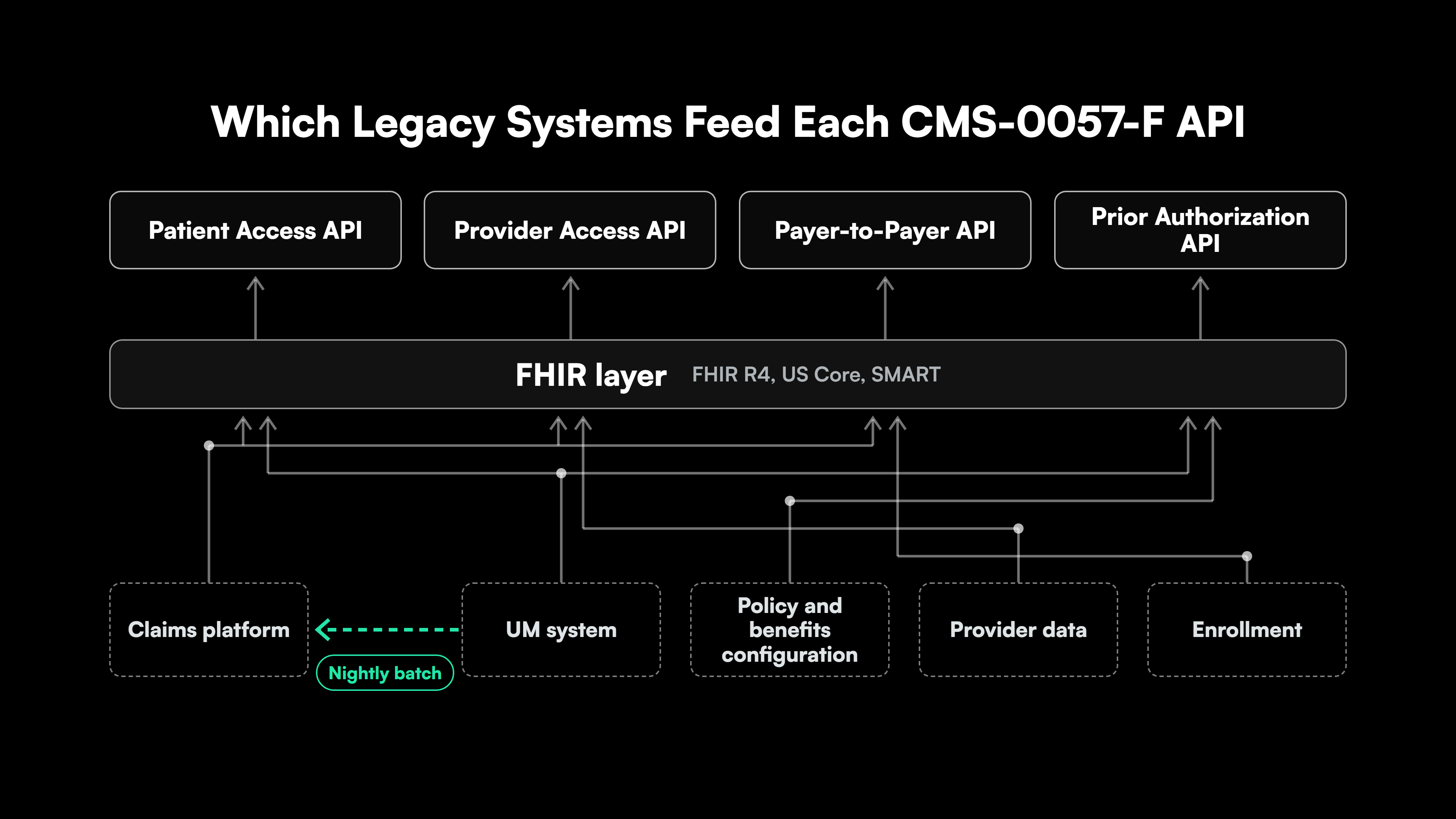
The Payer-to-Payer API carries the widest data reach. A member’s five-year history can include claims adjudicated on a platform the payer retired after an acquisition. If that history sits in an archive the FHIR layer cannot query, the API returns an incomplete record. Payers modernizing claims processing systems face the same archive question for adjudication history.
The Provider Access API depends on attribution, the process of linking each member to the providers treating them. CMS-0057-F requires payers to run an attribution process that links members to in-network providers with a treatment relationship, and to honor patient opt-outs. In legacy estates, the evidence of that relationship sits in claims, and opt-out flags sit in a member portal or enrollment system. The FHIR layer has to join both on every request, across provider identifiers that differ between systems.
The Prior Authorization API carries the deepest logic dependency. To tell a provider whether a service needs authorization and what documentation to send, the API needs the payer’s coverage rules in a form software can query. In older UM and benefits applications, those rules are branches in .NET or Java code and conditions inside Oracle PL/SQL or T-SQL procedures. The same problem drives policy administration system modernization on the benefits side.
Can a FHIR Layer Over Legacy Systems Meet CMS-0057-F?
A FHIR layer over existing claims and UM systems can meet the January 1, 2027 API date. CMS requires FHIR Release 4.0.1, US Core and the SMART App Launch framework at the API boundary, per CMS’s Prior Authorization API workflow. No requirement reaches the internal architecture of a claims or UM system. With six weeks to the deadline, a FHIR layer that reads from existing systems is the build that fits the time left.
A FHIR layer leaves four problems in the legacy systems behind it:
- Data currency: A real-time API serving data from a nightly extract returns yesterday’s prior authorization status. Providers and members see decisions a day late.
- History completeness: The Payer-to-Payer API covers five years of dates of service. Gaps in archived or acquired claims platforms become gaps in the API response.
- Mapping maintenance: Each FHIR resource is mapped to source tables. A schema change in the claims or UM application breaks the mapping. Standard versions also move; CMS’s older US Core, SMART and USCDI versions expired on January 1, 2026.
- Security exposure: The APIs put protected health information on new external endpoints, served from applications never designed for that exposure. The HIPAA Security Rule requirements for access control and audit logging apply to the full path, legacy back end included.
The FHIR layer needs the same design discipline as any enterprise API modernization program:
- Versioned contracts: Each FHIR profile version is published and retired on a schedule, so a standard upgrade does not break the apps that consume it.
- One gateway: Authentication, consent and opt-out checks, and rate limits run in one place in front of all four APIs.
- Event-driven updates: Where a claims or UM application can emit change events, those events replace batch extracts and remove the overnight delay.
The $0 Security Assessment maps the legacy applications behind your CMS-0057-F APIs, their end-of-life runtimes, hard-coded credentials and vulnerabilities, to exact code locations.

 +more
Coverage Rules in Legacy UM Systems and the Prior Authorization API
The Prior Authorization API reaches deeper into legacy logic than the other three CMS-0057-F APIs, because it answers coverage questions inside the provider’s workflow. CMS lists three Da Vinci implementation guides as recommended for it:
- Coverage Requirements Discovery (CRD): Tells a provider whether prior authorization is required for a service.
- Documentation Templates and Rules (DTR): Communicates the documentation a request needs.
- Prior Authorization Support (PAS): Carries the request and the payer’s decision.
Health plans have also set a speed target of their own. In AHIP’s June 2025 commitments, plans covering 257 million Americans pledged that in 2027, at least 80% of electronic prior authorization approvals with complete documentation would be answered in real time.
A real-time answer requires the coverage rule to run as a service the API can call. In a legacy UM application, the rule for an MRI or a home health episode is often spread across a screen’s validation code, a stored procedure and a configuration table, with no document describing it. Extracting that rule takes three steps:
- Find every place the rule is enforced, across code, database logic and configuration.
- Rebuild it as a rules service the Prior Authorization API can query.
- Prove the rebuilt rule returns the same decision as the legacy application for historical requests.
Parity validation decides whether a rebuilt coverage rule can be trusted. A rule that drifts during extraction produces wrong approvals or wrong denials, and each denial must carry a specific reason under CMS-0057-F.
What CMS-0062-P Proposes After CMS-0057-F
CMS-0057-F leaves drugs out of its prior authorization requirements. CMS-0062-P, a proposed rule that CMS and ONC published in the Federal Register on April 14, 2026, would add them and update the standards behind the APIs. Comments closed June 15, 2026. As of mid-November 2026, no final rule has been published. The proposals land on the same legacy systems as CMS-0057-F:
| Proposal | Proposed date | Systems affected |
| Electronic prior authorization for drugs: medical-benefit drugs on the Prior Authorization API, pharmacy-benefit drugs on NCPDP SCRIPT, Formulary and Benefit, and Real-Time Prescription Benefit standards | October 1, 2027 | UM system, pharmacy benefit systems |
| Drug prior authorization information on the Access APIs, with drug-specific denial reasons | October 1, 2027 | Claims platform, UM system |
| API endpoint reporting to CMS | 60 days after a final rule | FHIR layer |
| API usage and prior authorization metrics under new reporting rules | 2028 | Reporting and data warehouse |
| Interoperability requirements for small group QHP issuers on the FF-SHOPs | Plan years from January 1, 2028 | QHP issuer systems |
| FHIR and Da Vinci guides adopted as HIPAA standards for prior authorization | 24 months after a final rule | UM system, EDI gateway |
| Expiration of current ONC API standard versions | January 1, 2028 | FHIR layer and its mappings |
Drug prior authorization is the largest item for legacy systems. Drug coverage rules often sit in a separate pharmacy benefit application from medical UM, so a payer that extracts medical coverage rules in 2027 faces a second extraction for drugs. The CMS-0062-P dates are proposals and can change in a final rule.
CMS-0057-F Compliance Plan for Legacy Payer Systems
CMS-0057-F compliance continues after the APIs go live. The annual metrics, the five-year Payer-to-Payer window and the proposed CMS-0062-P dates all run through the same claims, UM and benefits applications. A practical sequence for payers on legacy systems runs in five steps:
- Before January 1, 2027: Ship the four APIs on the FHIR layer. Record every known gap, such as stale feeds, missing history and hard-coded rules, in a single register with an owner per gap.
- First quarter of 2027: Assess the applications behind each API. Produce dependency maps, data flows and an inventory of where coverage rules are enforced.
- Second and third quarters of 2027: Extract medical coverage rules from the UM application into a rules service. Validate each rule against historical prior authorization decisions before the API uses it.
- By October 1, 2027, if CMS-0062-P is finalized as proposed: Extend the same path to drug prior authorization and drug-specific denial reasons.
- 2028: Move the FHIR layer to updated standard versions. Replace batch feeds with direct reads module by module, using the strangler fig approach to retire legacy components behind a stable API.
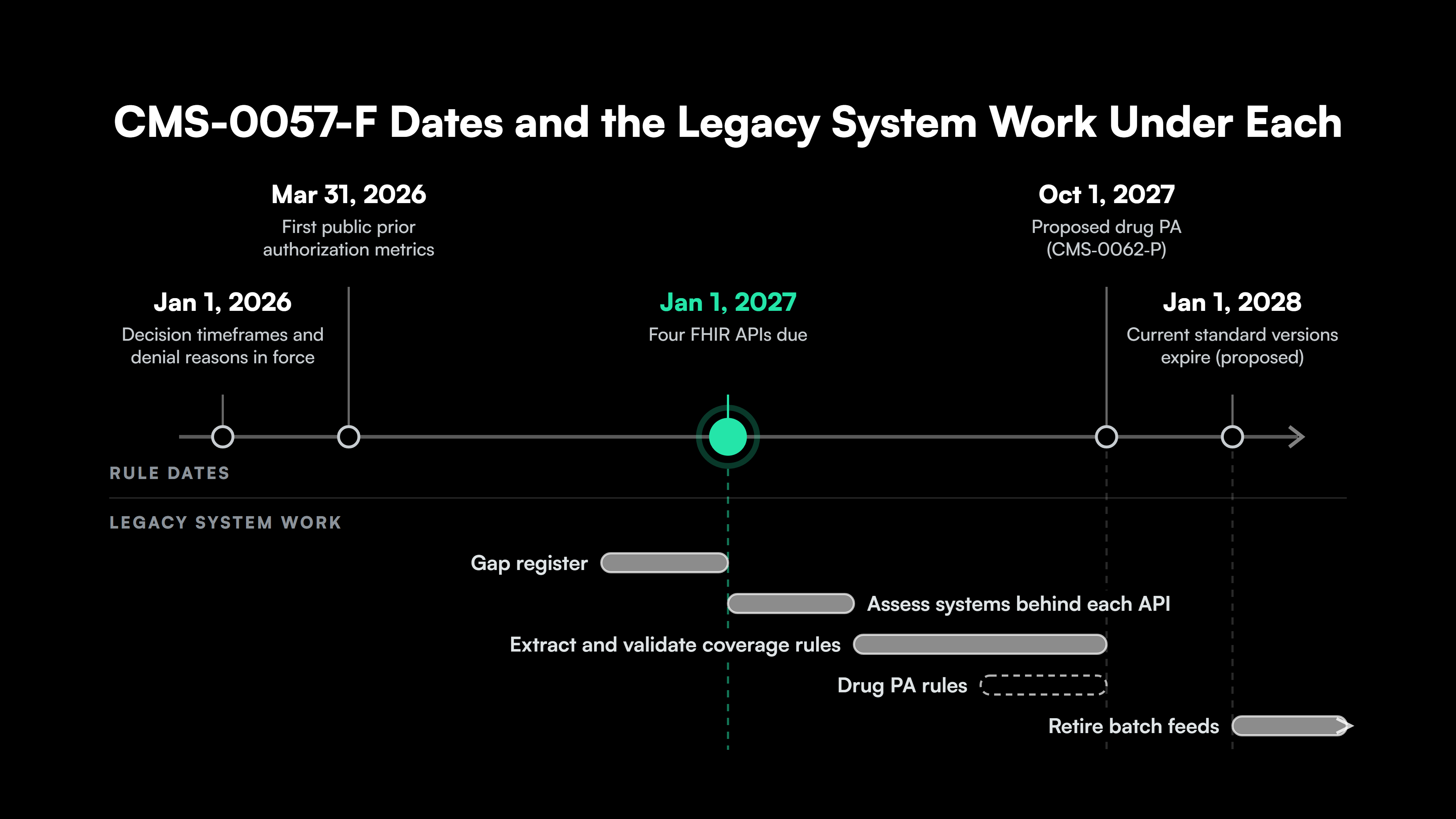
The gap register is the most useful artifact in a CMS-0057-F compliance plan. It turns each compromise made to hit the deadline into a dated item tied to a specific application.
Modernizing Legacy Payer Systems for CMS-0057-F With Legacyleap
A CMS-0057-F gap register points to work inside specific applications. Typical entries are a UM system whose coverage rules nobody has documented, a claims platform that feeds the APIs through batch, and a retired platform holding part of the five-year history. Legacyleap runs that work as a Gen AI modernization platform in which specialized agents handle each stage of the lifecycle, from assessment to deployment, with engineers approving every change.
Five Legacyleap agents map to the steps of a CMS-0057-F compliance plan:
- Assessment Agent: Produces dependency maps, risk indicators and effort estimates across the claims, UM and benefits applications behind each API, in 2-5 days per application.
- Documentation Agent: Reconstructs data flows, integration maps and business logic from the code, including the coverage rules spread across .NET or Java code and database procedures.
- Recommendation Agent: Turns the gap register into ordered migration phases, with a refactor, replace or retain decision and an effort and risk score for each module.
- Modernization Agent: Transforms the modules that hold those rules and feeds, delivered as diff-based pull requests that engineers review before anything merges. About 70% of the transformation is automated, and human review governs the rest.
- QA Agent: Generates regression and parity tests, 70-80% of them automatically, to prove a rebuilt coverage rule returns the same decision as the legacy application.
Parity validation shows a compliance lead whether a rebuilt coverage rule approves and denies the same requests, with the same reasons, as the legacy application. Copilots and IDE assistants generate code one file at a time and leave that proof to the team. Legacyleap builds that proof into the modernization program.
Legacyleap runs inside the payer’s own environment, so no source code or protected health information leaves it. Payers can engage it through Turnkey Modernization Services or Platform Licensing. Legacyleap’s legacy application modernization approach takes the claims, UM and benefits applications behind CMS-0057-F through assessment, comprehension, modernization, validation and phased deployment.
Next Steps for Payers Running Legacy Systems
Payers have six weeks until January 1, 2027, and that time goes to shipping the FHIR layer and recording its gaps. The CMS-0057-F work after that date sits in the claims, UM and benefits applications behind the APIs, and CMS-0062-P would add drugs to it by October 1, 2027.
The $0 Security Assessment maps the security findings in those applications to exact code locations, with a fix approach for each. It takes 3 to 5 days, costs nothing and runs inside your environment. To see how the agents extract and validate business rules, book a Technical Demo.
FAQs
No, unless the plan is one of the five impacted payer types. CMS-0062-P proposes extending the interoperability requirements to small group QHP issuers on the FF-SHOPs for plan years beginning on or after January 1, 2028.
CMS lists them as recommended. The required standards are FHIR R4.0.1, US Core and SMART App Launch. CMS-0062-P proposes adopting FHIR and certain Da Vinci guides as HIPAA standards for prior authorization transactions.
CMS’s Compliance and Enforcement FAQ states that each CMS program oversees compliance under its existing authorities and can choose from a range of enforcement actions. Patients and providers can file complaints with the program that covers them.
Since February 28, 2024, CMS’s National Standards Group has exercised enforcement discretion for covered entities that run a FHIR-based Prior Authorization API without the X12 278 standard.
MIPS eligible clinicians attest to at least one electronic prior authorization through a Prior Authorization API during the CY 2027 performance period. Hospitals and critical access hospitals attest for the CY 2027 EHR reporting period.
References
- CAQH, “CAQH Index 2025 FHIR Report.”
- Centers for Medicare & Medicaid Services, “CMS Interoperability and Prior Authorization Final Rule CMS-0057-F.”
- Centers for Medicare & Medicaid Services, “CMS Interoperability and Prior Authorization Final Rule (CMS-0057-F).”
- Centers for Medicare & Medicaid Services, “Prior Authorization API Workflow (CMS-0057-F).”
- AHIP, “Health Plans Take Action to Simplify Prior Authorization.”
- Federal Register, “Interoperability Standards and Prior Authorization for Drugs (CMS-0062-P).”
- Centers for Medicare & Medicaid Services, “Compliance and Enforcement.”