TL;DR
- Claude Code is a genuinely strong agentic coding assistant, and it still rebuilds its understanding of a codebase every session. Anthropic’s own documentation says its context window fills up fast and performance degrades as it does, sometimes forgetting earlier instructions.
- Past roughly 30,000 lines in a single session, holding a useful mental map of the codebase gets hard. Every fresh Claude Code session starts rebuilding that map from file reads rather than picking up where the last one left off.
- A major US airline’s flight-operations app had 2,588 COM references, 195 Win32 API calls, and zero documentation or tests. Legacyleap re-platformed it to React and .NET Core and made it audit-ready in 8 weeks, with zero critical security issues post-transformation.
- Enterprise-scale Claude Code usage can run from the low five figures to over $100,000 a month. That cost tracks re-explanation overhead more than headcount, since re-briefing architecture from scratch every session adds up as codebase size grows.
- The two aren’t rivals, Legacyleap already runs inside Claude Code’s own CLI today in customer pilots. Developers keep the same commands while Legacyleap’s persistent graph, parity validation, and test generation run as the modernization layer underneath.
A lot of people land on “Claude Code alternative” expecting a straight swap, a different agentic coding tool to install instead. That’s a fair search for most use cases. It’s the wrong search for one specific job, modernizing a large, undocumented, business-critical legacy estate.
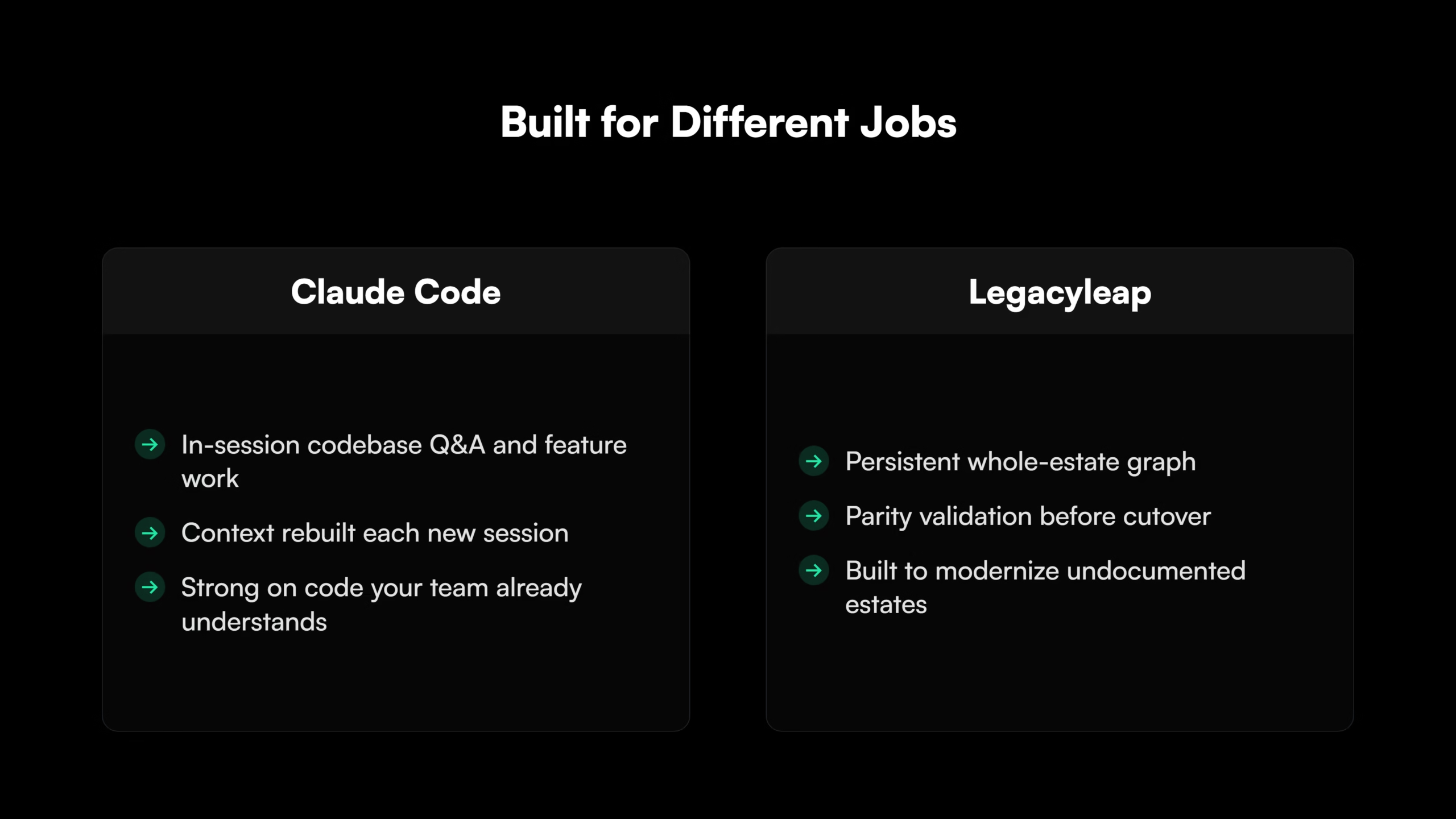
Claude Code is genuinely strong at codebase Q&A, day-to-day feature work, and ad-hoc refactors, inside a session, on a codebase a developer already points it at. It has no built-in mechanism for org-level dependency mapping, functional parity validation against a legacy baseline, or persistent architectural memory that survives past a single session. Those are exactly what Legacyleap runs on.
Used together, both jobs get done.
Claude Code: What It Does Well
Claude Code is a genuinely strong agentic coding assistant, worth saying plainly and without a hedge. Anthropic built a tool developers actually reach for, not just tolerate, and that reputation is earned, not marketed.
Where it shines, in an active session on a codebase a developer already has open:
- Codebase exploration and Q&A. Ask it to explain an unfamiliar module or trace a bug across a few files, and it answers like a strong, fast pair programmer.
- Day-to-day feature work. Writing, refactoring, debugging, and scaffolding tests inside a repo it already knows is its primary use case, and by most accounts it does that well.
- A familiar, low-friction developer experience. Same CLI, same commands, same loop a team already knows, nothing new to learn to get value from it right away.
- Real enterprise-grade safety controls. Permission-based execution that defaults to read-only, a sandboxed bash tool, SOC 2 Type 2 reporting, and ISO 27001 certification. Legitimate controls, not an afterthought.
The adoption numbers back this up. Among developers who regularly use AI coding agents, a majority reach for Claude Code specifically, and independent developer surveys consistently rate it one of the most-loved tools available [1]. That’s the honest starting point for the rest of this piece.
Where Claude Code Reaches Its Limit
The limit shows up at a different scale, not a different quality bar. Anthropic’s own best-practices documentation says its context window fills up fast, and performance degrades as it fills, sometimes to the point that Claude starts forgetting earlier instructions [2].
Past roughly 30,000 lines in a single session, the useful mental map of a codebase gets harder to hold. Every fresh session starts rebuilding it from file reads rather than picking up where the last one left off.
That’s a scope difference, not a defect. A codebase nobody has fully documented, running business logic nobody currently on staff wrote, needs something built to hold the whole estate permanently, across sessions, not rebuild its understanding every time. That’s where Legacyleap starts.


What Legacyleap Brings to the Modernization Landscape
Gartner recognized Mechanical Orchard, a modernization-specific platform, as a 2025 Cool Vendor in AI Code Assistants, distinct from general-purpose coding assistants [3]. Independently funded competitors are drawing the same line. Legacyleap is built the same way: to comprehend, govern, and validate a legacy estate, not just to write good code inside a session.
| Category | Claude Code | Legacyleap |
| Source code context | Built fresh each session, from file reads and tool calls | Persistent Multi-Layer Meta-Cognitive Graph, structural and semantic, updated incrementally |
| Day-to-day feature work | Primary use case, strong | Not the focus, a program-level tool |
| Architectural decomposition | Possible with direction, no built-in framework | First-class, defines modules and target-state architecture |
| Functional parity validation | Not a built-in workflow | First-class, validated against the legacy baseline before cutover |
| Test generation at scale | Generates tests when asked, file by file | Generates full E2E, integration, API, and unit suites as part of the modernization output |
| Org-level repo mapping | Not a built-in capability | Complete map across repos, APIs, events, and shared libraries |
Legacyleap’s Five Agents, Mapped to the Modernization Lifecycle
A modernization program runs through five distinct jobs:
- Assess the estate’s risk and dependencies
- Comprehend what the system actually does
- Modernize the code against a target architecture
- Validate that behavior didn’t change
- Deploy with a rollback plan intact
Legacyleap runs a dedicated agent against each one.
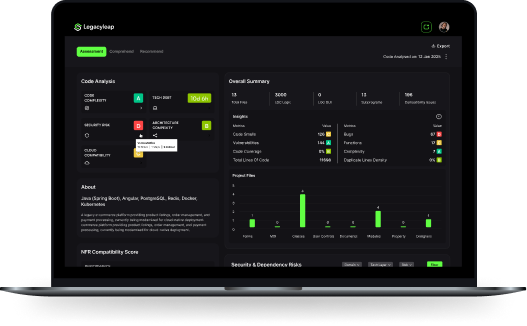
- The Assessment Agent produces the technical debt report, dependency map, and risk indicators.
- The Documentation Agent reconstructs architecture, data flows, and business logic, including for systems with no existing documentation.
- The Recommendation Agent decides what to refactor, replace, or retain, and sequences the migration.
- The Modernization Agent generates the actual pull requests.
- The QA Agent generates and runs the parity tests.
A general-purpose coding assistant can be directed to do pieces of any one of these. It isn’t structured around owning all five, in sequence, with the outputs of one feeding the next automatically. That’s the difference between a tool a developer directs, and a companion platform built for the full modernization journey, five agents deep, not one.
Legacyleap’s Graph vs. Claude Code’s Per-Session Context
Legacyleap’s Multi-Layer Meta-Cognitive Graph holds a persistent structural and semantic model of the entire codebase, architecture, modules, dependencies, call graphs, business domains, built once and updated incrementally, not rebuilt from file reads every session. It’s proven at over 10 million lines of code across sharded, task-based agent orchestration, well past the point where a single session’s working memory starts to strain.
This isn’t a knock on Claude Code’s context window design. The graph and the window solve different problems, at different scales, and an enterprise estate in the tens of millions of lines needs the graph regardless of how good the window gets.
Diff-Based Review and Parity Validation, Built In
Every change Legacyleap’s Modernization Agent produces ships as a diff-based pull request for human review. Nothing merges, deploys, or executes on its own.
Before cutover, the QA Agent validates the modernized code against the legacy baseline through auto-generated unit, integration, regression, and end-to-end tests, targeting full functional parity between old and new behavior. That discipline runs on a governed gateway with guardrails and human-in-the-loop checkpoints, enforced on every run, not a policy on paper.
That matters more than it might sound. US banking regulators flagged generative AI and AI coding tools as novel in 2026, with model-risk guidance for them still unsettled [4]. Provable review and parity checking aren’t optional in that environment. Legacyleap makes them the default, on every change, not a step a team has to remember to add.
Legacyleap Runs Inside Claude Code Today
The choice isn’t binary. Legacyleap’s graph, agents, parity validation, and test generation already run inside Claude Code today, in pilot with customers. Developers keep the CLI they already use, the same commands, the same loop. Legacyleap shows up as the modernization layer inside that same session, backed by an estate-wide graph running on the customer’s own infrastructure.
Source code never leaves that environment, even while a developer is interacting through Claude Code. There’s no new tool to roll out, no new seats to provision, no parallel workflow competing for a developer’s attention. Procurement is additive, not a replacement decision.
A major US airline’s audit-flagged flight-operations application, 2,588 COM references, 195 Win32 API calls, zero documentation, zero tests, was re-platformed to React and .NET Core and made audit-ready in 8 weeks, with zero critical security issues post-transformation and 50% lower cost than the traditional estimate.
| Stage | Claude Code’s role | Legacyleap’s role |
| Discover | Answers developer-level questions about specific files and modules | Maps the org-level repo graph, architecture, domains, and dependencies |
| Plan | Helps engineers prototype and reason about specific design decisions | Defines target-state architecture and modernization layers |
| Modernize | Handles edge cases, custom refactors, and one-off scripts alongside the program | Drives spec-driven, incremental transpilation with parity validation and test generation |
| Validate & Operate | Becomes the developers’ day-to-day tool on the modernized codebase | Validates against golden artifacts and ties specs back to code |
How to Split the Work Between Claude Code and Legacyleap
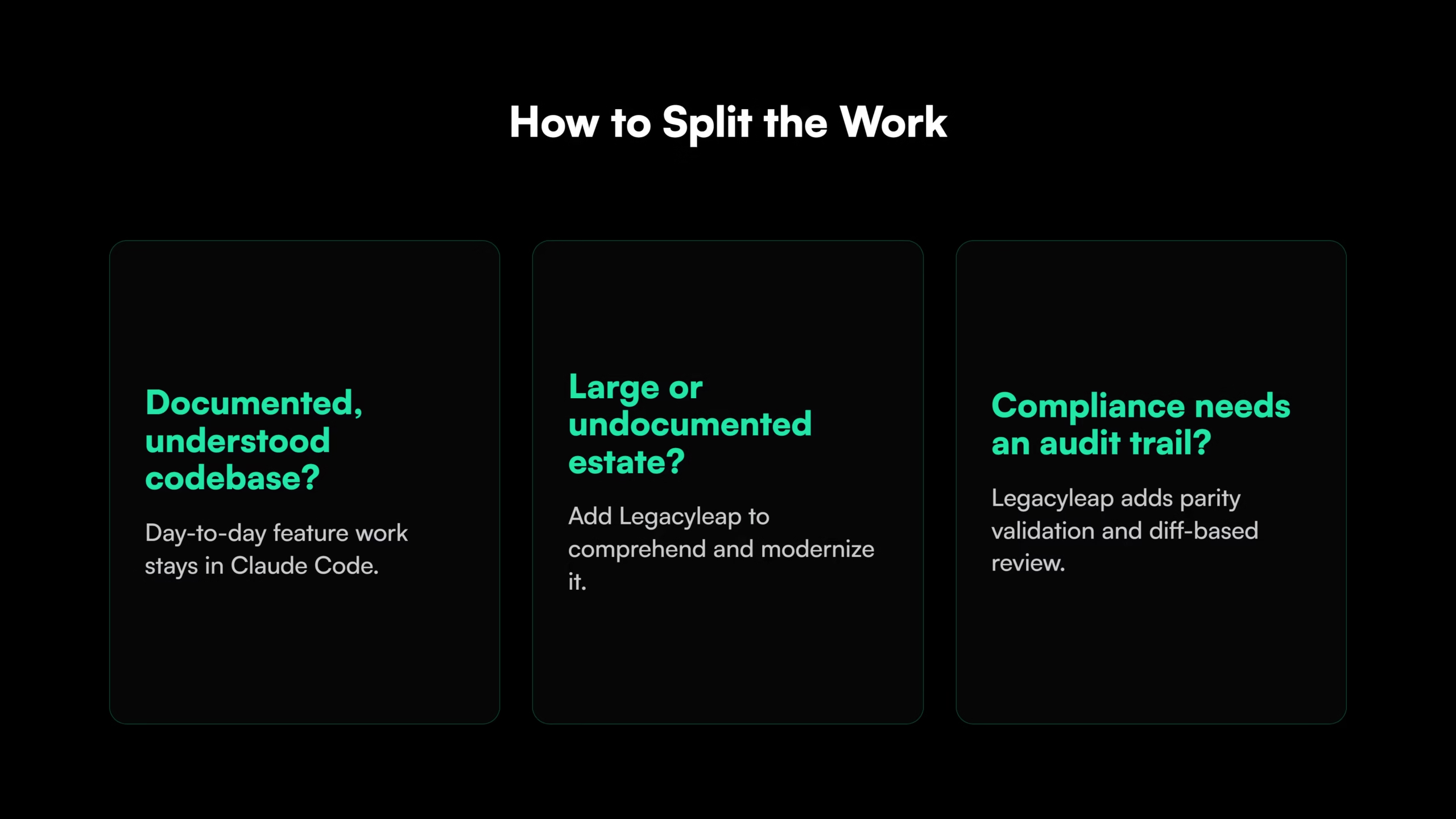
Here’s a practical way to sort it. Day-to-day feature development, on a codebase your team already understands, with tests and documentation in reasonable shape, is squarely Claude Code’s lane. Adding Legacyleap on top of that work would be overhead nobody needs.
Assessing, documenting, or modernizing a large, undocumented, or polyglot estate, where functional parity and an audit trail actually matter to the outcome, is where Legacyleap earns its place. It runs in the same harness rather than a separate one.
Cost belongs in this decision from the start. Token cost compounds with codebase size and session count, and re-explaining architecture from scratch every session adds up fast. Industry cost analyses put enterprise-scale Claude Code usage anywhere from the low five figures to over $100,000 a month, depending on team size and usage patterns [5].
Legacyleap’s persistent, cached understanding of the codebase doesn’t re-accumulate that cost every time a new session starts, and that’s a meaningful, practical reason it exists as a separate layer.
Use Claude Code and Legacyleap Together
The honest answer to “Claude Code alternative,” for enterprise legacy modernization specifically, was never a different CLI. Claude Code does its job well. The gap shows up at a different scale, on a different kind of system. Closing it takes Legacyleap, built for that job specifically, not a bigger context window or a longer prompt.
Legacyleap already runs inside Claude Code today. Developers keep the tool they already use. The modernization program runs around them, on infrastructure they already control.
Start with a $0 Modernization Assessment to see exactly where the gap sits on your own codebase, or book a Technical Demo to see Legacyleap’s agents running inside the harness your team already uses.
FAQs
Yes, but only for the parts of the job that fit inside a session. It gets pointed at legacy code more often than people expect, and the gap only shows up once a codebase gets too large or too undocumented for one session to hold the whole picture.
It works, and many teams already work around the limit manually today, splitting a large repo into subsystems and re-briefing Claude Code at the start of each session. That’s real engineering time spent every session, which is exactly the cost a persistent, estate-wide model like Legacyleap removes.
At the platform level, yes, SOC 2 Type 2 and ISO 27001 are real, audited controls. What they don’t cover is change-level evidence, proof that one specific modernization changed nothing it wasn’t supposed to, which regulated teams tend to ask for once code starts moving at real scale.
Industry estimates put it anywhere from the low five figures to over $100,000 a month, and the number tracks re-explanation overhead more closely than headcount. Teams that restructure a codebase into smaller, better-documented modules often see the same tool get cheaper without touching seat count.
Yes, and it already runs inside Claude Code’s own CLI today, so there’s no new tool for a developer to learn. Most teams start by pointing the $0 Modernization Assessment at a single repo before deciding how far to expand it.
References
[1] Gradually.ai, Claude Code Statistics. https://www.gradually.ai/en/claude-code-statistics/
[2] Anthropic, Claude Code Best Practices. https://code.claude.com/docs/en/best-practices
[3] Mechanical Orchard, Named a 2025 Gartner Cool Vendor in AI Code Assistants. https://markets.financialcontent.com/stocks/article/bizwire-2025-6-11-mechanical-orchard-named-a-2025-gartner-cool-vendor-in-ai-code-assistants
[4] Office of the Comptroller of the Currency, Bulletin 2026-13. https://www.occ.treas.gov/news-issuances/bulletins/2026/bulletin-2026-13.html
[5] CloudZero, Claude Code Alternatives (cost analysis). https://www.cloudzero.com/blog/claude-code-alternatives/