Results at a Glance
| Metric | Result |
| Delivery Timeline | 8 weeks to UAT readiness |
| Time Savings | 50% shorter than manual rewrite estimate |
| Cost Savings | 50% reduced delivery cost |
| Automation Rate | 60–65% automated code conversion |
| Compliance | Audit-flagged application remediated before mandatory deadline |
| Test Coverage | From zero to full automated unit and functional test suites |
| Documentation | From zero to complete technical and functional documentation |
Engagement Snapshot
| Industry | Aviation Operations and Compliance |
| Location | North America |
| Application | ETOPS Monitor – Extended-range Twin-engine Operational Performance Standards compliance tracking |
| Legacy Stack | VB6 desktop app, ADO, ActiveX components, COM (2,588 references), Win32 APIs (195 calls) |
| Target Stack | React frontend + .NET Core/LTS backend, cloud-ready with HA/failover |
| Databases | Microsoft SQL Server, Informix, Oracle, Microsoft Access (retained in Phase 1) |
| Scale | 11K LOC, 29 files, 563 subprograms, 67 UI instances, 588 compatibility issues |
| Team | 4-member team |
| Timeline | 8 weeks to UAT readiness |
About the Client
The client is a leading North American airline operating extended-range flight routes that require strict compliance with ETOPS (Extended-range Twin-engine Operational Performance Standards). Their ETOPS Monitor application tracks and validates aircraft operational metrics to meet these regulatory requirements, making it critical for compliance, safety, and operational decision-making.
The application had been audit-flagged as a top-priority remediation item with a mandatory deadline of December 2025. A recent outage had exposed prolonged disaster recovery times and the complete lack of application-tier failover, underscoring the operational risk of remaining on the legacy platform.
Challenge
The ETOPS Monitor faced five compounding constraints under a hard regulatory deadline:
Out-of-Support Technology Under Audit Pressure
The application was built on VB6, a technology no longer supported by Microsoft. Technical debt was growing with every month the system remained on the legacy stack. The audit had flagged it as a top-priority remediation item with a mandatory December 2025 deadline, meaning modernization was not optional and the timeline was not flexible.
No Application-Tier High Availability
A recent outage had exposed the system’s complete lack of application-tier failover. Recovery times were prolonged, and the operational risk was unacceptable for a compliance-critical application supporting extended-range flight operations. Any modernization had to establish HA/failover at the application layer.
Complex Legacy Stack Spanning Four Database Platforms
The VB6 application integrated with four separate database platforms (Microsoft SQL Server, Informix, Oracle, and Microsoft Access) using ActiveX Data Objects (ADO) for data access. The system also relied on COM components for encryption, API communication, and email, plus Win32 API calls across 8 libraries. This diversity of dependencies made the migration surface area significantly larger than a typical VB6 application.
Zero Documentation
No functional or technical documentation existed for the application. The 11K lines of code, 563 subprograms, and 2,588 COM references were entirely undocumented, making knowledge transfer slow and migration planning risky without automated code analysis.
Zero Test Coverage
The application had no automated tests, no structured test plans, and no regression coverage. For a compliance-critical aviation system, this meant that any changes, including modernization, carried unquantifiable risk without first establishing a testing foundation.
How Legacyleap Delivered Audit-Ready Modernization in 8 Weeks
Legacyleap executed the modernization with a 4-member team across three structured phases, delivering UAT readiness in 8 weeks, 50% faster than the 14-16 week manual rewrite estimate.
Phase 1: Assessment and Discovery (Week 1)
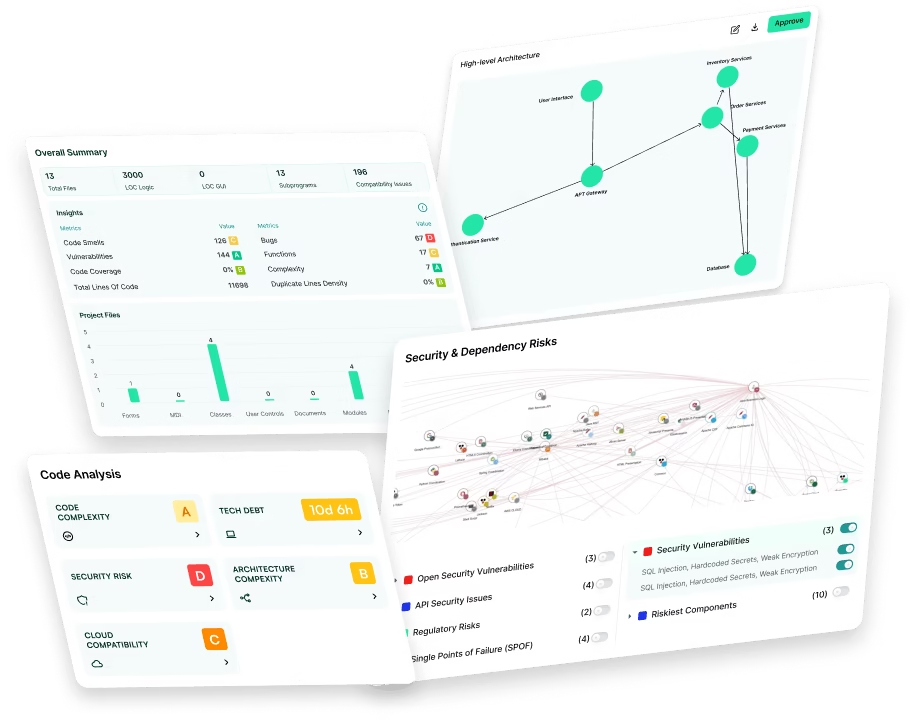
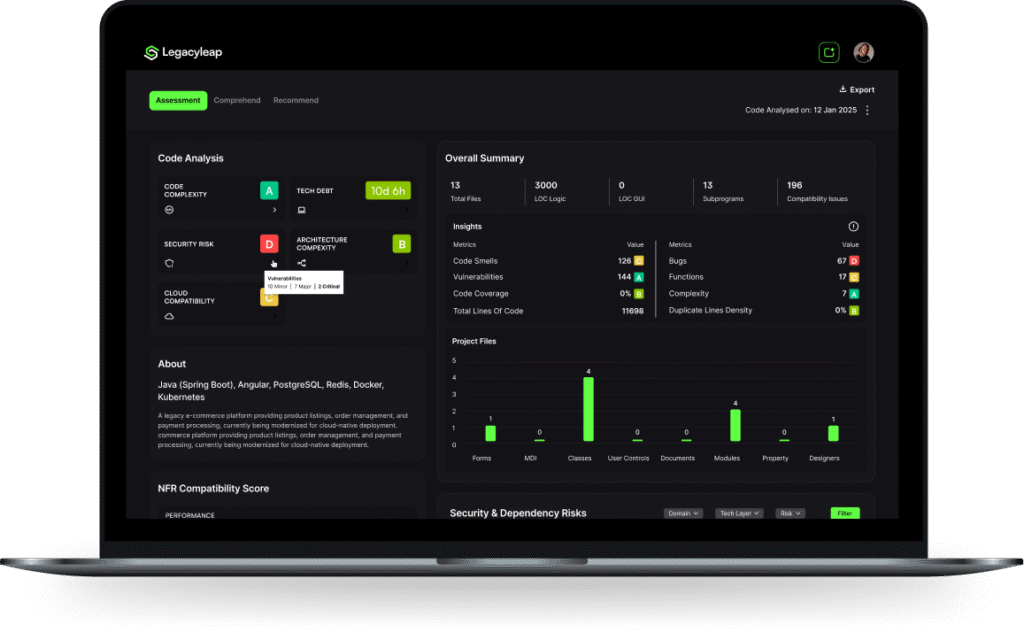
Legacyleap conducted a comprehensive review of the ETOPS Monitor system: analyzing all 29 files, mapping 2,588 COM references and 195 Win32 API calls, scoping user stories, setting up environments, and finalizing the deployment strategy. This phase produced the migration map that informed every subsequent decision, including identifying the 588 language compatibility issues that would need to be addressed during conversion.
Phase 2: Automated Code Conversion (Weeks 2–3)
Legacyleap’s Gen AI platform performed automated VB6 to React + .NET Core/LTS conversion, achieving 60–65% automation across the codebase. The conversion translated VB6 forms into React components, rewired ADO data access patterns to .NET, and replaced ActiveX and COM dependencies with modern equivalents. Iterative passes refined accuracy before handing off to the manual refinement phase.
Phase 3: Manual Refinement, Testing, and Documentation (Weeks 4–7)
The remaining 35-40% of the codebase for complex business logic, edge cases, and integration-specific behavior required manual refinement, as human judgment was paramount. Simultaneously, Legacyleap created what had never existed for this application:
Automated test suites covering unit and functional testing, giving the compliance-critical ETOPS Monitor structured test coverage for the first time. Complete technical and functional documentation, eliminating the documentation gap that had made the legacy system a knowledge-transfer risk. Final release packaging for UAT and production readiness.
What Remained Client-Owned
UAT execution and production deployment were owned by the client. Database-tier HA/failover was scoped for a future phase, and this engagement addressed application-tier HA only. Identity server configuration, role mapping, and environment provisioning (Azure VDI/Citrix access, database connections, Git setup) were handled by the client’s infrastructure team.
Legacyleap vs. Manual Rewrite
| Manual Rewrite | Legacyleap | |
| Team Size | 4–6 members | 4 members |
| Timeline to UAT | 14–16 weeks | 8 weeks |
| Time Savings | Baseline | 50% shorter |
| Cost Savings | Baseline | 50% lower |
| Automation | 0% — fully manual | 60–65% automated conversion |
| Documentation | Created manually (adds weeks) | Generated as part of the engagement |
| Test Coverage | Built manually (adds weeks) | Automated test suites delivered |
Quantified Results
| Metric | Before | After | Validation Method |
| Technology | VB6 — out of support, growing technical debt | React + .NET Core/LTS — modern, supported, cloud-ready | Architecture review |
| Timeline | 14–16 week manual estimate | 8 weeks to UAT readiness | Delivery timeline |
| Cost | Full manual rewrite cost for 4–6 member team | 50% lower with 4-member team | Cost comparison |
| Automation | 0% — no automation capability | 60–65% automated code conversion | Automation coverage audit |
| High Availability | No application-tier HA; prolonged recovery from outages | HA/failover at application layer | Infrastructure review |
| Documentation | Zero — no functional or technical docs | Complete technical and functional documentation | Documentation deliverable |
| Test Coverage | Zero — no automated tests or test plans | Automated unit and functional test suites | Test coverage audit |
| Compliance | Audit-flagged, mandatory Dec 2025 deadline | Remediated and UAT-ready before deadline | Compliance review |
| COM Dependencies | 2,588 references to external COM components | Eliminated — replaced with modern equivalents | Dependency audit |
| Win32 APIs | 195 calls across 8 libraries | Replaced with .NET equivalents | Migration completion report |
Delivered Artifacts
- Modernized React + .NET Core/LTS ETOPS Monitor application
- Target architecture documentation
- Complete functional and technical documentation
- Automated unit and functional test suites
- Final release package for UAT and production readiness