TL;DR
- Four extraction strategies exist for a legacy Angular monolith, and picking the wrong one is the real risk. Microfrontend extraction, a hybrid frontend, a backend-first rebuild, and shadow deployment each fit a different team topology and release cadence.
- Native Federation is the modern default for a new Angular microfrontend extraction. Angular’s build tooling moved to esbuild in version 17, and Module Federation, a webpack plugin, has no native path on that toolchain.
- Shared dependency versioning and zoneless change detection are the two technical failure points most guides skip. Both determine whether federated modules stay in sync with the shell or drift apart in production.
- Each extraction strategy carries its own timeline and risk profile. A microfrontend extraction and a backend-first rebuild carry different cost profiles and different failure modes.
- Functional parity has to be proven before cutover. Verifying that an extracted module behaves identically to the legacy code it replaces is the step most guidance skips entirely.
Angular microfrontend modernization gets treated as a single topic when it is really two questions stacked on top of each other.
The first is architectural. How an Angular micro frontend gets built, with Module Federation or Native Federation, host apps, remote apps, shared libraries.
The second is a modernization question. How a legacy Angular monolith gets extracted into that architecture incrementally, without a rewrite.
Published guidance for the first question is strong. Guidance for the second is thin.
This piece leads with the second question. Extraction strategy, sequencing, and risk come first. Federation mechanics come second, and point to a dedicated implementation guide rather than repeating it here.
The Different Modernization Strategies for a Legacy Angular Monolith, and How to Choose
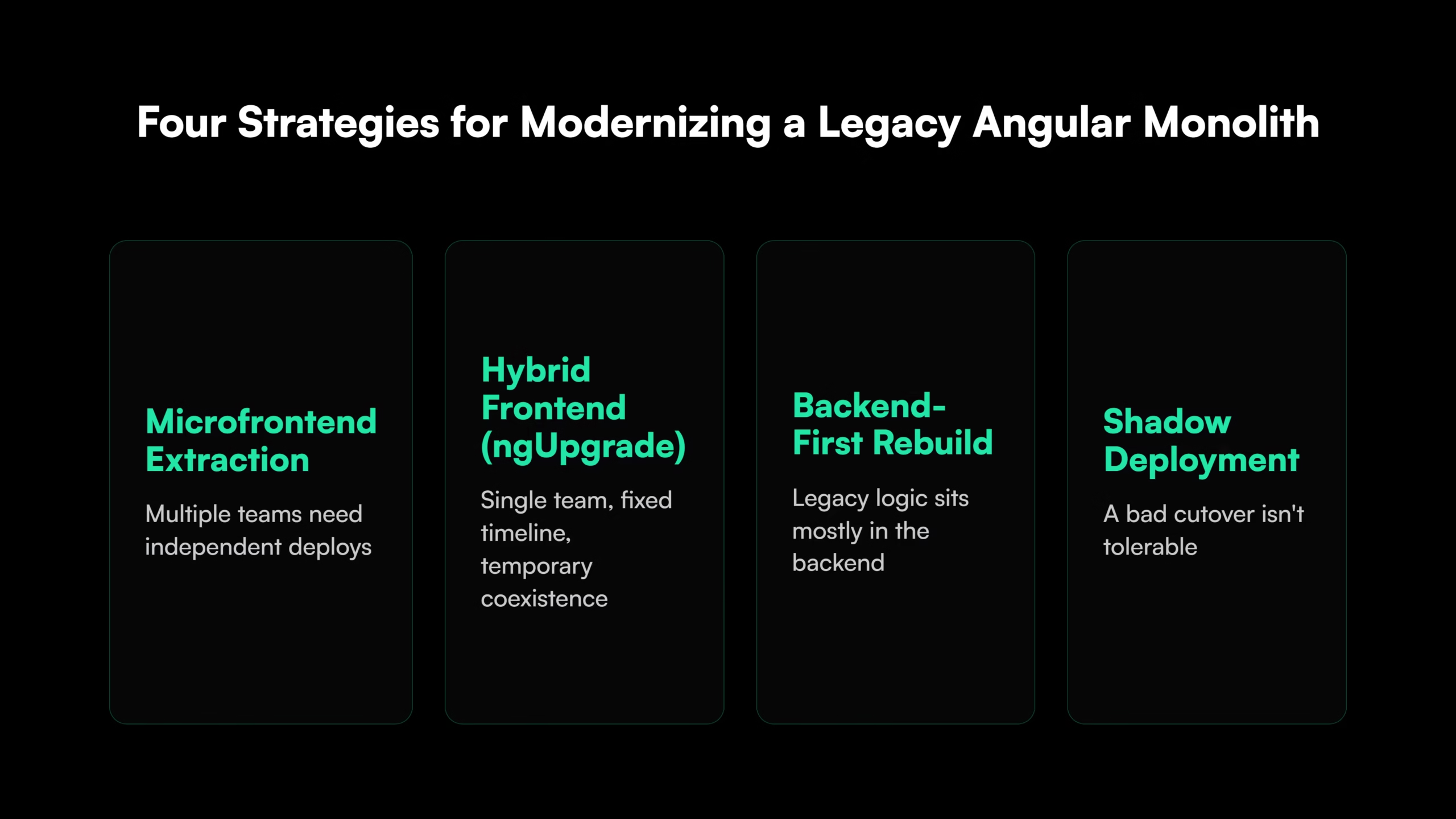
Four strategies exist for modernizing a legacy Angular monolith. Microfrontend extraction splits the application into independently deployable remotes. It’s the strangler pattern applied to a frontend monolith, extracting and cutting over one module at a time while the rest of the system keeps running.
A hybrid frontend, built on ngUpgrade, runs the old and new framework together temporarily. A backend-first rebuild anchors the work on a new API layer first.
A shadow deployment runs a new frontend alongside the old one before cutover.
The right choice depends on four factors: team topology, release cadence, risk tolerance, and existing test coverage.
A single team with a slow release cadence and strong test coverage rarely needs the operational overhead of a full microfrontend split. A multi-team organization shipping weekly, with weak test coverage and a monolith actively blocking release velocity, usually does.
The table below scores each strategy against those four factors.
| Strategy | Best Fit When | Release Cadence Impact | Risk Profile |
| Microfrontend extraction | Multiple teams need independent deploys; the monolith blocks release velocity | Enables independent release cycles per team | Moderate. Shared-dependency governance becomes the main risk surface |
| Hybrid frontend (ngUpgrade) | Single team, fixed timeline, willing to run AngularJS and Angular side by side temporarily | Minimal disruption to current cadence | Lower short-term, but extends the migration’s overall timeline |
| Backend-first (BFF-led) rebuild | Legacy business logic sits mostly in the backend; the frontend is the smaller problem | Frontend cadence unaffected until the new API stabilizes | Concentrated in the API layer; frontend risk stays low |
| Shadow deployment | High-traffic applications where a bad cutover isn’t tolerable | No cadence change until traffic starts shifting | Lowest cutover risk; highest infrastructure cost to run two systems in parallel |
Existing test coverage changes the calculus more than any single architectural choice. A monolith with strong test coverage can absorb a microfrontend extraction with reasonable confidence that regressions surface quickly.
A monolith with little or no coverage, the more common case in a system old enough to need this conversation, needs test coverage built alongside the extraction itself. That dependency, more than the choice between Module Federation and Native Federation, is usually the real reason a migration stalls.
A microfrontend extraction and a hybrid frontend migration get confused often, and they solve different problems. A microfrontend split creates genuinely independent deployable units, each with its own build and release pipeline.
A hybrid frontend, built on ngUpgrade, runs AngularJS and Angular in the same application at the same time, so a team can migrate component by component without a full rewrite or a hard cutover. The hybrid approach is usually the right call for a single team on a fixed timeline. The microfrontend approach is usually the right call once multiple teams need to stop blocking each other.
The keyword itself blurs two separate questions worth pulling apart. An architecture question asks how an Angular micro frontend gets built. A modernization question asks how an existing, working, revenue-generating monolith gets extracted into that architecture without stopping the business along the way.
Published guidance answers the architecture question well. Sequencing, which modules get extracted first, in what order, against what test coverage, is what answers the modernization question, and it is the part a team has to get right.
That sequencing logic is the same one behind incremental, continuous approaches to legacy modernization generally: governance and sequencing decide the outcome more than the specific federation technology chosen.
Start a $0 Modernization Assessment
A $0 Modernization Assessment scores your specific Angular monolith against these same four factors, team topology, release cadence, risk tolerance, and test coverage, and returns a migration plan built for your system rather than a generic framework, at no cost and from inside your own environment.
What Is the Modern Default for Angular Microfrontends?
How an Angular micro frontend’s host application wires to its remote modules is a separate, deeper question than which federation approach to start with. Those configuration steps are covered in full in a dedicated guide to Module Federation implementation. This section covers the decision itself, plus the Angular-specific mechanics other guides skip.
Angular’s build tooling moved to esbuild as the default starting in version 17 [1]. Teams that have made the switch report build-time improvements of roughly three to four times over the previous webpack-based pipeline [2]. Module Federation is a webpack plugin.
It has no native path on a build tool that isn’t webpack, which leaves every new Module Federation setup either pinned to webpack directly or working around esbuild instead of with it.
A monolith still running Angular 12 through 15 predates this shift entirely. It was likely built on Module Federation already, since Native Federation’s standalone-components model only became the default path in version 17.
Native Federation was built by Angular Architects, the same consultancy behind Angular’s original webpack-based Module Federation tooling, specifically to close that gap [3]. Instead of wiring federation into the bundler, it operates around the bundler, using browser-native ECMAScript modules and import maps to resolve remote code at runtime.
That makes it bundler-agnostic, and it gives it a direct line to standalone components, which expose routes for federation without an NgModule wrapper around them.
| Factor | Webpack Module Federation | Native Federation |
| Bundler dependency | Webpack only | Bundler-agnostic; works with esbuild, Vite, or Webpack |
| Build performance | Inherits webpack’s build profile | Faster. One enterprise team reported cold builds falling from roughly 45 seconds to under 10 seconds after switching [4] |
| Angular alignment | Predates standalone components and esbuild | Built for standalone components’ route-based exposure model |
| When it’s still the right call | Existing investment already on webpack, where migration cost outweighs the gain | New extractions, or any project already moving to esbuild |
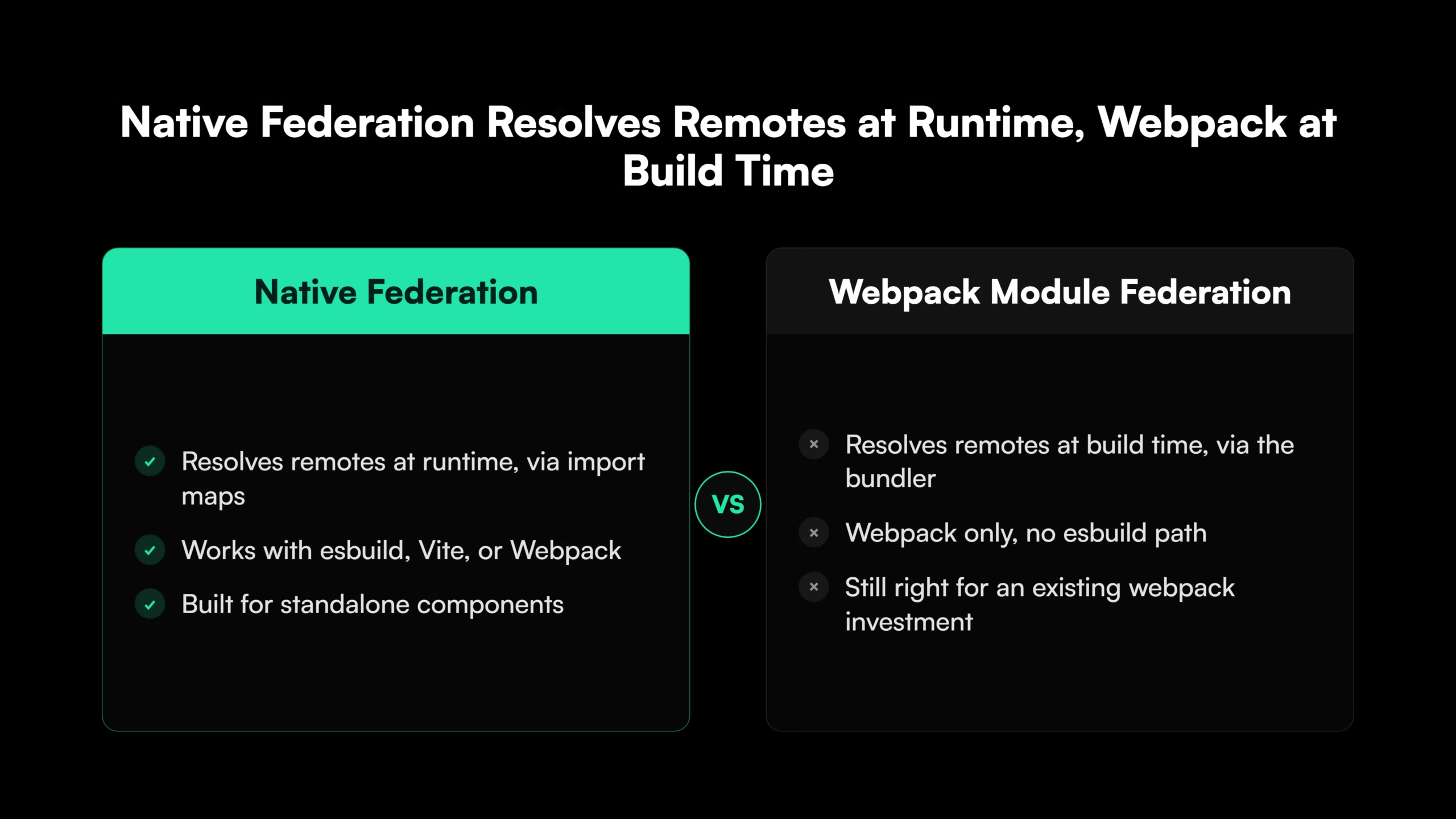
A federation boundary gets exercised every time a route loads, well beyond its initial configuration. A remote’s routes are typically lazy-loaded from the shell through a dynamic import mapped to a path, which means the federation boundary and the routing boundary are usually the same boundary.
Extraction sequencing, which module becomes the first remote, tends to follow the application’s existing route structure more closely than its internal folder structure. A route that already loads independently is usually the easiest one to federate first.
How Does Dependency Injection Work Across Federated Angular Modules?
Angular’s dependency injection system does not automatically understand federation boundaries. A service registered as a singleton in the shell, and the same service registered the same way inside a remote, are not automatically the same instance.
The injection scope has to be deliberately shared across the boundary for that to hold. Getting this wrong does not throw an obvious error. It produces duplicate state, two separate instances of what was meant to be one shared service, silently.
Any service that needs to stay singleton across the shell and every remote has to be provided at the root injector explicitly, as a decision made deliberately before extraction begins.
How Do You Manage Shared Dependency Versioning Across Angular Microfrontends?
The standard pattern locks core Angular packages, @angular/core, @angular/common, @angular/router, as singletons with strict version matching between the shell and every remote. That prevents silent drift, where a remote quietly ships against a different Angular version than the shell expects.
It also means a version mismatch fails hard at runtime instead of degrading gracefully, which turns the version policy into a governance decision rather than a one-time configuration flag. Every team deploying a remote independently needs to know that policy in advance, before a production incident makes it obvious the hard way.
What Does Zoneless Change Detection Change About Federation Boundaries?
Zoneless change detection reached stable status in Angular version 20.2, removing the dependency on Zone.js for triggering change detection [1]. In a federated application, the shell and every remote need a consistent change-detection strategy.
A remote still running zone-based change detection inside a zoneless shell, or the reverse, does not fail immediately. It produces inconsistent update behavior at the boundary between them that is difficult to diagnose after the fact, since nothing in the build or the console flags it as an error.
Deciding the change-detection strategy at the shell level, before extracting the first remote, avoids the problem instead of debugging it later.
What Does an Angular Microfrontend Migration Cost in Time and Risk?
Timeline ranges vary by strategy more than by codebase size alone. A microfrontend extraction sequenced module by module, the pattern this piece recommends over a big-bang split, typically moves in phases measured in weeks per module rather than months for the entire system at once.
A backend-first rebuild runs on the timeline of the new API layer, often the longer path since business logic has to be untangled before frontend work can start in earnest. A shadow deployment adds real infrastructure cost for as long as both systems run in parallel, a cost decision as much as a timeline one.
A monolith still on Angular 12 through 15 adds one more variable: whether to bundle a version upgrade into the same project or extract first and upgrade each remote after. Extracting first usually keeps the two efforts from blocking each other.
Published case data from comparable Angular modernization work gives a directional sense of what’s achievable. Continental Automotive’s engagement reports a roughly 40 percent reduction in development time from a gradual microfrontend approach [5].
Siemens Healthineers’ engagement, combining Angular with an Nx monorepo, reports a time-to-market improvement described only as “several dozen percent,” not a precise figure [5]. Both are third-party results, useful mainly as a directional sense of scale rather than a number to build a budget around. Neither reflects Legacyleap’s own data.
| Risk | What Causes It | What It Looks Like in Production |
| Bundle bloat | Shared dependencies not locked to a single version across shell and remotes | Duplicate copies of the same library shipped to the browser; slower load times that are hard to trace back to their source |
| Cross-team contract drift | Independent teams changing a shared route or API contract without coordinating the change | A remote breaks in production after a shell deploy that looked unrelated |
| Governance gaps | No documented versioning or ownership policy in place before extraction begins | Problems that don’t surface until multiple teams are deploying remotes independently, well after the first module shipped cleanly |
None of these risks show up during a single team’s first extraction. They surface once a second and third team start deploying remotes independently, which is exactly when they are hardest to unwind. Each has a mitigation that costs little to put in place early:
- A written version-locking policy in place before the second team starts.
- A contract-testing step on any route or API a remote shares with the shell.
- A single owner accountable for the shared dependency graph, rather than whichever team touched it most recently.
All three are governance decisions, which is why they get skipped as often as they do.
Start a $0 Modernization Assessment
A $0 Modernization Assessment maps the actual dependency graph and test coverage of your Angular monolith before extraction begins, replacing directional timeline ranges with a plan sized to your system, at no cost and from inside your own environment.
How Does AI Help Validate Functional Parity Before a Microfrontend Cutover?
The traffic-routing mechanics behind an incremental cutover, feature flags, gradually shifting traffic from the legacy module to the new one, monitoring during the transition, are the well-solved part of this problem.
The harder, mostly unaddressed question is how a team knows, before shifting any traffic, that the new module behaves identically to the one it replaces.
Behavioral parity is a different claim than functional completeness. A rewritten module can implement every documented feature and still diverge from the legacy system’s actual behavior at the edges.
How it handles a malformed input, an empty state, a timing-dependent interaction the original developers never documented because they never thought of it as a feature worth writing down, are exactly the places that diverge.
Differential testing against the legacy baseline catches gaps like these. The method itself is well documented as a general discipline. Run the same input against both the legacy module and the new one, then treat any behavioral difference as evidence to investigate rather than proof of a bug on either side [6].
What’s usually missing is a team applying that discipline specifically at the boundary being extracted, rather than treating a microfrontend cutover as a deploy-and-monitor exercise. A functional smoke test of the new module in isolation catches neither kind of gap.
Where AI helps is comprehension speed: reconstructing what an undocumented legacy module does, and generating a larger set of regression and parity test cases faster than a team could write them by hand.
AI can help identify the smallest behavioral difference between two versions once a difference is found. It should not be the one deciding which behavior is correct. That judgment call stays with the engineers who own the module.
The mechanics of using GenAI specifically to accelerate an AngularJS-to-Angular migration, comprehension, code generation, and validation working together, are covered in a dedicated look at GenAI-assisted AngularJS modernization. The parity-validation discipline above applies whether or not GenAI tooling is involved in the extraction itself.
How Does Legacyleap Modernize a Legacy Angular Monolith Into Microfrontends?
Legacyleap is a Gen AI-powered legacy application modernization platform built on multi-agent orchestration, running the full Assess, Comprehend, Modernize, Validate, and Deploy lifecycle through five specialized agents rather than a single tool. Applied to an Angular monolith headed toward a microfrontend architecture, all five agents map directly onto the hardest parts of this migration.
The Assessment Agent and the Recommendation Agent handle the decision this piece opens with. They score the monolith’s actual dependency structure and risk indicators.
The output is an ordered migration plan: which modules extract first, in what sequence, against what effort and risk estimate, rather than a team applying the four-factor framework above by hand.
The Documentation Agent reconstructs architecture, module boundaries, and data flow directly from the legacy codebase, producing the system inventory and dependency map that most legacy Angular applications never had documented in the first place. That output is what makes the sequencing decision something a team can apply to its own system, instead of a framework it has to guess its way through.
The Modernization Agent executes the extraction itself: diff-based, human-reviewed pull requests that convert legacy modules into federated remotes, with humans retaining authority over architecture and release decisions at every step. Nothing merges or deploys without review.
The QA Agent is the direct answer to the previous section’s whitespace. It auto-generates unit, integration, and regression test cases and runs differential checks between the legacy baseline and the modernized module, producing a parity validation report before cutover instead of after.
All of it runs entirely inside the client’s own environment. No source code leaves the customer’s infrastructure.
The starting point is the $0 Modernization Assessment: a technical debt report, dependency map, and modernization plan for the specific Angular monolith in question, delivered in two to five days at no cost. It replaces the directional timeline ranges from the earlier section with numbers specific to the system being migrated.
What Decides Whether an Angular Microfrontend Migration Succeeds?
Native Federation is the right default for a new Angular micro frontend extraction today, and that architecture choice matters. It matters less, though, than two decisions made earlier, before any federation config gets written.
Which of the four strategies fits the team’s topology, release cadence, risk tolerance, and test coverage is the first. Whether the organization commits to proving functional parity before cutover, instead of discovering gaps after, is the second.
Both of those are governance and methodology questions before they are technology questions. Getting them right is what separates a migration that ships cleanly, module by module, from one that stalls somewhere in the middle with two systems to maintain and neither one finished.
Ready for a Plan Sized to Your System?
A $0 Modernization Assessment maps the dependency graph, test coverage, and extraction risk of your specific Angular monolith before you commit to a strategy, at no cost and from inside your own environment.
Book a Technical Demo
See how Legacyleap’s agents handle whole-estate comprehension and parity validation on a codebase like yours.
FAQs
Full decoupling isn’t required for the migration to have succeeded. A monolith with its highest-traffic or most-blocking modules extracted, and the rest left on a stable maintenance footing, is a legitimate end state.
Yes, for any application already running on it. Module Federation remains the right call for an existing webpack investment, and the two can run side by side during a transition rather than requiring a hard switch.
Not directly. AngularJS has to move to Angular first, since Module Federation and Native Federation are both Angular-specific tooling; a hybrid ngUpgrade phase is the usual bridge between the two.
A tightly compatible version, at minimum. Strict version locking on shared singletons tolerates minor-version differences; a major-version gap between the shell and a remote is where compatibility breaks.
An undocumented module with no reliable owner on the team, more than test coverage or codebase size alone. Nobody can confirm the extraction is complete when nobody can say with confidence what the module was supposed to do in the first place.
Functional testing confirms a feature works as documented. Behavioral parity testing confirms the new module produces the same output as the legacy module for the same input, including the undocumented edge cases nobody wrote down.
References
[1] Angular. Roadmap
[2] ANGULARarchitects. Micro Frontends with Modern Angular, Part 1: Standalone and esbuild
[3] ANGULARarchitects. Announcing Native Federation 1.0
[4] DEV Community. Native Federation vs Webpack Module Federation, Which Should You Choose in 2026?
[5] House of Angular. How to approach legacy-to-Angular frontend modernization step by step?
[6] freeCodeCamp. How to Use Differential Testing During a Legacy Migration