
TL;DR
- AngularJS has been unpatchable since its end-of-life in December 2021, and the unpatched CVEs keep stacking up. Publicly disclosed vulnerabilities like CVE-2024-21490, a high-severity ReDoS flaw, have no patch available, which counts as a material audit finding under HIPAA, SOC 2, PCI DSS, or FedRAMP.
- The migration target isn’t a moving goalpost, it’s a specific release: Angular 21, out November 20, 2025. Angular 21 makes zoneless change detection the default, replaces Karma with Vitest as the standard test runner, and adds native MCP-based AI tooling to the CLI.
- Enterprises choose between two fundamentally different migration paths, not a spectrum of options. Incremental migration via ngUpgrade lets both frameworks coexist for 6 to 18 months on large apps, while a full rewrite takes 3 to 9 months on mid-sized apps but requires a feature freeze.
- Gen AI’s contribution to the migration is bounded and specific, not a blanket productivity claim. Internal benchmarks show up to 40% effort reduction concentrated in code analysis, dependency mapping, component conversion, and test generation, while architecture and UX decisions stay human-led.
- Migration cost scales sharply with codebase size across three concrete bands. Small apps under 30 components run 2 to 4 months with 2 to 3 engineers, while large enterprise apps with 100+ components run 12 to 18 months with a multi-role team.
Despite reaching its end-of-life in 2021, AngularJS remains deeply embedded in enterprise applications. Whether due to developer familiarity, high modernization costs, or the principle of not breaking what works, organizations have been reluctant to move away.
However, as security vulnerabilities and compatibility issues mount, the risks of maintaining outdated systems are becoming impossible to ignore.
With the world shifting toward an AI-first era, enterprises need to stay agile, scalable, and secure. Legacy AngularJS applications struggle to integrate with modern APIs, support cloud-native architectures, and enable AI-driven functionalities. This growing disconnect between old frameworks and new demands makes migrating AngularJS to Angular necessary.
What Enterprises Should Know Before Starting
- There is no direct upgrade path. AngularJS and Angular use different architectures (MVC vs component-based), dependency injection systems, templating syntax, and runtime models. Migration requires structured refactoring rather than a version upgrade.
- Two migration approaches exist.
- Incremental migration (ngUpgrade): Allows AngularJS and Angular to coexist, typically 6–18 months for large enterprise applications, depending on scope and complexity.
- Full rewrite: Rebuilds the frontend in Angular, often 3–9 months for mid-sized applications, and usually requires a coordinated feature freeze.
- Incremental migration (ngUpgrade): Allows AngularJS and Angular to coexist, typically 6–18 months for large enterprise applications, depending on scope and complexity.
- Gen AI reduces engineering effort by up to 40% compared to fully manual migrations. This estimate is derived from internal benchmarks across enterprise modernization engagements and reflects effort reduction at specific stages rather than total project duration guarantees.
- AI reduces effort primarily in code analysis, dependency mapping, component conversion, and regression test generation. Architecture decisions, UX validation, performance tuning, and rollout sequencing remain human-led.
- Migration cost varies significantly based on application size, UI complexity, third-party integrations, and test coverage. A structured codebase assessment is required to estimate scope and effort accurately.
- Today’s migration target is Angular 21, released November 20, 2025. It introduces zoneless change detection as the default, Vitest as the standard test runner replacing Karma, experimental Signal Forms, and native MCP-based AI tooling in the Angular CLI.
When used right, Gen AI is one of the most versatile tools for accelerating application modernization projects for intelligently analyzing legacy code, automating refactoring, and optimizing dependencies. It can streamline migration, reducing complexity and effort.
In this guide, we’ll explore why migrating AngularJS to Angular is essential and dive deep into how Gen AI can accelerate and optimize this process.
Why AngularJS Is a Security and Compliance Risk for US Enterprises in 2026
AngularJS reached end-of-life on December 31, 2021. No security updates, bug fixes, or patches will ever be released. Multiple high-severity CVEs have been publicly disclosed since that date, all permanently unpatched.
| CVE ID | Severity | Type | Patch Available |
| CVE-2024-21490 | High | ReDoS via ng-srcset directive | No |
| CVE-2024-8372 | Medium | Content spoofing | No |
| CVE-2024-8373 | Medium | Content spoofing | No |
| CVE-2022-25844 | Medium | ReDoS | No |
| CVE-2022-25869 | Medium | XSS | No |
For US enterprises subject to HIPAA, SOC 2, PCI DSS, or FedRAMP, running an EOL framework with publicly disclosed and unpatched CVEs is a material audit finding.
See how Legacyleap’s AngularJS migration service executes this with agentic AI.
Despite its legacy, moving from AngularJS to Angular is now essential because AngularJS no longer meets the demands of modern application development, security, and scalability. Its architecture, performance limitations, and lack of official support make modernization necessary for enterprises seeking scalability, security, and long-term maintainability.
Key Differences Between AngularJS and Angular That Impact Migration
These differences are often the deciding factor for organizations choosing to convert AngularJS to Angular.
| Feature | AngularJS (1.x) | Angular (2+) |
| Architecture | MVC (Model-View-Controller) | Component-Based Architecture |
| Language | JavaScript (ES5) | TypeScript (ES6+) |
| Data Binding | Two-way binding | Optimized two-way binding |
| Mobile Support | Limited | Fully optimized for mobile |
| Performance | Slower (digest cycle-based) | Faster with enhanced change detection |
| Dependency Injection | Limited and less flexible | Powerful and hierarchical |
| Directives | Complex syntax | Simplified and improved |
| Routing | Third-party libraries required | Built-in powerful routing module |
| Testing | Less testable | Vitest (default since Angular 21), native TypeScript support, no browser automation overhead. Karma is deprecated. |
| Change Detection | Digest cycle-based, performance bottleneck | Zoneless by default in Angular 21, Signals-driven, no Zone.js dependency |
| Component-Based | Partial support | Full support with reusable components |
| CLI Support | No official CLI | Angular CLI for automation |
| Modular Development | Not modular | Fully modular with lazy loading |
| SEO Support | Limited | Improved SEO with Angular Universal (SSR) |
| Community Support | Legacy support only | Active support with regular updates |
Why Angular Is the Better Choice for Modern Applications
When you convert AngularJS to Angular, you solve the biggest problems that AngularJS comes with: performance, security, and scalability.
- Performance boost: Faster applications with optimized change detection and efficient dependency injection.
- Stronger security: Compliance with OWASP security standards [2] to mitigate vulnerabilities.
- Developer efficiency: TypeScript’s static typing prevents runtime errors, and Angular CLI automates workflows.
- Future-ready architecture: Component-based design for modular, maintainable, and scalable applications.
- Mobile & SEO optimization: Built-in mobile-first support and server-side rendering (SSR) for search visibility.
For businesses still on AngularJS, the cost of delay grows daily. Upgrading ensures security, longevity, and adaptability in an AI-first, cloud-native world.
ngUpgrade or Full Rewrite: Which AngularJS Migration Approach Is Right for You?
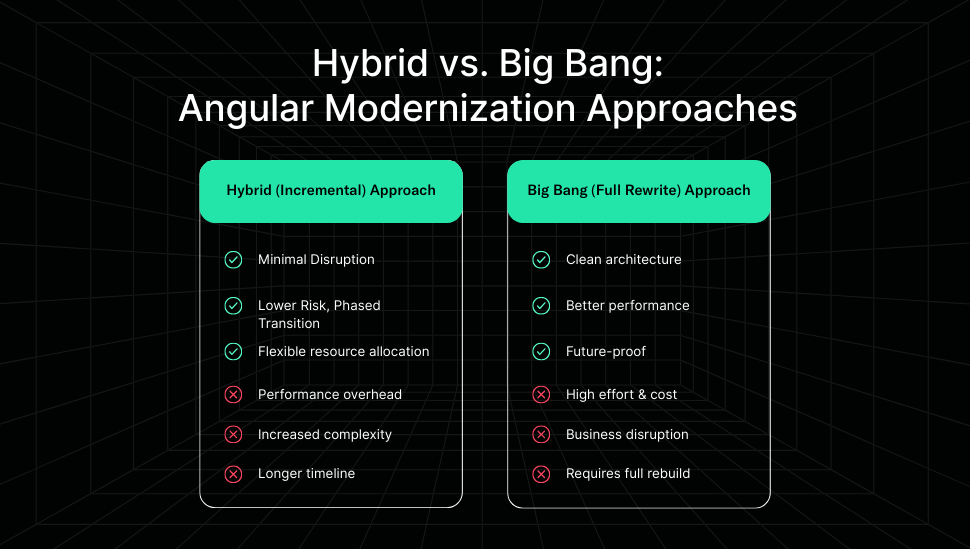
Modernizing from AngularJS to Angular typically follows one of two strategies, each with its own advantages and challenges.
1. Hybrid (Incremental) Approach
This method leverages ngUpgrade, allowing AngularJS and Angular to coexist within the same application. Developers modernize components and services gradually while keeping the application functional.
Pros:
- Minimal disruption: Enables a phased transition without affecting users.
- Easier risk management: Critical features remain stable while sections are modernized.
- Flexible resource allocation: Teams can modernize incrementally without halting other development efforts.
Cons:
- Performance overhead: Running both frameworks simultaneously can slow down the app.
- Code complexity: Maintaining two frameworks increases technical debt.
- Longer modernization timeline: Full transition can take months or years.
2. Big Bang (Full Rewrite) Approach
In this method, developers rebuild the entire Angular application from the ground up, replacing AngularJS completely.
Pros:
- Cleaner architecture: Eliminates legacy dependencies, leading to better maintainability.
- Performance gains: Fully optimized for modern browsers and devices.
- Future-proofing: Ensures long-term compatibility with Angular updates.
Cons:
- High initial effort: Requires a full redesign, testing, and validation before launch.
- Business disruption: The application remains in development until the new version is ready.
- Resource-intensive: Demands dedicated teams and significant development effort.
Regardless of the approach chosen, the traditional modernization process follows a structured series of steps from initial assessment to final deployment. Below is an overview of the key stages involved in a typical AngularJS to Angular migration.
Hybrid vs. Big Bang: AngularJS to Angular Migration Approaches
| Factor | Hybrid (Incremental) | Big Bang (Full Rewrite) |
| Disruption | Minimal. App remains live while new Angular modules are introduced gradually | High. Requires freeze or full cutover once the Angular rewrite is complete |
| Speed to Start | Fast. Teams can begin replacing high-priority features immediately | Slower to start due to upfront architecture and re-scaffolding work |
| Code Complexity | Dual-framework complexity (AngularJS + Angular coexist), especially in routing and state | Cleaner, unified codebase — no legacy compatibility overhead |
| Risk Level | Lower. Rolls out features incrementally with functional parity checks | Higher. Issues may surface only at the end if testing isn’t exhaustive |
| Performance Impact | Temporary trade-offs from bootstrapping both AngularJS and Angular runtimes | Fully optimized performance for Angular from the start |
| Cost Profile | Spread over time; easier to stage resourcing | Higher upfront cost but potentially faster overall if done right |
| Best Suited For | Large, business-critical apps needing continuity during migration | Smaller apps or those undergoing broader architectural overhaul |
AngularJS Migration Cost and Timeline: What US Enterprise Teams Should Budget
Migration cost is driven by application size, code quality, migration approach, and team structure. The ranges below reflect typical effort across enterprise engagements. For guidance on broader application modernization cost factors, a codebase assessment is required for a project-specific estimate.
| Application Size | Components | Typical Timeline | Team Size |
| Small | Under 30 | 2 to 4 months | 2 to 3 engineers |
| Mid-size | 30 to 100 | 5 to 9 months | 3 to 6 engineers |
| Large enterprise | 100+ | 12 to 18 months | Multi-role team |
*Gen AI-assisted migration through Legacyleap reduces effort at key stages such as code analysis, dependency mapping, component conversion, and test generation by up to 40% compared to fully manual approaches, based on internal engagement benchmarks.



Common Pitfalls and Challenges in AngularJS to Angular Migration
- Compatibility gaps: AngularJS and Angular follow fundamentally different architectures, making direct interoperability challenging. Legacy AngularJS code relies heavily on $scope and controllers, while Angular is component-driven and reactive. Bridging these differences often leads to inconsistencies, requiring additional refactoring efforts.
- Performance bottlenecks: Hybrid migrations using ngUpgrade allow AngularJS and Angular to run side by side, but this approach can introduce inefficiencies. Increased memory consumption, duplicate event bindings, and unnecessary digest cycles can slow down performance, especially in large-scale applications. Optimizing this transition requires careful dependency management and phased rollouts.
- Testing challenges: Angular 21 uses Vitest as the default test runner, replacing Karma and Jasmine. Teams migrating from AngularJS should modernize their test harnesses accordingly to benefit from faster execution, native TypeScript support, and improved CI performance.
- Skill gaps: Modernizing to Angular requires developers to adapt to new paradigms, including TypeScript for static typing, RxJS for reactive programming, and a modular component-driven structure. Teams unfamiliar with these concepts face a steep learning curve, which can slow down modernization efforts and introduce bugs if best practices are not followed.
Overview of the Traditional Modernization Process
| Step | Key Actions | Considerations |
| 1. Planning & Assessment | Analyze the existing codebase and define modernization goals. | Evaluate app complexity, business impact, and resources. |
| 2. Choose a Modernization Strategy | Select Hybrid (ngUpgrade) or Full Rewrite. | Balance resource constraints, disruption, and timeline. |
| 3. Setup Angular Environment | Install Angular CLI, configure dependencies. | Ensure compatibility with existing project structure. |
| 4. Hybrid Modernization (ngUpgrade) | Run AngularJS and Angular in parallel. | Suitable for phased modernization with minimal downtime. |
| 5. Component & Service Modernization | Convert components/services, adopt Angular DI patterns. | Move from $scope to RxJS-based reactive programming. |
| 6. Routing Modernization | Replace $routeProvider with Angular Router. | Implement lazy loading for better performance. |
| 7. Data Binding & Forms | Modernize from ng-model to Angular’s form handling. | Ensure unidirectional data flow for efficiency. |
| 8. HTTP Requests | Transition from $http to Angular HttpClient. | Improve API call efficiency and error handling. |
| 9. Dependency Management | Replace outdated third-party libraries. | Ensure compatibility with Angular modules. |
| 10. Testing & Validation | Use Vitest for unit tests (default in Angular 21), and Playwright or Cypress for end-to-end testing. Protractor was deprecated in Angular 15 and should not be used. | Maintain feature parity and stability. |
| 11. Finalizing Modernization | Remove AngularJS code, optimize performance, and deploy. | Monitor for issues and fine-tune post-modernization. |
Checklist for a Successful AngularJS to Angular Migration with Gen AI
- Analyze the existing codebase: Use Gen AI and ESLint with the Angular ESLint ruleset to document architecture, identify dependencies, and estimate ROI.
- Choose the right migration strategy: Decide between a hybrid (ngUpgrade) approach or a full rewrite based on complexity, disruption tolerance, and timelines.
- Set up the Angular environment: Install Angular CLI, configure dependencies, and ensure compatibility with existing project structures.
- Modernize components and services: Convert AngularJS controllers/services to Angular components using AI-driven dependency injection and RxJS for reactive programming.
- Upgrade routing: Replace $routeProvider with Angular Router and enable lazy loading for performance optimization.
- Update forms and data binding: Migrate from ng-model to Angular’s reactive forms, ensuring unidirectional data flow.
- Transition HTTP requests: Replace $http with Angular’s HttpClient for better API handling, caching, and error management.
- Replace outdated dependencies: Identify and remove unsupported third-party libraries; ensure compatibility with Angular modules.
- Implement automated testing: Use Gen AI to generate unit, integration, and end-to-end test cases with Vitest for unit tests and Playwright or Cypress for end-to-end tests.
- Deploy with monitoring: Integrate AI-generated deployment artifacts into CI/CD pipelines, and set up post-launch monitoring to detect and resolve issues early.
How Does Gen AI Accelerate AngularJS to Angular Migration?
Moving from AngularJS to Angular is a complex process that involves understanding legacy code, refactoring outdated patterns, and ensuring a seamless transition — all while minimizing disruption.
Traditionally, this requires extensive manual effort, but Gen AI transforms the modernization process by automating key migration tasks, reducing errors, and accelerating timelines.
Here’s how Gen AI plays a significant role in accelerating Angular migration.
- Automated business logic extraction: One of the biggest challenges in migration is deciphering the original application’s logic. Gen AI accelerates this by scanning the existing AngularJS codebase, extracting business rules, and mapping dependencies, eliminating the need for tedious manual analysis.
- Intelligent code refactoring: Instead of a direct translation, Gen AI refactors code based on best practices for Angular. It identifies outdated patterns, optimizes performance, and converts JavaScript-based logic into structured, maintainable TypeScript code.
- Automated test case generation: A risk-free migration demands rigorous testing. Gen AI generates test cases across unit, integration, and functional levels, ensuring that the modernized application maintains feature parity with the legacy system while improving overall stability.
- Compatibility issue detection & auto-fix: Migrating to Angular introduces compatibility challenges, from third-party dependencies to API changes. Gen AI detects potential issues in real time and applies automated fixes, preventing common roadblocks before they impact development.
- Continuous optimization & performance enhancements: Gen AI doesn’t just modernize code, it enhances it. During the assessment phase, it identifies inefficient code structures, recommends optimizations, and ensures that the final Angular application is scalable, secure, and high-performing.
Get a free $0 AngularJS codebase assessment, delivered in days, not weeks.
Gen AI is now embedded directly into the Angular ecosystem itself. Angular 21 introduces official AI-assisted tooling through Model Context Protocol (MCP) integrations, enabling context-aware analysis and code recommendations inside Angular CLI workflows.
This reflects a broader shift of AI no longer being an add-on layer but a part of the framework’s core developer experience.
Enterprise migrations benefit most when these native AI capabilities are combined with structured modernization platforms that operate at system scale.
Legacyleap’s Gen AI Modernization Framework for Angular Migration
Modernizing an AngularJS application requires a structured approach to ensure efficiency, maintainability, and minimal disruption. Legacyleap’s framework leverages Gen AI-driven automation combined with expert oversight to accelerate and optimize every stage of migration.
1. Tech Assessment
- Utilize Gen AI and ESLint with the Angular ESLint ruleset to analyze the existing codebase and estimate the ROI of migrating.
- Automatically generate detailed documentation, architectural diagrams, and dependency graphs to guide the transition strategy.
2. Choosing the Right Migration Strategy
- Gradual hybrid migration using ngUpgrade allows AngularJS and Angular to run side by side, minimizing disruption for large applications.
- Full rewrite for legacy applications that are too outdated or complex, with Gen AI optimizing the new architecture from the ground up.
3. Component & Service Modernization
- AI-driven dependency injection patterns streamline component and service conversion.
- Shift from $scope-based data flow to RxJS-driven reactive programming for improved performance and scalability.
4. Routing, Forms & API Transition
- Replace $routeProvider with Angular Router, enabling lazy loading for faster load times.
- Upgrade from $http to Angular’s HttpClient, ensuring improved error handling, request caching, and observability.
5. Code Refactoring & Optimization
- Gen AI detects and eliminates redundant, inefficient, or legacy code structures, ensuring maintainability.
- Security enhancements with OWASP-compliant coding standards are built into the migration process.
6. Test Case Generation & Validation
- AI-driven automation generates unit, integration, and functional test cases, ensuring complete feature parity.
- Utilize Vitest for unit testing and Playwright or Cypress for end-to-end testing across all application layers.
7. Deployment & Monitoring
- AI-generated deployment artifacts ensure seamless CI/CD integration.
- Post-migration monitoring prevents architecture drift and optimizes performance in the live environment.
Tools and Technologies for AngularJS to Angular Migration
A successful Angular migration demands the right combination of automation, analysis, and validation tools. Legacyleap integrates Gen AI-driven automation with industry-standard frameworks to enhance efficiency and accuracy.
Key technologies in our migration framework:
- Gen AI Integration: Automates code analysis, modernization, and test case generation, reducing manual effort.
- ESLint with Angular ESLint: The current standard for static analysis and linting in Angular projects, replacing the deprecated TSLint.
- Vitest: The default unit test runner as of Angular 21, providing fast execution, native TypeScript support, and no browser automation overhead. For end-to-end testing, Playwright or Cypress are the recommended frameworks.
- Legacyleap’s Proprietary IDE: Custom-built with enterprise-specific enhancements for seamless migration workflows.
- Continuous Testing Frameworks: AI-powered automated testing that identifies migration issues early, ensuring smooth transitions.
Role of Human Expertise
While Gen AI accelerates migration, human expertise remains essential for strategic oversight and fine-tuning. Legacyleap’s team ensures a seamless transition by balancing automation with deep technical insight.
Here’s where human expertise makes the difference:
Critical decision-making in strategy:
- Choosing between hybrid migration and a full rewrite based on business goals and technical constraints.
- Defining modularization strategies to enhance scalability in the new Angular architecture.
Fine-tuning & validation in complex scenarios:
- Handling non-standard legacy code where AI-based automation requires manual intervention.
- Ensuring data integrity, security compliance, and performance optimizations post-migration.
- Reviewing and optimizing automated test cases to align with business logic and real-world usage.
By integrating AI-driven automation with expert oversight, Legacyleap delivers a risk-free, scalable, and future-ready Angular migration experience.
How Gen AI Reduces AngularJS Migration Effort: Key Benefits
Traditional migration methods are time-intensive, error-prone, and heavily dependent on manual effort. Legacyleap’s Gen AI-driven platform eliminates these inefficiencies by introducing automation, security compliance, and continuous validation, ensuring a faster, more reliable transition to Angular.
1. Efficiency Gains
Gen AI accelerates Angular migration by automating code analysis, modernization, and validation, reducing the time and effort required.
- 40% faster migration compared to traditional approaches, based on internal benchmarks.
- AI-generated test cases, deployment artifacts, and documentation streamline the process.
- Ensures high-quality code that aligns with enterprise-grade standards.
2. Risk Mitigation
Seamless migration requires continuous monitoring and validation to prevent performance issues or disruptions.
- Automated compatibility checks during hybrid migration ensure a smooth transition.
- Continuous testing with AI-generated unit, integration, and functional test cases minimizes business downtime.
- Detailed code analysis with visual diagrams and code graphs helps developers catch and fix issues early.
3. Scalability & Security
Security and maintainability are critical in any migration effort. Legacyleap’s platform ensures future-proof applications with built-in security compliance and post-migration monitoring.
- OWASP-compliant code refactoring enhances security from the ground up.
- Hybrid migration with continuous testing ensures zero downtime during the transition.
- Post-migration monitoring prevents architectural drift and maintains long-term scalability.
By leveraging Legacyleap’s AI-powered framework, businesses can migrate AngularJS applications faster, with higher reliability, reduced risk, and future-ready architecture.
Why Generic Migration Tools Fail Enterprise AngularJS Projects
Modernization platforms often use Gen AI as an add-on, assisting with isolated tasks like code conversion or documentation. This makes it helpful but not central to the process.
Legacyleap takes a fundamentally different approach. It is the only purpose-built platform where Gen AI drives every phase of Angular migration, ensuring a seamless transition with zero business disruption.
Learn more about how our agentic AI modernization platform operates at the system level.
Beyond automation, three core aspects set Legacyleap apart for Angular migration:
1. Agentic AI for Angular-Specific Tasks
Instead of applying a generic model, Legacyleap’s agentic AI architecture selects the best-fit models for each stage, whether it’s analyzing TypeScript structures, migrating AngularJS controllers to components, or optimizing modern Angular architecture with RxJS.
2. Enterprise-Tuned Modernization for Angular Frameworks
The platform learns from enterprise tech guidelines, developer inputs, and compiler feedback, ensuring that the migration process follows best practices for Angular architecture, dependency injection, and modularization while adhering to security standards like OWASP compliance.
3. Continuous AI-Powered Monitoring for Future Angular Versions
Legacyleap’s AI-driven monitoring agents track changes in the Angular ecosystem post-migration and proactively flag compatibility risks, allowing enterprises to stay ahead of deprecations and framework updates.
With Gen AI deeply embedded in every step, from assessment to post-migration monitoring, Legacyleap accelerates Angular migration while maintaining code quality, security, and long-term adaptability.
How to Start Your AngularJS Migration: Recommended Next Steps
Starting an AngularJS migration comes down to three steps: assess the scope of your codebase, choose your migration approach (incremental or full rewrite), and select an execution partner with proven Angular modernization capability.
AngularJS migration is not a cosmetic upgrade. It requires architectural restructuring, controlled dependency mapping, and validated UI parity to prevent behavioral drift.
Manual rewrites increase delivery risk and extend timelines through rework. Structured automation reduces that risk by making migration stages observable, measurable, and reversible.
Legacyleap’s Gen AI-assisted approach is implemented through Legacyleap’s AngularJS migration services, where automated dependency analysis, component-level migration planning, and parity validation help teams move from AngularJS to modern Angular without disrupting production behavior.
If you want clarity before committing to a migration plan, start with a $0 AngularJS Migration Assessment. We analyze a representative portion of your codebase and deliver:
- Dependency and component inventory
- Migration path recommendation (incremental vs rewrite)
- Risk hotspots and parity gaps
- Effort band estimation
For teams evaluating execution partners or platform capabilities, you can also Book a Demo to see how dependency mapping, component transformation, and regression validation work in practice.
Migration decisions are easier when scope, risk, and effort are visible upfront.
FAQs
No. You migrate directly from AngularJS to Angular 21. No sequential version stepping is required. AngularJS and modern Angular are architecturally distinct frameworks, and the migration path is a structured rewrite or incremental modernization, not a version-by-version upgrade chain.
Migrate now. Angular 22 is expected around May 2026 and will not introduce breaking changes that would invalidate a migration completed on Angular 21. Waiting adds months of continued exposure to unpatched AngularJS CVEs with no material benefit. Angular 21 is in active support and is the stable, recommended target today.
Zoneless change detection removes Angular’s dependency on Zone.js, which was responsible for triggering change detection cycles across the application. In Angular 21, it is the default for new applications. For teams migrating from AngularJS, this means the modernized application will have more predictable rendering behavior, lower bundle overhead, and improved runtime performance compared to Zone.js-based Angular applications. It is an improvement you inherit by migrating to Angular 21.
Karma is deprecated in Angular 21 and replaced by Vitest as the default test runner. Your existing Karma-based tests will not run as-is in the new environment. As part of migration, test harnesses need to be updated to Vitest for unit tests and Playwright or Cypress for end-to-end tests. Gen AI can accelerate this process by generating Vitest-compatible test cases from your existing test logic, significantly reducing the manual effort involved.
For most enterprise teams, yes, and the calculus becomes clearer the longer migration is delayed. AngularJS has been EOL since December 2021, with no patches available for any disclosed CVEs. Large codebases do face higher migration effort, but they also carry the highest compliance exposure and the greatest long-term maintenance cost from staying on an unsupported framework. Gen AI-assisted migration specifically reduces the effort burden on large codebases through automated code analysis, dependency mapping, and component conversion, which is where large-scale projects spend the most engineering time.
References
[1] HeroDevs — Angular Version History: Every Release Date, Support Window, and End-of-Life Date from AngularJS to Angular 22. https://www.herodevs.com/blog-posts/angular-version-history-every-release-date-support-window-and-end-of-life-date-from-angularjs-to-angular-22
[2] OWASP — OWASP Top Ten. https://owasp.org/www-project-top-ten/