TL;DR
- The GLBA Safeguards Rule’s eight mandatory technical controls have been enforceable since June 2023, and the deadline has already passed. The 2021 amendments to 16 CFR Part 314 converted a principles-based program into named, testable requirements including encryption, MFA, and secure development practices.
- Five of the eight controls are architecturally impossible for pre-2015 .NET, Java EE, or VB6 applications to meet. Encryption at rest, MFA, asset inventory, secure development practices, and user activity monitoring each require capabilities these platforms were never built to produce.
- A reverse proxy enforcing MFA at the network perimeter is not the same as MFA compliance in a forensic review. Cyber insurers have treated partial, gateway-only MFA enforcement as no MFA enforcement at all when adjudicating claims, because application-layer authentication records don’t exist.
- The 2021 amendments added a category that surprises many technology firms: ‘finders’ who connect buyers and sellers in financial transactions. The FTC’s enforcement action against LightYear Dealer Technologies confirmed that fintech SaaS platforms and similar technology providers processing NPI are themselves covered financial institutions.
- A May 2024 amendment added a public 30-day breach notification requirement that raises the stakes for unresolved gaps. Institutions must notify the FTC within 30 days of a notification event involving unencrypted data affecting 500 or more consumers, and these filings become public record.
The GLBA Safeguards Rule’s Mandatory Controls Have Been in Effect Since June 2023
For financial services firms running legacy .NET, Java EE, or VB6-class applications, the GLBA Safeguards Rule is no longer a compliance checklist. It is an enforcement posture with eight named, mandatory technical controls and a 30-day public breach notification requirement.
The 2021 amendments, effective June 9, 2023, converted what had been a principles-based information security program into specific, testable requirements [1]. Failing to implement MFA, encryption, or secure key management is now likely to be treated as unreasonable data security under the GLBA, even in the absence of a breach [4].
That enforcement date is three years past. For firms running pre-2015 .NET, Java EE, or VB6-class line-of-business applications in production, the GLBA cybersecurity requirements that those amendments established did not become satisfiable at the deadline. The underlying platforms determine what the applications can technically produce, and for a significant portion of legacy financial services software, several of the eight mandatory controls are architecturally beyond reach without retrofit, replacement, or modernization.
A May 2024 amendment added a breach notification requirement: institutions must notify the FTC within 30 days of discovering a notification event, defined as unauthorized acquisition of unencrypted customer information affecting 500 or more consumers [5].
These filings are public. FTC Safeguards Rule enforcement does not require a breach to proceed; the combination of mandatory controls and a public notification regime means the stakes for running legacy systems with structural control gaps have increased materially since 2023.
For a breakdown of how the GLBA Safeguards Rule intersects with NYDFS Part 500, PCI DSS 4.0, and HIPAA enforcement posture across legacy systems, see Legacy Software Compliance Risk: The 2026 Enforcement Guide.
Who Must Comply with the GLBA Safeguards Rule
The Safeguards Rule defines “financial institution” by activity, not charter type. The FTC’s own guidance lists thirteen covered entity categories [3], and the definition has been interpreted expansively:
- Mortgage lenders and brokers
- Payday lenders, finance companies, and account servicers
- Check cashers, wire transferors, and collection agencies
- Credit counselors and financial advisors
- Tax preparation firms
- Non-federally insured credit unions
- Investment advisers not required to register with the SEC
- Auto dealers that arrange consumer financing or lease vehicles for longer than 90 days
- Finders: companies that bring buyers and sellers together in financial transactions (added in the 2021 amendments)
The 2021 amendments added a category that catches many technology firms off guard: finders, defined as companies that bring buyers and sellers together in financial transactions.
The FTC’s enforcement action against LightYear Dealer Technologies confirmed that technology providers processing NPI to enable financial activity by their clients are themselves financial institutions under the Safeguards Rule.
A fintech SaaS platform whose software touches consumer credit decisions, a tax software provider processing return data, or a regional auto dealer group arranging consumer financing are each covered by the full technical requirements of the rule, including encryption, MFA, and annual penetration testing.
One exemption applies at §314.6: institutions maintaining customer information on fewer than 5,000 consumers are exempt from the written risk assessment, the Qualified Individual board report, the incident response plan, and the penetration testing requirement. Encryption, MFA, access controls, and training remain in effect regardless.
Many organizations that do not think of themselves as financial institutions (a regional auto dealer group, a tax software provider, a mortgage technology firm) are subject to the Safeguards Rule’s full technical requirements and may not have engaged with their legacy application compliance posture accordingly.
GLBA Safeguards Rule Requirements: The Eight Technical Controls
The 2021 amendments to 16 CFR Part 314 specify eight technical safeguards that covered institutions must implement [2]. These replaced the prior rule’s flexible program requirements with named, testable controls.
| Safeguard | What the Rule Requires | Key Nuance |
| Access controls | Least-privilege access; periodic review; limit access to authorized individuals with a legitimate business need | Shared accounts are structurally non-compliant |
| Asset inventory | Accurate, current inventory of all systems, devices, and applications storing, transmitting, or processing customer information | Gaps in the inventory are themselves a finding |
| Encryption | Encrypt customer NPI at rest and in transit | An equivalent alternative requires documented Qualified Individual sign-off; silence is not an approved alternative |
| Secure development practices | Implement secure development practices for in-house applications | Unmaintained codebases on EOL platforms have no vendor-supported secure SDLC to follow |
| Multi-factor authentication | MFA for all individuals accessing any information system containing customer information | Covers all access: remote, local, administrative, and user-level |
| Secure data disposal | Securely dispose of customer information within two years of last use | Applies to physical and electronic records |
| Change management | Procedures for monitoring and managing material changes to systems containing customer information | EOL systems with no change management capability cannot satisfy this requirement |
| User activity monitoring | Monitor and detect unauthorized access and activity on systems containing customer information | Application-layer logging with individual user attribution is required; network-level logging alone is insufficient |
Three additional governance obligations sit alongside the eight safeguards:
- Testing: The GLBA penetration testing requirement mandates annual penetration testing and vulnerability assessments at least every six months for institutions without continuous monitoring (§314.4(d)). Vulnerability scanning does not satisfy the penetration testing requirement; the rule treats them as distinct.
- Qualified Individual: The GLBA Qualified Individual must be a named individual, internal or outsourced, accountable for overseeing the program and submitting a written report to the board at least annually, covering program status, risk assessment findings, material security events, and management responses.
- Breach notification. Under the November 2023 amendment, effective May 13, 2024, institutions must notify the FTC within 30 days of a notification event affecting 500 or more consumers [5]. The “unencrypted” qualifier in the definition is the direct reason GLBA encryption at rest is not discretionary.
GLBA Safeguards Rule Compliance Gaps: The Legacy System Root Cause
The 2021 amendments did not create new technical risk for financial services firms. They made existing legacy infrastructure risk legible as a regulatory finding. Each control firms most commonly fail maps to something a pre-2015 .NET, Java EE, or VB6-era application structurally cannot produce without architectural change [6].
The Five Controls Firms Fail on Legacy Platforms
| GLBA Control | Legacy System Failure Mode | Why the Gap Is Structural |
| Encryption at rest | Pre-2013 SQL Server, Oracle, and Access databases often have no native TDE or column encryption; application-layer encryption was not built into the data access layer | The equivalent alternative requires documented Qualified Individual sign-off; informal practice does not satisfy §314.4(c)(3) |
| MFA for all access | Applications built before SAML, OAuth2, and OIDC cannot natively integrate with modern identity providers; authentication logic is hard-coded with no federation layer | A reverse proxy enforces MFA at the perimeter, but forensic review of the authentication chain requires application-layer MFA event records, not gateway logs |
| Asset inventory | Undocumented legacy codebases with unmapped dependencies cannot produce the complete, accurate system inventory §314.4(c)(2) requires | No policy document bridges the gap; legacy applications without dependency mapping have structural inventory gaps |
| Secure development practices | Unmaintained codebases on EOL platforms (VB6, .NET Framework 4.x, Java EE 5, Struts 1.x) have no active vendor-supported secure SDLC | §314.4(c)(4) applies to in-house applications; a codebase that cannot receive patches has no available secure development process by architectural definition |
| User activity monitoring | Legacy applications with shared accounts and minimal application-layer audit logging cannot produce individual user attribution at the database level | Network-level logs show traffic; the rule requires application-layer logs with user attribution showing who accessed what and when |
Annual penetration testing of a legacy system on an EOL platform produces unresolvable findings every engagement cycle. Vulnerabilities that cannot be patched because the vendor no longer issues patches persist as open items. The Qualified Individual’s board report must describe these findings and their remediation status. A finding with no available remediation path is a permanent, documented compliance gap that reappears in every test cycle.
The operative logic is that the moment a regulation mandates a control a system cannot produce, the organization is out of compliance. A working legacy system is not a compliant one. For many legacy financial applications, the gap predates the June 2023 enforcement deadline entirely.
For a detailed examination of how end-of-life software creates structural compliance exposure, see our analysis of VB6 on Windows 11 and the compliance implications of EOL software.
The Limits of the Retrofit Approach: What Compensating Controls Cannot Fix
The instinctive first response to a Safeguards Rule compliance gap is infrastructure remediation: add a reverse proxy for MFA, apply storage-layer encryption, tighten network segmentation. These measures are reasonable starting positions. They are not a compliance posture.
What retrofit achieves. A reverse proxy enforces MFA at the network perimeter. Storage-layer encryption protects data at rest without requiring application changes. For cyber insurers, a documented remediation roadmap supported by compensating controls can sustain coverage for one to two renewal cycles, provided the roadmap shows measurable progress between renewals.
Where retrofit reaches its ceiling is where the three categories of control gaps cannot be closed at the infrastructure layer.
The Forensic Audit Chain Problem
A reverse proxy enforces MFA at the network perimeter. In normal operations, this distinction is invisible. In a post-breach forensic review, it is the difference between a covered claim and a denied one. Forensic investigators and FTC enforcement reviewers examine the authentication event record at the application layer, not at the gateway.
A proxy log shows that the proxy enforced MFA. It does not show that the application authenticated the user. Cyber insurance carriers treating partial MFA enforcement as no MFA enforcement for claim adjudication purposes is an established pattern in this space, not a theoretical risk [6].
For a legacy application with no native IdP integration, a reverse proxy does not close this gap.
The Penetration Testing Problem
The GLBA penetration testing requirement produces a specific structural problem for legacy systems: annual testing against an EOL application generates findings that cannot be remediated through compensating controls. The vulnerabilities exist in the code and the platform. These open findings recur in every annual test cycle and must be reported to the board.
The Secure Development and Inventory Ceiling
No infrastructure overlay creates a secure SDLC for an unmaintained in-house application. No network configuration produces a complete asset inventory from an undocumented codebase. These requirements apply to the application itself, not to the infrastructure surrounding it.
Organizations running legacy financial applications are operating with a compliance timeline, not a compliance posture. The average financial services data breach exceeds $6 million in direct and remediation expenses, not including consent order costs or the operational restrictions that often accompany FTC enforcement.
For a detailed analysis of how cyber insurance claim denial patterns and legacy system exposure interact, see our coverage of cyber insurance requirements for organizations running legacy software.


The Board Report Problem: What the Qualified Individual Signs
The Safeguards Rule requires the Qualified Individual to report to the board in writing at least annually, covering program status, risk assessment findings, material security events, and management responses. For an institution whose legacy applications produce structural control gaps, this obligation has a documentation problem built into it.
An honest board report from a Qualified Individual overseeing a program where legacy systems cannot natively satisfy encryption, MFA, or secure development requirements describes a set of open findings. If those findings have no viable remediation path attached, the report documents a compliance gap with no resolution on record.
The 30-day FTC breach notification requirement sharpens the consequence. A notification event at a legacy system with unencrypted NPI becomes a public FTC filing within 30 days of discovery. At that point, the prior year’s board report becomes relevant context for any enforcement review.
The Security Posture Assessment produces the evidence base the Qualified Individual needs to move from “documented gap with no remediation” to “documented gap with a credible program underway”: every finding mapped to its code location, an exact timeline against the deadline, and a proof-of-approach that can be presented to the board.
Retrofit, Replace, or Modernize: Choosing the Right Path for GLBA-Covered Legacy Applications
Each remediation path produces a different compliance artifact profile and closes a different subset of the control gaps identified above. The right choice depends on the application’s architecture, the institution’s timeline, and the depth of the compliance gap.
| Retrofit / Compensating Controls | Replace (Commercial Platform) | Modernize (Application Modernization) | |
| Control gaps closed | MFA at perimeter, encryption at storage layer (partial) | Full, once live | Full, as each module is completed |
| Compliance artifacts produced | Documented compensating controls; remediation roadmap | New platform’s native controls; requires new documentation set | Dependency maps, data flow diagrams, asset inventory, parity validation reports, produced as a byproduct of the process |
| Penetration testing findings | Legacy findings remain open and recurring | Resolved once live | Resolved as each legacy module is retired |
| Qualified Individual board report | Reports open findings with compensating controls and a remediation timeline | Reports full compliance once replacement is live | Reports in-progress remediation with measurable milestone evidence each cycle |
| Timeline | Weeks to months | 12–36+ months for complex systems | Compressed by Gen AI-powered automation; approximately 2x the speed of traditional approaches |
| When to choose | While a replacement or modernization program is being planned; requires a written roadmap to sustain insurer coverage | Standard-function applications with a viable commercial replacement | Complex, business-critical in-house applications (loan origination, servicing platforms, tax processing) where embedded logic cannot be transferred through configuration |
Before scoping any of these paths, the current system’s business rules and data flows must be extracted. A replacement program that skips this step routinely fails at go-live when the new platform does not replicate edge-case logic that the legacy system was encoding. A modernized program depends on the same dependency mapping before any transformation begins.
For institutions with loan origination or mortgage servicing systems specifically, see our guide to Gen AI-powered modernization for loan origination software.
How Legacyleap Addresses the GLBA Safeguards Rule Compliance Gap
Legacyleap is a Gen AI-powered legacy application modernization platform built on multi-agent orchestration. For GLBA-covered organizations with legacy applications in production, the platform’s outputs map directly to the compliance artifacts the Safeguards Rule requires.
Agent-to-Control Mapping
| Agent | What It Produces | GLBA Requirement It Supports |
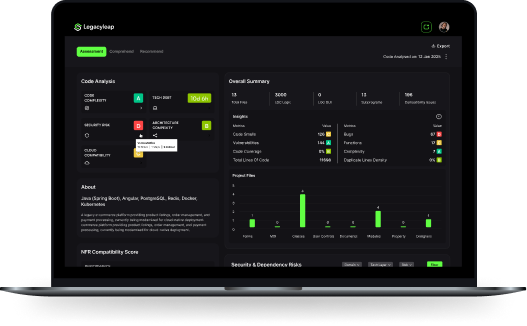
| Assessment Agent | Technical debt report, dependency map, EOL component inventory, security vulnerability map, risk indicators | Asset inventory and system classification (§314.4(c)(2)); foundation for the Qualified Individual’s risk assessment |
| Documentation Agent | Architecture diagrams, data flow maps, module boundaries, API inventories, integration maps | Written information security program documentation; data flow evidence for the board report |
| Recommendation Agent | Ordered modernization plan, target framework selection, module-level effort and risk scoring | Written remediation roadmap the Qualified Individual can present as evidence of a credible compliance program in progress |
| Modernization Agent | Governed, diff-based code transformations reviewed by human engineers; pull requests requiring approval before acceptance | Authentication layer moved to IdP-compatible architecture; native encryption at the data access layer; active secure SDLC established |
| QA Agent | Auto-generated unit, integration, regression, and functional test cases; 100% functional parity validation report | Documented evidence that no behavioral regression occurred during compliance-driven modernization |
All Legacyleap processing runs within the client’s own infrastructure, on-premises or VPC-hosted. No source code leaves the client’s environment. No outbound API calls to external LLM providers are required.
For GLBA-covered institutions evaluating whether AI-assisted modernization tooling can operate on regulated codebases, this deployment posture removes the primary operational barrier.
The Security Posture Assessment
The Security Posture Assessment is a fixed-scope engagement that turns your audit findings and your codebase into an exact, costed, time-boxed delivery plan. For a decided buyer who needs to close specific Safeguards Rule findings against a deadline, it provides scope certainty, proof-of-approach, and a side-by-side comparison with what an SI or generic migration tool would deliver.
What Legacyleap ingests:
- Your security audit or pen-test report
- SAST, DAST, and SCA scanner exports (Snyk, SonarQube, dep-scan, and similar)
- The application source code, within your environment
What the Assessment analyzes:
- EOL runtimes and frameworks with no patch path
- Vulnerable dependencies and known CVEs
- Deprecated cryptography: weak TLS, outdated hashing and ciphers
- Hardcoded secrets and credentials
- OWASP-class vulnerabilities in legacy code
- Blast radius: what depends on each vulnerable component
What you receive:
- Security Debt Inventory: every finding mapped to its exact code location and root-cause technology
- Exact scope, cost, and timeline by remediation tier, scheduled against your deadline
- Fix approach per finding: in-place upgrade, re-architecture, or re-platform
- Proof-of-approach: a demonstration of how Legacyleap modernizes safely and what the evidence pack will look like
- Modernization Opportunity Map: adjacent technical debt beyond the audit scope
- Go-forward recommendation: the fastest defensible path to closure
The Assessment is currently offered at no cost as a proof-of-concept and evaluation. It is the lowest-risk way to see exactly how Legacyleap would execute the work before committing.
Map Your Compliance Gap with a Security Posture Assessment
The Security Posture Assessment maps your existing audit findings to your actual codebase, then turns that map into an exact scope, cost, and timeline against your deadline. You get a Security Debt Inventory pinpointing every finding’s code location, a fix approach for each one, and a proof-of-approach demonstration, generated entirely within your infrastructure. No source code leaves your environment.
Get your free security posture assessment.
For IT leaders and Qualified Individuals who want to see the Assessment Agent, Documentation Agent, and Modernization Agent workflows in action before sharing code.
FAQs
FTC Safeguards Rule enforcement can result in civil penalties and consent orders under Section 5 of the FTC Act; consent orders typically impose multi-year third-party audit requirements and operational restrictions. Beyond enforcement action, non-compliance commonly results in cyber insurance claim denials and loss of banking or vendor relationships.
The GLBA Qualified Individual must be named and accountable for overseeing the institution’s information security program; the role can be outsourced to a third party, but a senior internal employee must supervise that relationship. Accountability for the program’s adequacy stays with the institution regardless of who fills the role.
The rule permits an equivalent alternative control in place of encryption, but only with written sign-off from the Qualified Individual and documented justification. Informal practice, assumed security, or undocumented workarounds do not satisfy §314.4(c)(3); the documentation itself is what the auditor reviews.
A risk assessment identifies and evaluates potential threats to customer information across the institution’s full system inventory; a penetration test actively attempts to exploit vulnerabilities in systems in scope for NPI. The rule requires both, treats them as distinct obligations, and does not allow one to substitute for the other.
The Privacy Rule governs how covered institutions share customer NPI with third parties and requires providing customers with privacy notices. The Safeguards Rule governs how institutions protect that same NPI technically and operationally; the two rules share the same statute but impose entirely different requirements.
References
[1] FTC Safeguards Rule: https://www.ftc.gov/legal-library/browse/rules/safeguards-rule
[2] 16 CFR Part 314, Standards for Safeguarding Customer Information: https://www.ecfr.gov/current/title-16/chapter-I/subchapter-C/part-314
[3] FTC, Safeguards Rule: What Your Business Needs to Know: https://www.ftc.gov/business-guidance/resources/ftc-safeguards-rule-what-your-business-needs-know
[4] Corbado, FTC Safeguards Rule MFA Compliance: https://www.corbado.com/blog/ftc-safeguards-rule-mfa-compliance
[5] Federal Register, Standards for Safeguarding Customer Information (November 2023 breach notification amendment): https://www.federalregister.gov/documents/2023/11/13/2023-24412/standards-for-safeguarding-customer-information
[6] Isora GRC, GLBA Cybersecurity Requirements: Complete Guide 2026: https://www.saltycloud.com/blog/glba-cybersecurity-requirements-complete-guide-2026/