TL;DR
- A legacy system audit produces a decision, and modernization comes after it. Scope the audit to answer retain, remediate, modernize, replace, or retire for each application, with evidence attached to every answer.
- Audit code and data as separate dimensions. A well-structured codebase sitting on undocumented schemas and business rules buried in stored procedures still carries a large share of the migration risk.
- If AI-assisted modernization is the likely path, audit for it now. Source code completeness, a behavioral baseline to test against, and data residency constraints decide how much of the transformation can be automated safely.
- An audit is finished when every finding maps to an owner and a disposition. Findings with no owner, sequence, or plan for the legacy system become one more report nobody acts on.
What is a Legacy System Audit?
A legacy system audit is a structured review of an aging application’s code, data, architecture, security posture, and support team, run to decide what should happen to that system next. Its output is a set of evidenced findings and a recommended disposition for each application in scope.
The terms legacy system audit and legacy system assessment are used interchangeably across the industry, and this guide treats them as one exercise. The shorter “legacy audit” refers to the same scope.
This guide covers where an audit ends and modernization begins, and the signals that justify running one. It then sets out what the review should examine across code and data, what changes when AI-assisted modernization is the likely path, and how findings become a roadmap.
Legacy System Audit vs. Modernization
A legacy system audit decides what should happen to a system. Modernization carries out that decision. The two have different owners, budgets, and definitions of done, and combining them tends to skip the decision entirely.
An audit changes nothing in production. It reads the codebase, profiles the data, interviews the people who maintain the system, and ends with a recommendation the business can approve or reject. Modernization changes the system itself, and it ends when the target system passes validation and the legacy system is retired.
A legacy system modernization audit is the same review scoped with a probable modernization in view. It adds target-state questions, such as which framework fits, which modules can move first, and how much of the transformation can be automated.
| Legacy System Audit | Modernization | |
| Purpose | Decide the disposition of each system | Execute the approved disposition |
| Changes production | No | Yes |
| Primary output | Findings, risk ratings, recommended path | Transformed code, migrated data, validated release |
| Ends when | Every finding has an owner and a disposition | The target system passes validation and the legacy system is retired |
| Typical owner | Enterprise architecture and the application owner | Delivery team, platform, or modernization partner |
| Can conclude “keep the system as it is” | Yes | No |
An audit that recommends retaining a system for three more years has done its job, provided the recommendation rests on evidence.
6 Signs You Need a Legacy System Assessment
The need for a legacy system assessment shows up in engineering and budget signals well before anyone schedules one. A 2024 survey of 500 US business and technology leaders found that 80% had a business-critical project delayed or canceled in the previous 12 months because of technical debt [1]. 85% said that debt impairs their ability to launch new solutions [1].
Each signal below points to a specific audit dimension.
- New engineers take weeks to make a safe change. Long onboarding means the system’s behavior is held by a few people, with little of it captured in code, tests, or documentation. It points the audit toward documentation and knowledge risk.
- Production failures take longer to diagnose than to fix. When incident root causes are hard to trace, dependencies and data flows are undocumented. The audit needs a dependency map and an integration inventory.
- Maintenance absorbs the budget. A system that spends most of its allocation on patches, workarounds, and hosting leaves little for new capability. The cost of maintaining legacy systems is spread across several budget lines, which is why an audit has to assemble it.
- One or two people understand a critical module. Knowledge concentration is a continuity risk that a retirement or resignation converts into an incident.
- The runtime or framework is past end of support. With no patch path, security findings accumulate and no fix exists inside the current stack.
- AI initiatives stall at the integration step. A pilot that works on exported data and fails when it needs live access to the legacy system has surfaced an architecture and data finding.
Two or more of these signals in the same application justify a scoped audit of that application first, ahead of a portfolio-wide review.
What a Legacy Audit Covers Across Architecture, Code, Security, and Operations
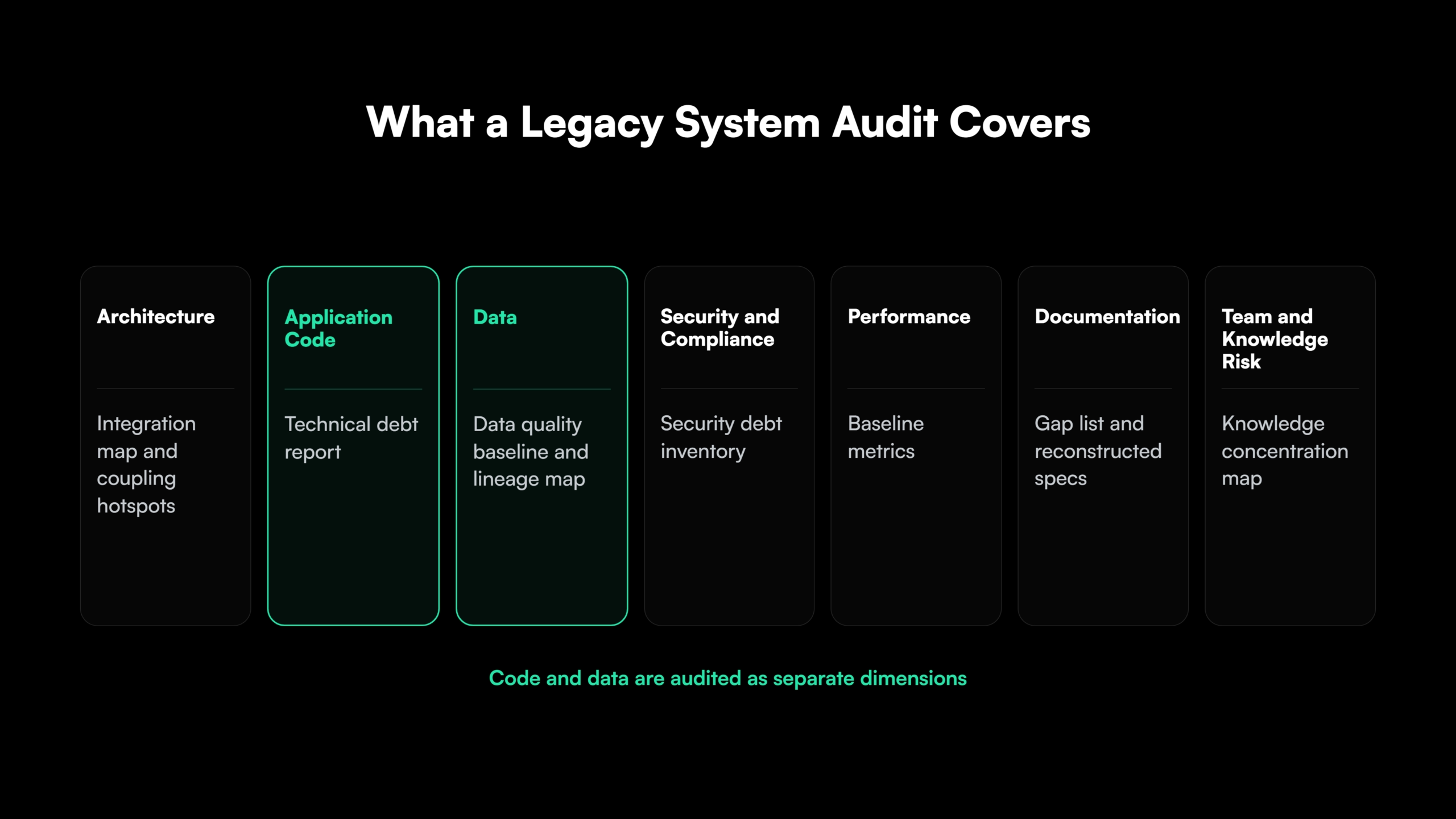
A legacy audit covers six dimensions beyond data, which gets its own section below. Each dimension should end in evidence a decision-maker can inspect, such as a map, a report, or a list tied to code locations.
| Dimension | What the Audit Examines | Evidence It Should Produce |
| Architecture | Module boundaries, coupling, shared databases, integration points, deployment topology | Architecture diagram, integration map, coupling hotspots |
| Application code | Framework and runtime versions, dead code, duplicated logic, build reproducibility, test coverage | Technical debt report, module-level complexity and risk scores |
| Security and compliance | End-of-life components, vulnerable dependencies, deprecated cryptography, hardcoded secrets | Security debt inventory mapped to code locations |
| Performance | Response times, error rates, resource usage, batch windows, scaling limits | Baseline metrics to compare against after modernization |
| Documentation | Existence, accuracy, and age of functional and technical documentation | Gap list and reconstructed specs for critical modules |
| Team and knowledge risk | Who can safely change each module, hiring market for the stack, on-call load | Knowledge concentration map by module |
Security findings carry weight beyond their count. CISA lists the use of unsupported or end-of-life software in service of critical infrastructure as a bad practice that is dangerous and significantly elevates risk [2]. An end-of-life runtime constrains every other decision in the audit, since remediation options inside that runtime are limited.
Where security is the primary trigger, a dedicated legacy system security assessment goes deeper on this dimension.
Performance baselines are easy to skip and hard to reconstruct later. Without them, there is no way to show the modernized system performs as well as the one it replaced.
Data in a Legacy System Audit: Schemas, Business Rules, Quality, and Lineage
Data carries a large share of legacy modernization risk, and audit frameworks commonly compress it into a single line item. Data accumulates rules, exceptions, and dependencies over decades, and much of that behavior is invisible in the application code. It also changes on its own schedule, through imports, manual fixes, and downstream integrations.
A data audit should examine six areas.
- Schema inventory and drift. Every table, view, and column in use, compared against what the application expects, including columns nothing references and nullability that no longer matches the business rule.
- Business logic stored in the data layer. Stored procedures, triggers, and ETL transformation logic often hold rules that exist nowhere in the application code. They have to be extracted and documented before any migration plan is credible.
- Data quality baseline. Duplicate rates, null rates, orphaned records, and inconsistent codes, measured now so the migration can be validated against a known starting point.
- Lineage and downstream consumers. Every report, feed, API, and partner integration that reads from the system. A consumer missed in the audit is a consumer broken at cutover.
- Code-to-data coupling. A database shared by several applications cannot move on one application’s timeline, which changes the sequencing of the whole program.
- Classification and retention. Which data is regulated, how long it must be kept, and where it is allowed to live.
Unresolved findings in this dimension become data debt, and they resurface during migration, when fixing them costs the most.
Start a $0 Modernization Assessment

 +more
+moreLegacy System Modernization Audit: What to Check for AI-Assisted Transformation
When AI-assisted modernization is the likely path, the audit has to answer a second set of questions. The answers set how much of the transformation can be automated and how the result will be proven equivalent to the original.
| Audit Question | Why It Matters for AI-Assisted Modernization |
| Is the full source code available and buildable? | AI transformation depends on reading the whole codebase. Missing source, binary-only libraries, and unreproducible builds cap what can be automated. |
| Is there a behavioral baseline to validate against? | Existing tests, logged production transactions, or recorded outputs become the reference for proving parity after transformation. |
| Can business logic be reconstructed from code and data? | Recoverable logic can be turned into specifications that engineers review before transformation starts. |
| Which modules rely on dynamic, generated, or reflective code? | These areas carry lower transformation confidence and need heavier human review. |
| Can the source code leave the environment? | Data residency and IP rules decide whether cloud-hosted AI tooling is usable or the platform has to run on the organization’s own infrastructure. |
| Is the data ready for AI use after modernization? | A modernized application on unprepared data passes the same limits on to downstream AI initiatives. |
The last question has a measurable cost. Gartner predicts that through 2026, organizations will abandon 60% of AI projects unsupported by AI-ready data, and 63% of organizations either lack or are unsure they have the right data management practices for AI [3].
Each answer changes the plan. A buildable codebase with a strong test baseline supports a high automation share. Missing source or no behavioral baseline shifts effort toward reconstruction and test generation first. The controls that keep AI-driven changes safe once work starts, from diff review to parity testing, are the safety nets for Gen AI in legacy modernization.
Turning Legacy System Audit Findings Into a Modernization Roadmap
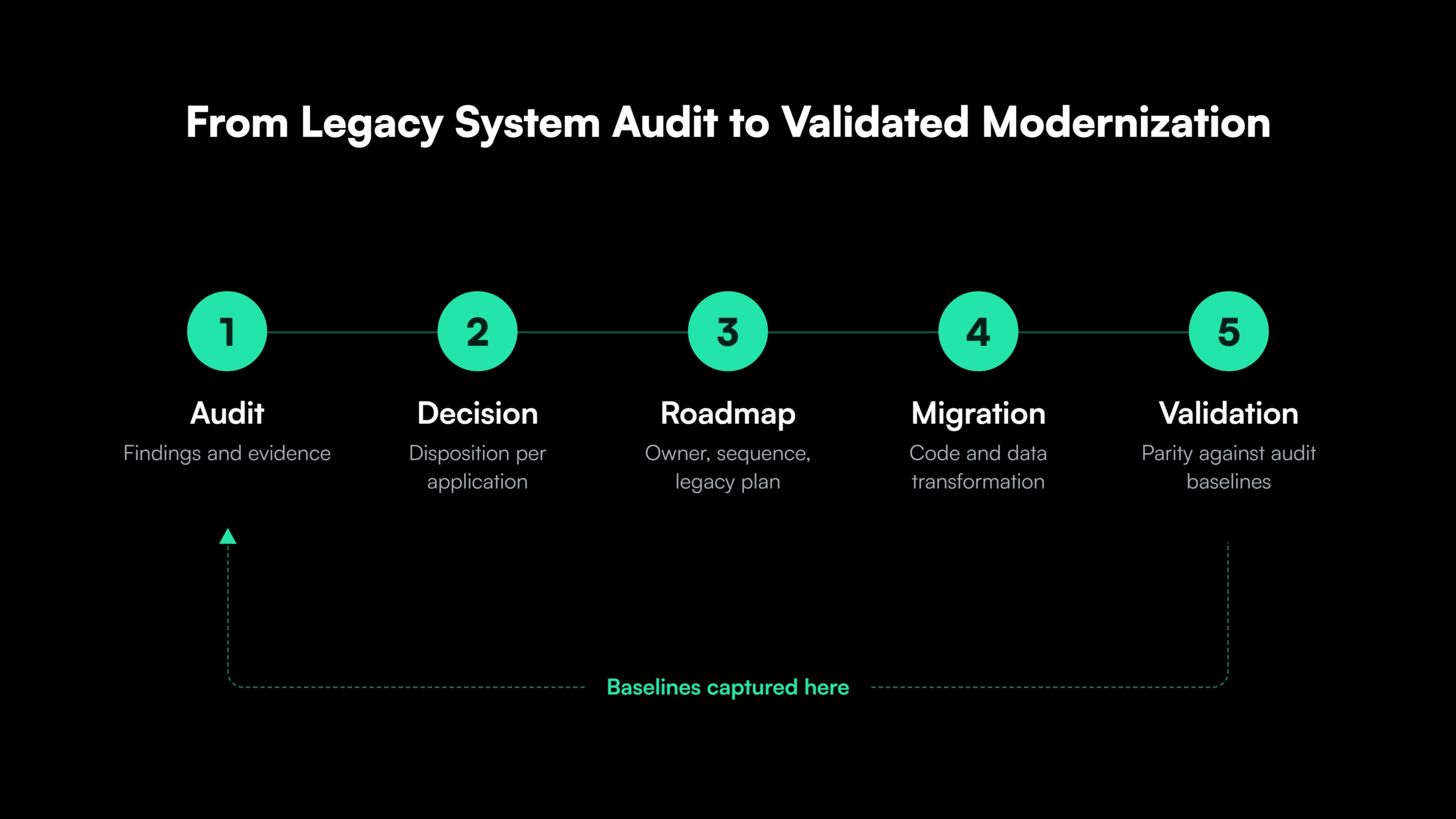
A legacy system audit is complete when every finding has an owner, a disposition, and a place in a sequence. An audit that stops at a findings report leaves the decision it was commissioned to support unmade.
Findings convert into one of six dispositions per application or module.
| Disposition | When the Audit Findings Point to It |
| Retain | Stable behavior, supported runtime, low change demand, acceptable risk |
| Remediate | Isolated security or quality findings fixable inside the current stack |
| Rehost or replatform | Sound application logic on infrastructure or a runtime that is the main constraint |
| Refactor | Valuable business logic held back by coupling, debt, or an end-of-life framework |
| Replace | Commodity capability available off the shelf at an acceptable data migration cost |
| Retire | Low usage, duplicated capability, or consumers that can move to another system |
Each disposition needs an owner, a validation criterion, and a plan for the legacy system after cutover before it becomes part of an application modernization roadmap. Sequencing follows the coupling findings, since shared databases and integration hubs set the order in which applications can move.
The audit also sets up the checks that close the program. The data quality baseline and behavioral baseline captured during the audit become the reference points for data migration validation after cutover. That makes the audit the first step in a sequence that runs from decision to migration to validation.
How Legacyleap’s Gen AI Agents Act on Legacy System Audit Findings
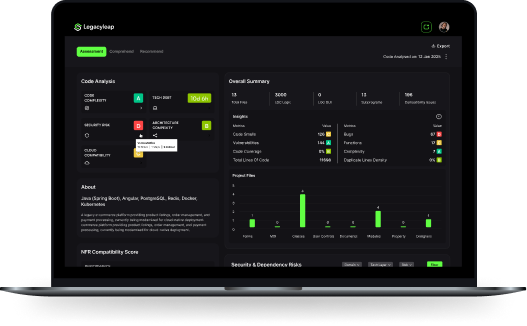
Legacyleap is a Gen AI-powered legacy modernization platform built on multi-agent orchestration. Its five agents cover the full Assess, Comprehend, Modernize, Validate, and Deploy lifecycle, so the evidence an audit produces becomes the working input for the program that follows.
- Assessment Agent. Produces the technical debt report, dependency map, risk indicators, security vulnerabilities, and migration effort estimate from the codebase itself.
- Documentation Agent. Reconstructs architecture diagrams, module boundaries, data flows, and API specs, including for systems with no existing documentation.
- Recommendation Agent. Converts findings into refactor, replace, or retain decisions, module-level effort and risk scores, and an ordered migration plan.
- Modernization Agent. Executes the plan as diff-based pull requests for human review. Roughly 70% of the modernization work is automated, and the agent cannot merge, deploy, or execute code on its own.
- QA Agent. Generates unit, integration, regression, and API tests and validates behavior parity against the legacy baseline before cutover.
All processing runs inside the organization’s own infrastructure, and no source code leaves the environment. That settles the data residency question from the AI-readiness audit before tooling is chosen.
Next Steps After a Legacy System Audit
A legacy system audit earns its cost when its findings turn into approved decisions and a sequenced plan. Code and data audited as separate dimensions, with the AI-readiness questions answered up front, give that plan a realistic basis.
For teams that want to see those findings for one of their own applications, the $0 Modernization Assessment produces them in 3 to 5 days, at no cost and inside the client’s environment. The output covers functional and technical documentation, a dependency and module map, a risk and complexity heatmap, and a modernization plan.
More than 150 production-grade assessments have been completed to date. A technical demo shows how the five agents take an approved plan through modernization and validation.
See Audit Findings for One of Your Applications
A $0 Modernization Assessment produces documentation, a dependency and module map, a risk and complexity heatmap, and a modernization plan for one application in 3 to 5 days, at no cost and inside your own environment.
FAQ
Run a full audit on each critical application every two to three years. Add a targeted review whenever a trigger appears, such as an end-of-support date, a compliance finding, or a major new integration.
No. An audit can recommend modernization, and it can equally recommend retaining or retiring a system, which is why the recommendation should stay independent of the team that would carry out the work.
It is the version to run once leadership has committed budget to modernization, since it adds module-level automation potential, effort estimates, and a proposed migration order to the standard audit findings.
For the code, data, and AI-readiness dimensions, yes. Interviews and document reviews can cover architecture and team risk. Findings on debt, security, or automation potential depend on reading the source and the schemas.
An internal architect who knows the business context, paired with an outside reviewer or tooling that has no stake in the outcome. Each covers what the other lacks, institutional knowledge on one side and independence on the other.
References
[1] Morning Consult, commissioned by Unqork. 2024 Morning Consult + Unqork Survey: Tech Debt Stifles Innovation at 80% of Enterprises Surveyed
[2] Cybersecurity and Infrastructure Security Agency (CISA). Bad Practices
[3] Gartner. Lack of AI-Ready Data Puts AI Projects at Risk (press release, February 26, 2025)