TL;DR
- Cloud modernization is a strategy-selection problem before it’s a vendor-selection problem. Seven strategies exist per application, from retire through refactor, and choosing the wrong one for a given application is the single biggest driver of cost overruns.
- The cost gap between adjacent strategies can run 5 to 10 times for the same application. A replatform mis-scoped as a refactor, or the reverse, is where budgets break.
- Manual, portfolio-wide strategy assessment does not scale past a few dozen applications without slowing down or losing consistency. AI-assisted assessment targets that specific bottleneck.
- Delivery model, not the name on the contract, determines most of the cost and timeline outcome. Staffing-led time-and-materials and AI-platform-led fixed-scope produce structurally different results from the same starting point.
- Cost overruns are common in cloud modernization programs. The average enterprise overspends its cloud migration budget by 14% every year, with global overruns exceeding $100 billion over three years.
What Cloud Modernization Services Include, and How They Differ From Cloud Migration
Cloud modernization services change how an application is built to run on cloud infrastructure. Cloud migration relocates the application without changing its architecture. Modernization engagements typically include application refactoring or replatforming, data and analytics platform updates, middleware and API work, and security posture changes scoped to the target architecture. Which combination applies depends on the specific application, not a fixed package sold the same way to every client.
Which public cloud the workload ultimately runs on, AWS, Azure, or GCP, is a related but separate decision, usually driven by existing enterprise agreements, data residency needs, and platform-specific service fit. That choice shapes deployment details. It does not change which of the seven strategies below fits a given application, which is the decision that drives cost and timeline.
This piece assumes the reader already knows why modernization matters. The more useful question, and the one most vendor pages and provider listicles answer poorly, is how to evaluate what a provider is proposing once they’re in the room.
Choosing a Cloud Modernization Strategy: What the Cost Gap Between Rehost, Replatform, and Refactor Looks Like
Every application in a cloud modernization program falls into one of seven strategies [1]. Treating every application the same way, or defaulting to whichever strategy the last project used, is where cost estimates stop matching reality.
| Strategy | What It Means | Effort | When It Fits |
| Retire | Decommission the application | Minimal | No longer used, or duplicated elsewhere in the estate |
| Retain | Leave it unchanged for now | None | Stable, low-change, or compliance-locked applications |
| Rehost | Move to cloud infrastructure without code changes | Low | Deadline-driven exits, or a staging step before deeper modernization |
| Relocate | Move at the platform or hypervisor level | Low | VMware-based estates moving to a cloud or container platform |
| Repurchase | Replace with a SaaS equivalent | Low to Medium | Commodity functions with no competitive differentiation |
| Replatform | Targeted upgrades (managed database, containers, CI/CD) without a full rebuild | Medium | Sound architecture running on outdated infrastructure |
| Refactor / Re-architect | Rebuild the application’s structure for cloud-native operation | High | Core, differentiating systems that need to evolve architecturally |
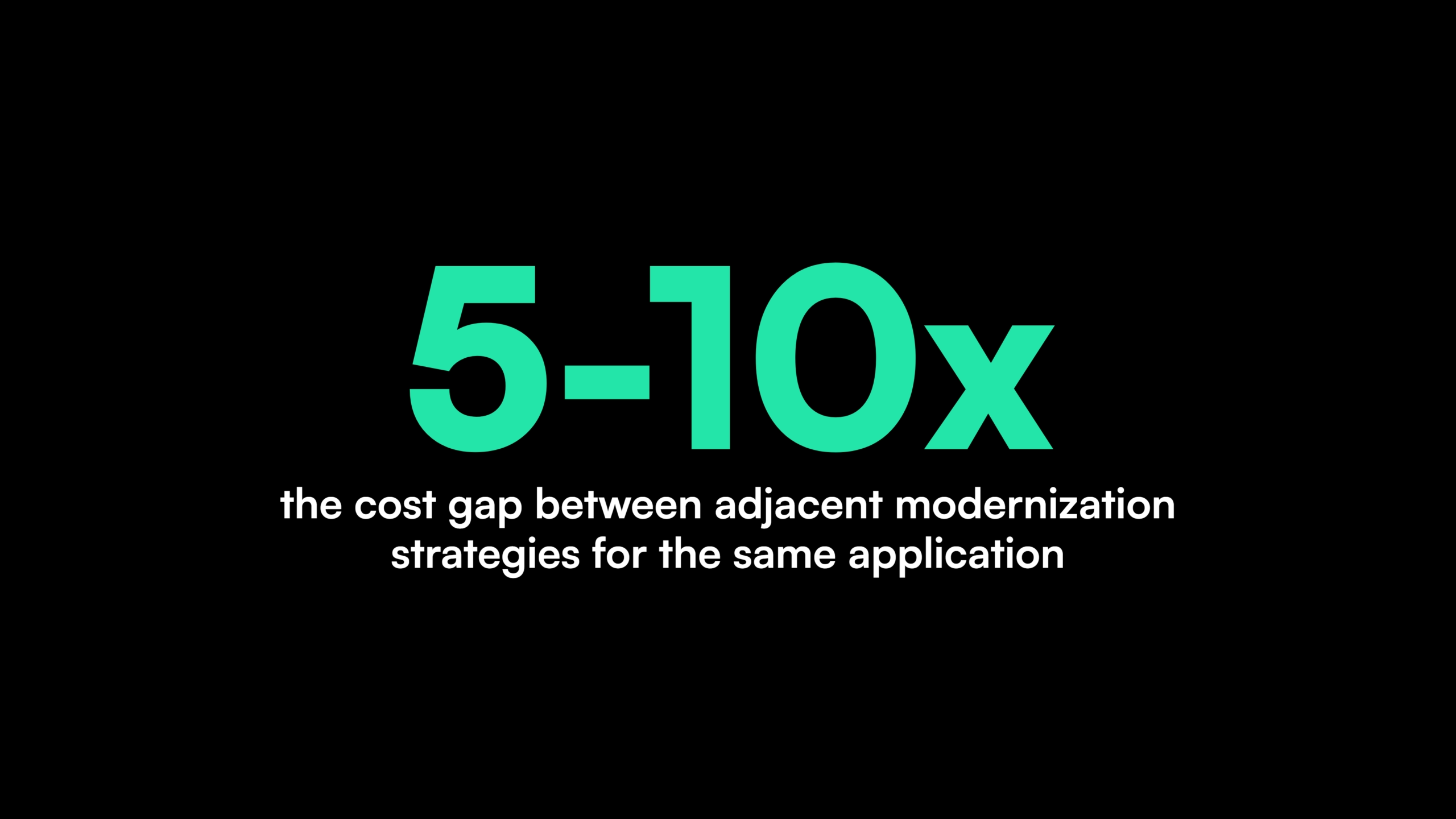
For a single application, replatforming and refactoring can look similar in a proposal and cost very differently in delivery. The gap between adjacent strategies commonly runs 5 to 10 times for the same application, driven by how much of the existing code and data model carries forward.
Over-investing in a rebuild an application doesn’t need, or under-investing in a replatform that can’t reach its target state, is a bigger cost driver than which cloud platform gets chosen.
Why Manual Application Portfolio Assessment Slows Cloud Modernization Programs
The strategy decision above has to be made once per application, across an estate that can run into the hundreds. Manually, that means an architect or consultant reviewing code, dependencies, and data flows one application at a time, often starting from incomplete documentation.
At that pace, assessment itself becomes the bottleneck before modernization work begins. Strategy choices also get inconsistent across a large portfolio when the people making them change over a multi-month engagement, or when assessment quality depends on which consultant got staffed to which application.
McKinsey research on enterprise cloud migration found the average organization spends 14% more than planned every year, with overruns exceeding $100 billion globally across three years [2]. Delays follow the same pattern, with 38% of organizations slipping a full quarter or more past their planned timeline [2].
The organizations that migrate on schedule and on budget share specific traits: active executive sponsorship, a documented roadmap before work starts, and dedicated DevOps and FinOps hiring [2].
Hundreds of small assessment decisions, made under time pressure without a consistent method across the portfolio, add up to that pattern.
Start a $0 Modernization Assessment

 +more
+moreTraditional Systems Integrator Delivery vs. AI-Platform-Led Cloud Modernization
Most cloud modernization services get evaluated as a choice between named vendors, one systems integrator against another, or against a boutique specialist. That comparison skips a more consequential decision sitting underneath it. The real choice is whether the engagement is staffing-led or platform-led.
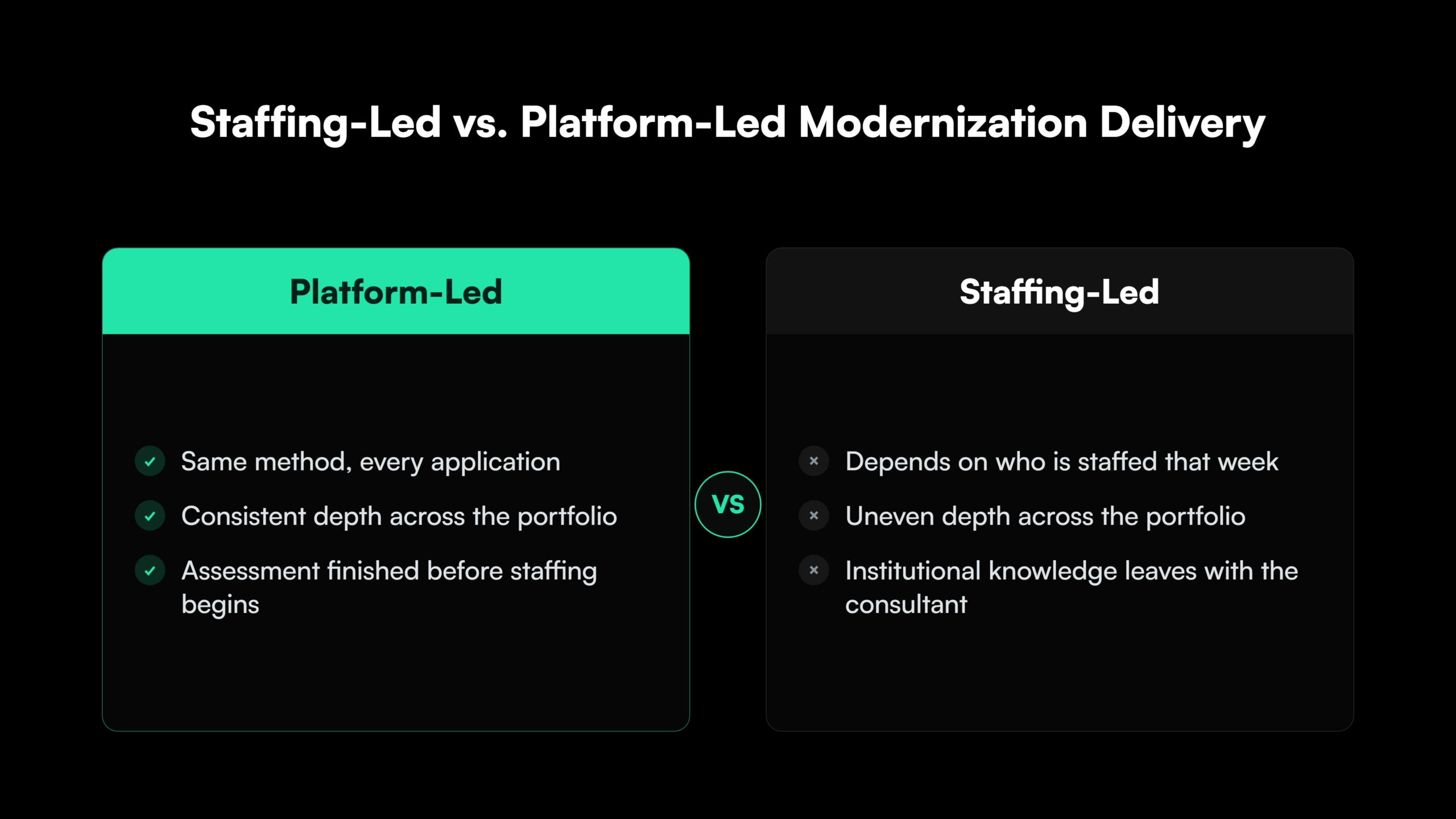
A staffing-led engagement bills time and materials against whichever consultants get assigned. Assessment quality depends on who’s on the team that week. Documentation, where it exists, gets built by hand, one application at a time, and institutional knowledge leaves when a consultant rotates off the account.
A platform-led engagement runs the same assessment method against every application in the portfolio, consistently, before any consultant or engineer is assigned to execute. That consistency is the mechanism behind a faster, more predictable cloud modernization program. It is a claim about assessment quality no longer depending on which specific person is staffed that week.
What Changes When Application Assessment Is AI-Assisted
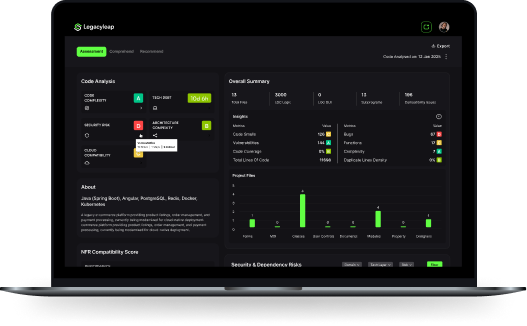
Legacyleap’s Assessment Agent and Documentation Agent read the full codebase, not a sample, before any transformation work is scoped. That produces a dependency map, a risk and complexity assessment, and a migration effort estimate for every application in the portfolio. The result lands in 2 to 5 days, not the weeks a manual review of the same estate would take.
Because the same method runs against every application, the strategy call from the previous section, rehost, replatform, refactor, or otherwise, gets made the same way regardless of portfolio size or which engineer reviews which system. That is what closes the cost-gap risk described above. The decision itself still needs a human sign-off; what changes is that the input reaching that decision is now consistent and complete.
What AI-Assisted Assessment Does Not Replace
Roughly 70% of the modernization work itself is automated once a strategy is set. Architecture decisions, and everything before them, stay with engineers.
The Assessment and Documentation Agents surface the dependency map and the effort estimate. They do not decide the target architecture, sign off on business logic, or approve a release. All code changes ship as diff-based pull requests, reviewed by engineers before anything merges, and no code deploys without that review.
A vendor claim that skips human review at the architecture or release stage relocates risk into production rather than removing it.
Where a specific vendor or platform fits into that broader landscape, spanning hyperscalers, systems integrators, and point tools, is its own evaluation exercise. A full breakdown of application modernization platforms and providers covers where each category’s responsibility starts and stops.
What to Ask a Cloud Modernization Services Provider About Their AI Tooling
The distinction between staffing-led and platform-led delivery only matters if it changes what gets asked in a vendor conversation. A handful of direct questions separate a credible platform from a relabeled staffing engagement:
- What does the tooling assess: dependencies, business logic, and data flows, or just file structure and syntax?
- What percentage of the transformation is automated, and what specifically requires human review before it ships?
- Does the assessment run once at the start, or does it inform every application’s strategy choice individually?
- How does the proposed timeline change once the assessment is complete, and is that estimate portfolio-wide or per application?
- What happens to documentation and decisions already made if a specific engineer or consultant leaves the engagement?
A vendor that answers “our consultants handle that” for the assessment or validation questions is describing a staffing engagement with an AI label attached, not a platform.
See the Assessment in Practice
A Technical Demo walks through how the Assessment and Modernization Agents evaluate an application portfolio and apply the seven-strategy framework end to end.
Cloud Modernization Services Cost and Timeline: What Realistic Ranges Look Like
Cost and timeline both trace back to the strategy mix from the section above, not to a flat per-application rate. A portfolio weighted toward rehost and replatform work moves faster and costs less than one weighted toward refactor and re-architecture, because the effort levels in that table are not distributed evenly by accident.
| Strategy Tier | Typical Timeline (per application) | Typical Cost Driver |
| Rehost / Relocate | Days to a few weeks | Infrastructure and licensing, minimal engineering effort |
| Replatform / Repurchase | Weeks to a few months | Targeted engineering effort plus data migration |
| Refactor / Re-architect | Months, sometimes over a year for a single complex application | Architecture redesign, data model changes, extensive testing |
Beyond the strategy mix, four factors move cost most within a given tier: how complete the existing documentation is, how many distinct legacy technology stacks are in scope, whether compliance requirements such as HIPAA, PCI-DSS, or FedRAMP apply, and how much validation the target application needs before cutover. Two applications on the same strategy tier can still land at very different price points once these are factored in.
McKinsey’s research shows overruns are common against these baselines, with the average enterprise overspending 14% against plan annually and delays past a full quarter affecting more than a third of organizations [2]. Every additional month an application spends unmodernized is also a month it keeps costing what an unmodernized legacy estate already costs to run, a cost that compounds regardless of which modernization strategy eventually gets chosen.
A $0 Modernization Assessment replaces industry ranges with a program-specific number: architecture diagrams, a dependency map, and a modernization timeline and cost estimate for the actual portfolio in scope, delivered in 2 to 5 days.
How Legacyleap Approaches Cloud Modernization Across the Full Lifecycle
Legacyleap is a Gen AI-powered legacy application modernization platform built on multi-agent orchestration, structured around five agents that carry a cloud modernization engagement across its full lifecycle: Assess, Comprehend, Modernize, Validate, and Deploy.
The Assessment Agent and Documentation Agent produce the dependency map, risk indicators, and architecture documentation described earlier, built from full-codebase grounding rather than sampling or interviews.
That grounding matters most on estates that mix multiple legacy stacks, a Java service layer sitting alongside a .NET front end, for example. It also matters on applications with little to no existing documentation, where a sampled review would miss cross-system dependencies entirely.
The Recommendation Agent applies the seven-strategy framework per application, at portfolio scale, rather than leaving that call to whichever consultant is available that week.
The Modernization Agent executes the transformation as diff-based, human-reviewed pull requests, with roughly 70% of the work automated and every change reviewed before it merges.
The QA Agent auto-generates unit, integration, regression, and functional test cases, and validates functional parity against the legacy baseline before cutover. That matters most on large, undocumented, or polyglot estates, where manual test coverage was never built in the first place.
All processing runs inside the client’s own infrastructure, and no source code leaves the client’s environment during assessment or modernization. A $0 Modernization Assessment is the standard entry point, a fixed-scope, no-cost technical exercise producing the same artifacts described throughout this piece for one representative codebase.
This is the same agentic AI approach to modernization, applied consistently across comprehension, transformation, and validation instead of one phase at a time.
Choosing a Cloud Modernization Services Partner
Two decisions determine most of the outcome in a cloud modernization program: which strategy fits each application, and which delivery model applies that strategy consistently across the whole portfolio. Neither decision is answered by comparing vendor logos or reading another accelerator pitch.
A $0 Modernization Assessment answers both for a specific codebase: which strategy each application needs, and what a platform-led engagement finds that a staffing-led one would take weeks longer to surface.
Get Your Portfolio’s Strategy Map
A $0 Modernization Assessment maps every application in scope against the seven strategies and returns a program-specific cost and timeline estimate in 2 to 5 days, with no source code leaving your environment.
FAQs
Migration relocates an application to cloud infrastructure without changing its architecture. Modernization changes how the application is built, which is why the per-application strategy choice, not the hosting decision, drives most of the cost.
Cost tracks the strategy mix across the portfolio. Rehost and replatform work typically costs far less than refactoring the same application, with the gap between adjacent strategies commonly running 5 to 10 times.
A single rehost can take days to a few weeks. A refactor of a complex, differentiating application can run months or longer, with portfolio timelines set by how applications are assessed and grouped by strategy.
Platform choice is separate from strategy selection and is usually set by existing enterprise agreements and data residency needs. It affects deployment details, not which strategy a given application needs.
It changes assessment consistency across a portfolio, not the engineering judgment behind a release. The real distinction is whether a vendor’s tooling reads the full codebase to inform every application’s strategy, or accelerates code-level tasks after the strategy was already guessed at.
References
[1] IBM. The 7 R’s of cloud migration
[2] McKinsey & Company. Cloud migration: The opportunity’s growing. So are the missteps.