TL;DR
- Cloud-native transformation re-architects the application. Cloud migration only relocates it. Treating the two as interchangeable is why lift-and-shift projects keep hitting the same wall on monolithic systems.
- Which applications to retire, replace, or transform matters more than how you transform them. A full-codebase dependency-mapping pass, run before that decision, catches coupling a manual audit typically finds only after cutover.
- Cultural resistance has overtaken technical debt as the leading barrier to cloud-native adoption. The 2026 CNCF Annual Cloud Native Survey found culture ranked as the top challenge for the first time, ahead of any technical concern.
- AI increasingly performs the modernization work itself: dependency mapping, refactoring, re-architecting. That is a different claim than AI making cloud infrastructure run better once the work is done, and it is the part of this story most guides on the topic still miss.
A cloud migration and a cloud-native transformation solve different problems, but enterprise IT teams still budget, staff, and schedule them as if they were the same project. That confusion is expensive.
A legacy system lifted onto cloud infrastructure without being re-architected carries its tight coupling, undocumented business logic, and technical debt straight into the new environment. It arrives at cloud rates instead of data-center rates.
This piece treats the migration-versus-transformation distinction as the known part and spends its time on what has changed since most guides to this topic were written. AI now performs a meaningful share of the transformation work itself: dependency mapping, refactoring, re-architecting. Historically, AI’s role in cloud-native projects has been limited to running the infrastructure that transformation produces.
What Is Cloud-Native Transformation, and How Is It Different From Cloud Migration?
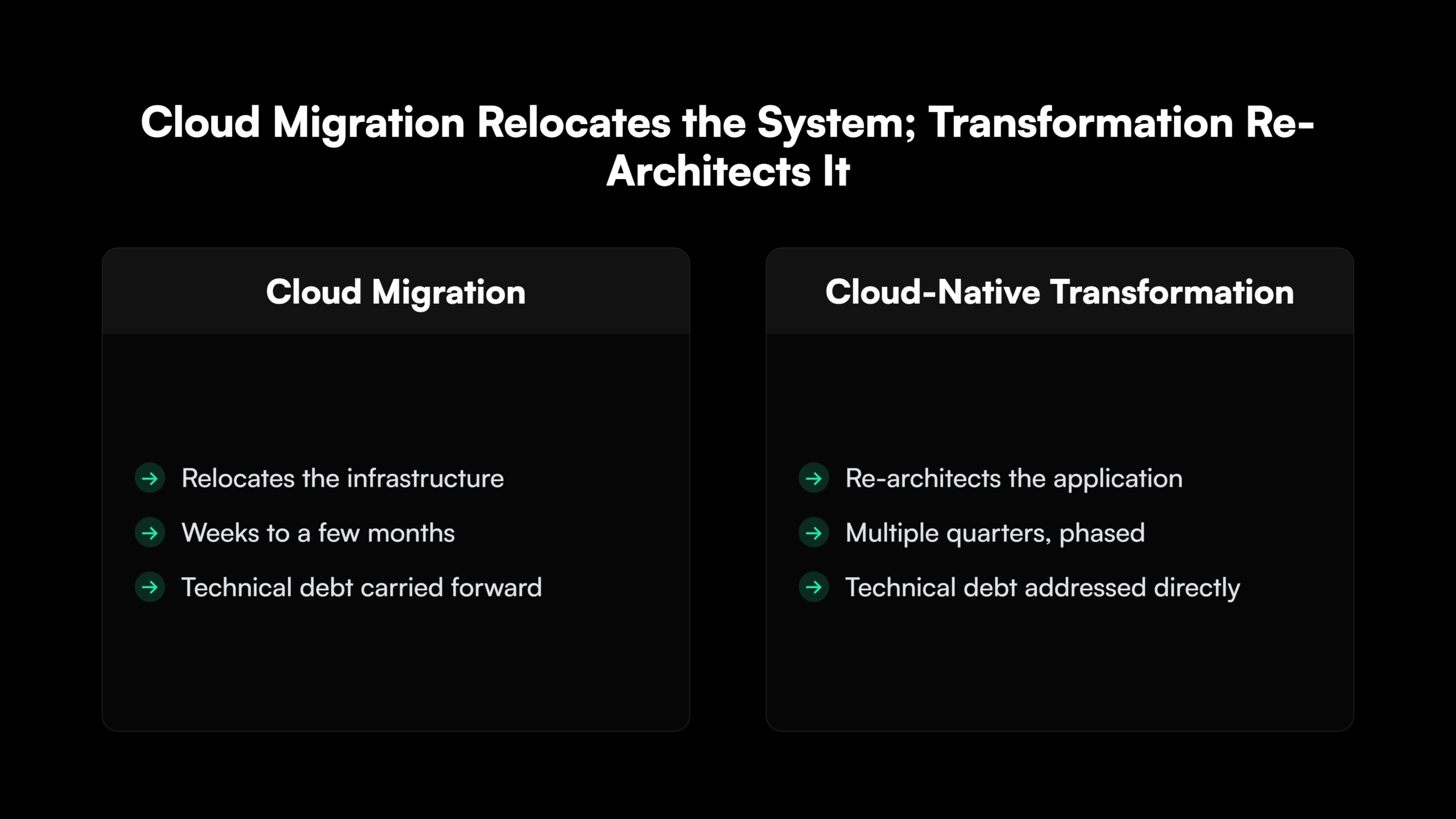
Cloud migration relocates an existing system onto cloud infrastructure with the architecture largely unchanged, commonly called lift-and-shift. Cloud-native transformation re-architects the application itself to run on cloud-native patterns: microservices instead of a monolith, containers instead of a fixed server, orchestration instead of manual scaling, automation instead of manual release cycles.
The distinction matters because the two produce different outcomes for the same investment. A migrated monolith runs on newer hardware and still fails the same way it failed on-premises.
A transformed application behaves differently:
- Scales a single overloaded service without touching the rest of the system
- Deploys independently
- Recovers from a failure in one component without taking down the whole application
| Cloud Migration | Cloud-Native Transformation | |
| What changes | Infrastructure location | Application architecture |
| Typical timeframe | Weeks to a few months | Multiple quarters, phased |
| Risk profile | Lower short-term risk, debt carried forward | Higher short-term complexity, debt addressed |
| Typical outcome | Same system, new hosting bill | Independently deployable, independently scalable services |
A cloud modernization strategy that treats these as one project usually ends up doing neither well. The migration timeline gets padded to account for re-architecture work nobody scoped, or the transformation gets cut down to fit a migration-sized budget.
Vendors sometimes blur this line further by pricing a migration and calling it a transformation, since a like-for-like move to managed cloud services is easier to scope and sell than an architectural rebuild. The gap shows up months later, when the promised gains in resilience or release speed never materialize because the underlying monolith never changed shape.
Why Do Legacy Monolithic Systems Resist Cloud-Native Transformation?
Lift-and-shift works reasonably well for a system with clean boundaries and few dependencies. Most enterprise legacy systems have neither. A ten- or twenty-year-old monolith accumulates problems a clean system does not carry:
- Shared database tables accessed by a dozen different modules
- Business logic embedded in stored procedures nobody has touched since the person who wrote them left
- Implicit dependencies that surface only when something downstream breaks
Two numbers explain why this problem is bigger than any one system. Federal agencies alone spend more than $100 billion a year on IT, and roughly 80 percent of that goes to operating and maintaining systems that already exist rather than modernizing them [1].
Across the broader US economy, the total cost of poor software quality reached $2.41 trillion in 2022. Roughly $1.52 trillion of that is attributable to accumulated technical debt specifically [2].
That debt does not disappear when a system moves to the cloud. It moves with it, unless something addresses the architecture directly.
The coupling inside a monolith architecture travels with it regardless of where it runs. Re-architecting it resolves that coupling. Relocating it does not.
Start a $0 Modernization Assessment


 +more
+moreHow Do You Decide What to Retire, Replace, or Transform?
Not every application in a legacy portfolio deserves the same treatment. Before any re-architecture work starts, each application needs a disposition decision.
| Disposition | Typical Trigger | What Happens Next |
| Retire | Low or no remaining business value, redundant with another system | Decommission, migrate any needed data, shut down |
| Replace | Commercial or SaaS alternative already covers the function well | License and integrate the replacement, retire the original |
| Transform | High business value, high technical debt, no adequate replacement exists | Re-architect for cloud-native patterns, in phases |
The hard part is not the framework. It is knowing, with confidence, which bucket a given application belongs in.
That requires understanding what the application does and what depends on it before anyone commits to a plan.
Getting that decision right, application by application, is what turns a one-off re-architecture project into an actual cloud modernization strategy rather than a set of disconnected system rewrites.
What Does AI-Assisted Dependency Mapping Reveal?
A manual dependency audit typically works from documentation, interviews with whoever is still around, and sampling a subset of the codebase. It is slow, and it misses things.
Three kinds of coupling typically surface only after cutover, once something breaks in production:
- Cross-service calls that were never documented
- Database tables read by a reporting job nobody remembers building
- Configuration-driven behavior that changes what a module does at runtime
An automated pass across the full codebase surfaces that same coupling while the modernization plan is still being built. A sample-based pass surfaces it only after something ships.
It builds a complete map of what calls what, what reads and writes which data, and where a change in one module changes behavior somewhere else entirely. That map, along with a realistic effort and risk estimate, is what informs the retire, replace, or transform decision for each application.
Legacyleap’s own comprehension layer works this way: it reads the whole codebase before any transformation starts, rather than sampling it, and keeps that understanding current as the transformation proceeds.
That mapping work also determines whether the transformation happens all at once or as an incremental, module-by-module migration. A monolith with genuinely independent modules can be extracted one service at a time. One with deeply entangled shared state needs those dependencies decoupled first, before any single service can be safely pulled out.
What Are the Biggest Risks in Cloud-Native Transformation?
Every guide to this topic names the same three failure modes:
- Technical debt carried forward instead of resolved
- A shortage of engineers who know both the legacy stack and cloud-native patterns
- Organizational resistance to changing how teams build and release software
All three are real. None of them is currently the biggest one.
The 2026 CNCF Annual Cloud Native Survey found that cultural change with development teams is now the top challenge to container deployment, cited by 47 percent of respondents [3]. That is the first time culture has outranked technical concerns in the survey’s history.
Adoption of cloud-native technology overall reached 98 percent among surveyed organizations. Kubernetes hit 82 percent production usage among container users [3].
The infrastructure problem is largely solved. The organizational one is not.
The same 2026 CNCF survey found GitOps adoption split sharply by organizational maturity. None of the least mature organizations surveyed had adopted GitOps workflows, against 58 percent of the most mature ones [3]. That gap tracks the same pattern as the culture finding above: the technology arrives well ahead of the organizational discipline needed to run it.
Separately, a 2024 survey of 500 US business and technology leaders found that 92 percent of organizations carry some form of technical debt today. Eighty percent reported a delayed or canceled business-critical project in the prior twelve months because of it [4].
Put together, the sharpest risk in a cloud-native transformation is moving into execution before the organization understands what it is changing. Teams under pressure to show progress cut corners in predictable ways:
- Refactoring before the dependency map is complete
- Committing to a target architecture before the retire-replace-transform decision is settled
- Splitting a monolith along boundaries that looked obvious from the outside but do not match how the system behaves
This is the one failure mode that assessment speed genuinely addresses. Comprehension has to precede transformation. It cannot follow it.
When the comprehension phase takes months, teams face real pressure to shortcut it. When it takes days instead, there is no longer a good reason to skip it.
Architectural Clarity Before Execution
Execution pressure cuts architectural clarity first. A $0 Modernization Assessment produces that clarity before any code changes, built from what the system does today rather than what the documentation claims.
How Is AI Changing Cloud-Native Transformation in 2026?
Every widely read guide to cloud-native transformation that mentions AI at all frames it the same way. AI workloads need elastic, cloud-native infrastructure to run, and AI-driven tooling can optimize that infrastructure once it exists.
Both are true. Neither is the part of the story that changes how a transformation project gets executed.
The CNCF survey above also found that AI deployment maturity is still early. Only 7 percent of organizations deploy AI models daily, and more than half do not train models at all, prioritizing reliable operation of pre-trained models instead [3].
That is worth naming plainly, because it keeps this argument honest. The shift described here is not that AI runs enterprise modernization end to end. It is that AI now performs specific, previously manual pieces of the transformation work directly, with a human reviewing the output at every step.
AI now performs several specific, previously manual pieces of this work directly:
- Full-codebase dependency mapping, covered above
- Code comprehension: reconstructing what an undocumented system does from its source rather than from stale documentation
- Generating a first-pass refactored service boundary
- Generating a migration script
- Generating a test suite that checks the new code behaves like the old code
None of this work used to be something software did. It used to be billed by the hour to a consulting team, or absorbed by whatever engineers on staff already knew the legacy stack well enough to attempt it.
| Manual Approach | AI-Assisted Approach | |
| Comprehension | Weeks to months, sampled review, relies on available documentation | Days, full-codebase read, current regardless of documentation state |
| Dependency mapping | Interview- and sample-driven, gaps surface after cutover | Automated, surfaces coupling before the plan is finalized |
| Refactoring | Hand-written, reviewed after the fact | Machine-generated, reviewed before merge |
| Validation | Manual test writing, partial coverage | Machine-generated test cases, checked against the legacy baseline for parity |
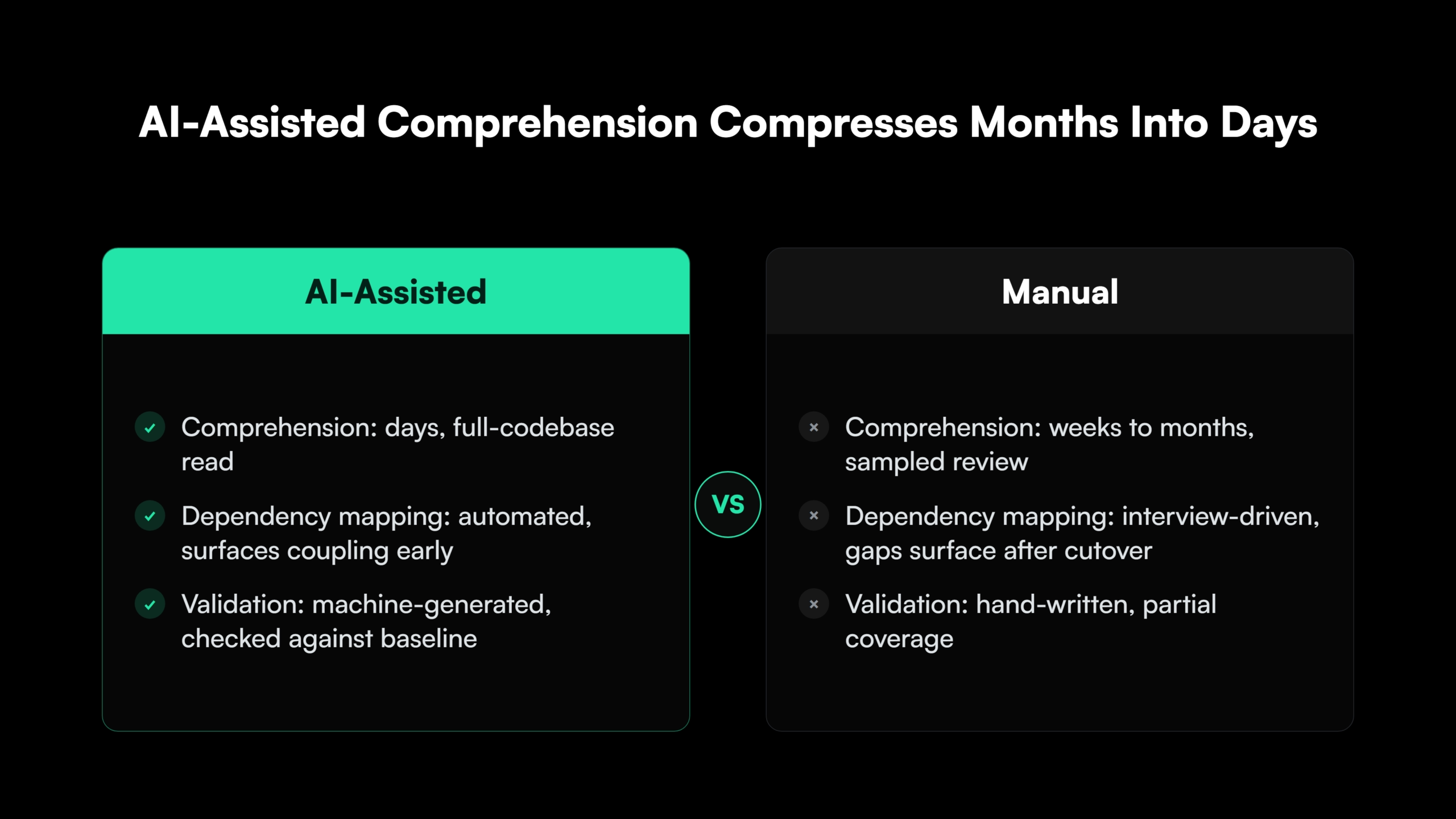
This is where cloud native modernization looks different from the 2025-era guidance already published on the topic.
The infrastructure layer was the first thing to get automated. The comprehension and transformation layer is next, and it is the layer every top-ranking piece on this exact keyword still skips.
How Does Cloud-Native Transformation Affect the Data Layer?
Application-layer transformation rarely happens in isolation from the data underneath it. A monolith being broken into services usually reads and writes a shared database that assumed a single application had exclusive access to it.
Splitting the application without addressing that assumption just moves the coupling problem from the code into the database.
The same dependency-mapping pass that informs the retire-replace-transform decision at the application layer should extend to the data layer. It should identify:
- Which services will need their own dedicated data store
- Which shared tables have to be decomposed first
- Which reporting or analytics jobs quietly depend on a table structure the new architecture is about to change
How Legacyleap’s Five AI Agents Handle Cloud-Native Transformation
Legacyleap is a Gen AI-powered legacy application modernization platform built on multi-agent orchestration, five specialized agents that execute the modernization lifecycle rather than a single model that assists with parts of it. Each agent maps to a stage of the same lifecycle described above: Assess, Comprehend, Modernize, Validate, Deploy.
That five-stage lifecycle is what a cloud modernization strategy looks like once AI performs the execution work directly, rather than a framework a team maps by hand onto separate, loosely connected projects.
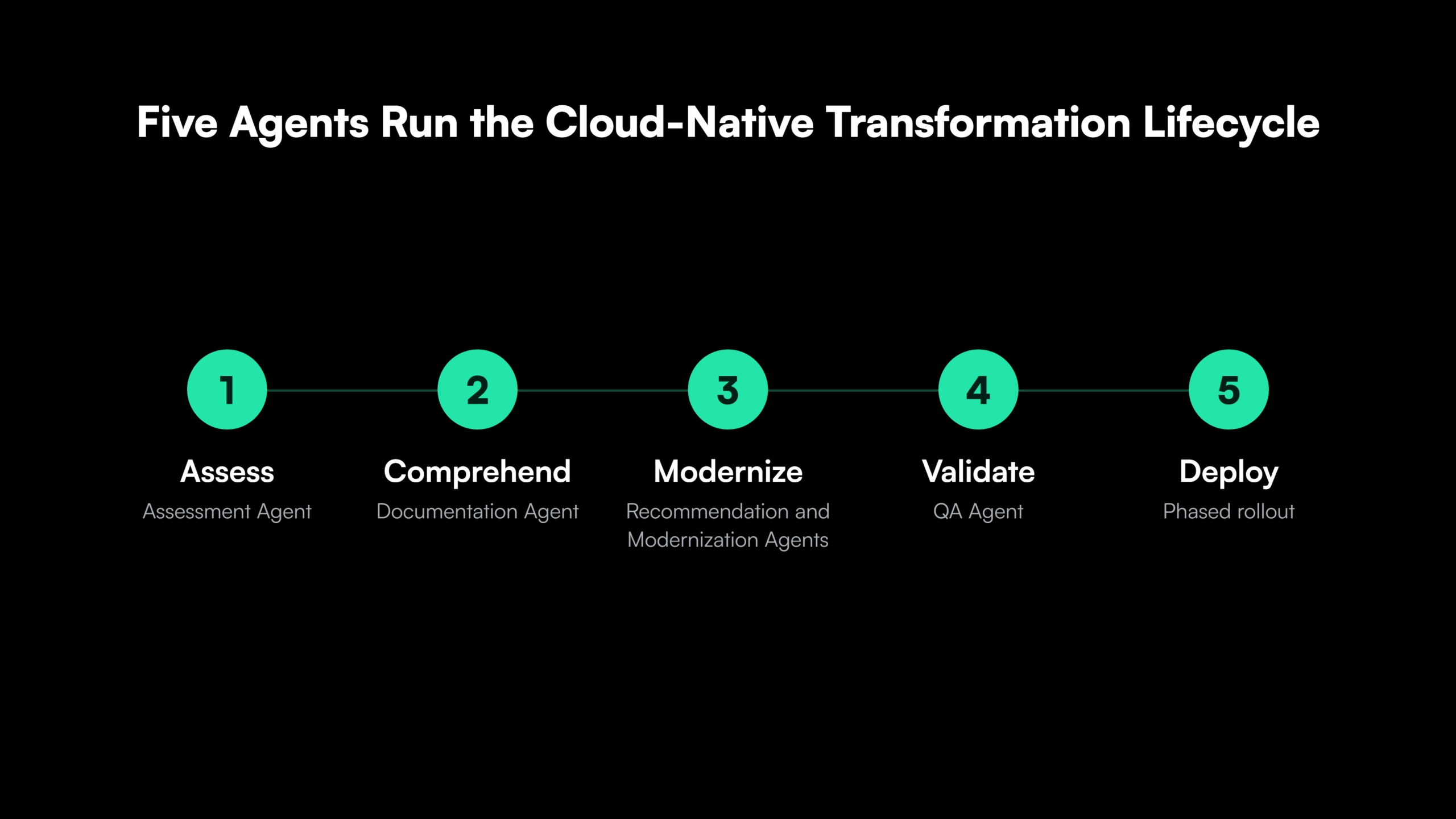
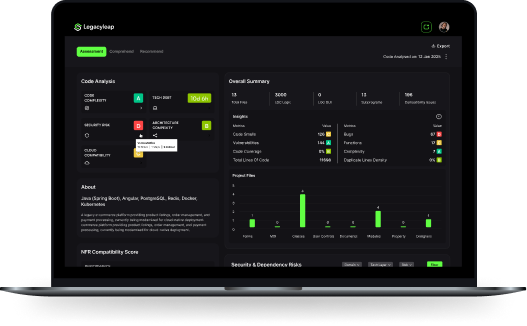
The Assessment Agent produces the technical debt report, dependency map, and risk indicators that inform the retire, replace, or transform decision covered earlier.
The Documentation Agent reconstructs architecture diagrams, module boundaries, and data flows directly from the codebase, the mechanism behind full-codebase grounding rather than sampled review.
The Recommendation Agent turns that comprehension into an ordered migration plan, deciding which modules to transform first, which to retire, and what the target architecture should look like.
The Modernization Agent generates the actual refactored code and pull requests. Roughly 70 percent of the modernization work is automated this way, with the remaining share handled by engineers reviewing and completing the business logic the agent flags as low-confidence.
Every change arrives as a diff-based pull request for human review. Nothing merges, deploys, or executes without that review.
The QA Agent then validates functional parity against the legacy baseline before anything reaches production, generating unit, integration, and regression test cases and comparing behavior directly rather than assuming it matches.
This matters most on the codebases most likely to get avoided rather than scheduled: large, undocumented, or polyglot systems where no single engineer holds the full picture. Full-codebase grounding does not depend on the codebase being in one language or having current documentation to begin with.
The entire process runs inside the customer’s own environment. Source code does not leave the client’s infrastructure at any stage.
Enterprises that want to see this against their own codebase before committing to anything can start with the $0 Modernization Assessment. It is a zero-cost, no-obligation pass that delivers a dependency map, risk and complexity heatmap, and a modernization plan in 2 to 5 days, on a representative codebase.
What Does an AI-Assisted Cloud-Native Transformation Look Like in Practice?
The following is a composite, built from patterns typical of enterprise cloud-native engagements rather than one specific named client. No single published case study covers this exact combination of application-layer and data-layer transformation.
Consider a mid-market financial services company running a fifteen-year-old policy administration monolith. The system has no current architecture documentation and a small internal team that inherited it rather than built it.
It also carries a mandate to support new digital products, something the current release process cannot accommodate without a full rewrite.
A manual comprehension and dependency-mapping phase for a system this size typically runs four to eight weeks before any transformation work can start. Even then, it relies on sampling rather than a complete read of the codebase.
An AI-assisted assessment covering the full codebase completes in 2 to 5 days. It produces the same dependency map, architecture reconstruction, and risk heatmap a manual pass would eventually produce, without the sampling gaps.
From there, roughly 70 percent of the resulting modernization work, the actual refactoring into independently deployable services, is generated directly rather than hand-written. Engineers review every diff and complete the business logic the system flags as uncertain.
Functional parity against the original system is validated before any cutover. It is not assumed afterward.
The compressed timeline is not the only benefit. The comprehension phase finishing in days instead of months removes the exact pressure, described earlier, that pushes teams into execution before the architecture is understood.
Next Steps for Cloud-Native Transformation
Cloud native transformation and cloud migration solve different problems, and only one of them addresses the technical debt a legacy system carries. Deciding what to retire, replace, or transform, grounded in a complete dependency map rather than a partial one, is the decision that determines whether the rest of the project goes well.
A cloud modernization strategy that gets this sequence right, comprehension before disposition, disposition before execution, is what separates a transformation that compounds from one that stalls halfway through the portfolio.
What has changed by 2026 is who does the comprehension and transformation work. AI used to only run the infrastructure that work produced.
Now it performs the work directly, with a human reviewing every step. That shift is what makes architectural clarity achievable on the same timeline pressure that used to force teams to skip it.
See Your Own System’s Dependency Map
A $0 Modernization Assessment is a low-friction way to see what a complete dependency map and modernization plan look like for your specific system. It runs at no cost, with no source code leaving your environment.
FAQs
No. Kubernetes is the most common orchestration choice, but the defining trait is the architecture itself. An application counts as cloud-native when its services are independently deployable and independently scalable, regardless of which orchestration tool runs them.
Most integration contracts, APIs and message formats, usually survive unchanged. What typically needs rework is any integration built directly against the monolith’s internal database, since that access pattern rarely survives the transformation.
A phased, module-by-module extraction can pause after any single service is completed without stranding the rest of the system. That is one reason phased execution is more common than a single big-bang rewrite.
The underlying obligations usually stay the same, but independently deployable services make evidencing compliance easier, since access controls and audit logging can be enforced consistently service by service rather than across one large monolith.
Enterprise architects usually define the target state, application owners supply domain knowledge, and engineering teams execute and review, with a program lead coordinating the retire, replace, or transform decisions across the portfolio.
Usually yes. A cloud-native architecture bills for the capacity each service uses, rather than the flat capacity needed to run the whole application. That is typically where the cost profile shifts most.
References
[1] U.S. Government Accountability Office. Information Technology: Agencies Need to Plan for Modernizing Critical Decades-Old Legacy Systems
[2] Consortium for Information & Software Quality. The Cost of Poor Software Quality in the US: A 2022 Report
[3] Cloud Native Computing Foundation. Kubernetes Fuels AI Growth; Organizational Culture Remains the Decisive Factor, 2026 Annual Cloud Native Survey
[4] Morning Consult and Unqork. 2024 Survey: Technical Debt Stifles Innovation at 80% of Enterprises Surveyed