TL;DR
- NDC airlines in the US still sell about four in five agency transactions outside NDC. ARC put NDC at 20.9% of settled agency transactions in October 2026, a 1% increase on the previous year.
- NDC changes how an airline sells, and ONE Order changes how the sale is recorded. The PNR, e-ticket and EMDs give way to a single Order, and ARC began settling orders in January 2026.
- Airline-owned code still reads tickets, EMDs and booking-class letters. Revenue accounting feeds, servicing tools, loyalty accrual, agency portals and reporting all have to work from the Order.
- Translation layers only cover the gap for the next few years. IATA expects early PSS decommissioning to begin in 2027 and leading airlines to remove PSS dependency in 2028-29, so parity tests between the ticket path and the order path belong in the plan now.
ARC’s October 2026 release put NDC at 20.9% of the transactions it settled for US travel agencies, a 1% increase from the previous year. For NDC airlines that have spent years on incentives, GDS agreements and agency onboarding, that pace points to the legacy systems behind the API.
Those systems belong to the airlines. American and United have sold through NDC for years, and Southwest plans an in-house direct connect by the end of 2026 and Amadeus Altéa NDC in 2027. At each carrier, distribution, commercial technology and revenue accounting teams maintain code written for PNRs, e-tickets and fare classes. That code sits outside the PSS, in the same airline-built layer covered in airline IT modernization.
This guide covers which of those systems change as airlines move from tickets to offers and orders, and where translation layers stop helping. It then sets out how to modernize the code while refunds, exchanges and settlement keep returning the same results.
NDC Airlines in the US and Why Adoption Has Slowed
NDC reaches more US agencies than it did, and still carries a minority of their airline sales. ARC’s October 2026 release counted 1,322 agencies reporting NDC transactions, while NDC made up about one in five ARC-settled transactions.
American Airlines pushed agencies toward NDC and then reversed course. In 2024 it reinstated competitive fares in the channel agencies and corporate travel programs use, and renegotiated corporate and agency contracts. American also said the earlier strategy would keep weighing on revenue for the rest of that year.
Agency objections centered on servicing: exchanges, schedule changes, refunds and back-office settlement. Servicing is where an NDC sale meets systems built for tickets. Alaska Airlines’ NDC documentation shows the limit from the airline side. Its NDC API, on schema 21.3, does not yet support voluntary exchanges, cannot cancel previously exchanged tickets, and returns ticket numbers through an OrderRetrieve call after the order is created.
The four US carriers below show the pattern:
| Carrier | NDC position | What it shows about the systems behind NDC |
| American | Live in NDC, with competitive fares back in agency EDIFACT channels after its 2024 reversal | Pushing agencies onto NDC cost American revenue |
| United | Live in NDC, with continuously priced offers unavailable over EDIFACT since its 2023 Sabre launch | Fares now exist outside the booking-class ladder older code expects |
| Alaska | Proprietary NDC API on schema 21.3, no ARC or BSP settlement | NDC orders still produce e-tickets and EMDs underneath |
| Southwest | In-house direct connect by end of 2026, Amadeus Altéa NDC in 2027 | Each new channel adds another path into the same downstream systems |
NDC requires modernizing legacy systems because the API covers how offers are built and sold, and the records created after the sale stay the same. Behind it, airlines still record each sale as a PNR, an e-ticket and EMDs, priced in booking classes and settled as tickets. The airline-owned code for revenue accounting, servicing, loyalty and reporting reads those records, and it has to work from orders before NDC can carry full volume.
What Changes When Airlines Move From Tickets to Offers and Orders
The records behind an NDC sale are the next thing the industry plans to change. IATA places NDC in the offers phase of its model, where NDC messages carry shopping, pricing, booking and changes between airline and seller. IATA ONE Order governs the airline’s own record of the sale.
IATA’s ONE Order fact sheet, updated June 2026, describes the standard as consolidating PNRs, e-tickets and EMDs into a single Order. Accounting moves from tickets and EMDs to payment for the services ordered.
The US settlement side has started to move. On January 27, 2026, ARC launched what it calls the air travel industry’s first orders-based reporting and settlement system. The first release handles orders paid with a cash form of payment, and ARC plans to support orders alongside GDS EDIFACT and NDC transactions.
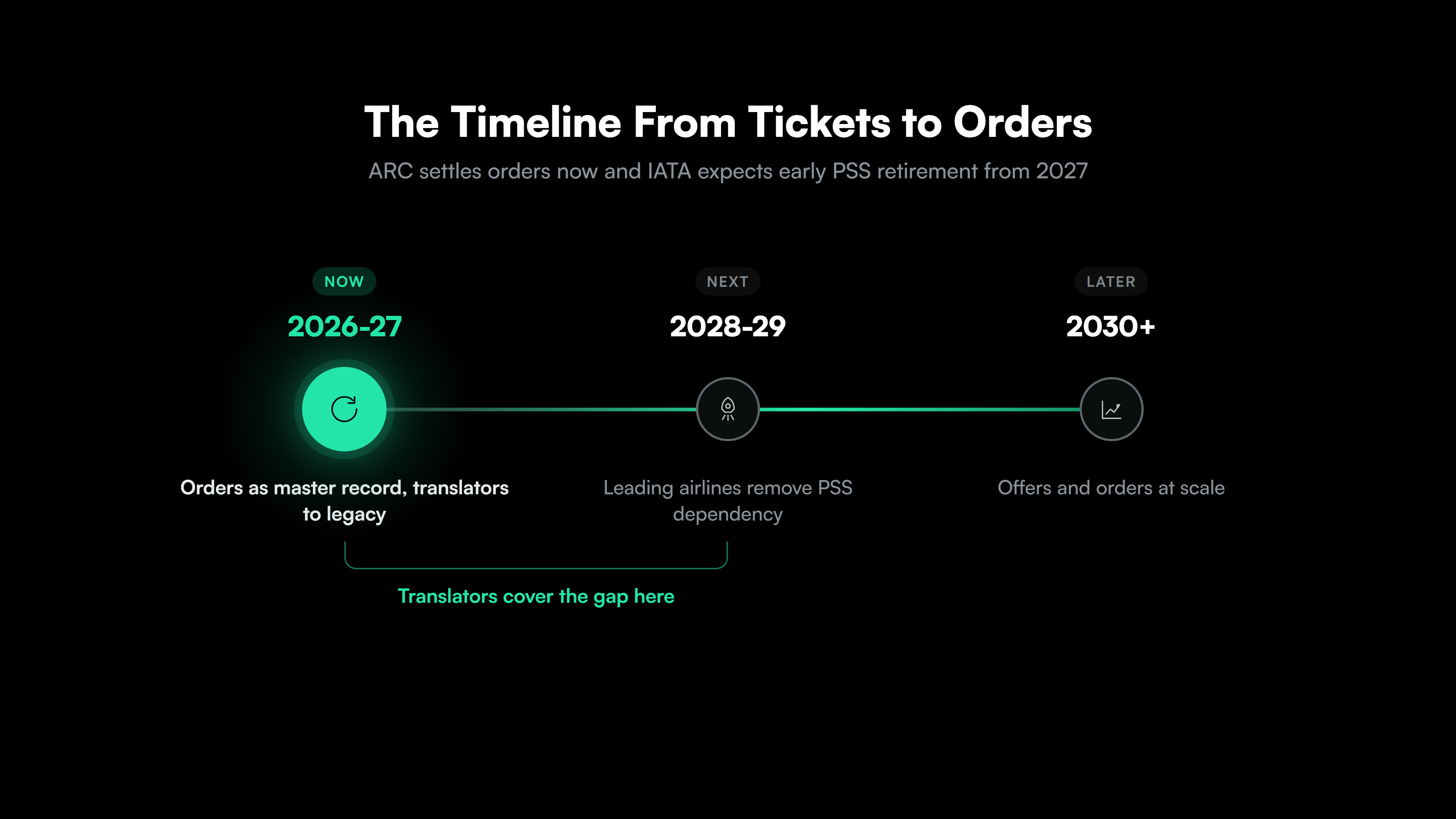
IATA’s 2025 Annual Review sets out the airline timeline:
- 2026-27: Leading airlines test on the direct channel, use Orders as the master record and run translators to legacy systems.
- 2028-29: Leaders use native offers and orders capabilities and gradually remove their dependency on the PSS. The first offers and orders interline deployments follow.
- 2030 and later: Offers and orders become mainstream, interline included, and legacy standards are decommissioned after 2030.
IATA’s 2026 Annual Review reports that modern airline retailing moved from preparation to implementation in 2025. As of February 2026, 10 airlines or airline groups had signed contracts with an IT provider to deploy offers and orders solutions, and almost 50 airline trials and proofs of concept were underway. The same review expects early PSS to be gradually decommissioned beginning in 2027.
Pricing is changing at the same time. When United launched NDC offers in Sabre in 2023, its lowest third-party offer was generated with continuous pricing, content unavailable to agencies shopping United over EDIFACT. Code that assumes every fare maps to a filed fare and a booking-class letter no longer sees the full set of prices.
Each legacy record has an order-world equivalent and a set of airline-owned systems that depend on it:
| Legacy record | Order-world equivalent | Airline-owned code that assumes the legacy record |
| PNR | Order | Agency and call-center tools, reaccommodation, customer service lookups |
| E-ticket and flight coupons | Order items with service status | Revenue accounting feeds, interline billing, unused-ticket tracking |
| EMD | Order items for ancillaries, with no accountable document | Ancillary revenue reporting, refund tools |
| Booking-class letter (RBD) | Offer price set at the time of the request | Loyalty earning and upgrade rules, corporate discount rules, revenue reports |
| Ticket-based ARC reporting | Orders-based reporting and settlement | Sales reconciliation, agency billing, finance feeds |
The order management layer exposes these records through APIs, and the patterns in enterprise API modernization apply to the internal services that call them.
Airline-Owned Systems Built on Tickets, EMDs and Fare Classes
The records in that table are read by code the airline owns. The vendor PSS core stays a vendor product. The systems below are written, extended and maintained by the airline’s own teams, and their documentation rarely keeps pace with their rules.
The airline-owned systems that change under orders:
- Revenue accounting feeds and interline proration: Sales arrive as tickets and coupons, and interline revenue is prorated by coupon. Order-based settlement data replaces the coupon as the unit of record.
- Exchange, refund and reaccommodation tools: Reissue logic works from ticket and coupon status. An order changes by modifying order items, so each rule that calculates a fare difference, penalty or residual value has to run against the Order.
- Agency, corporate and direct-connect portals: Lookups key on record locator and ticket number. During the transition an Order references its tickets, and both identifiers have to resolve to the same booking.
- Loyalty accrual and status rules: Earning eligibility, upgrade eligibility and partner accrual reference booking-class letters. Offers priced outside the filed fare structure need a defined mapping before they credit miles or qualify for upgrades.
- Corporate contracts, commissions and incentives: Discounts and commissions apply by fare class, ticket designator or tour code. Those rules have to be expressed against offers and order items.
- Revenue integrity, reporting and the data warehouse: The flight coupon is the usual grain of airline revenue reports. Moving to order items changes how yield, ancillary revenue and channel mix are calculated.
- In-house middleware: EDIFACT and Type B message handlers, SOAP services between the PSS and internal systems, and the translators built for NDC each carry assumptions about tickets.
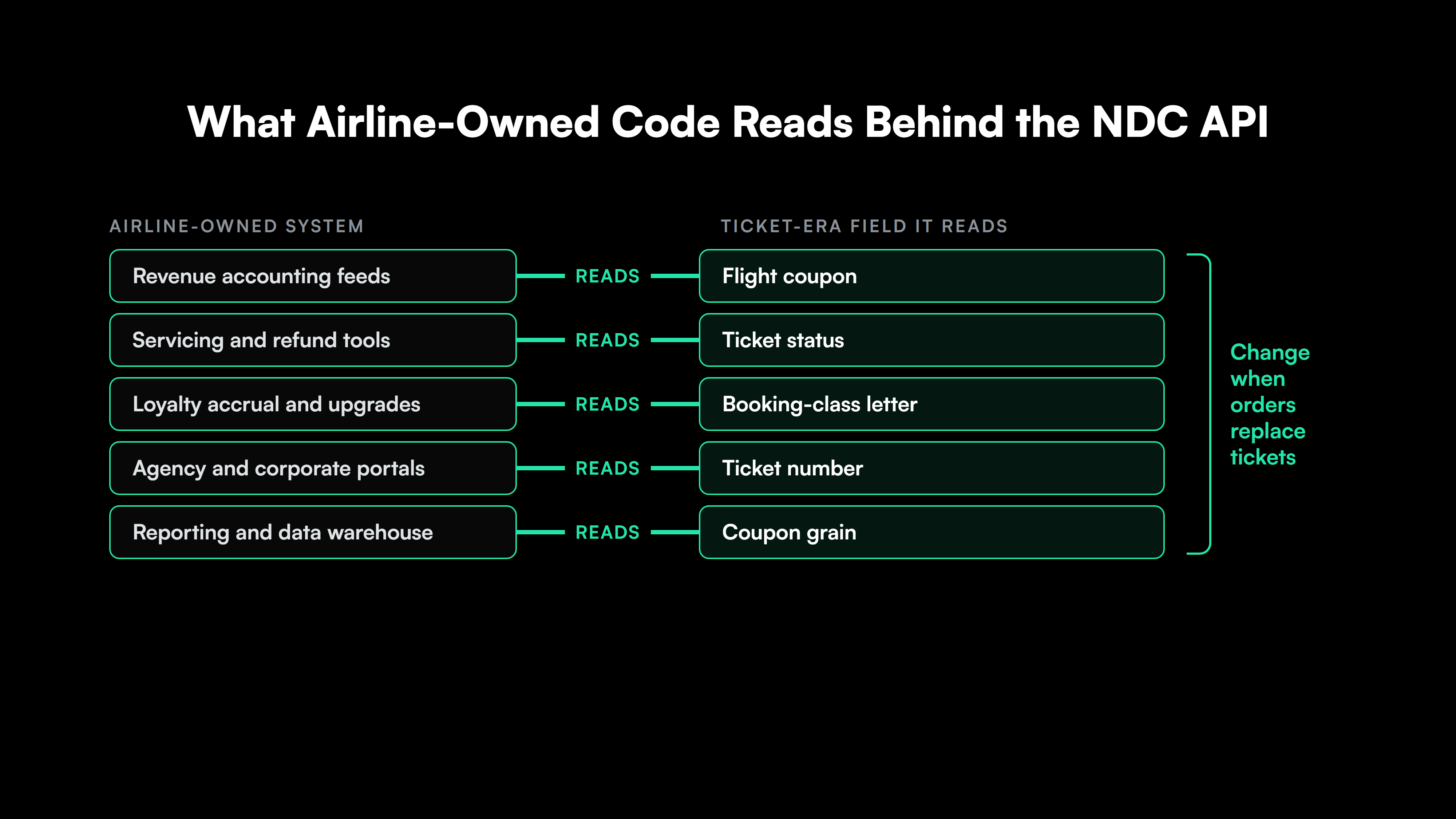
The risk in this inventory comes from what is undocumented. Proration exceptions, refund rules for partially flown tickets and loyalty mappings for discounted fares often exist only in code, written by teams that have since moved on.
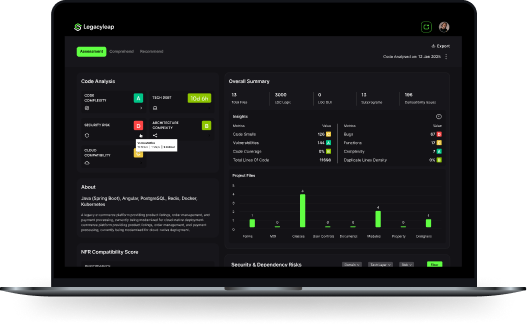
Find every module, batch job and report in your distribution code that reads tickets, EMDs or booking classes. The $0 Modernization Assessment returns a dependency map and a modernization plan, inside your environment.

 +more
Limits of NDC Middleware and Translation Layers on Legacy Systems
Middleware is the standard answer to the systems in that inventory, and IATA’s own roadmap relies on translators to legacy through 2026-27. In NDC API integration with a legacy PSS, a translator or middleware layer lets an NDC order reach a ticket-based back end without rewriting the back end first.
IATA’s ONE Order transition study describes what that hybrid period requires:
- An interim record that wraps the PNR, e-ticket and EMD data until a full Order exists.
- Data copied into legacy records so coupon status keeps working, with both copies kept in sync.
- A reference between each OrderID and its ticket numbers.
- Revenue accounting that reports each sale once, even when the order and its linked ticket both arrive.
- Staff access to legacy records and order records, and departure control handling legacy and ONE Order messages for passengers on the same flight.
Each of those mechanisms is code with business rules inside it. A translator that turns an order change into a ticket reissue decides how residual value, penalties and taxes carry across. When the translator is retired, those decisions have to exist somewhere tested.
Airline middleware from the 2000s often runs as WCF services on .NET Framework or as SOAP-based Java services, which predate the order model. Teams moving those services toward order-aware APIs face the same work covered in WCF to REST migration and in modernizing SOAP-based Java services.
Translators defer the change to the 2028-29 stage, when leading airlines start removing PSS dependency. Airlines that reach that stage with untested translator logic carry two sets of servicing rules into the cutover.
A Phased Plan to Modernize NDC Legacy Systems
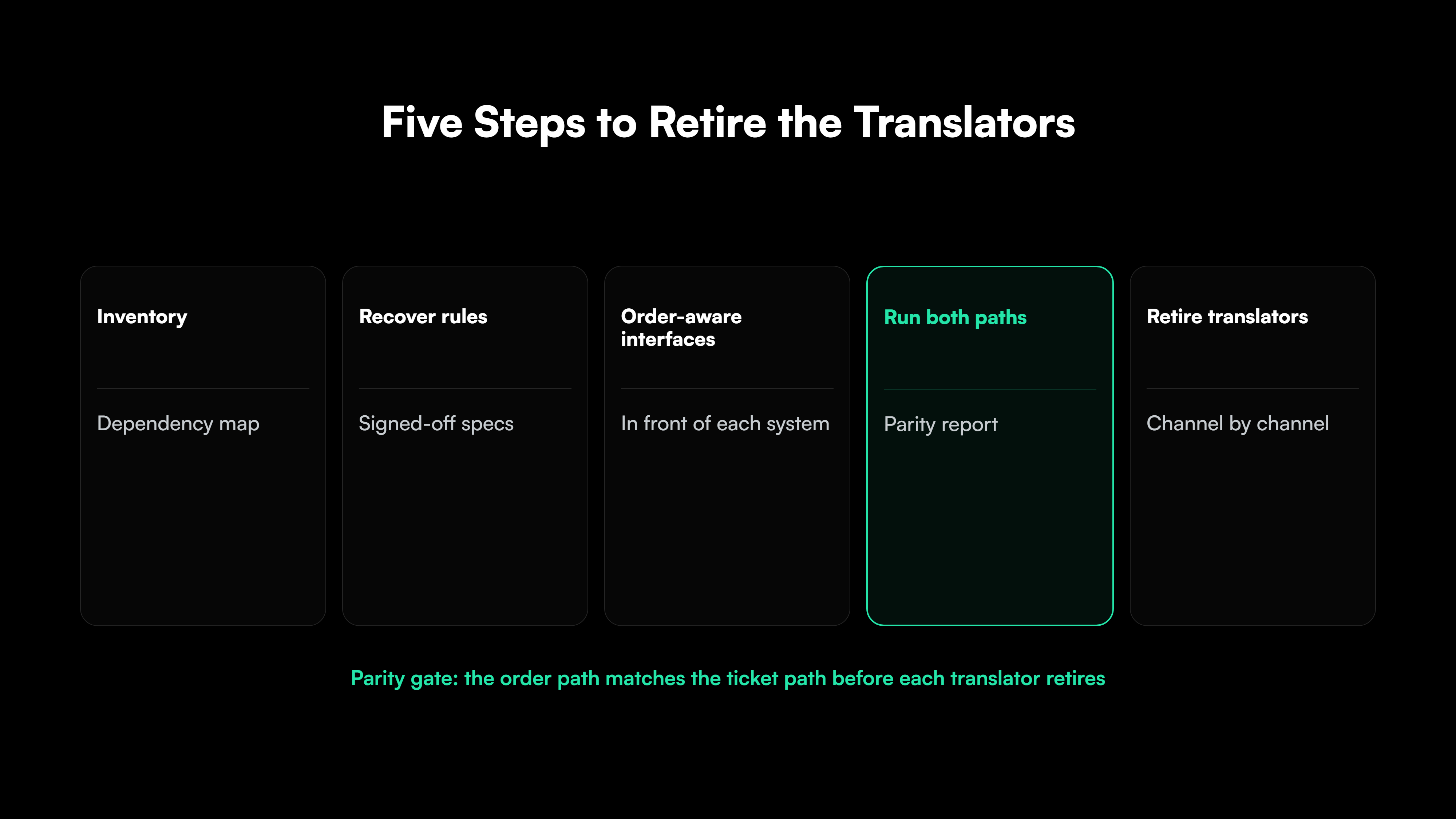
Retiring translators safely depends on the order in which the airline-owned systems change. The plan below puts discovery and rule recovery ahead of any code change:
- Inventory every reader of ticket data: Map each module, batch job, report and interface that reads ticket number, coupon status, EMD or booking class, including the data warehouse loads.
- Recover the rules into specifications: Extract exchange, refund, proration, accrual and commission rules from the code into specifications that distribution and revenue accounting owners review and sign off.
- Put order-aware interfaces in front of each system: Move logic behind stable interfaces one component at a time, using the strangler fig approach so the ticket path keeps running while the order path is built.
- Run the ticket path and the order path side by side: Replay the same historical sales through both paths, including exchanges, involuntary reaccommodations, interline itineraries, partial refunds and ancillaries.
- Retire translators channel by channel: IATA’s transition study names NDC and web or mobile as the easiest channels to switch to order records, with GDS sales last. Retire each translator once its channel passes the parity gate.
The parity gate between steps 4 and 5 is the acceptance test for each component. A component passes when the order path returns the same refund amount, residual value, settlement record and loyalty credit as the ticket path for every replayed sale. Each difference has to trace to a rule change that the business owner approved in step 2. Reconciliation methods from data migration validation apply to the settlement and reporting records.
Interline itineraries need the longest parity window. Proration stays in use until partner airlines price interline offers through NDC, so the old proration rules and the new settlement values run together for longer than any other component.
Using Legacyleap to Move Airline Distribution Code From Tickets to Orders
The two hardest steps in that plan are finding every piece of airline-owned code that reads ticket, EMD and fare-class data, and proving the order path returns the same results. Legacyleap runs both with coordinated Gen AI agents, one for each stage from assessment through deployment, and engineers approve every change.
For distribution code, the agents map to the phased plan:
- Assessment Agent: Builds the dependency map of ticket, coupon, EMD and booking-class reads across modules, batch jobs, reports and interfaces, with risk indicators and an effort estimate.
- Documentation Agent: Recovers exchange, refund, proration and accrual rules into functional specifications tied back to the code, along with data flows and integration maps.
- Recommendation Agent: Sets the refactor, replace or retain decision for each component and orders the phases, translator retirement included.
- Modernization Agent: Delivers converted code as diff-based pull requests that engineers review. About 70% of the modernization work is automated, and the AI cannot merge, deploy or execute code.
- QA Agent: Generates 70-80% of the test cases and produces parity validation reports that compare ticket-path and order-path results for the same replayed sales.
The platform runs inside the airline’s environment, and source code never leaves it. The PSS stays with its vendor. Delivery can run as legacy application modernization services owned end to end by Legacyleap’s team, or as a platform license operated by the airline’s engineers.
Legacyleap’s airline proof point comes from operations code with the traits distribution code shares: regulated logic, no documentation and a fixed deadline.
A North American airline’s VB6 application for monitoring extended-range twin-engine (ETOPS) operations was audit-flagged for remediation. It had 2,588 COM references, 195 Win32 API calls, no documentation and no automated tests. Legacyleap automated 60-65% of the conversion to React and .NET Core, and a 4-person team reached UAT readiness in 8 weeks, 50% faster and at 50% lower cost than the manual rewrite estimate.
Next Steps for NDC Legacy Systems Modernization
ARC already settles orders, IATA expects early PSS decommissioning to begin in 2027, and its roadmap has leading airlines removing PSS dependency in 2028-29. The work starts with knowing which airline-owned code reads tickets, EMDs and booking classes, and which rules sit inside it.
The $0 Modernization Assessment covers one codebase of up to about 50,000 lines in 3-5 days, inside the airline’s environment. It returns documentation, a dependency and integration map, a risk heatmap and a modernization plan with timelines. To see the agents work on distribution code first, book a demo.
FAQs
Yes, wherever the airline fulfils NDC orders with e-tickets and EMDs, which is the norm during the transition. IATA added the reference between OrderID and ticket number to the standard in schema 19.2.
No. NDC standardizes the messages between airline and seller, from shopping to booking and changes, and ONE Order standardizes the airline’s record used for fulfilment, delivery and accounting. An airline can run NDC entirely on tickets until ONE Order retires them.
IATA’s 2025 roadmap places full technical PSS decommissioning after 2030, and its 2026 review expects early PSS to start retiring in 2027. The airline-owned systems that read tickets change whichever route the PSS takes.
Agency mid-office and back-office systems built around GDS PNRs face the same record change from the seller side. ARC’s orders-based settlement adds an orders reporting path that agency accounting systems have to reconcile alongside ticket reporting.
IATA places mainstream offers and orders, interline included, after 2030. Its transition study expects legacy PNRs to stay in use for inventory and schedule changes for a long period, so hybrid systems run for the rest of this decade at least.
References
- Airlines Reporting Corporation, “U.S. Agency Air Ticket Sales Reach $9.8 Billion in October 2026.”
- Alaska Airlines, “NDC FAQ.”
- International Air Transport Association, “Fact Sheet: ONE Order.”
- Airlines Reporting Corporation, “ARC Launches Orders-Based Reporting and Settlement System to Advance Airline Retailing.”
- International Air Transport Association, “Annual Review 2025.”
- International Air Transport Association, “Annual Review 2026.”
- International Air Transport Association, “ONE Order Transition Study.”