TL;DR
- AWS Transform handles in-stack upgrades well, especially across .NET. Its .NET agent ports C# and VB.NET projects, including Web Forms, WCF, WinForms and WPF, to .NET 8, 10 or 11. Its managed transformations upgrade Java, Python, Node.js and PHP.
- AWS Transform keeps AWS-bound code current after modernization. Continuous modernization runs scheduled tech-debt scans across connected repositories and opens pull requests for the fixes. Its built-in deployment targets are AWS services.
- Legacyleap modernizes the stacks AWS lists no managed transformation for. VB6, Delphi, ColdFusion, Oracle Forms, Struts and AngularJS 1.x applications move to a new architecture, such as VB6 to React and .NET, with about 70% of the work automated and engineers reviewing every change.
- Legacyleap proves each rewrite matches the legacy application and runs inside your environment. Its QA Agent generates 70-80% of the test cases and checks behavior against the legacy baseline. Source code stays on your hardware or in your cloud account, and the modernized app can still deploy to AWS.
- Four questions decide which tool takes each application. AWS Transform fits when the stack has an AWS-managed transformation, the language stays the same, tests run on old and new code, and the code can be processed in an AWS Region. A single no points to Legacyleap, and AWS Transform can keep the rewritten app current afterward.
AWS Transform is often seen as AWS’s migration service for VMware and Windows workloads. Its documentation describes a code modernization tool as well. The .NET agent ports C# and VB.NET applications to modern .NET, AWS-managed transformations upgrade Java, Python, Node.js and PHP code, and continuous modernization scans connected repositories on a schedule.
That raises a practical question for anyone weighing AWS Transform alternatives during an AWS transformation. Which legacy applications can AWS Transform modernize as they are, and which ones need a platform that rewrites them into a new stack and proves they still behave the same?
This comparison answers that application by application, starting with a side-by-side view and ending with four questions that assign each application in a portfolio to the right tool.
AWS Transform vs. Legacyleap at a Glance
Here’s how AWS Transform and Legacyleap compare on the points that decide a legacy modernization project:
| AWS Transform | Legacyleap | |
| Built for | Upgrading and porting workloads within their stack, migrating them to AWS, and keeping code current with scheduled scans | The full modernization lifecycle, including rewrites into a new stack and architecture |
| Legacy stacks with a ready path | .NET Framework (C#, VB.NET, Web Forms, WCF, WinForms, WPF), SQL Server, Java, Python, Node.js, PHP, Angular | .NET Framework, VB.NET, Web Forms, WCF and Java EE, plus VB6, Classic ASP, Delphi, ColdFusion, Oracle Forms and PL/SQL, PHP, AngularJS, Struts and EJB |
| Rewrites into another language | Web Forms UI to Blazor Server and Angular to React (early access); other paths through AWS Transform custom, defined by your team | VB6 to React and .NET, Delphi to .NET, Struts to Spring Boot, Oracle Forms to Java or .NET, ColdFusion or PHP to Node.js or Python |
| Testing | A build plus existing or generated unit tests; your own build and test commands in AWS Transform custom | 70-80% of test cases generated, with behavior parity checked against the legacy app before cutover |
| Where code is processed | AWS-hosted agents in your workspace’s AWS Region; some analyses and builds can run on your machine or in your AWS account | Inside your own environment, on your hardware or in your cloud account, with no outbound calls required |
| Built-in deployment targets | Amazon EC2, ECS and EKS; Aurora PostgreSQL and RDS for PostgreSQL for databases | AWS, another cloud or on-premises servers |
| How changes land | A new branch, or a pull request on GitHub, GitLab or Bitbucket | Diff-based pull requests that engineers review; the AI can’t merge, deploy or execute code |
| Ongoing upkeep | Continuous modernization scans on a daily, weekly or monthly schedule | Handed to your team after cutover, where AWS Transform continuous modernization can take it on |
| Way to start | Assessment, Windows and VMware agents at no cost; custom transformations at $0.035 per agent minute; continuous modernization as a paid feature | A $0 Modernization Assessment on one codebase; also listed on AWS Marketplace |
In short, AWS Transform fits applications that stay in their stack and land on AWS, and it keeps them current afterward. Legacyleap fits applications that change stack, run on a stack with no AWS-managed transformation, or can’t leave your network, and it can still deploy them to AWS.
AWS Transform: What It Does Well in 2026
AWS Transform is a capable, well-documented service for the upgrade work in a .NET, Java or Python backlog. Teams run it from the AWS Transform web application, the AWS Toolkit for Visual Studio and the AWS Transform CLI.
Here’s what AWS’s documentation covers:
- .NET: .NET Framework 3.5 and later, .NET Core 3.1 and .NET 5 and later, ported to .NET 8, 10 or 11. AWS’s .NET documentation lists C# and VB.NET across MVC, Web API, Web Forms, WCF services, ASMX services, WinForms, WPF and Xamarin projects, and the agent ports Web Forms UI to Blazor Server.
- SQL Server: Schemas and .NET data-access code moved to Aurora PostgreSQL or RDS for PostgreSQL, with functional equivalence tests.
- AWS-managed transformations: Generally available upgrades for Java, Python 3.8-3.10 to 3.11-3.13, Node.js, PHP to 8.5 and Spring Boot 3 to 4, plus unit-test generation for C#, Java, JavaScript and Python. Early-access entries include JBoss to Spring Boot, Java EE to Quarkus and Angular to React with Playwright end-to-end tests.
- Continuous modernization: Scheduled tech-debt and modernization-readiness analyses across connected repositories, run daily, weekly or monthly. AWS’s change log for November 20, 2026 added OAuth connections for GitHub and GitLab and an AWS Health readiness analysis. That analysis finds the Lambda runtimes, EKS Kubernetes versions and Elastic Beanstalk PHP platforms in your infrastructure code that need an upgrade. Fixes arrive as pull requests on GitHub, GitLab or Bitbucket.
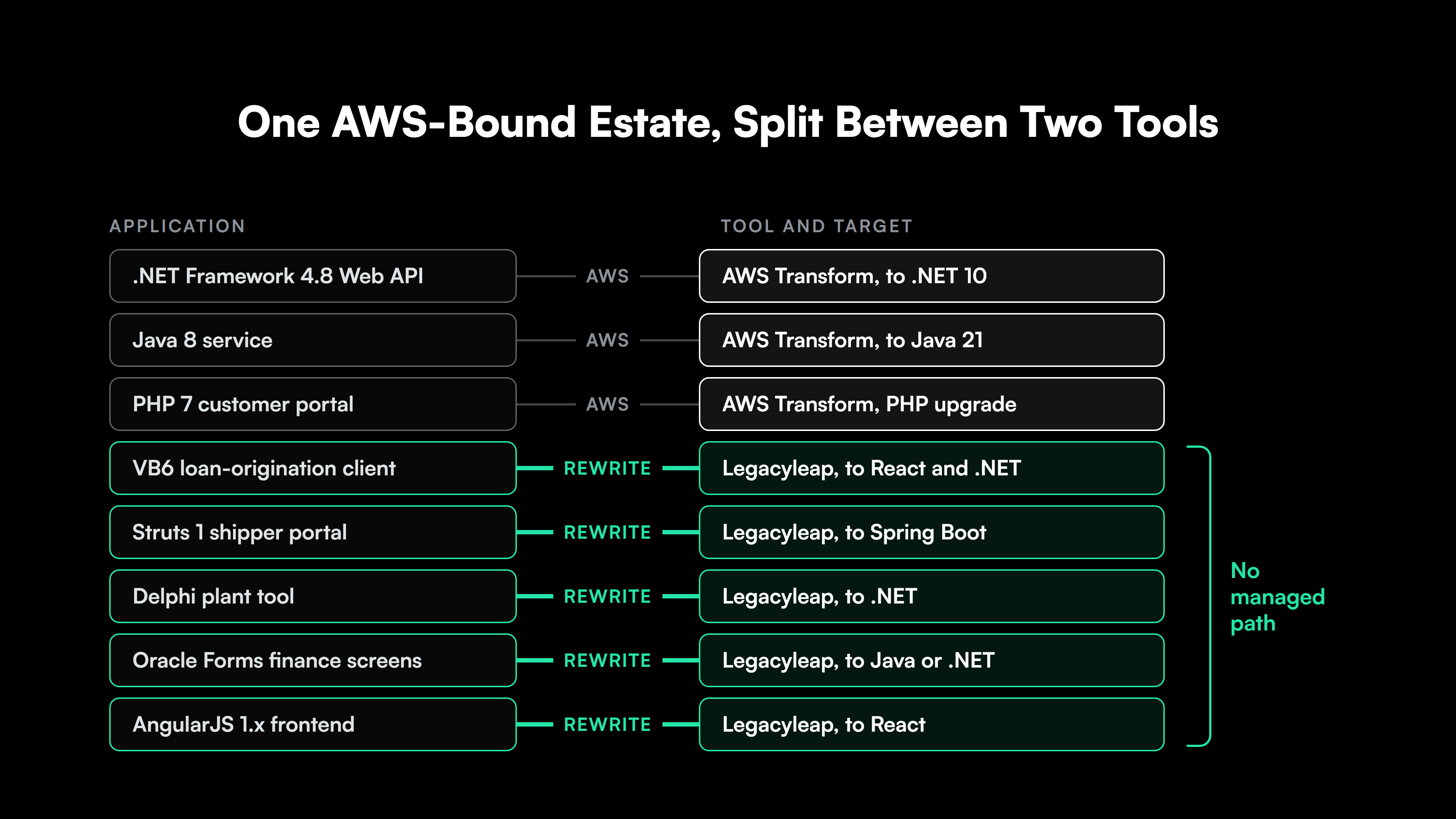
A .NET Framework 4.8 Web API headed to .NET 10 on Amazon ECS, or a Java 8 service moving to Java 21, is a good first job for AWS Transform. The same holds for an ASP.NET Web Forms intranet where Blazor Server is the agreed target, and the trade-offs of a Web Forms to Blazor migration have already been settled.
When AWS Transform Alternatives Make Sense for Legacy Applications
AWS Transform upgrades an application within its current language and framework, or ports it along a path AWS has defined, and its built-in deployment paths lead to AWS. Legacy applications outside that pattern run into four limits:
- Stacks with no AWS-managed transformation: AWS’s documentation lists no managed path for VB6, Delphi, ColdFusion, Oracle Forms, Struts or AngularJS 1.x. The .NET agent supports VB.NET, and VB6 is a separate, older runtime that AWS doesn’t list. AWS Transform custom can be pointed at any code, with your team writing the transformation definition and refining it across runs.
- Rewrites outside .NET: AWS’s .NET documentation limits the agent to .NET-to-.NET transformation and sends paths such as Web Forms to React to AWS Transform custom. A VB6 desktop client rebuilt as a React and .NET web app has no managed path, and neither does a move from Oracle Forms to a web application.
- Validation that assumes tests exist: The .NET agent validates with a local build and unit test execution, and the AWS Transform FAQ says custom transformations use user-defined build and test commands. Legacy applications often have few tests or none, and tests written for a VB6 client can’t run against the React code that replaces it.
- AWS-hosted agents and AWS targets: The AWS Transform FAQ says data is processed in the AWS Region where the workspace was created, and its built-in deployment outputs target Amazon EC2, ECS, EKS, Aurora and RDS. Source code that can’t be sent to an AWS-hosted service from an on-premises or air-gapped network needs a tool that runs inside that network.
One application can hit several of these limits at once. A credit union’s VB6 loan-origination client, with no automated tests and source code that has to stay on the credit union’s own servers, meets three of them.
Start With a $0 Modernization Assessment
Get a dependency map, risk heatmap and modernization plan for one VB6, Struts or Delphi application in 3-5 days, run inside your own infrastructure.

 +more
How Legacyleap Modernizes Applications With No AWS-Managed Transformation
VB6 clients, Struts portals and source code that can’t leave the customer’s network need more than an in-stack upgrade. They need a new target architecture, proof that the rewrite behaves like the original, and tooling that runs where the code lives.
Legacyleap is a modernization platform built for that work. Its specialized agents assess an application, rewrite it, test it against the legacy version and prepare it for deployment, with engineers reviewing every change.
Legacyleap Rewrites VB6, Delphi, Struts and Oracle Forms Applications Into a New Architecture
Legacyleap modernizes applications across these legacy stacks, and more:
- Microsoft: VB6, Classic ASP, ASP.NET Web Forms, WCF and .NET Framework
- Java: Struts, EJB and Java EE
- Oracle: Oracle Forms and PL/SQL
- Other legacy stacks: Delphi (including Delphi 2007), ColdFusion, PHP and AngularJS
Three of Legacyleap’s agents carry an application from the legacy code to a reviewed rewrite:
- Assessment Agent: Reads the whole codebase and maps dependencies, risks and effort, including the COM references and Win32 API calls in a VB6 client.
- Recommendation Agent: Sets the target architecture and migration order, such as splitting a desktop app into a web UI and REST services.
- Modernization Agent: Converts the code and opens pull requests. About 70% of the modernization is automated, with engineers in the loop for 20-25% of the effort, or up to about 30% on complex codebases.
How Legacyleap Checks a Rewrite Against the Legacy Application
Legacyleap’s QA Agent generates 70-80% of the test cases, covering unit, integration, regression, API, functional and Gherkin end-to-end tests, and runs them against live servers. The new application’s behavior is checked against the legacy application’s baseline before cutover. That check matters most for a legacy app that arrives with no tests of its own.
Each change arrives as a diff-based pull request for engineers to review. The AI can’t merge, deploy or execute code, and every AI action is logged from the original code to the modernized version.
Legacyleap Runs in Your Environment and Deploys to AWS
Legacyleap runs entirely inside the customer’s environment, on its own hardware or privately in its own cloud account, with no outbound calls required. Source code never leaves that environment. The modernized application can deploy to AWS, another cloud or on-premises servers, with CI/CD-ready artifacts and a phased cutover.
Legacyleap is also available on AWS Marketplace, sold by Ideas2IT.
Teams can license the platform for their own engineers or an SI, or hand the whole project to Legacyleap’s team. The trade-offs of platform-led or services-led delivery usually decide which. Both models deliver Legacyleap’s legacy application modernization services through the same stages of assessment, comprehension, modernization, validation and deployment.
A US financial institution’s VB6 application, with inadequate documentation and business logic that had to be preserved exactly under strict financial regulation, was modernized to C# and .NET using AWS services. Amazon Bedrock handled code comprehension and translation, Amazon Neptune mapped legacy-to-modern component relationships, AWS Glue moved the data and Amazon CodeGuru reviewed the code. Code conversion ran 70-80% faster than manual conversion, and compliance held through every stage.
The financial institution’s VB6 application had no AWS-managed transformation path, and its VB6 to .NET migration still ran on AWS services.
Legacy Application Modernization Services
See how Legacyleap’s team or your own engineers take a VB6, Struts or Delphi application from assessment to a validated production release.
Explore Application Modernization Services →How to Split an AWS Transformation Between AWS Transform and Legacyleap
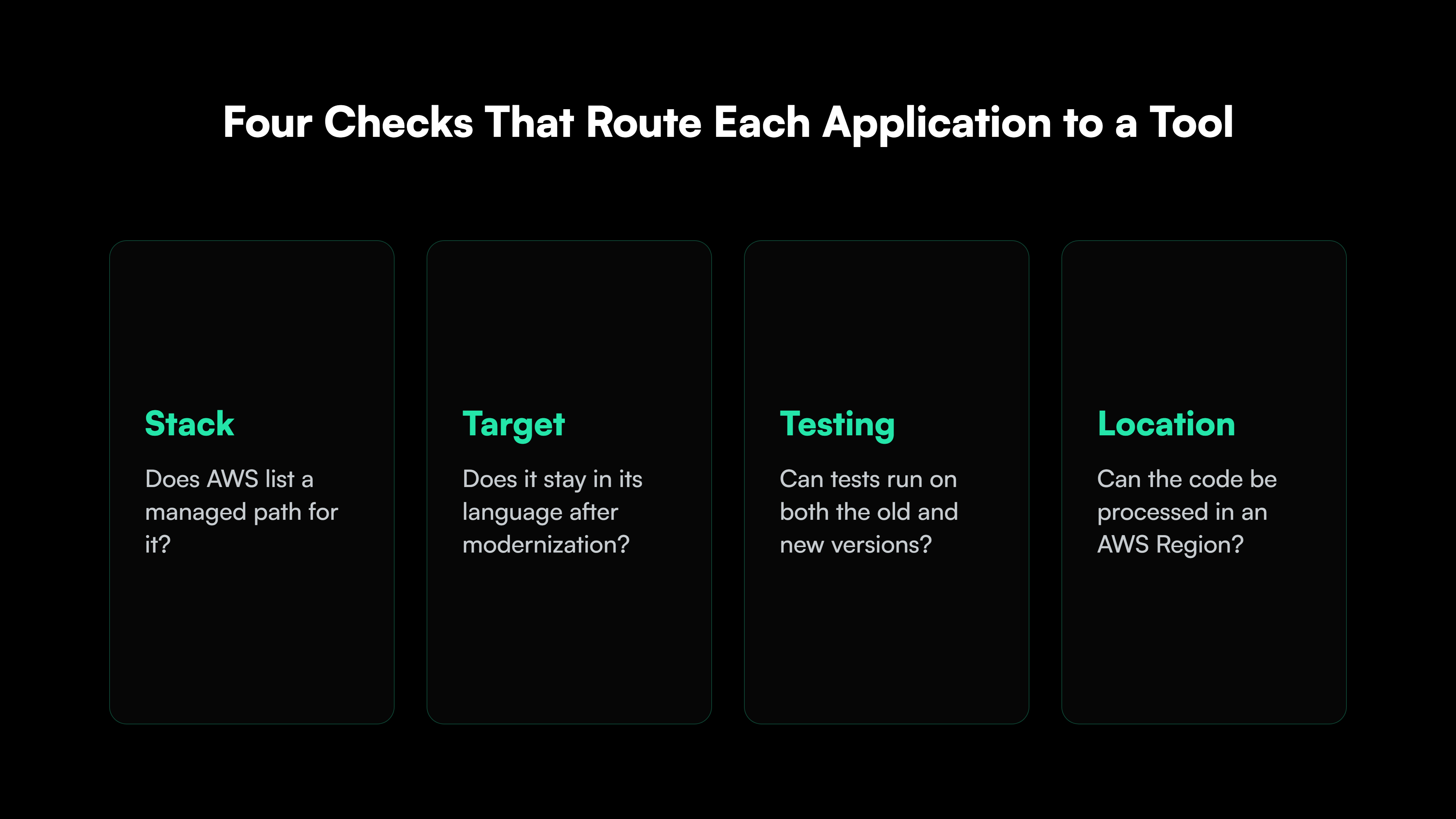
For each application in the portfolio, four questions decide which tool takes it:
- Stack: Does AWS list a managed transformation for the application’s stack, such as .NET Framework, Java, Python, Node.js or PHP?
- Target: Will the application stay in its language after modernization, or follow a path AWS defines, such as Web Forms to Blazor?
- Testing: Can existing or generated tests run on both the old and the new version?
- Location: Can the source code be processed in an AWS Region?
Four yes answers mean AWS Transform can handle the application. A single no means the application needs a modernization platform, and that’s where AWS Transform alternatives such as Legacyleap belong in the plan.
Take a freight carrier with a .NET Framework 4.7.2 rating API headed for Amazon ECS and a Struts 1 shipper portal that calls it. The rating API passes all four questions and goes to AWS Transform. The shipper portal fails the first question and goes to Legacyleap for a Struts migration to Spring Boot.
The two tools also work one after the other. Once the shipper portal runs on Spring Boot, it falls inside AWS’s managed Java version and Spring Boot upgrades. AWS Transform continuous modernization can then scan it on a schedule and open pull requests for each version bump. That hand-off from a one-time rewrite to scheduled upkeep is the core of a continuous modernization operating model.
Use AWS Transform and Legacyleap Together
An AWS transformation rarely runs on one tool. For in-stack .NET, Java, Python, Node.js and PHP upgrades headed to AWS, AWS Transform does the job and keeps those applications current. For VB6, Delphi, ColdFusion, Oracle Forms and Struts applications, rewrites into a new architecture, and code that has to stay inside your own network, Legacyleap covers what AWS Transform’s managed paths don’t.
Start with a $0 Modernization Assessment on one application. In 3-5 days, inside your infrastructure, it returns documentation, architecture diagrams, a dependency map, a risk heatmap and a modernization plan. To see Legacyleap’s agents work on a codebase like yours, book a Technical Demo.
Get a $0 Modernization Assessment for One Legacy Application
You get documentation, a dependency map, a risk heatmap and a modernization plan in 3-5 days, run inside your own environment.
FAQs
AWS’s documentation doesn’t list VB6. The .NET agent covers VB.NET projects, and AWS’s VBA to Python transformation covers Excel VBA macros, a different language from VB6. Legacyleap moves VB6 applications to C# and .NET, or to React and .NET.
The assessment, Windows modernization and VMware migration agents are free, and AWS-managed .NET transformations include up to 50,000 agent minutes a month at no charge. Other custom transformations bill $0.035 per agent minute, and continuous modernization is a paid feature whose remediations use the same rate.
Legacyleap’s Documentation Agent reconstructs the application’s business logic and functional specs from the code, and the QA Agent generates parity tests from that legacy baseline. The rewrite has to pass those tests before cutover, so a missing test suite doesn’t hold the project back.
It covers one representative codebase of up to about 50,000 lines, run inside your own cloud with no source code leaving it. If the results fit, the usual next step is a paid pilot on one application or module.
Yes, on different layers. For a .NET Framework 4.8 application with an AngularJS 1.x frontend, AWS Transform’s .NET agent can port the backend to .NET 10 while Legacyleap rewrites the AngularJS frontend in React.
References
- Amazon Web Services, “Modernizing .NET with AWS Transform.”
- Amazon Web Services, “AWS-Managed Transformations.”
- Amazon Web Services, “AWS Transform continuous modernization.”
- Amazon Web Services, “AWS Transform Change Log.”
- Amazon Web Services, “AWS Transform FAQs.”
- AWS Marketplace, “Legacyleap: GenAI Platform for Legacy Application & Data Modernization.”
- Amazon Web Services, “AWS Transform Pricing.”