TL;DR
- Crew scheduling failures spread through the systems around the optimizer. Tracking, notification, hotel and phone systems broke down with the core tools at Southwest, Delta and JetBlue.
- Legality parity is the acceptance test for a new crew system. The new code has to return the same legal or illegal verdict as the old code on each FAA Part 117, Part 121 and labor contract rule.
- Replacing a crew system carries operational risk of its own. Crew systems run around the clock, hold undocumented contract logic and show capability gaps only when disruption volume arrives.
- Modernize one component at a time and cut over outside peak seasons. Test each one at worst-day change volume and run old and new in parallel before switching.
Over a weekend in July 2026, JetBlue cut its JFK operation by half. ALPA’s JetBlue pilot leadership blamed “ongoing outages in the Company’s scheduling system” for crews that could not be positioned where they were needed. JetBlue became the third major US carrier in four years to lose control of crew recovery, after Southwest in December 2022 and Delta in July 2024.
Airline crew scheduling software at a US carrier is rarely one product. A vendor optimizer builds pairings and rosters, and a set of airline-built applications handles crew tracking, notification, legality checks, pay, hotels and feeds to dispatch. Airline IT and flight operations technology teams own much of that code.
This guide covers how to modernize that estate without the migration becoming the next disruption, and without changing which pilots and flight attendants are legal to fly.
Crew Scheduling Failures at Southwest, Delta and JetBlue Make Modernization Urgent
Crew recovery has broken down four times at three major US carriers since October 2021. Each started with a different trigger and failed in the crew scheduling estate. The table sets out what the airline, the regulator or the pilots’ union said failed in each case:
| Airline and date | Trigger | What failed, per the named source | Scale |
| Southwest, October 2021 | Disruption over a holiday weekend | Pilots’ union: crew scheduling processes could not keep up | Over 2,200 flights cancelled and a $75 million cost (Southwest pilots’ union) |
| Southwest, December 2022 | Winter weather from December 21 | Southwest’s COO: crew scheduling software kept running but could not solve a backlog of broken crew pairings. Pilots’ union: separate dispatch and crew tools, an overwhelmed crew hotel system, jammed scheduling phone lines and manual crew tracking | 16,900 flights cancelled and over 2 million passengers stranded (DOT) |
| Delta, July 2024 | Microsoft Windows outage caused by a faulty CrowdStrike update, July 19 | Delta’s CEO: a crew tracking-related tool could not process the volume of changes the shutdown triggered | Recovery still under way two days later (Delta) |
| JetBlue, July 2026 | Weekend of operational disruption | Pilots’ union: outages in the scheduling system, crew scheduling unreachable with hours-long holds, no hotels for stranded crews | JFK operation cut by half (ALPA) |
Southwest’s COO, Andrew Watterson, described the turning point to the Senate Commerce Committee in February 2023. In his words, “what began as a weather event on December 21st turned into a Crew Scheduling event by December 24th.”
DOT’s December 2023 consent order set a $140 million civil penalty, and DOT put Southwest’s total cost of the meltdown at over $750 million.
The Southwest Airlines Pilots Association testified at the same hearing that crew changes ran through a separate tool, SkySolver, beside a dispatch optimizer with minimal crew programming. The union said the two tools could produce contradictory solutions.
Delta CEO Ed Bastian wrote on July 21, 2024 that one of Delta’s crew tracking-related tools was “unable to effectively process the unprecedented number of changes triggered by the system shutdown.”
Change volume links the four breakdowns. Each crew estate fell behind once changes arrived faster than the connected systems could re-solve pairings, reach crews and book hotels. Phones and manual tracking became the fallback, and Southwest’s pilots described crews spending hours on hold.
Four developments make crew scheduling software modernization a current priority for US airlines:
- The breakdowns keep recurring: Southwest’s pilots’ union told the Senate the airline had averaged one major operational failure every 18 months since 2011. JetBlue’s breakdown in July 2026 came two years after Delta’s.
- Regulators credit recovery investments: In December 2025, DOT amended Southwest’s consent order and credited $11 million of the penalty to operational investments. DOT cited more than $112.4 million Southwest put into its Network Operations Control, including optimizers for aircraft and crew network recovery. Southwest ranked 3rd among the 10 largest US carriers in on-time performance and completion factor for the first nine months of 2025, up from 6th and 8th in 2022.
- Pilot unions name the software publicly: ALPA’s JetBlue pilot leadership said in July 2026 that management “must provide necessary scheduling software” along with hotels and staffing.
- Industry-wide triggers test every carrier: The FAA’s nationwide ground stop on November 13, 2026 left aircraft and crews out of position across US airlines, and recovery ran through that weekend.
Modernizing crew recovery systems between incidents lets an airline schedule that work on its own terms.
What Airline Crew Scheduling Software Includes Beyond the Vendor Optimizer
The systems that failed at Southwest, Delta and JetBlue sit around the vendor optimizer as much as inside it.
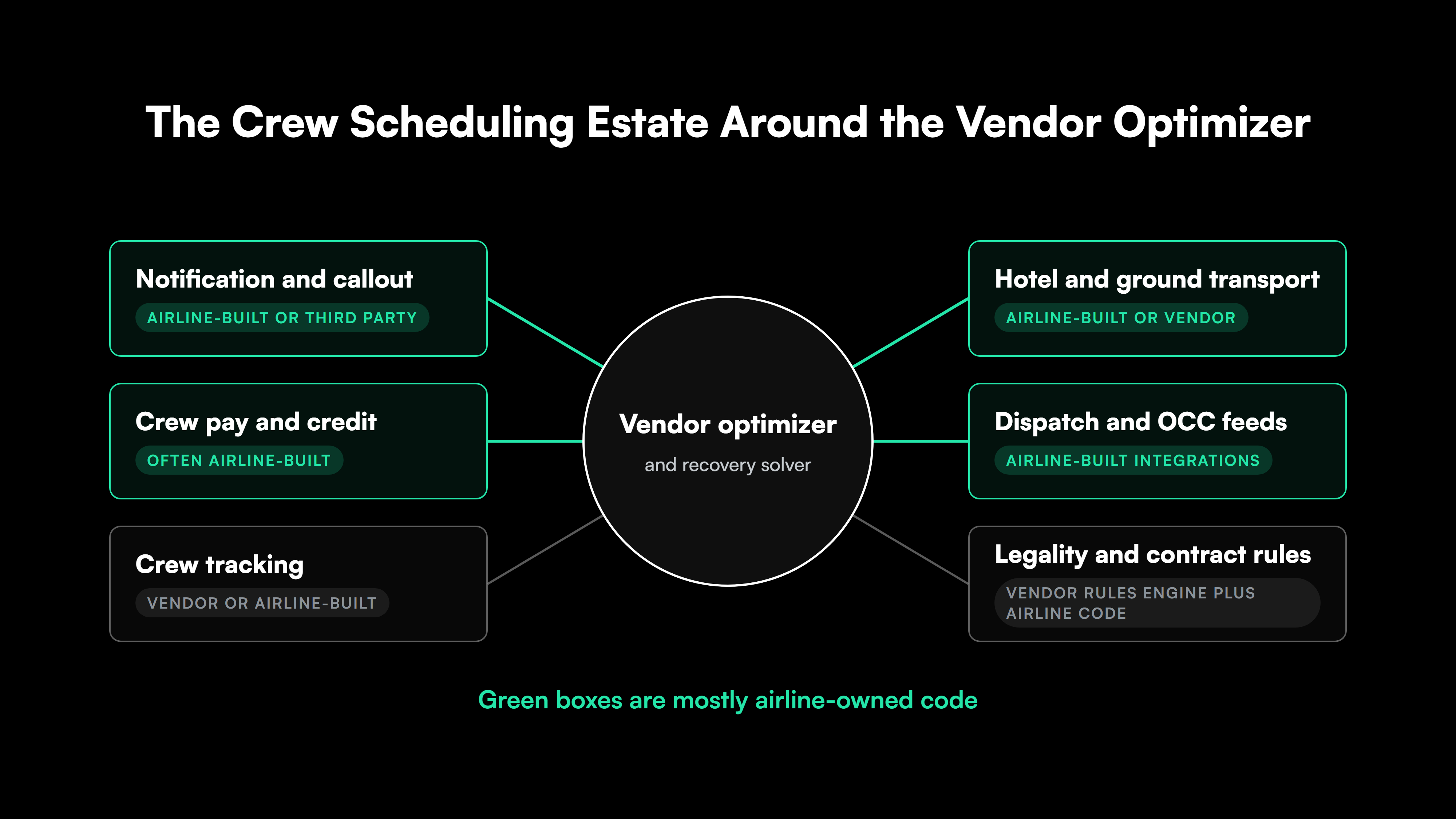
Airline crew scheduling software modernization covers the whole crew estate. That estate includes the vendor optimizer and the airline-owned systems for crew tracking, notification, legality and contract rules, pay, hotels and data feeds to dispatch. A safe program maps those systems, extracts the legality rules into reviewed specifications and modernizes one component at a time. Each component proves that its legality checks return the same results as the legacy code before cutover.
A US carrier’s crew estate typically breaks down into these components:
| Component | Typical owner | Job during a disruption |
| Pairing and rostering optimizer | Vendor suite (CAE, Jeppesen ForeFlight, Lufthansa Systems NetLine, GE) | Builds legal pairings and rosters during planning |
| Crew recovery solver | Vendor, often customized | Re-solves broken pairings when flights cancel |
| Crew tracking | Vendor or airline-built | Records where each crew member is and what they are legal to fly |
| Notification and callout | Airline-built or third party | Reaches crews and reserves and fills open trips |
| Legality and contract rules checks | Split between a vendor rules engine and airline code | Tests each assignment against FAA limits and the labor agreement |
| Crew pay and credit | Often airline-built | Calculates pay protection and premiums triggered by changes |
| Hotel and ground transport | Airline-built or vendor | Books rest for reassigned crews |
| Leave and attendance | Often airline-built | Shows who is available |
| Feeds to dispatch and operations control | Airline-built integrations | Keeps crew, aircraft and passenger plans in step |
The vendor side has changed hands too. CAE bought Sabre’s AirCentre flight and crew portfolio in 2022, and Boeing sold Jeppesen to Thoma Bravo in 2025. Interfaces an airline built against those products years ago now depend on a new owner’s roadmap.
Dispatch, operations control and maintenance systems show the same pattern, covered in Legacyleap’s guide to airline IT modernization.
Why Replacing Crew Scheduling Software Carries Operational Risk
Replacing the vendor crew suite outright carries its own risk for four reasons:
- No downtime window: Crew tracking and recovery run around the clock, so a big-bang switch has no window in which the crew system can be offline. A cutover that goes wrong during irregular operations repeats the failure it was meant to fix.
- Contract logic in code: Reserve rules, pay protection and coverage order sit in airline-built code and vendor customizations, often with little current documentation.
- Gaps that appear only under load: Southwest’s crew software kept running in December 2022, and Watterson told the Senate it needed added functionality to recover from a mass cancellation event. Capability gaps in crew recovery stay hidden until disruption volume exposes them.
- Integrations that stay behind: A new vendor product still needs the airline’s tracking, notification, pay, hotel and dispatch integrations rebuilt or re-pointed.
A lower-risk route modernizes the estate component by component, with the vendor core kept, upgraded or replaced on its own schedule.
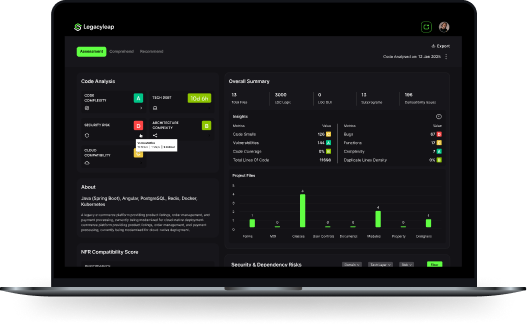
The $0 Modernization Assessment maps one crew application’s dependencies, integrations and risk hotspots in 3-5 days, inside your environment.

 +more
FAA Part 117 and Part 121 Legality Rules in Flight Crew Scheduling Software
Federal duty and rest rules are the part of a crew estate that carries safety weight, and they live in code. 14 CFR Part 117 sets flight time, duty and rest limits for pilots in Part 121 passenger operations. Section 117.11 opens with “No certificate holder may schedule”, so the limits apply at the point of scheduling.
The federal rules that crew scheduling code evaluates include:
- Flight time limits (117.11): Table A limits for a minimum crew, 13 hours for three pilots and 17 hours for four.
- Rest before duty (117.25): At least 10 consecutive hours, including 8 uninterrupted hours of sleep opportunity.
- Weekly rest (117.25): 30 consecutive hours free from all duty within the 168 hours before any reserve or flight duty period.
- Flight attendant limits (121.467): A 14-hour scheduled duty period, extendable when extra flight attendants are added. At least 10 hours of rest follow it, with 24 hours free in any 7 days.
Exceedances leave a regulatory record. Carriers report flight time beyond the 117.11 limits to the FAA within 10 days, and flight duty period extensions under 117.19 carry the same 10-day report.
Labor agreements add a second layer of rules covering reserve availability, rest above the federal minimum, pay credit and the order in which open trips are offered. Contract rules run through the same code paths as the federal checks.
Federal crew rules are also under active rulemaking. In July 2026, the FAA proposed that federal duty and rest rules preempt state and local meal and rest break laws for pilots and flight attendants. The proposal is not final and faces opposition from state attorneys general. Any change to break or rest logic in crew code has to pass the same parity tests before it goes live.
A legality rule rarely sits in one function. Crew scheduling code spreads each rule across time zone conversion, rounding at rest boundaries, deadhead handling and rolling cumulative windows. A rewrite can change business logic buried across every layer by accident when nobody has mapped where it lives. A few minutes of difference in one calculation can turn a legal assignment illegal, or block a legal pilot during recovery. The parity tests have to cover each place a rule lives:
| Rule logic | Where it typically lives | Parity test before cutover |
| Rest period start and end | Duty time calculations, time zone and acclimation handling | Same rest duration, to the minute, for each historical duty period |
| Rolling 168-hour and cumulative windows | Batch jobs and query logic | Same window totals on each roster date |
| Flight time and duty period limits | Pairing validation and recovery solver inputs | Same legal or illegal verdict for each historical pairing |
| Deadhead and reserve status | Crew tracking and assignment code | Same status and rest outcome for reassigned crews |
| Contract rules and pay credit | Airline-built rules and pay code | Same coverage order and pay result for past open-time awards |
Undocumented regulated logic is a familiar legacy software compliance risk. A parity record for each rule documents what the new code does if an exceedance is reviewed.
A Phased Plan for Airline Crew Scheduling Software Modernization
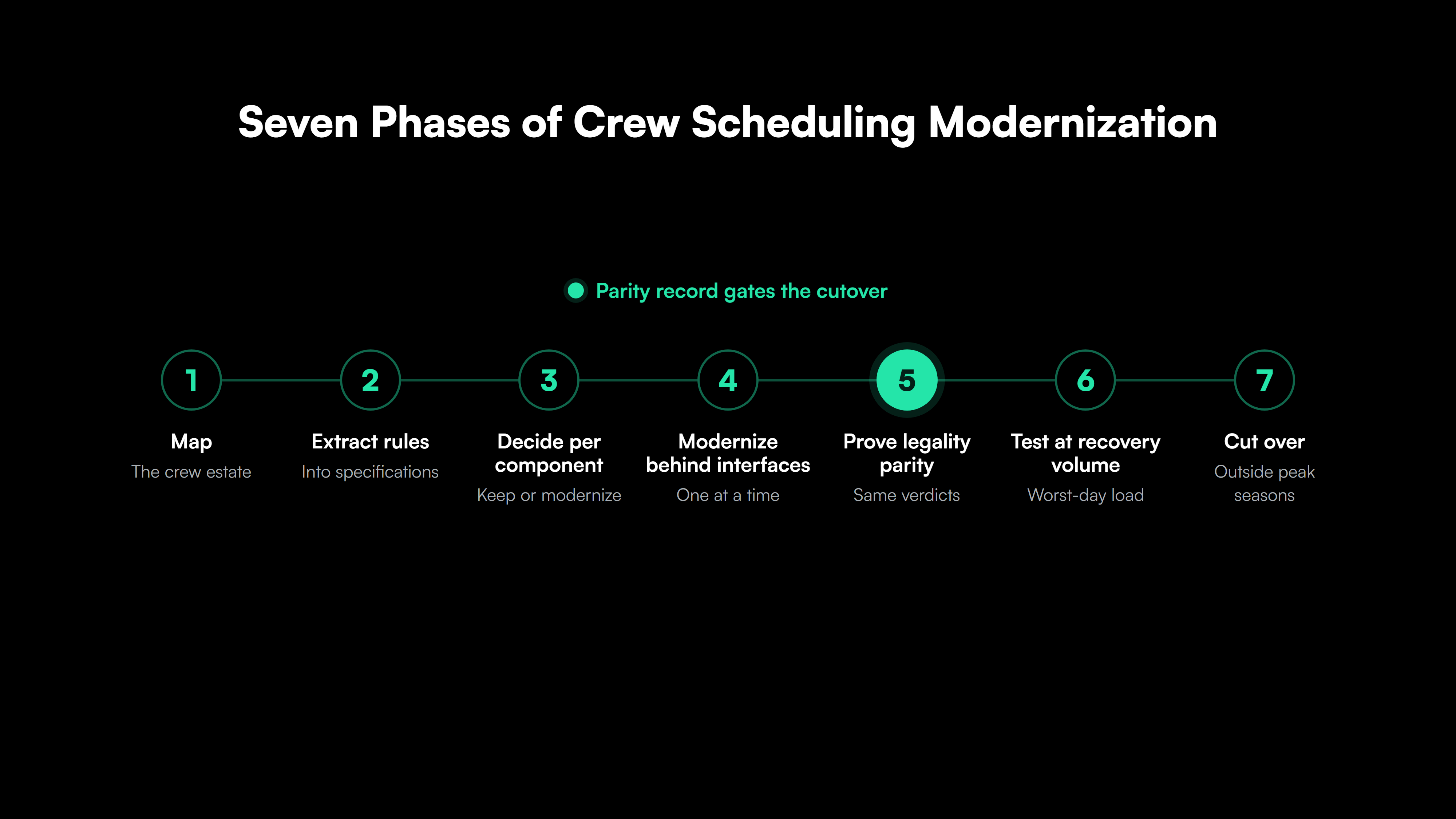
Legality parity and recovery capacity translate into seven phases, each with an exit test:
- Map the crew estate: List each crew application, vendor interface, data feed and manual fallback, with the team that owns it. Include the phone and spreadsheet processes schedulers use when systems fall behind.
- Extract legality, contract and pay rules into specifications: Tie each rule to the code that implements it. Crew scheduling and labor relations specialists review the specifications before any code changes.
- Decide per component: Keep the vendor product, move to a newer vendor module or modernize airline-owned code.
- Modernize behind stable interfaces: Replace one component at a time while the rest of the estate keeps calling the same interface. This is the strangler fig approach applied to crew systems.
- Prove legality parity: Run the airline’s historical rosters, pairings and disruption days through the old and new code. Each verdict, duty period and rest calculation must match, with any difference explained and signed off. Automated regression safety nets keep the check running after each change.
- Test at recovery volume: Load the new component with the change volume of the airline’s worst disruption days. A recovery that falls behind on change volume is the failure this test exists to catch.
- Cut over outside peak windows: Avoid holiday peaks, the summer peak and winter operations. Run old and new in parallel, compare outputs daily and keep a tested rollback.
How Legacyleap Modernizes Airline-Owned Crew Scheduling Software
Legality parity is what makes airline crew scheduling software modernization safe, and the code that has to pass it is the airline-owned layer around the vendor optimizer. Legacyleap is a Gen AI modernization platform built for that code. Specialized agents carry a codebase through assessment, comprehension, transformation, validation and deployment, with engineers reviewing each change.
For a crew estate, the agents line up with the phased plan:
- Assessment Agent: Builds the dependency map across crew applications, vendor interfaces and data feeds, with risk indicators, modernization hotspots and an effort estimate.
- Documentation Agent: Recovers legality, contract and pay logic into functional specifications tied back to the code, along with data flows and integration maps.
- Recommendation Agent: Sets the refactor, replace or retain decision for each component and orders the migration phases.
- Modernization Agent: Delivers converted code as diff-based pull requests that engineers review. About 70% of the modernization work is automated, and the AI cannot merge, deploy or execute code.
- QA Agent: Generates 70-80% of the unit, integration and regression test cases and produces parity validation reports against the legacy baseline. For crew code, the airline’s historical rosters and pairings serve as the golden artifacts, so each legality verdict is compared side by side before cutover.
The platform runs inside the airline’s own environment, and source code never leaves it. Scope follows the stacks Legacyleap supports, including .NET, VB6, Java, Delphi and Oracle Forms, and vendor optimizers stay with their vendors. Airlines that want delivery handled end to end can use Legacyleap’s legacy application modernization services, and teams with their own capacity can license the platform.
Legacyleap’s closest airline proof point is a compliance application with the same traits as crew legality code, including regulated logic, no documentation and a fixed audit deadline.
A North American airline’s VB6 application for monitoring extended-range twin-engine (ETOPS) operations was audit-flagged for remediation by December 2025. It had 2,588 COM references, 195 Win32 API calls across 8 libraries, four databases, no documentation and no automated tests.
Legacyleap automated 60-65% of the conversion to React and .NET Core, and engineers handled the complex business logic and edge cases. The application gained its first functional and technical documentation and automated test suites. A 4-person team reached UAT readiness in 8 weeks, ahead of the deadline, 50% faster and at 50% lower cost than the manual rewrite estimate.
Next Steps for Crew Scheduling Software Modernization
Crew scheduling modernization starts with knowing which application carries which legality, contract and pay rules, and which integrations each one depends on.
The $0 Modernization Assessment covers one codebase of up to about 50,000 lines in 3-5 days, inside the airline’s environment. It returns documentation, a dependency and integration map, a risk heatmap and a modernization plan with timelines. To see the agents work on a codebase like yours first, book a demo.
FAQs
Large carriers pair vendor aviation crew scheduling software for pairing, rostering and recovery with airline-built tracking, pay and notification applications. Ground and station employees are usually scheduled in separate airline staff scheduling software.
SkySolver, GE’s Crew Optimization product, according to the Southwest Airlines Pilots Association’s Senate testimony. The same testimony noted that other airlines used SkySolver through the same storm without a comparable breakdown.
No. Flight attendants fall under 14 CFR 121.467, which counts duty periods and rest without Part 117’s flight duty period tables. A carrier can apply Part 117 limits to flight attendants instead, under written procedures the FAA approves.
A legality check tests whether an assignment keeps a crew member within FAA flight time, duty and rest limits and the labor agreement. Crew systems run it at planning, at each reassignment and when a crew member accepts an open trip.
Pick the application with the most regulated logic and the least documentation, provided it does not sit at the center of the recovery path. A smaller pay or notification component builds the parity method before the airline touches crew tracking.
References
- Air Line Pilots Association, “JetBlue Pilots Respond to Company’s System-Wide Scheduling Failures.”
- Southwest Airlines Pilots Association, “Written Testimony of Captain Casey Murray, Senate Committee on Commerce, Science, and Transportation.”
- Southwest Airlines, “Testimony of Andrew Watterson, Chief Operating Officer, Senate Committee on Commerce, Science, and Transportation.”
- U.S. Department of Transportation, “DOT Penalizes Southwest Airlines $140 Million for 2022 Holiday Meltdown.”
- Delta Air Lines, “An Update to Delta Customers from CEO Ed Bastian.”
- U.S. Department of Transportation, “Southwest Airlines Co., Consent Order, Order 2025-12-4.”
- Electronic Code of Federal Regulations, “Title 14, Chapter I, Subchapter G: Air Carriers and Operators for Compensation or Hire (Parts 117 and 121).”