TL;DR
- Between 70 and 90 percent of mergers fail to meet their objectives, and integration difficulty is a leading reason why. IT integration alone typically costs 1-7 percent of deal value, with one analysis of 70 mergers finding costs ranging from $4 million to $3.8 billion.
- Choosing an integration architecture before assessing either platform is the mistake behind most failed cutovers. One IT leader described a migration that failed cutover three times because no one had confirmed what the legacy platform actually required to move safely.
- Consolidate, federate, or modernize-then-integrate, the right choice depends on which platform is actually safe to touch. Modernizing the legacy platform first is the option most generic checklists skip, because they assume both systems are already healthy enough to connect.
- Roughly a quarter of all post-merger integration work still runs past the two-year mark most playbooks assume. Work left past that window compounds into what one analyst calls scar tissue, growing costlier and more politically difficult the longer it sits.
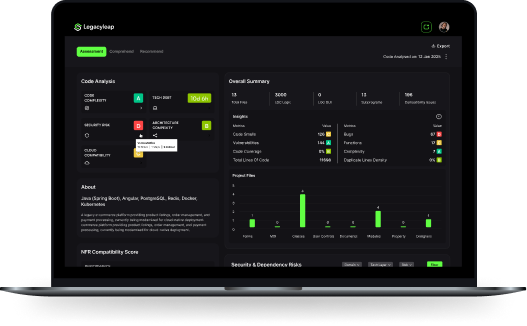
- A Day-1-to-Day-100 cadence only works when assessment happens before architecture, not after. Legacyleap’s Assessment Agent produces a dependency map and technical debt report in 2-5 days, and the QA Agent validates parity before any phased cutover.
Post-acquisition data integration is usually treated as a single decision: integrate the two platforms, federate them, or consolidate onto one. That decision is being made in the wrong order. The platforms have to be assessed first, because one of them, usually the acquired company’s, is more likely than not carrying technical debt nobody flagged during diligence.
Skipping that assessment is why so many post-acquisition data integrations run over budget or fail outright. The sequence that actually works runs in a fixed order: assess both platforms, decide and execute the architecture, validate that the result behaves the same as what it replaced, then cut over in phases rather than all at once.
Why Post-Acquisition Data Integration Breaks Down After the Deal Closes
Between 70 and 90% of mergers fail to meet their objectives, and integration difficulty is one of the most consistently cited reasons why [1]. For IT and data specifically, the numbers are just as blunt. Integration typically costs 1-7% of deal value regardless of how large the deal is, with a 2010-2016 analysis of 70 mergers finding costs ranging from $4 million to $3.8 billion [2].
Roughly 70-80% of that integration work has to happen within two years of close. Work left past that window compounds into what one analyst calls scar tissue, growing harder, costlier, and more politically difficult to fix the longer it sits [2].
One IT leader described a real post-acquisition data migration in which the team hit technical issues and failed the cutover three times in a row before it finally held [2]. An architecture decision had been executed before anyone confirmed what the legacy platform actually required to move safely.
That gap between choosing an architecture and understanding what either platform can support is the pattern behind most of the failures above, not a single bad tool choice or a single missed deadline.


The Architecture Decision: Integrate, Federate, or Modernize the Legacy Platform First
The clearest existing framework for this decision comes from Deloitte, which scores the choice across four maturity levels: Converge (full integration), Combine (a balanced middle path), Coexist (minimal integration), and Continue (full autonomy). It weighs those levels against data management needs, collaboration requirements, financial tradeoffs, and future divestment risk [3].
It is a legitimate starting point. What it does not address is whether either platform is actually safe to touch, which is the question that determines how any of those four levels gets executed in practice.
Three practical options follow once that question is asked:
| Option | What it resolves | What it does not resolve on its own | Best fit |
| Consolidate onto one platform | Eliminates duplicate infrastructure and long-term maintenance | Does nothing about technical debt or undocumented logic on the platform being retired or absorbed | Both platforms are reasonably well understood and one is clearly the stronger long-term fit |
| Modernize the legacy platform, then integrate | Removes the technical debt and documentation gap before it becomes the integration’s problem | Takes longer up front than a direct connection | One platform is undocumented, end-of-life, or carries real technical debt |
| Run federated | Preserves both systems’ autonomy and avoids a forced migration deadline | Leaves long-term duplicate maintenance cost in place, and complicates any future divestment | Both platforms need to keep operating independently, at least in the near term |
Modernizing the legacy platform first is the option every generic checklist skips, because most guidance assumes both platforms are already healthy enough to connect. When one platform is the acquired company’s twenty-year-old ERP system, that assumption does not hold. The same tradeoff shapes a platform vs. services modernization decision more broadly: who executes the work matters as much as which target architecture gets chosen.
The pattern recurs constantly in legacy ERP modernization: acquirers standardize on their own ERP, deliberately keep both systems where business lines genuinely differ, or discover too late that both run the same stack but were never properly connected. None of those three outcomes gets safer by skipping the assessment step.
Not Sure Which Platform Should Win?
Book a Technical Demo and see how Legacyleap’s Assessment Agent maps dependencies and technical debt across both platforms before any architecture decision is finalized.
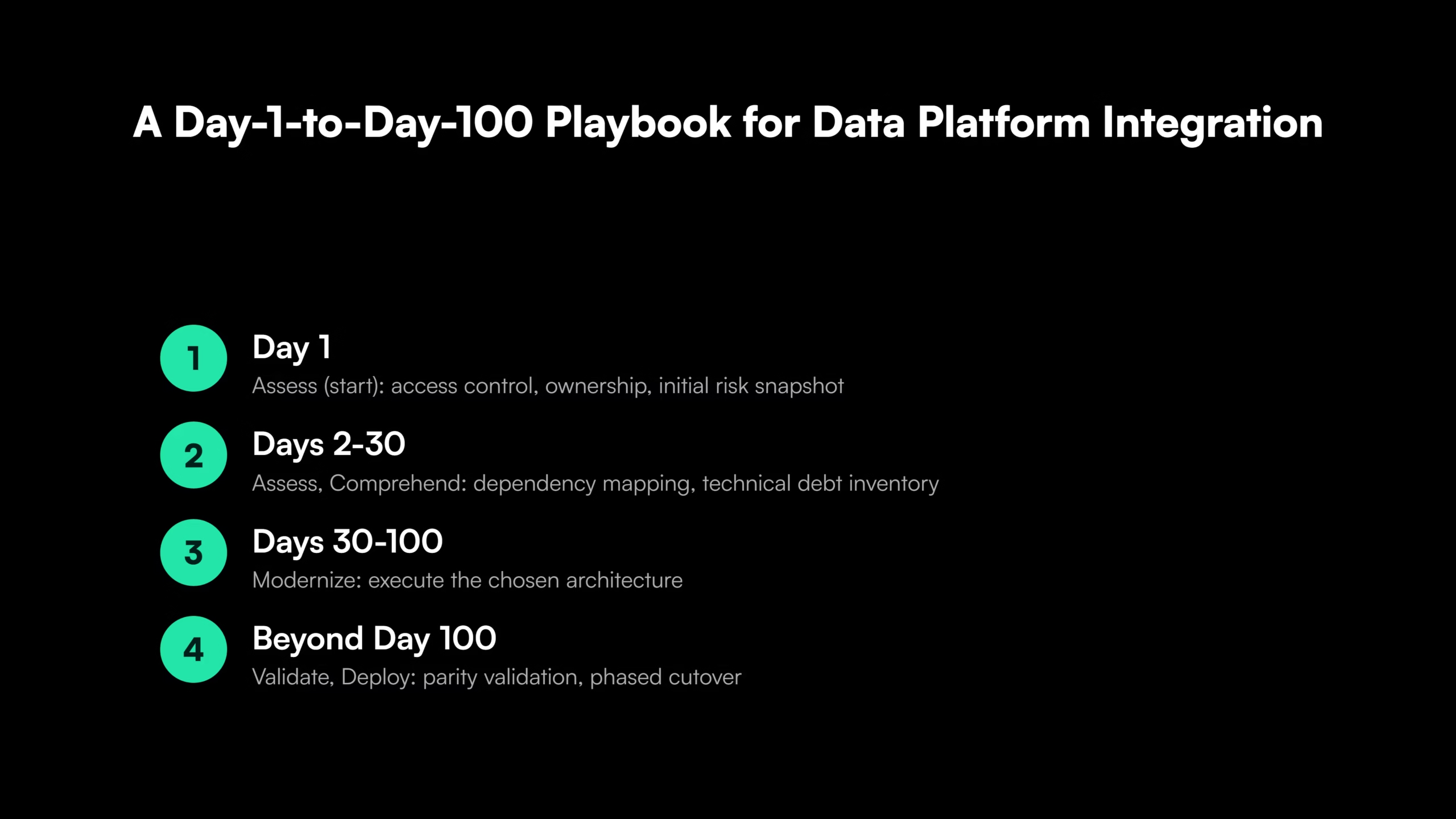
A Day-1-to-Day-100 Playbook for Data Platform Integration
The generic post-merger acquisition checklist most integration teams already have treats this decision as a single line item, consolidate the most critical systems first. That guidance is directionally correct and too thin to execute against for data platforms. The same familiar Day-1-to-Day-100 cadence works better mapped explicitly onto the lifecycle that actually needs to happen.
Day 1: What you need to know before touching anything. Freeze access changes, confirm ownership of both estates, and produce an initial dependency snapshot. This is the beginning of assessment, not integration.
Days 2-30: Assessing and documenting the legacy platform. This is the phase most checklists compress into a single audit line, and the one that determines everything downstream. Whichever platform is older needs a real dependency map, a technical debt inventory, and documentation of logic that may never have been written down. Skipping this is how a team discovers, mid-migration, that a “simple” data platform modernization is blocked by a dependency nobody knew existed.
Days 30-100: Deciding and executing the architecture. Apply the consolidate, modernize-then-integrate, or federate decision from the previous section, now informed by what Days 2-30 found. This is where the real modernization work happens if the legacy platform needs it, well beyond a connector configuration exercise. The window scales with the legacy platform’s actual complexity. A single application can close within it; a larger or more tangled estate may extend past Day 100, which is exactly why roughly a quarter of all integration work still has runway beyond the two-year mark referenced earlier.
Beyond Day 100: Validating parity and cutting over in phases. Confirm the result behaves the same as what it replaced before anyone relies on it, then cut over in stages rather than a single event. A migration that completes but produces different numbers than either original system has not actually finished.
| Phase | Lifecycle Stage | What Happens | Primary Risk If Skipped |
| Day 1 | Assess (start) | Access control, ownership, initial risk snapshot | Uncontrolled access during the highest-risk window |
| Days 2-30 | Assess, Comprehend | Dependency mapping, technical debt inventory, documentation of undocumented logic | Architecture gets chosen blind to what either platform actually requires |
| Days 30-100 | Modernize | Execute the chosen architecture, including modernization work if the legacy platform needs it | Carrying forward the same technical debt into the new combined estate |
| Beyond Day 100 | Validate, Deploy | Parity validation, phased cutover | A migration that completes but silently produces different results |
How Legacyleap Executes This Lifecycle for Post-Acquisition Data Platforms
Legacyleap runs this exact sequence through five coordinated agents rather than leaving each phase to a manual checklist line item. The Assessment Agent produces the dependency map, technical debt report, and risk indicators that Days 2-30 require, typically in 2-5 days.
The Documentation Agent reconstructs business logic and system behavior directly from the codebase, which matters most when the legacy platform was never formally documented, a common condition for a platform that has just arrived through an acquisition rather than been built in-house.
The Recommendation Agent produces the ordered migration plan feeding the Days 30-100 decision. The Modernization Agent then executes the transformation as diff-based, human-reviewed pull requests, roughly 70% automated with the remainder governed by engineering review. No code is merged, deployed, or executed autonomously.
The QA Agent auto-generates unit, integration, regression, and functional test cases to validate parity before cutover, directly addressing the earlier failure mode of a migration that completes without actually matching either original system’s behavior.
| Manual, checklist-driven approach | With Legacyleap | |
| Assessment and documentation | Weeks to months, limited by whatever institutional knowledge is still available | 2-5 days, produced directly from the codebase |
| Modernization effort | Fully manual engineering time, pulled from the product roadmap | Roughly 70% automated via diff-based, human-reviewed pull requests |
| Parity validation | Ad hoc, often reduced under deadline pressure | Unit, integration, regression, and functional test cases generated and run before cutover |
| Where the work happens | Varies by vendor or contractor | Entirely inside the client’s own infrastructure, no source code leaves the environment |
A semiconductor manufacturer inherited six mission-critical VB6 components through an acquisition, with technical debt that threatened precision hardware communication. Phased, AI-accelerated modernization to .NET across more than 3 million lines of code resolved the risk without a disruptive rewrite.
That on-infrastructure boundary matters specifically in an M&A context, where two companies’ data are both still sensitive and often still subject to separate governance obligations until the integration is complete.
Conclusion: Assess Before You Choose an Architecture
Two data platforms rarely arrive in equally good condition. The architecture decision, whether to consolidate, modernize the legacy side first, or run federated, only holds up when it follows an honest assessment of both platforms rather than preceding it. A Day-1-to-Day-100 sequence built around assess, comprehend, modernize, validate, and deploy is what keeps that decision from being made blind, and what keeps a migration that technically finishes from quietly producing the wrong answer.
A $0 Modernization Assessment scopes exactly this kind of dependency and technical debt picture for either platform, at no cost and no obligation, before any integration architecture is finalized. A Technical Demo is available for teams that want to see the assessment and modernization workflow directly.
FAQ
The process of combining or connecting two companies’ data platforms after a deal closes, covering the assessment, architecture decision, and validation work needed before either platform’s data is fully trusted together.
Data integration connects two platforms so information flows between them without necessarily retiring either system. Data migration permanently moves data from one platform to another, typically as the final step of consolidating onto a single platform.
The CIO or VP Eng typically owns the timeline and risk tradeoffs against the deal thesis. The enterprise architect owns the target-state design and can veto an architecture that will not hold up long term.
A data clean room is a controlled environment for analyzing sensitive data pre-close without violating antitrust information-sharing limits. It applies during diligence and negotiation, before the post-close integration work this playbook covers.
References
[1] Progress/DataDirect. Agile M&A: A Pre- and Post-Merger Data Integration Guide
[2] CIO Dive. M&A playbook: How to prepare for the cost, staff and tech hurdles
[3] Deloitte Switzerland. To Integrate or To Federate, that’s an IT M&A Question