TL;DR
- One enterprise got hit with a $2.4 million surprise Java bill it didn’t know it owed. Since Oracle’s 2023 shift to employee-based pricing, every employee counts toward the subscription cost regardless of who actually uses Java.
- About 80% of enterprise Java applications migrate to OpenJDK with zero code changes. The remaining 20% cluster around identifiable Oracle-proprietary dependencies like JavaFX, Java Web Start, and JAXB/JAX-WS, which were stripped from the JDK core starting at Java 11.
- Switching JDK vendors and jumping Java versions are not separate decisions. Moving from Oracle JDK 8 straight to OpenJDK 21 crosses three breaking version boundaries at once, including the strong encapsulation changes introduced at Java 17.
- September 2026 is a hard cutover deadline, not a planning horizon. Oracle’s JDK 21 No-Fee Terms and Conditions license expires then, after which continued use reverts to the same per-employee Universal Subscription pricing.
- A 2026 industry survey shows the market has already voted with its feet. Azul’s State of Java Survey of over 2,000 professionals found 92% concerned about Oracle’s pricing and 81% reporting they have migrated all or part of their Oracle Java estate.
Oracle Java Pricing in 2026: Why US Enterprises Are Migrating at Scale
“Oracle sent us a compliance review letter. We had no idea we owed them anything for Java. Our bill came back at $2.4M.”
That quote comes from r/sysadmin. It is not an edge case.
Since Oracle’s 2023 shift to employee-based pricing, enterprises are discovering mid-cycle that every employee, not every Java user, counts toward their bill. The decision to migrate is effectively made for most US organizations.
This guide covers the engineering execution: how to find every Java installation, which applications actually break, and how to migrate at scale without disrupting production.
Oracle’s January 2023 licensing change moved Java SE from a per-processor or named-user model to a Universal Subscription billed per employee, regardless of whether they use Java. The cost math at US enterprise scale is straightforward:
| Org Size | Annual Oracle Java Cost [1] |
| 1,000 employees | ~$144,000/year |
| 5,000 employees | ~$630,000/year |
| 10,000 employees | ~$960K–$1.44M/year |
| 45,000 employees | ~$2.835M/year |
That represents a 3x–10x increase over the prior model for most organizations. An 8% annual escalation clause compounds the cost every year a team stays on Oracle [2]. JDK 8, 11, and 17 are already in paid or non-compliant territory. JDK 21 is free only through September 2026, after which the same employee-based pricing applies.
The market response reflects this arithmetic. According to the Azul 2026 State of Java Survey (n=2,000+ Java professionals), 92% of respondents expressed concern about Oracle’s pricing, and 81% reported migrating all or part of their Oracle Java estate [3].
Oracle has expanded its Java-specific audit capabilities since the 2023 pricing change. Oracle uses download telemetry, the Java Management Service (JMS) tool, and standard contract audit clauses to identify non-compliant installations.
The most common enterprise discovery is paying twice, once through bundled rights in a WebLogic or middleware contract, and again through a separate Java SE subscription covering the same servers. A completed estate inventory eliminates the ambiguity that makes audit exposure unpredictable.


Is OpenJDK the Same as Oracle Java? The Technical Reality
OpenJDK is the open-source reference implementation of Java SE. Oracle JDK is Oracle’s commercial build derived from that same source. The two share a codebase and are functionally equivalent for standard Java applications.
The formal proof of equivalence is TCK certification, the Java Technology Compatibility Kit, and the official conformance test suite. All major OpenJDK distributions pass it [4].
Distribution comparison for US enterprise selection:
| Distribution | Cost | LTS Support | Best For |
| Amazon Corretto | Free | Yes (AWS-backed) | AWS-hosted workloads, EKS, Lambda |
| Eclipse Temurin | Free | Yes (Eclipse Foundation) | Vendor-neutral enterprises, no cloud preference |
| Azul Zulu | Free / paid tiers | Yes (Azul) | Teams needing extended LTS flexibility or commercial support |
| Red Hat OpenJDK | Included with RHEL | Yes (Red Hat) | RHEL / OpenShift environments |
Selection heuristic: AWS shops default to Corretto. RHEL and OpenShift environments use Red Hat OpenJDK. Teams without a cloud preference, or those prioritizing community governance, typically go with Eclipse Temurin. Azul Zulu suits organizations that need support SLAs beyond standard LTS windows.
For standard server-side Java (Spring Boot, Jakarta EE, microservices), the migration is to swap the JDK, recompile, run tests, and deploy. The complexity in the next section applies to a specific, identifiable subset of applications.
Will My Java Applications Break on OpenJDK? The Four-Tier Enterprise Triage Framework
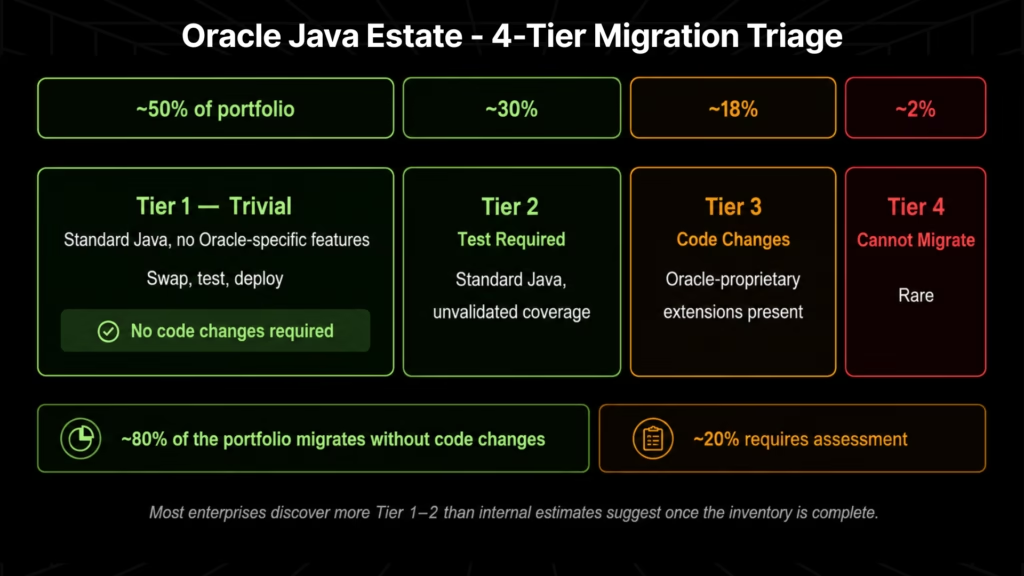
Advisory experience across enterprise migrations in the US suggests roughly 80% of Java applications migrate to OpenJDK without any code changes [5]. The remaining 20% require assessment, but they are not unpredictable. They cluster around a defined set of Oracle-proprietary dependencies.
Dependencies that require assessment:
- JavaFX applications: Decoupled from Oracle JDK in 2017. Requires OpenJFX or a bundled distribution.
- Java Web Start: Removed in JDK 11. Requires OpenWebStart or an architectural change.
- Oracle JDBC TDE extensions: Oracle’s proprietary TDE implementation needs case-by-case assessment.
- JAXB / JAX-WS: Removed from JDK core in Java 11+. Must be added as external Maven or Gradle dependencies.
The failure mode in most enterprise migrations is treating the entire portfolio as high-risk because no one has completed the triage. A structured framework prevents that:
| Tier | Profile | Action Required | Est. Share of Enterprise Portfolio |
| Tier 1: Trivial | Standard Java, no Oracle-specific features | Swap, test, deploy | ~50% |
| Tier 2: Test Required | Standard Java, unvalidated test coverage | Full regression testing; no code changes expected | ~30% |
| Tier 3: Code Changes | Oracle-proprietary extensions present | Assessment, remediation, and testing required | ~18% |
| Tier 4: Cannot Migrate | Vendor-certified Oracle-only dependency (rare) | Maintain minimal Oracle subscription for these only; migrate everything else | ~2% |
Tier 4 is genuinely rare. Most organizations that believe they have Tier 4 applications have not completed a thorough inventory. The actual Oracle-specific surface area in a typical enterprise portfolio is smaller than the licensing exposure suggests.
One compounding factor for enterprises still on Oracle Java 8 is switching JDK providers and jumping versions are not separate decisions.
- Moving from Oracle JDK 8 to OpenJDK 21 crosses three major version boundaries simultaneously.
- Java 8 to 11 removes JAXB and JAX-WS from the JDK core.
- Java 11 to 17 introduces strong encapsulation that breaks reflective access patterns common in older frameworks.
- Java 17 to 21 continues module system restrictions.
Tier 3 applications on Java 8 are not just Oracle-proprietary dependency problems. They are version migration problems that compound the remediation scope. Plan both migrations together, not sequentially.
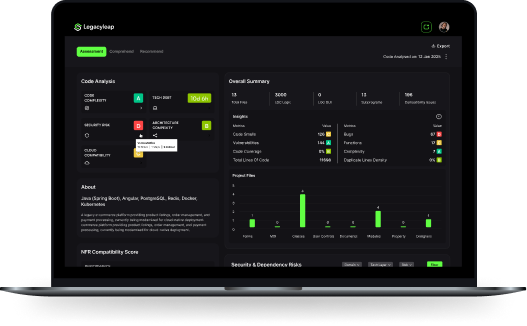
Legacyleap’s $0 Assessment categorizes your entire Java estate into this four-tier framework in 2–5 days, without source code leaving your environment. Request your $0 Assessment.
Why Legacyleap Is the Right Migration Partner for Enterprise Oracle Java Programs
Licensing consultancies identify what to do. JDK vendors and distribution providers tell you where to go. What most US companies find missing is the engineering infrastructure to execute the migration at scale: finding every Oracle JDK installation, applying the triage framework automatically, and generating the regression test volume required for validated cutover.
That is the gap Legacyleap, as a modernization platform and services partner, is built to close.
Assessment Agent: Solves the shadow Java discovery problem
Shadow Java installations accumulate in application servers, middleware bundles like WebLogic and Tomcat, CI/CD pipelines, Docker base images, and developer laptops, often without any central record. Every undiscovered Oracle JDK installation is both a migration gap and an audit exposure.
The most commonly cited practitioner pain point in enterprise Java migrations is not the JDK swap. It is finding every Oracle JDK installation across the estate. Documenting them manually is weeks of work.
Legacyleap’s Assessment Agent inventories the entire Java estate, every application, JDK version, Oracle-proprietary extension, and dependency chain, and delivers the complete inventory in 2 to 5 days. It maps each application to the four-tier triage framework automatically, isolating the 20% with Oracle-specific dependencies from the 80% that migrate trivially.
Documentation Agent: Solves the undocumented legacy problem
For Java 8 codebases that have been in production for a decade without maintained documentation, confident Tier 3 remediation decisions require architecture reconstruction first. The Documentation Agent rebuilds architecture diagrams, dependency graphs, and API integration maps from code behavior, the prerequisite for any code change decision on an undocumented application.
QA Agent: Solves the regression testing problem
“Just switch to OpenJDK” understates the testing scope. Every application running on Java requires regression validation after a JDK change, including GC algorithm differences that affect latency even when no code changes are made.
The QA Agent auto-generates unit, integration, regression, and functional test cases at roughly twice the speed of manual test creation, and validates behavior parity between Oracle JDK and OpenJDK runtime environments.
All transformations are delivered as diff-based pull requests requiring human review before acceptance. No AI-generated change merges or deploys autonomously.
$0 Modernization Assessment. The entry point for most US enterprises working with Legacyleap as their modernization vendor is the $0 Assessment: a complete Java estate inventory, dependency map, risk heatmap, and migration plan delivered in 2 to 5 days, entirely within the client’s infrastructure. No source code leaves the environment.
Want to see how enterprise Oracle Java migrations actually get structured?
Book a Demo to walk through the full path from inventory to validated cutover.
The Oracle Java Migration Playbook: Timeline, Phases, and Where to Start
Realistic timeline ranges for US enterprise planning:
- Simple server-side swap with a clean, documented inventory: days to weeks
- Full enterprise migration through dev → test → staging → production: 90–180 days for most organizations
- Large portfolios with compound version migrations (e.g., Java 8 to 17) and thin test coverage: 12–18 months [5]
The six-phase sequence that applies to most US enterprise programs:
- Discovery and inventory: Identify all Java installations, versions, and Oracle vs. non-Oracle dependency footprint
- Application triage: Categorize the full portfolio into the four tiers
- Dev/test environment migration: Validate the process before production is touched
- Tier 1 and 2 production migration: Lowest-criticality applications first; build team confidence and refine the process
- Tier 3 remediation and migration: Oracle-proprietary dependency removal, code changes, and validation
- Oracle footprint reduction: Confirm subscription reduction; document evidence for renewal negotiation
On timing: Organizations targeting the September 2026 Oracle JDK 21 NFTC expiration need to be in active execution now. Renewal negotiations are most effective when initiated 9–12 months in advance [2], which puts the planning window at Q3–Q4 2025 for most teams.
That window has passed for some. The priority shifts to ensuring migration is complete before the next renewal cycle locks in another year of employee-based pricing.
Switching JDK vendors resolves the licensing cost. The longer-term challenge, as LTS support timelines converge between 2029 and 2032, is a version-level modernization decision that warrants planning now.
Java migration follows the same phased approach that applies to broader application modernization programs: dev → test → staging → production, lowest criticality first.
For a structured look at how that sequencing works across a larger portfolio, see our incremental modernization guide.
The Licensing Decision Is Made. The Engineering Work Remains.
Oracle’s pricing model has effectively made the migration decision for most US enterprises. The question that determines whether a program succeeds or stalls is whether the engineering infrastructure exists to do it safely at scale.
The four-tier triage framework in this guide gives teams the methodology to scope the work accurately before committing resources. Most portfolios are heavier in Tier 1 and 2 than internal estimates suggest, which means the migration is more tractable than it looks until the inventory is done.
For organizations with an Oracle renewal approaching, the priority is completing a verified Java estate inventory before the next contract cycle locks in another year of employee-based pricing. That inventory is the prerequisite for every phase of execution that follows.
Start with a $0 Oracle Java Assessment or a complete inventory of your Java estate, a four-tier triage map, and a migration plan, delivered in 2–5 days inside your environment at no cost.
Or Book a Demo to see the Legacyleap assessment workflow in action.
FAQs
Oracle’s audit rights are embedded in standard Java SE subscription contracts. Triggers typically include download telemetry flagged through Oracle’s Java Management Service, gaps identified during contract renewals, or reports from third-party license monitoring tools. Oracle does not need to notify customers before initiating a review. Enterprises with undocumented Java installations, or those relying on bundled middleware rights to cover standalone Java usage, carry the most exposure. A complete estate inventory is the most effective pre-audit control available.
Oracle JDK 21 is currently available under a No-Fee Terms and Conditions (NFTC) license through September 2026. After that date, continued use defaults to the commercial Java SE Universal Subscription, billed per employee. Organizations that have not completed migration by that point will owe Oracle licensing fees for their full headcount, not their Java user count, retroactively from the expiration date depending on contract terms. The safest path is treating September 2026 as a hard cutover deadline, not a planning horizon.
Switching providers on the same version, for example from Oracle JDK 17 to Eclipse Temurin 17, is a runtime swap. The bytecode and APIs are identical; the change is in the distribution and support contract. Migrating from Java 8 to OpenJDK 21 is a version migration that crosses three major boundary changes simultaneously: JAXB and JAX-WS removal at Java 11, strong encapsulation of internal APIs at Java 17, and continued module system restrictions through Java 21. Applications that rely on any of these internal behaviors require code-level remediation before deployment, not just a distribution swap.
WebLogic and several other Oracle middleware products have historically bundled a certified Oracle JDK as part of their runtime. Switching the underlying JDK on a WebLogic deployment requires verifying that the OpenJDK distribution is supported by the installed WebLogic version, and in some cases, that certification may be absent for older WebLogic releases. Before migrating Java on any server running Oracle middleware, validate the support matrix against your specific WebLogic and JDK versions. Applications in this category typically land in Tier 3 of the triage framework and require assessment before migration.
Behavioral parity validation requires running the same application workloads against both Oracle JDK and OpenJDK in a controlled test environment and comparing outputs, error rates, and performance characteristics. The areas most likely to diverge are GC algorithm behavior (which can affect latency profiles even with no code changes), internal API access that was silently permitted under older Oracle JDK versions, and cryptographic provider differences in certain configurations. Automated regression test suites that cover functional behavior and performance baselines, run against both runtimes in parallel before cutover, are the standard approach for enterprise-grade parity validation.
References
[1] Oracle Java SE Universal Subscription — public pricing documentation — https://www.oracle.com/java/technologies/java-se-subscription.html
[2] Redress Compliance — “Java Licensing Cost 2026” / “Top 20 Java Licensing Strategies 2026” — https://www.redresscompliance.com/java-licensing-cost/
[3] Azul 2026 State of Java Survey (n=2,000+ Java professionals, February 2026) — https://www.azul.com/state-of-java-survey-2026/
[4] Eclipse Adoptium / Temurin TCK certification documentation — https://adoptium.net/aqavit/
[5] Atonement Licensing — “Oracle Java Licensing 2026: Cost Impact & Options” — https://www.atonementlicensing.com/oracle-java-licensing-2026/