The Cost Visibility Problem
Most enterprises can tell you what they spend on legacy infrastructure. Fewer can tell you what their legacy applications actually cost.
The gap is structural. Direct maintenance spend (patches, fixes, hosting, license renewals) sits in a visible budget line. But the costs that dominate the real total cost of ownership are distributed elsewhere:
- Talent premiums buried in HR budgets,
- Productivity loss absorbed by engineering,
- Compliance remediation charged to legal,
- Breach response funded from reserves.
No single function owns the aggregate number, so the aggregate number does not exist.
For enterprises running 10–15 legacy applications, direct maintenance alone runs $400,000–$800,000 annually, and that is before talent premiums, productivity loss, or risk exposure enter the picture. The true total cost of ownership is typically two to three times that of the visible line item.
Industry benchmarks consistently place legacy maintenance at 60–80% of total IT spend across enterprise portfolios (Gartner, Forrester, Deloitte). A 2025 GAO report on U.S. federal IT spending quantified the extreme case: 79% of a $105 billion-plus annual IT budget allocated to operations and maintenance, with only 3 of 10 previously flagged critical legacy systems modernized since 2019 [1].
The federal government is an outlier in scale, not in pattern. The same cost visibility gap exists in financial services, insurance, healthcare, and manufacturing, anywhere legacy applications have been running long enough that their true cost has become ambient and unchallenged.
This article breaks that cost into its actual components: direct maintenance, ESU and licensing fees, talent scarcity, developer productivity loss, risk exposure, and compounding total cost of ownership over five years. The goal is a framework a senior technology leader can take into a budget conversation. Not a conceptual argument for modernization, but the math behind one.
How Much Does It Cost to Maintain a Legacy System?
The average cost of maintaining a single legacy enterprise application is $40,000–$55,000 per year in direct maintenance alone.
When indirect costs are included (talent premiums, compliance remediation, productivity loss, security exposure, integration workarounds, and opportunity cost) the true annual cost for a mid-sized enterprise running 10–15 legacy applications ranges from $1.5M–$3.5M.
Legacy-heavy organizations spend 60–80% of their IT budgets on maintenance, leaving only 20–40% for innovation.
Direct Maintenance and Infrastructure
Across Legacyleap’s modernization engagements, a consistent pattern emerges in pre-assessment discovery: enterprises running 10–15 legacy applications typically carry $400,000–$800,000 in direct annual maintenance costs before talent, productivity, or risk exposure enters the picture.
Per-application costs range from $40,000 to $55,000, depending on stack complexity, hosting model, and the age of the surrounding infrastructure.
Hardware costs escalate post-warranty. Premium support contracts for end-of-life systems routinely run well above standard pricing, and annual increases compound. These costs are predictable in direction but rarely forecasted in portfolio-level planning.
What Are Extended Security Update (ESU) Fees?
Microsoft’s Extended Security Updates program offers the clearest example of what standing still actually costs in per-device, per-year terms.
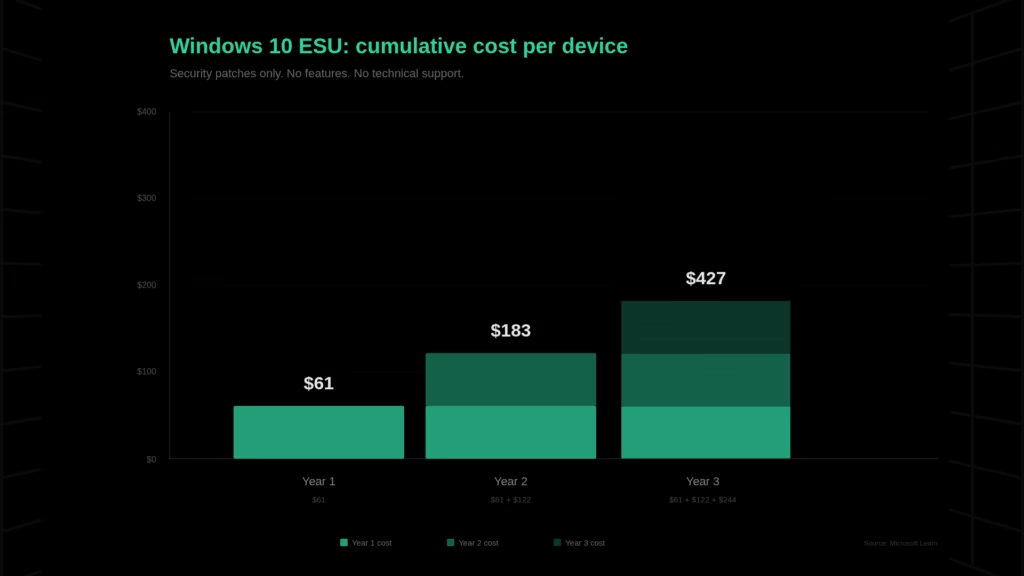
| Component | Year 1 | Year 2 | Year 3 | 3-Year Cumulative |
| Windows 10 ESU (per device) | $61 | $122 | $244 | $427 |
| SQL Server 2016 ESU | 75% of annual license | Cumulative | Cumulative | Escalating |
For an enterprise running 2,000 Windows 10 devices, the three-year ESU bill is $854,000. That covers security patches only. No new features. No technical support. Microsoft describes ESU explicitly as a “temporary bridge,” not a maintenance strategy.
This pricing is directly relevant to organizations running VB6, Web Forms, WCF, Classic ASP, and ADO.NET applications on Windows/.NET Framework infrastructure.
.NET Framework 4.8 support is tied to the lifecycle of the underlying Windows operating system, and Microsoft has confirmed it will not receive new features or independent development. Once the Windows version it runs on reaches end of life, the framework goes with it. For teams still running these stacks, the .NET modernization path is not a future consideration. It is a live dependency on a shrinking support window.
Why Legacy Developer Talent Is Getting More Expensive
Legacy talent markets are contracting across every stack Legacyleap supports, and the pattern is visible in almost every assessment engagement the platform runs.
Organizations are not just paying more for legacy specialists. They are waiting longer to find them, competing with a shrinking pool, and absorbing mounting maintenance backlogs while positions sit unfilled.
- VB6: Average salaries exceed $105,000/year in the US, and the job market for VB6-specific roles has effectively collapsed. Legacyleap’s VB6 modernization engagements in financial services and insurance consistently begin with the same trigger: the team that maintained the application has shrunk to one or two people, and replacement hiring has failed. For a detailed view of what Gen AI in VB6 to .NET modernization involves, see our modernization analysis.
- Java EE / EJB / Struts: Hiring timelines for specialists in these frameworks regularly exceed 120 days, with salary premiums running 40% above modern Java developer rates. The deeper the EJB or Struts coupling, the harder these roles are to fill, and the longer they sit open, the more maintenance backlogs compound. For organizations evaluating Java application server migration, the talent economics alone often justify the investment.
- AngularJS: End-of-life since December 2021. Migration to Angular 2+ is a complete rewrite, not an upgrade. Organizations still running AngularJS are dependent on a shrinking developer pool or paying for commercial extended support subscriptions with no end date.
Developer Productivity Drain
Maintenance burden is one of the least visible costs in a legacy portfolio, and one of the largest. Stripe’s 2018 developer survey quantified the pattern: developers spend 42% of their work week, roughly 17 hours out of 41, on maintenance and technical debt, with legacy system maintenance cited as the primary cause [2].
Applied to a team of 25 developers at an average fully loaded cost of $120,000/year, that is approximately $990,000 annually in engineering capacity absorbed by maintenance rather than product development.
The figure is directional, not precise to any single organization, but the order of magnitude is consistent with what Legacyleap observes in pre-assessment scoping, where engineering teams are stretched thin, not because of headcount, but because legacy maintenance consumes the capacity that should be going to product work.
This is the cost that rarely appears in any legacy maintenance budget: the innovation capacity that legacy systems silently consume.
The Integration Tax: What Legacy Systems Cost When They Can’t Connect
Legacy applications were built before APIs, cloud services, and AI tooling became foundational infrastructure. When they cannot connect to the systems around them, people become the integration layer.
The pattern is consistent across Legacyleap’s assessment engagements:
- Data re-keyed manually between legacy and modern systems,
- CSV exports run nightly because real-time data exchange is architecturally impossible, and
- Workaround scripts maintained by one or two engineers who understand both sides of the gap.
These workarounds are rarely budgeted as legacy costs. They show up as operational overhead, absorbed into team workflows as “how things work here.”
The compounding dimension is what makes this cost category particularly corrosive. As the rest of the technology stack modernizes around the legacy core, every new system that cannot connect directly to the legacy application adds another manual bridge.
The integration tax grows not because the legacy system is changing, but because everything around it is.
Knowledge Concentration Risk
Business logic in VB6 and Java EE systems is often encoded over decades with no external documentation. Module boundaries, exception handling paths, and integration behaviors exist only in the memories of the engineers who built or maintained them.
When those specialists retire or leave, the organization does not lose a team member. It loses the ability to safely modify or maintain the application. This is the single largest hidden cost driver in long-running legacy estates, and the one that is hardest to quantify until it materializes as a production incident or a stalled modernization attempt.
Legacyleap’s Documentation Agent was built specifically for this problem: reconstructing business logic, module boundaries, and workflow documentation directly from the codebase, converting institutional knowledge trapped in legacy code into a visible, maintainable asset.
If you don’t have a single view of what your legacy estate actually costs, the $0 Assessment is designed to produce exactly that. A dependency map, risk profile, and modernization blueprint at no cost.
What Are the Hidden Costs of Legacy Systems?
The costs above are detailed individually, but the reason they remain invisible is that they are never consolidated.
For decision-makers building a modernization business case, the following is the complete list of hidden cost categories that sit outside the direct maintenance budget:
- Developer productivity loss: Engineers spend 42% of their week on maintenance and technical debt rather than product development [2]
- Talent premiums: Legacy specialists command 30–50% above modern-stack salaries due to a shrinking supply pool with no replenishment pipeline
- Knowledge concentration risk: Critical business logic locked in the heads of one or two people approaching retirement, with no documentation to recover it
- Compliance remediation: Audit findings against unpatched or unsupported systems requiring manual controls, exception processes, and ongoing remediation spend
- Extended security update fees: ESU subscriptions costing $61–$244 per device per year with annual doubling, covering security patches only
- Integration tax: Manual workarounds where legacy systems cannot connect to modern APIs, cloud services, or AI tooling, with cost growing as the surrounding stack modernizes
- Opportunity cost: Cloud migration, automation, and AI capabilities structurally blocked by incompatible architecture
- Compounding effect: Legacy maintenance costs escalate 10–20% annually as hardware ages, talent retires, and compliance gaps widen
Every item on this list is a real budget line in a real department. The problem is that no single function aggregates them. The $0 Assessment exists to produce exactly that aggregation (more on this below).
What Are the Risks of Keeping Legacy Systems?
The costs above are operating costs. They show up whether or not anything goes wrong. The costs below show up when something does.
Breach Cost Exposure
Legacy systems are structurally more exposed to breaches than modern platforms. Limited logging capabilities delay detection.
Absence of modern encryption leaves data vulnerable in transit and at rest. Inability to apply timely patches keeps known vulnerabilities open for months or years. And when a breach does occur, the remediation is more expensive because legacy environments lack the instrumentation needed for rapid containment.
The IBM Cost of a Data Breach Report 2025 confirms this at industry scale: the global average breach cost reached $4.44 million, with the U.S. average at $10.22 million (a record high, up 9% year over year).
Breaches involving data stored across multiple environments, the typical profile for organizations running hybrid legacy-and-cloud architectures, averaged $5.05 million. Thirty-two percent of breached organizations paid regulatory fines, and 48% of those fines exceeded $100,000 [3].
For organizations running legacy applications in regulated industries, this is not a hypothetical risk category. It is an actuarial one.
Compliance Exposure
AngularJS has accumulated seven or more CVEs post-EOL (HeroDevs / NVD), with no official patches available. Each unpatched vulnerability is a compliance liability in any regulated industry (healthcare, financial services, insurance) where audit trails and patch currency are baseline requirements.
VB6 applications lack native data encryption, audit trail capabilities, and modern authentication frameworks. For organizations subject to SOC 2, HIPAA, or PCI-DSS requirements, every legacy application without these capabilities is an audit finding waiting to happen.
Teams evaluating their AngularJS to Angular migration path should weigh compliance exposure as heavily as technical debt.
In financial services, the compliance surface area is particularly large. SOX audit requirements, real-time transaction processing mandates, and regulatory reporting obligations create ongoing remediation costs for any system that cannot demonstrate current patch status, encryption standards, and access controls.
In healthcare, HIPAA exposure compounds the cost further: the IBM report consistently shows that healthcare breach costs run above the cross-industry average, and legacy systems that cannot integrate with modern EHR platforms create both clinical workflow friction and data governance gaps.
Downtime Costs
Legacy architectures carry disproportionate downtime risk because they lack the redundancy, failover mechanisms, and observability tooling that modern platforms provide as baseline infrastructure.
When a legacy system goes down, the blast radius is larger (tightly coupled architectures take more systems with them), detection is slower (limited monitoring), and recovery takes longer (manual processes, no automated failover).
For mid-size enterprises, industry research consistently places hourly downtime costs in the $300,000-plus range, with a significant share of firms reporting costs above $1 million per hour.
The dollar figure varies by industry and application criticality, but the structural point holds: legacy systems are more likely to go down, harder to bring back, and more expensive when they do.
ITIC’s 2024 Hourly Cost of Downtime survey quantifies the exposure: over 90% of mid-size and large enterprises report that a single hour of downtime exceeds $300,000 in costs, and 41% report costs above $1 million per hour [5].
These figures exclude litigation and regulatory penalties. For legacy-dependent organizations, the structural factors that cause downtime (aging hardware, limited redundancy, manual recovery processes) overlap almost entirely with the factors that make it expensive.
The Compounding Dimension
Each of these risk categories compounds independently. Every unpatched CVE increases the probability of a breach. Every year without compliance remediation increases the severity of an audit finding. Every additional legacy integration point increases the blast radius of a downtime event.
This is a cost that grows whether you invest in it or not. The only question is whether it surfaces as a planned modernization investment or as an unplanned incident response.
Why Do Legacy System Maintenance Costs Increase Over Time?
Legacy system maintenance costs compound at 10–20% annually because of four converging forces:
- Hardware components become scarcer and more expensive after warranty expiration,
- The talent pool of developers with legacy expertise shrinks as specialists retire,
- Third-party vendor support contracts escalate as vendors sunset legacy product lines, and
- Each year of deferred modernization adds technical debt that makes the eventual migration more complex and costly.
This is the pattern Legacyleap sees in every portfolio it assesses. Year-over-year, maintenance costs do not hold steady. They escalate in every category simultaneously.
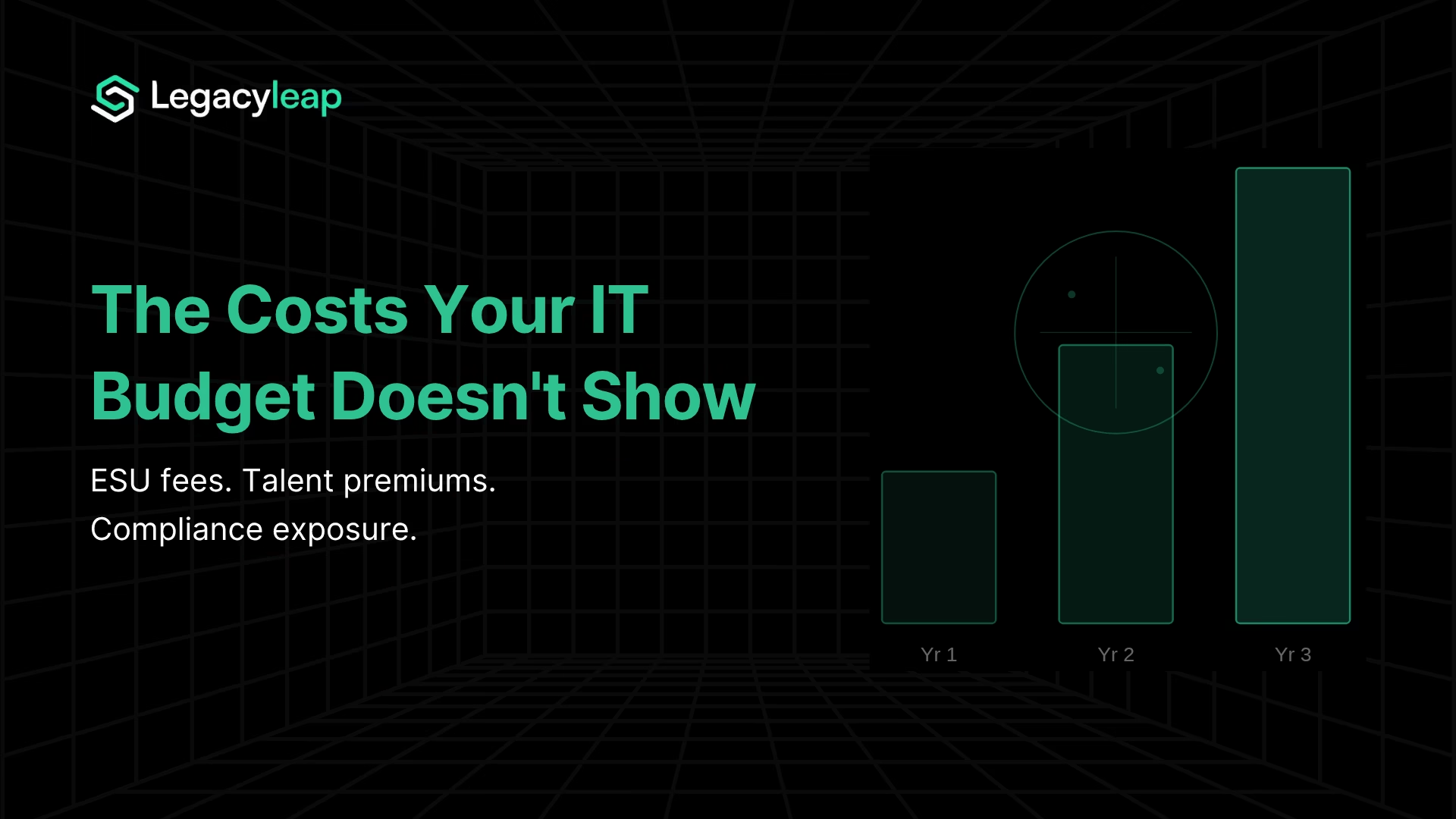
William Flaiz, a former Novartis Executive Director, documented this trajectory in concrete terms: a legacy application costing $2.4 million in year one escalated to $2.7 million in year two and $3.6 million by year five [4].
The drivers he identified are the same ones Legacyleap encounters across financial services, insurance, healthcare, and manufacturing: technical debt accumulation, hardware escalation, talent premium increases as specialists retire, and growing compliance remediation costs.
Each year of delay also increases the eventual modernization cost. The longer an application runs without documentation updates, dependency mapping, or architecture review, the more discovery work any future modernization program requires.
The Five-Year Math: Why “Cheaper to Maintain” Is a Compounding Lie
| Year 1 | Year 2 | Year 3 | Year 4 | Year 5 | |
| Legacy Maintenance (compounding) | $2.4M | $2.7M | $3.0M | $3.3M | $3.6M |
| Modernization Path | $1.5M (program) | $0.8M | $0.8M | $0.8M | $0.8M |
| Cumulative Difference | –$0.9M | +$0.1M | +$2.3M | +$4.8M | +$7.6M |
*Illustrative model based on the Flaiz compounding curve and Legacyleap’s post-modernization cost benchmarks. Actual figures vary by stack, scope, and modernization approach.
The assumption that legacy maintenance is cheaper than modernization survives for one reason: the comparison is almost always incomplete.
Most organizations compare the modernization investment against direct maintenance cost only, the $40,000–$55,000 per application that sits in the infrastructure budget. They exclude the 60–70% of true TCO that lives in talent premiums, productivity loss, compliance exposure, and risk.
In a recent VB6-to-C# engagement in financial services, Legacyleap’s platform compressed the modernization timeline by 70–80%, moving the crossover point from year three to year one.
The Ab Initio to Java Spark migration for a global credit scoring firm delivered 55% lower total cost with 80%+ automated conversion. These are not theoretical projections. They are measured outcomes from completed engagements.
Is It Cheaper to Maintain or Modernize Legacy Systems?
In the short term, maintaining a legacy system appears cheaper. But legacy maintenance costs compound at 10–20% annually while modernization is a bounded one-time investment.
A legacy application costing $2.4M annually in total maintenance escalates to $3.6M by year five. A modernization program for the same application typically costs $500K–$2M.
The crossover point, where cumulative maintenance exceeds the modernization investment plus post-modernization operating costs, typically falls within two to three years.
The critical difference: maintenance costs compound. Modernization costs are finite.
How Do You Build a Business Case for Legacy Modernization?
A credible modernization business case requires four inputs:
- Current-state run rate including all hidden costs from the sections above, not just the infrastructure line item
- Modernization investment covering program cost, timeline, and resource requirements
- Post-modernization run rate on the modern platform
- Risk-adjusted timeline accounting for the compounding cost of delay
The most common failure in modernization business cases is comparing input #2 against a partial version of input #1. The framework above corrects that by requiring the full cost picture before the comparison is meaningful.
Legacyleap’s delivery data reinforces the modernization side of this equation. Across engagements, the platform has delivered JSP/Servlets to Angular transformations covering 300+ screens and 5,000+ forms, and VB6 to .NET conversions at 60–80% accelerated timelines across financial services, insurance, and manufacturing.
These outcomes compress the modernization investment column in the table above, making the crossover point arrive earlier and the cumulative savings larger.
The business case starts with knowing what you actually spend today. Request a $0 Assessment to get a complete cost and risk picture of your legacy estate. Dependency map, risk indicators, and modernization blueprint included.
How Legacyleap Turns Cost Visibility Into a Modernization Starting Point
The previous sections establish a pattern: the true cost of legacy maintenance is invisible because the costs are scattered. Legacyleap is built to solve that visibility problem first, and then to act on what it reveals.
The $0 Assessment: Mapping What You Cannot Currently See
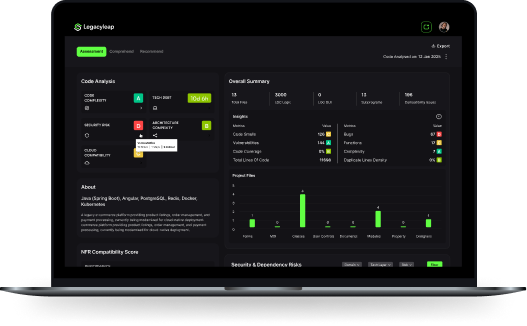
The $0 Modernization Assessment produces the complete picture that this article argues most organizations lack. The Assessment Agent analyzes the legacy codebase and generates a dependency and module map, risk indicators, architecture observations, effort and timeline estimates, and a structured modernization readiness view.
This is not a sales exercise. It is the exercise that assembles the first three inputs of the business case framework described above: current-state complexity, modernization scope, and risk profile.
For organizations that have never aggregated these into a single view, the assessment is the starting point.
The Documentation Agent: Recovering What Was Never Written Down
Section 2 identified knowledge concentration risk as one of the largest hidden cost drivers. The Documentation Agent addresses it directly by reconstructing business logic, workflows, module boundaries, and integration behaviors from the codebase itself.
The output converts the most dangerous form of hidden cost (institutional knowledge trapped in the minds of retiring specialists) into structured, maintainable documentation that engineering teams can use immediately.
For organizations where the last person who understood the system left two years ago, this capability changes the risk calculus of the entire modernization decision.
Governed Modernization: Comprehension First, Diff-Based Review, Full Engineering Control
Legacyleap requires full source code and dependency visibility before any modernization begins, directly addressing the most common failure modes: undocumented API calls, shared database schemas, and custom framework extensions that surface mid-program.
All code changes are diff-based and require human review before acceptance. The Modernization Agent cannot merge, deploy, or execute code autonomously. For teams evaluating how Legacyleap differs from coding copilots, this comprehension-first, human-controlled approach is the foundational distinction.
Conclusion: The Real Cost of Legacy Is the Cost of Not Knowing
The true cost of maintaining a legacy application is not the infrastructure line item that appears in the IT budget. It is the compounding total of ESU fees, talent premiums, productivity drain, breach exposure, compliance risk, and deferred innovation. These are costs that are real, growing, and almost never aggregated into a single number.
The “cheaper to maintain” assumption survives because the full cost picture is never assembled. Once it is, the modernization business case is not a difficult argument. It is arithmetic.
The first step is not a modernization program. It is cost visibility.
Request a $0 Modernization Assessment to start with a no-cost exercise that maps your legacy estate’s dependencies, risks, and modernization readiness, producing the complete picture that this article argues you need.
Book a Demo to see how Legacyleap’s modernization platform handles assessment, documentation, transformation, and validation within your infrastructure.
FAQs
There is no universal benchmark, but the pattern Legacyleap observes is consistent: organizations spending more than 60% of their IT budget on maintenance have structurally limited their ability to invest in new capabilities. The healthiest portfolios allocate 40% or less to maintenance and operations. If your ratio is inverted, the first step is understanding where the maintenance spend actually goes, which is often less obvious than it appears.
The immediate impact is the loss of security patches, which opens compliance gaps in regulated industries. Beyond that, third-party libraries and dependencies stop being tested against the unsupported platform, accelerating compatibility decay. Extended security update programs (where available) buy time but at escalating cost and with no feature development. Organizations that reach end-of-support without a modernization plan face a narrowing set of options, each more expensive than it would have been a year earlier.
Start with the applications that carry the highest combination of maintenance cost, risk exposure, and business criticality. Applications with a single remaining specialist, active compliance gaps, or inability to integrate with modern systems should rank highest. Legacyleap’s $0 Assessment produces a prioritized modernization readiness view that scores applications across these dimensions, giving portfolio leaders a sequencing framework grounded in actual codebase analysis rather than subjective estimates.
Rehosting (lift-and-shift) moves infrastructure to the cloud but does not resolve the underlying architectural constraints. A VB6 application running on a cloud VM is still a VB6 application: it still carries the same talent dependency, compliance exposure, and integration limitations. Cloud migration without modernization can reduce hosting costs but often increases complexity by adding cloud management overhead to an already brittle system. For most legacy estates, cloud readiness requires at least partial modernization of the application layer.
Timelines depend on application size, coupling depth, documentation availability, and modernization approach. Traditional manual rewrites for complex enterprise applications can take 12–24 months. With Legacyleap’s platform, AI-assisted comprehension, transformation, and validation compress timelines significantly. Across recent engagements, VB6 to C# conversions have been delivered at 60–80% accelerated timelines, and JSP/Servlets to Angular migrations covering 300+ screens have been completed in months rather than years.
References
[1] U.S. Government Accountability Office, IT Modernization: Actions Needed to Identify and Address Obsolete Information Technology (GAO-25-107795), July 2025.https://www.gao.gov/products/gao-25-107795
[2] Stripe, The Developer Coefficient, 2018.https://stripe.com/files/reports/the-developer-coefficient.pdf
[3] IBM Security / Ponemon Institute, Cost of a Data Breach Report 2025.https://www.ibm.com/reports/data-breach
[4] William Flaiz (former Executive Director, Novartis), “The Hidden Cost of Legacy Applications,” Medium.https://medium.com/@williamflaiz
[5] ITIC, 2024 Hourly Cost of Downtime Survey.https://itic-corp.com/itic-2024-hourly-cost-of-downtime-survey/