TL;DR
- The PSS cutover is one milestone in a longer integration. Customers see it, and it is settled by moving one airline onto the other’s vendor platform. The applications each airline built around its PSS stay separate until IT consolidates them one by one.
- Choose the surviving application per system and plan for the rules it lacks. The absorbed airline’s fare, service and loyalty rules have to be found in its code and carried into the survivor.
- Loyalty consolidation has to bring every balance, status level and earning rule through intact. DOT’s 2024 rewards inquiry asked American, Delta, Southwest and United for documents on how merged programs were integrated.
- Test the survivor against both airlines’ transactions before retiring anything. Let bookings drain off the retiring system over months, and compare outputs field by field.
Post-merger IT integration at an airline starts with two of nearly every system: two passenger service systems (PSS), two loyalty programs, and two sets of airport, revenue accounting, servicing and reporting applications. Vendor platforms such as the PSS consolidate through a choice of one contract. Applications each airline built and maintains itself need a separate decision for each one.
Alaska Air Group finished moving Hawaiian Airlines onto its Sabre PSS on April 22, 2026. Allegiant closed its acquisition of Sun Country on May 13, 2026, and said at closing that the two loyalty programs, reservations and check-in would stay separate in the near term. IT teams at both groups face the same work on the applications around those systems.
This guide covers how to decide which airline’s application survives and how to consolidate the loyalty program. It also sets out how to prove the merged applications return the same results for both airlines’ customers before the old ones are switched off.
Alaska-Hawaiian Airline Merger Integration Timeline, 2024 to 2026
Alaska Airlines and Hawaiian Airlines are the most recent US airline merger to reach a single PSS, and their public milestones show where the PSS sits in the sequence. Alaska’s announcements and its CIO’s account give these dates:
| Date | Milestone |
| September 18, 2024 | Alaska Air Group closes its acquisition of Hawaiian Holdings; the airlines keep separate websites, reservation systems and loyalty programs for now |
| August 20, 2025 | Atmos Rewards replaces Mileage Plan; HawaiianMiles balances move in on October 1, 2025 |
| October 2025 | New bookings for both airlines go onto Alaska’s PSS, and Hawaiian’s existing bookings drain off its old system |
| October 29, 2025 | The FAA issues a single operating certificate |
| April 22, 2026 | Hawaiian moves to Alaska’s Sabre PSS after five dress rehearsals, with one app and one record locator for both brands |
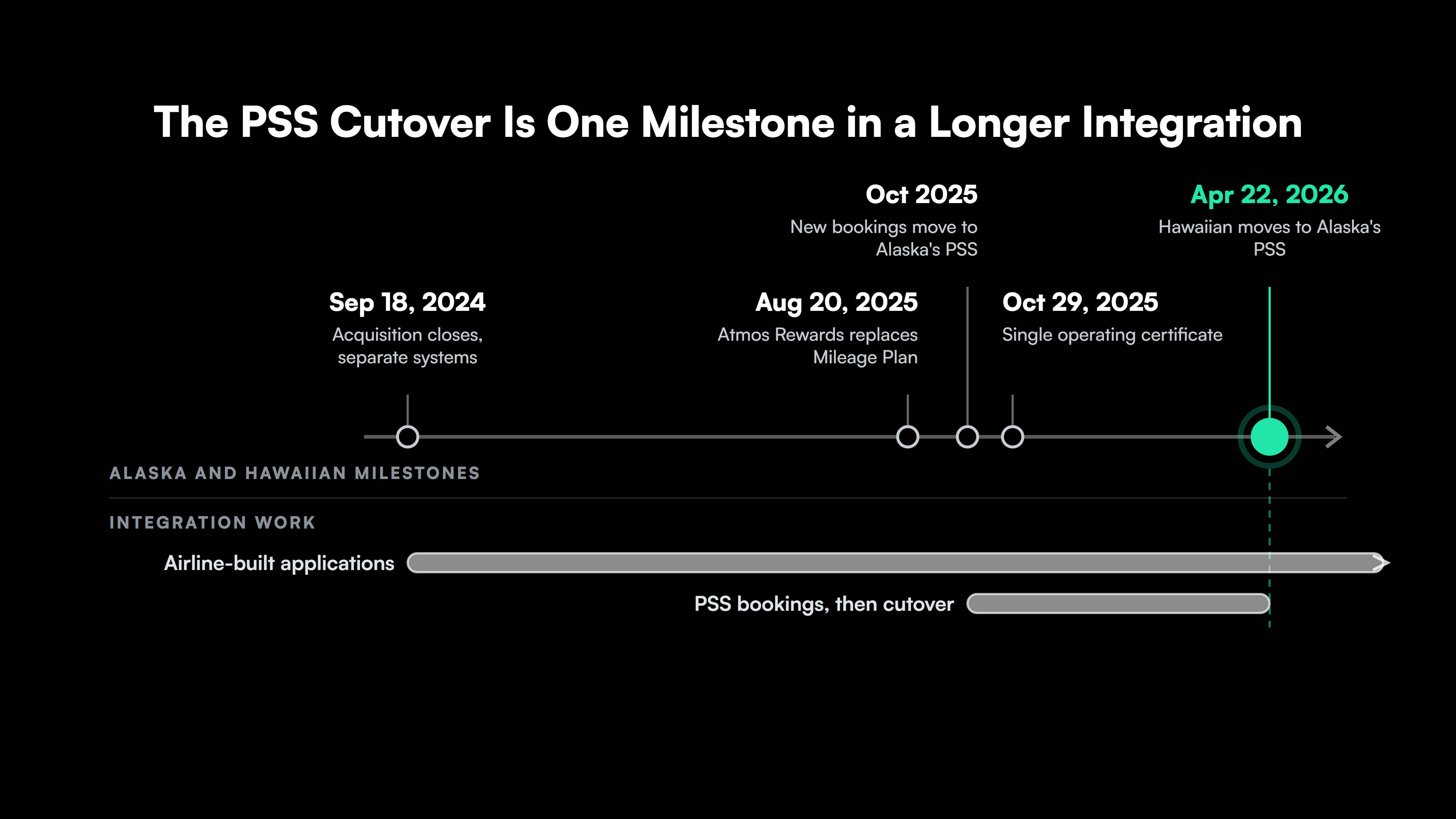
Two points in the timeline matter for IT planning. The loyalty programs merged eight months before the PSS did. Alaska’s single operating certificate announcement also listed work still ongoing, including joint collective bargaining agreements for flight crew, airport and maintenance teams.
Alaska CIO Charu Jain told CIO.com that the PSS cutover followed a “phased deployment and a phased cutover”, with no bulk migration of bookings. The PSS move carried the websites, the app, check-in and kiosks with it. Applications an airline builds for its own operations sit outside a PSS move and need decisions of their own, as in any airline IT modernization program.
In airline post-merger integration, the PSS is consolidated first by moving one carrier onto the other’s platform, as Hawaiian moved onto Alaska’s. Each airline also runs its own applications for loyalty, revenue accounting, airport work, agency servicing and reporting. For each duplicate, IT chooses the surviving application, moves the absorbed airline’s rules into it and tests it against both airlines’ transactions before the other is retired.
Choosing Which Airline’s Application Survives a Merger
Once the PSS decision is made, each duplicate airline-built application needs its own survivor decision. In an airline merger, the duplicates include these classes:
- Loyalty: the program engine, partner earning feeds and co-branded card feeds.
- Revenue accounting: sales and interline settlement feeds, refunds and proration.
- Airport and station tools: gate, baggage and special-service handling built around each airline’s procedures.
- Agency and corporate servicing: portals, waiver tools and corporate contract handling.
- Operations and reporting: dashboards, regulatory reports and internal analytics applications.
Warehouses and pipelines follow a separate track, covered in the post-acquisition data platform integration playbook. Crew applications wait on the joint labor agreements and follow the sequence in our guide to crew scheduling software modernization.
A reasonable default is to keep the application already connected to the surviving PSS. Its integrations exist, its data formats match, and its team knows the platform. The default fails when the other airline’s application handles business the survivor has never handled.
The choice for each application comes down to three paths:
| Path | When it fits | Main risk |
| Adopt the survivor as-is | Both airlines’ rules for this function already match | Absorbed-airline cases nobody listed fail after cutover |
| Adopt the survivor and port the other airline’s rules | The survivor fits the platform but lacks rules the absorbed airline relied on | Rules missed during extraction, found by customers |
| Rebuild on a modern stack | Neither application fits the combined airline, or both carry heavy technical debt | Scope grows into a second program alongside the merger |
The middle path carries its cost in the rules delta: what the absorbed airline’s application does that the survivor does not. Hawaiian brought international routes to Japan, South Korea and Australia, which Alaska’s website started selling only after the acquisition closed.
After the PSS move, the combined applications also have to tell the two brands apart. Hawaiian flights carry the AS code and appear as operated by Alaska as Hawaiian Airlines. Alaska’s April 2026 announcement lists service rules that apply only to Hawaiian-operated flights:
- Onboard service: complimentary alcohol for Atmos Gold, Platinum and Titanium members and Premium Class guests on Hawaiian’s transpacific flights.
- Meals: First Class meal pre-orders on Hawaiian, starting in May 2026.
- Brand: Hawaiian’s own logo, hospitality and onboard announcements.
Rules for routes, brands and partners the survivor never handled sit in the absorbed airline’s code, where documentation may be thin and the engineers who wrote it may have moved on.
The decision for each application rests on these criteria:
- Fit with the surviving PSS: existing integrations, message formats and record locators.
- Rule coverage: which of the absorbed airline’s cases the survivor already handles.
- Code health: framework age, security exposure and how hard changes are to make.
- Test coverage: whether either application has tests that describe its expected behavior.
- People: who still knows each codebase after the merger.
Scoring these across dozens of applications is the same exercise as assessing and sequencing an application portfolio, with two airlines’ portfolios in scope. Where the rebuild path wins, the choice between refactoring vs. replatforming follows.
Map Both Airlines’ Apps With a $0 Modernization Assessment
See the dependencies, integrations and business rules in one airline application before you choose which version survives.

 +more
Loyalty Program Consolidation After an Airline Merger
Loyalty is the airline application where the survivor, rules and parity method can be followed step by step on public facts. Alaska published how it merged Mileage Plan and HawaiianMiles, the merge came eight months before the PSS move, and DOT has asked the largest US carriers how their merged programs were integrated.
Alaska’s announcement of Atmos Rewards sets out the sequence. Mileage Plan members became Atmos Rewards members on August 20, 2025, and kept their account numbers. HawaiianMiles members moved on October 1, 2025, at one mile to one point. Members who had not linked a HawaiianMiles account to a Mileage Plan account received new account numbers.
The account-number rule shows what the consolidation code had to do first. It had to match members across two programs, merge the records of people who belonged to both, and issue new identities to everyone else.
The earning rules change next. Alaska’s launch announcement set out a choice of earning basis, starting later in 2026 and changeable once a year:
- Distance: 1 point per mile flown.
- Price paid: 5 points per dollar spent, including fares and premium cabin upgrades.
- Segments: 500 points per flight segment.
The combined program now calculates earning three ways, selected per member per year. Price-paid earning depends on the fare charged, so earning calculations need fare data that distance-based earning did not use. That dependency grows as airlines price more offers outside fixed fare classes, a shift covered in our piece on NDC and offers and orders.
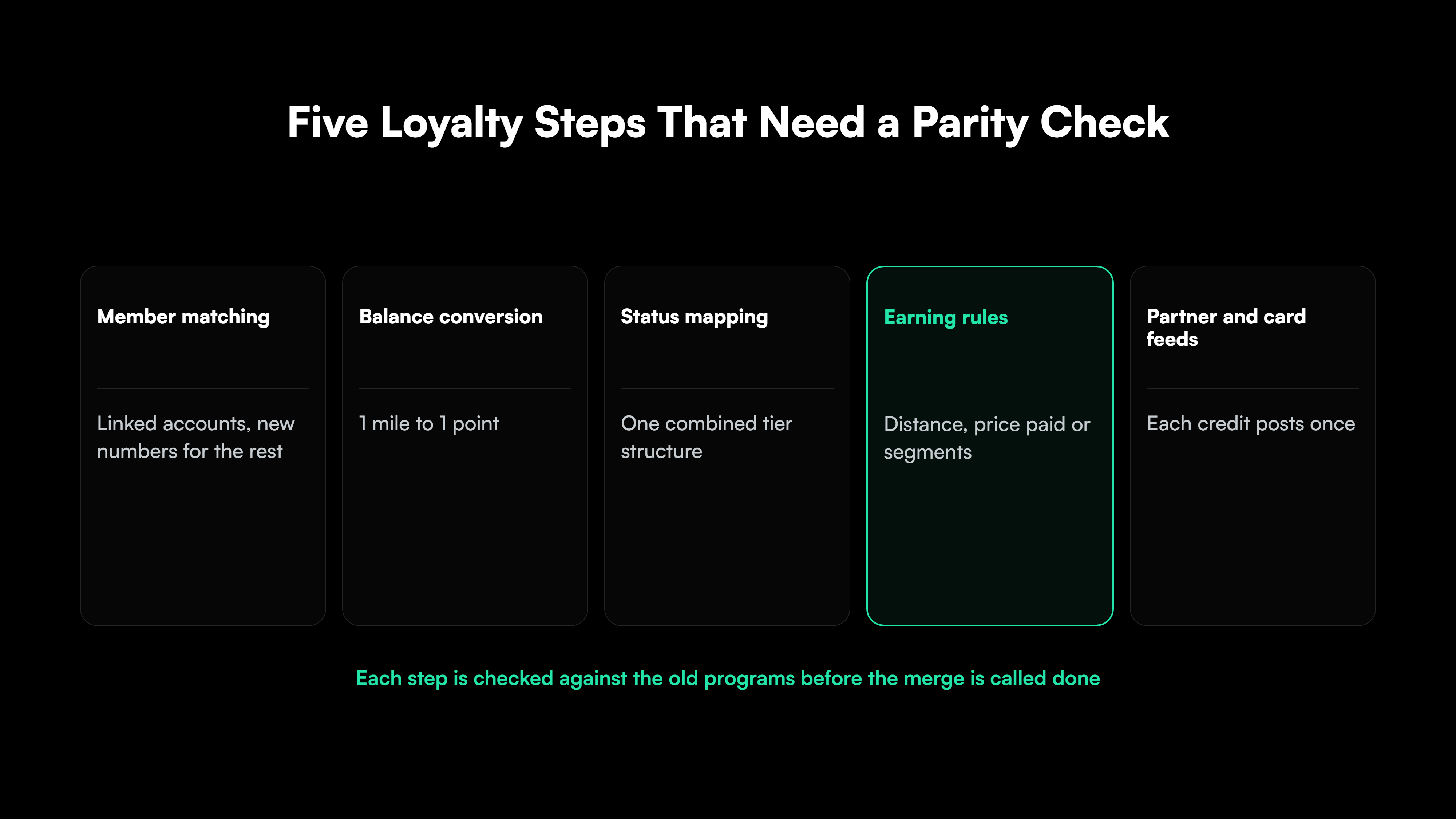
The consolidation breaks into steps, each with its own check:
| Step | What the surviving code must do | Parity check |
| Member matching | Link members of both programs; assign new numbers to the rest | No member lost or duplicated; linked accounts resolve to one record |
| Balance conversion | Convert at the published rate | Each converted balance equals the source balance at 1:1 |
| Status mapping | Place each member in the combined tier structure | Each member’s tier matches the published mapping |
| Earning rules | Calculate earning for both airlines’ flights under each basis | Sample itineraries earn the same as under the old program until the published change date |
| Partner and card feeds | Accept partner airline, hotel and co-branded card credits | Each partner credit posts once, to the right member |
Regulators are paying attention to these programs. The US Department of Transportation’s September 2024 inquiry ordered American, Delta, Southwest and United to report on devaluation, dynamic pricing, fees and competition. It also asked for documents on rewards-related mergers and how merged programs were integrated. DOT has not published findings from the inquiry.
The Protect Your Points Act of 2026 (S. 4244), introduced in the Senate on March 26, 2026, would require a year’s notice before any devaluation of points. It would also require airlines to display the value of a point. The bill was referred to the Senate Commerce Committee and has not passed. A balance or earning change caused by a consolidation error is the type of change both efforts target.
Allegiant and Sun Country have this sequence ahead of them. Allegiant’s closing announcement says Allways Rewards and Sun Country Rewards stay separate in the near term, with points, benefits and status keeping their current value.
Testing a Merged Airline Application Before Cutover
A surviving application with ported rules still has to prove it returns the same results for both airlines’ customers. The cutover method decides how much of that proof happens before customers arrive.
Alaska put new bookings onto its PSS months ahead and let Hawaiian’s existing bookings run down on the old system. As a result, few Hawaiian bookings were left to move at cutover. United’s one-night PSS conversion in March 2012 took the opposite approach. Some seat assignments and special meal requests were lost, and combining loyalty accounts took about a week after cutover.
Dress rehearsals test journeys. Alaska ran five, with real guests going through check-in, security, seating and baggage, and the fifth ran without medium or high issues. Application parity tests something different: whether each rule produces the same output in the surviving application as it did in the retiring one.
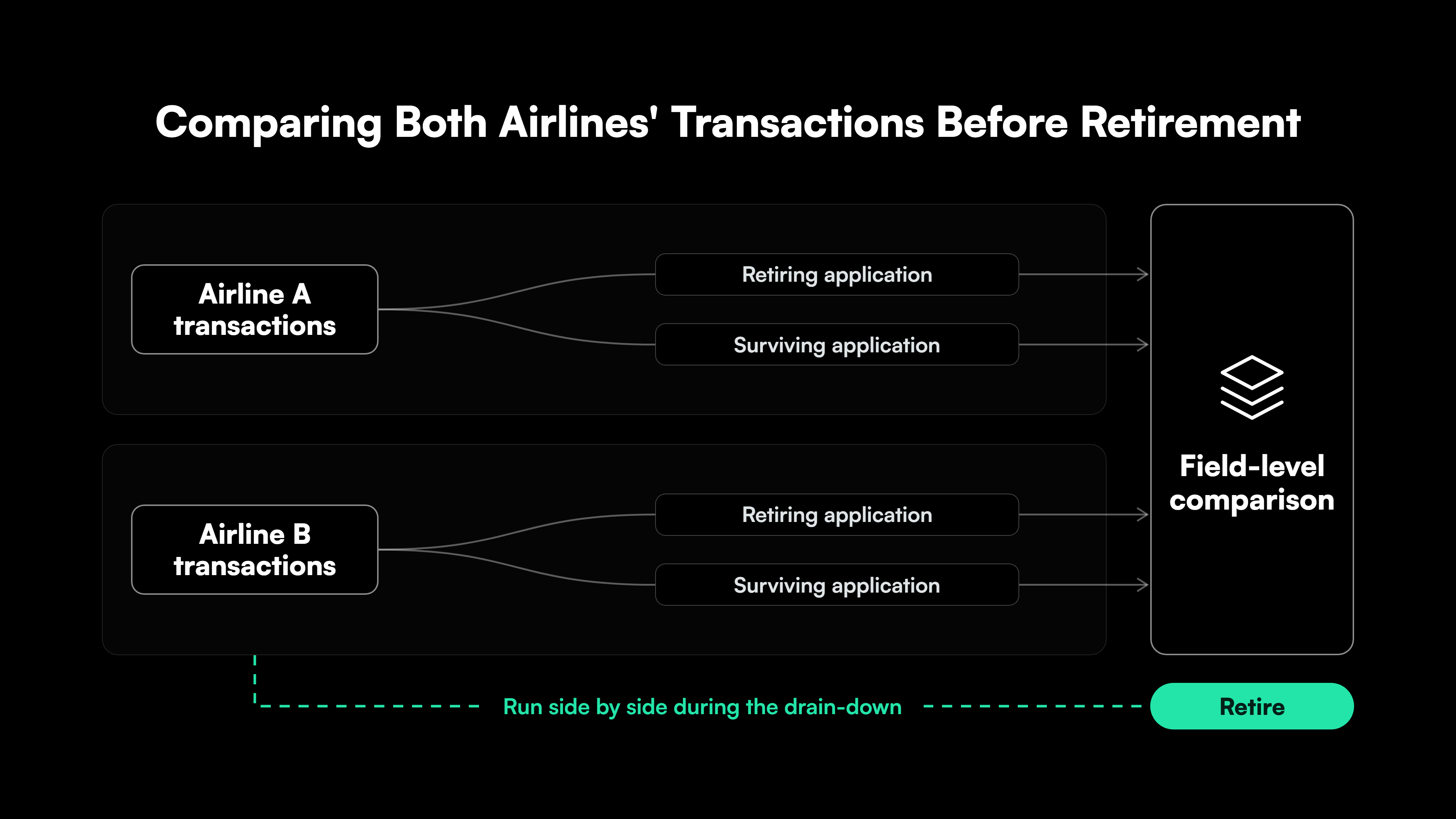
A parity check for a merged airline application covers six steps:
- Capture the baseline: record a sample of each airline’s real transactions and the outputs the current applications produced.
- Start with the absorbed airline’s edge cases: brand-specific service rules, routes only that airline flew and its partner agreements.
- Replay both airlines’ transactions through the survivor: run the recorded inputs through the surviving application with the ported rules.
- Compare field by field: fares, refunds, earned points, status, accounting entries and messages to partners.
- Run side by side during the drain-down: keep the retiring application live for its remaining bookings and compare outputs as both process real traffic.
- Retire after a clean comparison window: switch the old application off only when discrepancies are explained or fixed, and keep a rollback path until then.
Step 1 is often the hardest on the absorbed side, where specifications are missing and expected behavior has to be recovered from the code. Legacy system comprehension work turns that code into rules a reviewer can confirm before the test cases are written.
Legacy Application Modernization Services for Airlines
Carry the absorbed airline’s rules into the surviving application and prove parity on both airlines’ transactions before retirement.
Explore Application Modernization Services →Where Legacyleap Fits in Post-Merger IT Integration for Airlines
Consolidating airline-built applications depends on two things IT teams rarely have after a merger. One is a full account of the absorbed airline’s rules. The other is proof that the surviving application applies them the same way.
Legacyleap is a Gen AI modernization platform whose specialized agents cover the stages this guide describes, from mapping both estates to the parity record that clears an application for retirement. Engineers review every change, and the integration team keeps the adopt, port or rebuild decision.
The agents map to the merger work this way:
- Assessment Agent: maps both airlines’ applications, their dependencies, risks and technical debt, and their integrations with each PSS. This is the input for the survivor criteria above.
- Documentation Agent: recovers each airline’s business rules from the code into specifications reviewers can confirm, including the absorbed airline’s rules the survivor lacks.
- Recommendation Agent: produces an ordered migration plan and target architecture for each application on the adopt, port or rebuild path.
- Modernization Agent: ports rules into the survivor or rebuilds it as diff-based, human-reviewed changes, with about 70% of the modernization automated and engineers reviewing the rest.
- QA Agent: generates 70-80% of the test cases, runs them against the retiring and surviving applications, and produces parity validation reports.
Full-codebase grounding matters most on the absorbed side, where the people who wrote the code may have left. The agents read the whole codebase, so rules buried in rarely touched modules reach the specification and the tests. This is how Legacyleap approaches legacy application modernization when two estates have to become one.
The parity reports give the integration team the record step 6 of the checklist needs: which transactions were compared, which matched and which discrepancies were resolved before retirement. Deployment then follows the drain-down, with a phased cutover per application. The platform runs inside the airline’s own environment, and no source code leaves it.
Planning Post-Merger IT Integration Beyond the PSS Cutover
Post-merger IT integration plans at airlines set the PSS date first, and the airline-built applications decide how long the integration runs after it. Planning for them starts with three steps:
- List both estates before survivor decisions: every airline-built application, its PSS integrations and the rules it carries.
- Decide adopt, port or rebuild per application: based on fit, rule coverage, code health, tests and people.
- Treat loyalty as the first consolidation with a parity record: balances, status and earning checked for both programs’ members.
Inherited systems also carry inherited risk, so the estate list in step one should record support status and internet exposure for each application. In November 2026, Maersk said a data breach was isolated to a local system, and BleepingComputer reported that the breached systems belonged to a company Maersk had previously acquired.
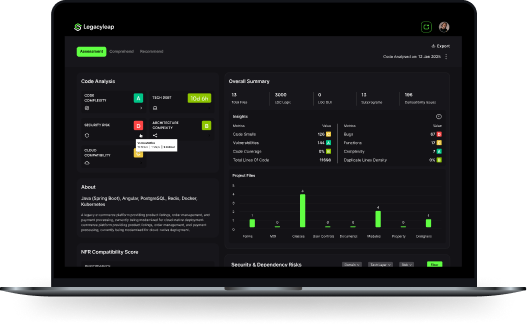
The $0 Modernization Assessment covers one codebase of up to about 50,000 lines in 3-5 days, inside your environment. It returns documentation, a dependency and integration map, a risk heatmap and a modernization plan with timelines. To see the agents work on an application like yours first, book a demo.
Start With a $0 Modernization Assessment
Get a dependency map, risk heatmap and modernization plan for one codebase in 3-5 days, inside your environment.
FAQs
Once the programs are combined, balances move into one program at a rate the airline publishes. HawaiianMiles moved into Atmos Rewards at one mile to one point on October 1, 2025. Allegiant said at its May 2026 closing that Allways Rewards and Sun Country Rewards would stay separate in the near term.
No. A federal court blocked the acquisition in January 2024, and the two airlines terminated the agreement in March 2024. Spirit later ceased operations on May 2, 2026.
Alaska and Hawaiian took about 19 months from closing to a single PSS. Applications that depend on joint labor agreements, such as crew systems, follow their own timeline after that.
No. The acquirer’s application is the usual starting point because it already connects to the surviving PSS. The absorbed airline’s version wins where it covers more of the combined business or has healthier code.
DOT opened an inquiry in September 2024 into the rewards programs of American, Delta, Southwest and United. It has not published findings, and the Protect Your Points Act of 2026 would add notice and disclosure rules if passed.
References
- Alaska Airlines, “Alaska Airlines, Hawaiian Airlines transition to shared passenger service system to deliver a more seamless guest experience.”
- Allegiant Travel Company, “Allegiant Completes Acquisition of Sun Country Airlines, Creating the Leading Leisure-Focused U.S. Airline.”
- Alaska Airlines, “Introducing Atmos Rewards.”
- Alaska Airlines, “Alaska Airlines and Hawaiian Airlines reach major integration milestone: a single operating certificate.”
- CIO.com, “Inside the post-merger IT overhaul at Alaska Airlines.”
- U.S. Department of Transportation, “USDOT Seeks to Protect Consumers’ Airline Rewards in Probe of Four Largest U.S. Airlines’ Rewards Practices.”
- U.S. Congress, “S. 4244, Protect Your Points Act of 2026.”