TL;DR
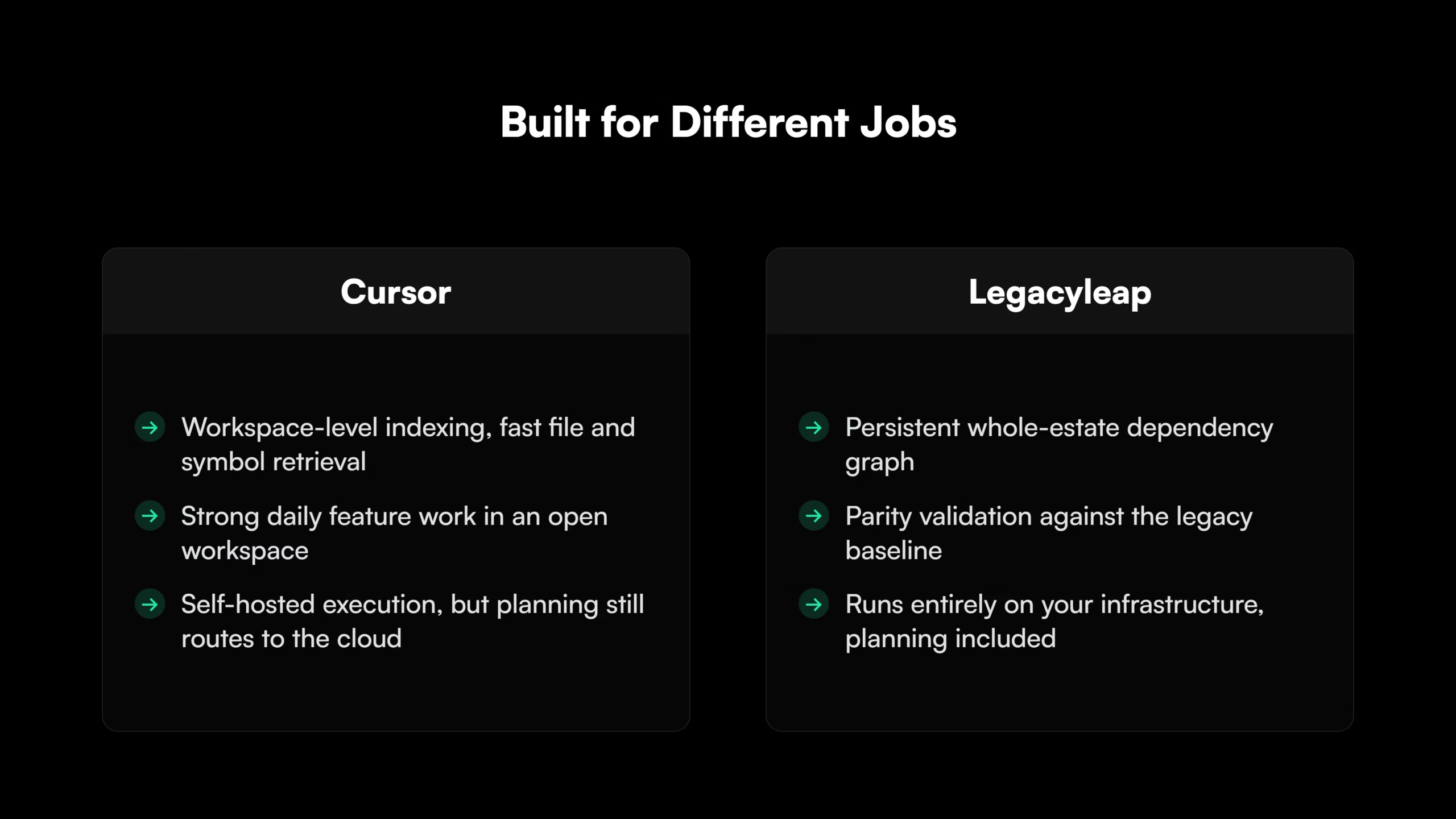
- Cursor is a genuinely strong IDE with over a million paying customers, and it still isn’t built to modernize a legacy estate. Its context engine draws only on open files, references, and a semantic index scoped to one workspace, not a persistent map of an entire multi-repo estate.
- One engineering manager’s Cursor session broke features across an entire Angular app by editing a single shared utility method. The thirty-minute task turned into three hours of debugging, and the team now requires senior review before Cursor touches anything shared.
- Cursor added self-hosted cloud agents in 2026, but planning and orchestration still route through Cursor’s own cloud. There is still no fully air-gapped tier, the exact team-level architectural context a workspace-scoped tool was never built to hold.
- Legacyleap’s Multi-Layer Meta-Cognitive Graph holds up past ten million lines of code through sharded, task-based orchestration. It’s built once and updated incrementally rather than reassembled every time a workspace changes, unlike Cursor’s per-session index.
- The two tools aren’t competing, Legacyleap already runs inside Cursor today in pilot with customers. A developer keeps the same commands while Legacyleap’s graph, agents, and parity validation run underneath, entirely on the customer’s own infrastructure.
Type “cursor alternative” into Google and most of what comes back is a list of other AI-powered editors, a different autocomplete to try instead. That’s the right search if the goal is a better daily coding tool. It’s the wrong search if the actual job is modernizing a legacy estate nobody has fully documented.
Cursor earns its reputation fairly. It’s a strong, fast IDE for a developer working inside a workspace they already know. On its own, it doesn’t map dependencies across an entire estate, and it doesn’t prove that modernized code behaves the same as the legacy version it replaced. It also doesn’t hold a model of a codebase that outlives whatever files happen to be open right now.
Legacyleap is built around exactly that gap, and the two run well together rather than compete for the same job.
Cursor: What It Does Well
Cursor deserves the credit it gets, no hedge needed. It’s a fast, well-built AI-powered IDE, and Anysphere’s own growth numbers show developers picking it on their own, not because procurement told them to.
Where it earns that reputation, inside a workspace a developer already has open:
- Tab completion, multi-file edits, and Composer. These make day-to-day feature work, debugging, and test scaffolding fast. They’re the reason most people open Cursor in the first place.
- Fast answers about an unfamiliar module. Ask it to explain a file or trace a bug across a few others, and it responds quickly, grounded in what it has already indexed.
- A real, scoped legacy-refactoring workshop. Cursor runs official training on refactoring legacy codebases [1]. It covers architectural overviews pulled from its index, Plan Mode for scoping multi-file migrations before anything executes, and multi-root workspaces for a handful of repos at once.
- Controls that hold up under a security review. SOC 2 Type II certification, annual third-party penetration testing, SSO and SCIM, and a Privacy Mode that stops training on a customer’s data.
More than a million paying customers and over fifty thousand engineering teams use Cursor today, and a majority of Fortune 500 companies already have it running somewhere in their engineering org [2]. Whatever this piece argues next, that scale is real and earned, not a caveat to get past.
Where Cursor Reaches Its Limit
The limit here is a difference in scope, not a difference in how well Cursor writes code. Its context engine draws on recently opened files, explicitly mentioned files, codebase search, and a semantic index, all tuned to whatever workspace happens to be open. None of that adds up to a persistent map of an entire multi-repo estate and the services it shares across teams.
One engineering manager who pointed Cursor at a legacy Angular application saw that gap firsthand. It modified a shared utility method meant for a single screen, and the change broke features across the rest of the application. A thirty-minute task turned into three hours of debugging, and the team now requires senior review before Cursor touches anything shared. Code quality wasn’t the issue. A tool with no visibility into cross-cutting dependencies had changed something more than one part of the system relied on.
Deployment is where the two tools genuinely diverge, just not as sharply as it would have a year ago. Cursor added self-hosted cloud agents in March 2026, and code execution, build artifacts, and secrets now stay on the customer’s own infrastructure [3]. Agent planning and coordination still happen in Cursor’s cloud regardless of that setting, and a HIPAA Business Associate Agreement is now available on request for Enterprise customers, something Cursor didn’t offer before this year [4].
What Cursor still doesn’t have is a fully air-gapped tier, one where planning never leaves the customer’s environment either. That gap is exactly the team-level architectural context a workspace-scoped tool was never built to hold.


What Legacyleap Adds to the Legacy Modernization Landscape
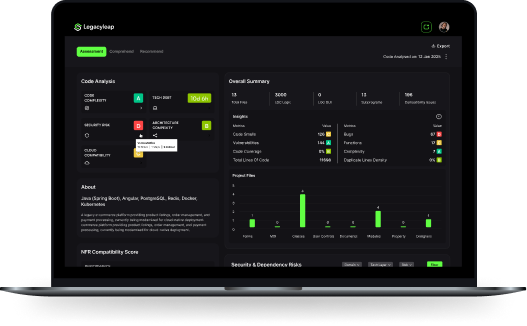
Legacyleap was built to comprehend, govern, and validate an entire legacy estate rather than write code inside one workspace.
| Category | Cursor | Legacyleap |
| Source code context | Workspace-level indexing, strong file and symbol retrieval | Persistent Multi-Layer Meta-Cognitive Graph, structural and semantic, updated incrementally across the estate |
| Deployment & code sovereignty | Self-hosted execution available (2026), planning and orchestration still route through Cursor’s cloud, no fully air-gapped tier | Runs entirely on enterprise-secured infrastructure, including planning, code never leaves the customer’s environment |
| Day-to-day feature work | Primary use case, strong | Not the focus, a program-level tool |
| Architectural decomposition | Possible with Agent mode, no built-in modernization framework | First-class, defines modules and target-state architecture |
| Functional parity validation | Not a built-in workflow | First-class, validated against the legacy baseline before cutover |
| Org-level repo mapping | Single-workspace indexing, no cross-repo dependency graph | Complete map across repos, APIs, events, and shared libraries |
Legacyleap’s Five Agents, Mapped to the Modernization Lifecycle
A modernization program has to get through five distinct jobs, in order:
- Assess the estate’s risk and dependencies
- Comprehend what the system actually does
- Modernize the code against a target architecture
- Validate that behavior didn’t change
- Deploy with a rollback plan intact
Legacyleap assigns one agent to each. Assessment produces the technical debt report, dependency map, and risk indicators. Documentation rebuilds architecture, data flows, and business logic, even where no documentation currently exists. Recommendation decides what to refactor, replace, or retain, and sequences the work. Modernization writes the actual pull requests. QA builds and runs the parity tests against the legacy baseline.
Cursor can be pointed at pieces of any single one of these jobs. It has no structure for owning all five in sequence, with each agent’s output feeding directly into the next. That’s the real difference between a tool a developer directs by hand and a companion platform built for the full modernization journey.
Legacyleap’s Graph vs. Cursor’s Workspace Index
Legacyleap’s Multi-Layer Meta-Cognitive Graph is a different kind of model entirely, structural and semantic, covering architecture, modules, dependencies, call graphs, and business domains across the whole estate. It’s built once and updated incrementally rather than reassembled every time a workspace changes, and it holds up past ten million lines of code through sharded, task-based agent orchestration.
That’s not a criticism of how Cursor indexes a workspace. The graph and the workspace index are answering different questions at different scales, and an estate in the tens of millions of lines needs the graph regardless of how far workspace-level retrieval improves.
Diff-Based Review and Parity Validation, Built In
Every pull request the Modernization Agent produces goes through human review before anything merges. Nothing deploys or executes automatically. Ahead of cutover, the QA Agent runs the modernized code against the legacy baseline through generated unit, integration, regression, and end-to-end tests, aiming for full functional parity between old and new behavior. That process sits behind a governed gateway with guardrails and human-in-the-loop checkpoints, applied on every run rather than left to individual judgment.
The regulatory backdrop makes that discipline matter more than it might otherwise. US banking regulators labeled generative and agentic AI novel in 2026, outside the scope of existing model risk guidance, with formal treatment still pending [6]. Provable review and parity checking are not optional in that environment. Legacyleap treats them as the default on every change, not a step someone has to remember.
Legacyleap Runs Inside Cursor Today
None of this requires giving anything up. Legacyleap already operates inside Cursor in pilot with customers today, its graph, agents, parity validation, and test generation all running in that same session. A developer keeps the same commands and the same loop, while Legacyleap handles the modernization layer underneath, backed by an estate-wide graph that runs on the customer’s own infrastructure.
Code stays inside that environment the entire time, including while a developer works through Cursor. There’s nothing extra to roll out on the tooling side, and nothing that pulls a developer’s attention into a second workflow. Whatever budget this takes gets added to what a team already spends, rather than replacing a line item that’s already there.
| Stage | Cursor’s role | Legacyleap’s role |
| Discover | Lets developers explore specific files and modules in their IDE | Maps the org-level repo graph, architecture, domains, and dependencies |
| Plan | Helps engineers prototype and reason about specific design decisions | Defines target-state architecture and modernization layers |
| Modernize | Handles edge cases, custom refactors, and one-off scripts alongside the program | Drives spec-driven, incremental transpilation with parity validation and test generation |
| Validate & Operate | Becomes the developers’ day-to-day tool on the modernized codebase | Validates against golden artifacts and ties specs back to code |
How to Split the Work Between Cursor and Legacyleap
There’s a simple test for this. If the codebase is one your team already understands, with tests and documentation in decent shape, day-to-day feature work stays entirely inside Cursor’s lane. Layering Legacyleap on top of that work would just be added overhead.
The other side of that line is where Legacyleap takes over. That’s an estate that’s large, undocumented, or spread across multiple languages, where an audit trail and proven functional parity are what actually decide the outcome. It works inside the same harness a team is already using, so nobody has to stand up a second one.
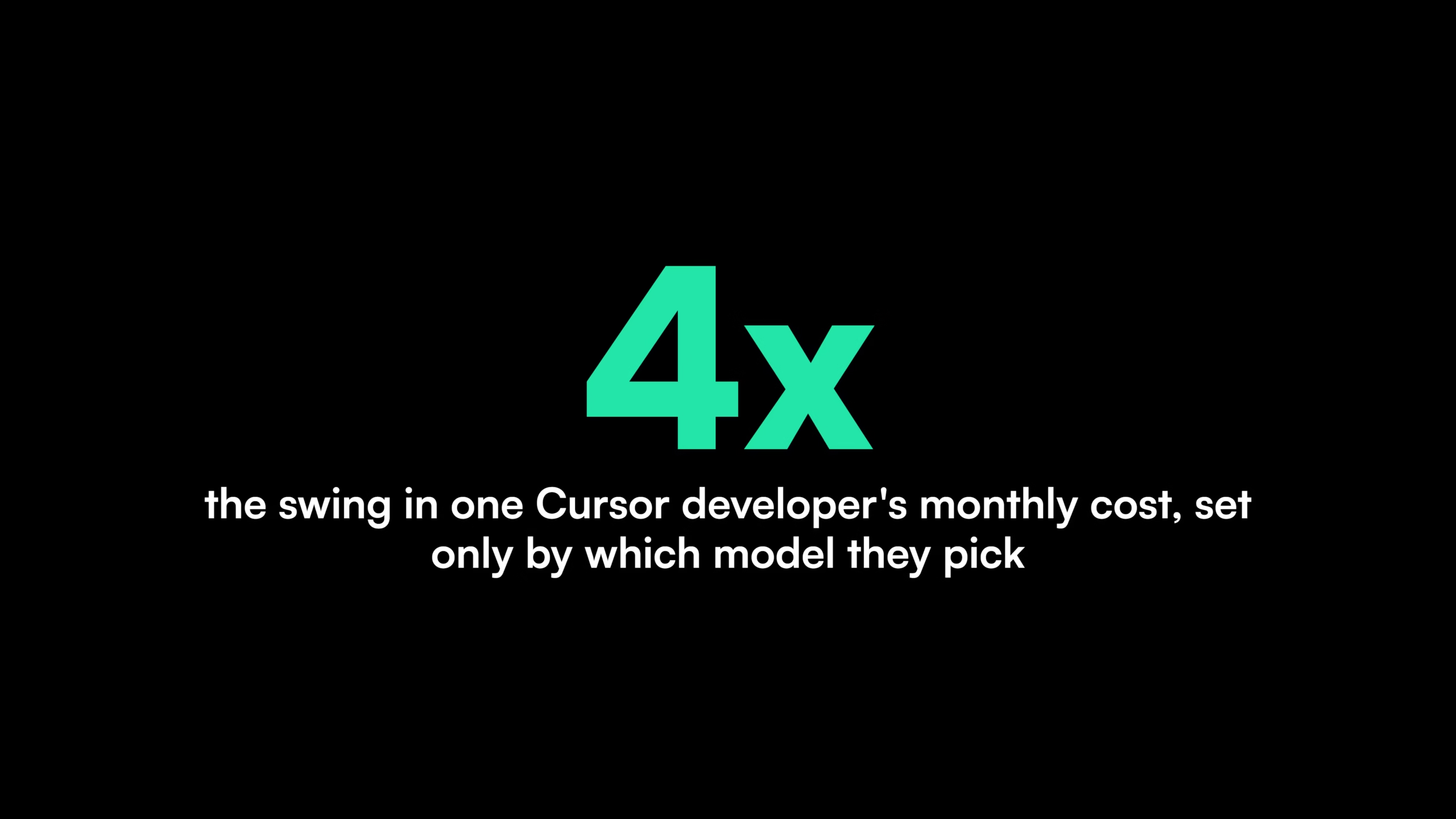
Cost plays into that same decision, just not the way a token-metered tool’s cost would. Cursor moved to credit-based pricing in mid-2025, and what a developer spends now depends heavily on which model they pick inside a given plan. Someone running mostly on Auto mode might land near twenty dollars a month. Someone manually selecting a frontier model on the same plan can clear eighty dollars or more [7].
Multiply that variance across twenty-five developers and the monthly bill can swing by several hundred dollars before a single legacy repo enters the picture. Legacyleap’s cost doesn’t move with which model a developer happened to pick that day, since its understanding of the codebase is cached and persistent rather than rebuilt per session.
Use Cursor and Legacyleap Together
“Cursor alternative,” for enterprise legacy modernization, was never really asking for a different IDE. Cursor is good at what it does. The part it can’t reach is a different scope of problem entirely, and closing that gap takes a platform built for it.
Legacyleap is already running inside Cursor today, not as a future roadmap item. Developers keep using the tool they picked for themselves, and the modernization work happens around them, entirely on infrastructure the company already owns.
A $0 Modernization Assessment is the fastest way to see where that gap actually sits on a real codebase. A Technical Demo is the way to see Legacyleap’s agents working inside the same tool a team already relies on.
FAQs
Not primarily. Cursor blends recently opened files, explicit file references, and a semantic index, with that index acting as a supplement rather than the main signal. Even so, all of it is scoped to one workspace, not an org-wide map of how repos depend on each other.
Increasingly, yes. That shift shows up in the funding and revenue mix behind the product as much as in how many individual developers use it. The growth itself is driven by developers adopting Cursor on their own, not by a modernization program evaluating it first.
Loss of sequential control. Developers on Cursor’s own community forum report it occasionally making multi-file changes without waiting for approval, even with custom rules asking for one change at a time. That’s a sign of a tool built around one developer’s flow, not a reviewed program.
Around 70%, with the rest handled through human review at defined checkpoints, roughly 20 to 25% of total effort depending on the codebase. That split is deliberate, and it’s why Legacyleap’s output ships as pull requests for review rather than changes that merge on their own.
Yes. Turnkey Modernization Services has Legacyleap’s own team own the program end to end, while Platform Licensing deploys the same system inside a company’s environment for an internal or SI team to run. Both start from the same $0 Assessment.
References
[1] Cursor, Refactoring Legacy Codebases. https://cursor.com/workshops/recording/refactoring-legacy-codebases
[2] Gradually.ai, Cursor Statistics. https://www.gradually.ai/en/cursor-statistics/
[3] Cursor, Self-Hosted Cloud Agents Changelog. https://cursor.com/changelog/03-25-26
[4] Cursor Docs, HIPAA Business Associate Agreements. https://cursor.com/docs/enterprise/baa
[5] Mechanical Orchard, Named a 2025 Gartner Cool Vendor in AI Code Assistants. https://markets.financialcontent.com/stocks/article/bizwire-2025-6-11-mechanical-orchard-named-a-2025-gartner-cool-vendor-in-ai-code-assistants
[6] Office of the Comptroller of the Currency, Bulletin 2026-13. https://www.occ.treas.gov/news-issuances/bulletins/2026/bulletin-2026-13.html
[7] CloudZero, Cursor AI Pricing in 2026. https://www.cloudzero.com/blog/cursor-ai-pricing/