TL;DR
- The ERP upgrade-versus-modernize-versus-replace decision should be driven by architecture state, not system age. A 10-year-old system with clean module boundaries may modernize cleanly, while a 5-year-old tightly coupled monolith with 20 years of undocumented patches may not be a modernization candidate at all.
- Lidl’s abandoned SAP rollout is the canonical warning against forcing a COTS replacement onto an unwilling organization. The retailer spent more than 500 million euros across seven years before abandoning the project because it refused to adapt its processes to SAP’s data model, requiring customization at an unsustainable scale.
- Six structural failure patterns, not poor project management, are what sink ERP modernization programs. They range from assessment failure and silent business logic loss to dual-system cost pressure forcing a premature go-live, a dynamic Panorama Consulting data ties to average program overruns of 189% of original budget.
- Hershey’s 1999 SAP go-live remains the textbook case for what happens when validation gets compressed. The system launched during peak Halloween season before testing was complete, producing $100 million in disrupted orders and a 19% drop in quarterly earnings.
- Phased ERP execution needs steps that generic frameworks like the 5 Rs simply don’t cover. The sequence includes full dependency mapping (four to eight weeks for a mid-sized ERP), building an API facade before extraction, and running shadow writes with line-by-line parity validation before any cutover.
The Hidden Cost of a Legacy ERP That Still Works
If your core business runs on a custom ERP built 10 to 20 years ago, you are probably not asking whether to modernize it. You are asking whether you can afford to, whether the disruption is worth it, and whether an ERP migration of this complexity is even executable without shutting down operations.
Those are the right questions. This guide answers them based on architecture state and real failure patterns.
The system was built 15 to 20 years ago on VB6, Java EE, Classic ASP, or .NET Framework. It runs every transaction, every financial close, every compliance workflow. One or two senior engineers understand it well enough to keep it operational, and both are approaching retirement.
Because the system functions today, the cost of inaction stays invisible until it isn’t. These costs accumulate across three categories:
Direct costs
- Maintenance contracts on end-of-life platforms, rising annually
- Premium rates for VB6, Classic ASP, and legacy Java engineers, who are increasingly scarce
- Ongoing hardware refresh cycles with no reduction in technical debt
Hidden costs
- Shadow systems: Excel spreadsheets, Access databases, and manual reconciliation built around every gap the ERP cannot fill
- Integration debt: every new system the organization adopts requires a custom bridge to the legacy ERP, and each bridge adds fragility
- Workaround labor that never appears in the modernization budget but compounds every quarter
Compounding costs
- Knowledge concentration: when the one or two people who understand the system leave, the cost of recovering that comprehension increases by an order of magnitude
- Compliance drift: for US public companies, SOX Section 404 requires documented, auditable controls over financial reporting. A legacy ERP with undocumented logic and knowledge concentrated in one engineer is a material weakness waiting to surface in an audit. Companies that updated revenue recognition workflows after ASC 606 but never rebuilt the underlying ERP logic are carrying quiet restatement risk every quarter. US cyber insurance underwriters are increasingly requiring evidence of supported, patched infrastructure before issuing or renewing policies, with premiums rising sharply for organizations running end-of-life platforms [1]
- Talent attrition as engineers move to organizations running modern stacks
The Cost of Inaction Itemized
For a mid-market manufacturer or distributor running a 15-year-old custom ERP, the costs are rarely invisible once itemized.
Shadow system labor like the fully loaded cost of employees maintaining Excel reconciliations, managing Access databases, and manually bridging integration gaps, routinely runs $150,000 to $350,000 per year in organizations with 200 to 500 ERP users.
That cost does not appear in the IT budget. It appears in headcount across finance, operations, and IT support, spread thin enough that no single line item triggers a modernization conversation.
Integration debt compounds it. Every new SaaS tool the organization adopts, be it a CRM, a warehouse management system, or an e-commerce platform, requires a custom bridge to the legacy ERP. Each bridge is built once and maintained indefinitely.
At 10 to 15 active integrations, the annual maintenance burden on those bridges alone runs $100,000 to $200,000 in developer time, with fragility that increases every year.
The dual-run cost is the number that most directly affects go-live decision-making. When a modernization program is delayed by three months, the cost of running both the legacy and new ERP simultaneously typically adds $200,000 to $500,000 in unbudgeted spend at mid-market scale, covering duplicated infrastructure, parallel staffing, and manual reconciliation.
The board-level reframe: the question is not “can we afford to modernize?” It is “can we afford the compounding cost of not modernizing, and does that cost grow every quarter?”
ERP Upgrade vs. Modernize vs. Replace: How to Choose Based on Architecture State
The most common first mistake in ERP modernization planning is treating this decision as a function of system age. It is not. It is a function of architecture state.
A 10-year-old system with identifiable module boundaries and reasonably documented logic may modernize cleanly. A 5-year-old tightly coupled monolith with 20 years of undocumented patches may not be a modernization candidate at all.
The architecture tells you which path is viable; the calendar does not.
| Architecture Condition | Recommended Path | Primary Risk |
| Low customization, vendor upgrade path exists | Upgrade | Cost overrun if customization depth is underestimated |
| Sound business logic, identifiable module boundaries, outdated stack | Modernize | Business logic loss without comprehension-first execution |
| Logic outdated, willingness to standardize processes to COTS | Replace | Process-to-system mismatch if standardization commitment isn’t enforced |
| Tightly coupled monolith, logic undocumented, high knowledge concentration | Modernize with assessment-first discipline | Scope and timeline collapse without dependency visibility |
| Architecture unclear with no documentation, no module boundaries | Assess before deciding | All paths carry elevated risk without structural visibility |
- Upgrade is viable when customization debt is low and a vendor path exists. It breaks down when the system is so heavily customized that upgrading means reimplementing everything at full cost, at which point upgrade is modernization with worse economics.
- Modernization is viable when the core business logic is sound but trapped in an outdated stack, and when the organization can acquire genuine comprehension of what the system actually does. This is the path where platform-led modernization has the strongest fit: the logic is the asset, the technology hosting it is the constraint.
- Replace (COTS) is viable when existing logic is genuinely outdated or when the organization is willing to standardize its processes to a commercial ERP’s data model. The Lidl case is the canonical reference: €500M+, seven years, and ultimately abandoned, because the organization refused to adapt its processes to SAP’s data model, requiring customization at a scale that made the system unmaintainable before launch. The root cause was process-to-system mismatch [2].
Diagnostic signals for the modernize path:
- Customization depth,
- Presence of identifiable module boundaries,
- Vendor support status,
- Documentation availability, and
- Knowledge concentration risk.
The last one is most frequently underweighted. If the system’s logic lives in one senior engineer’s memory and that engineer is 18 months from retirement, the comprehension timeline changes the economics of every path.
Where the 5 Rs Fall Short for Legacy ERP
The 5 Rs (Rehost, Replatform, Refactor, Rearchitect, Replace), are the most widely cited framework for legacy modernization decisions.
For general application modernization, they are a useful starting taxonomy. For legacy ERP specifically, they break down at the point that matters most: they tell you what category of change you are making, but not which category your system can actually support.
Rehosting a tightly coupled ERP monolith to the cloud does not reduce the technical debt; it relocates it.
Refactoring a system whose business logic is undocumented and whose dependencies are invisible produces clean architecture around logic nobody fully understands.
The 5 Rs assume you already know what your system does. Most legacy ERPs do not give you that clarity without deliberate discovery work first.
Use the 5 Rs to label the type of work you are doing. Use architecture state to determine whether that work is actually executable.
Six Failure Patterns That Sink ERP Modernization Programs
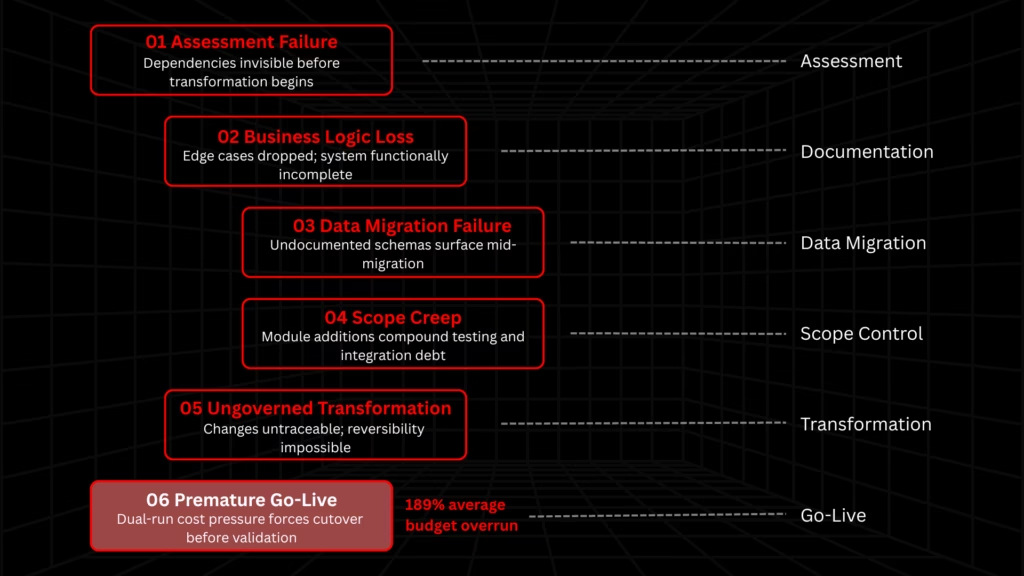
ERP programs usually fail because the same stages are consistently underscoped. Each stage’s gap becomes the next stage’s constraint. These six patterns repeat across industries and delivery models because the structural conditions that produce them are rarely addressed before execution begins.
Pattern 1: Assessment failure
Organizations cannot modernize what they cannot see. Stored procedures encode compliance rules added after a specific audit. Batch jobs run nightly transformations nobody documented. Triggers fire on conditions that were relevant a decade ago.
Manual discovery takes months, degrades the moment a key engineer exits, and produces a picture of the system that is already outdated before the first transformation decision is made. Every subsequent decision built on that foundation is speculative.
Pattern 2: Business logic loss
When modernization teams don’t fully understand what the legacy ERP does, they produce code that is architecturally clean but functionally incomplete.
Edge cases that represent 20% of the code and 80% of the business value get dropped for revenue recognition rules, discount logic, compliance validations, and exception handling paths that only surface under specific transaction conditions.
These failures don’t crash systems. They corrupt data quietly for days or weeks before anyone notices. “It worked in testing but failed in production” almost always traces back to insufficient comprehension at the start of transformation.
Pattern 3: Data migration underestimation
Data migration is the most consistently underestimated component of ERP modernization. Legacy ERP databases accumulate inconsistent schemas, duplicate records, orphaned references, and field meanings that changed over time without documentation.
A single “customer payment terms” field may need to split into credit limits, discount structures, payment codes, and dunning rules in the new architecture.
These problems surface mid-migration. The timeline in the original budget is almost always wrong. Mid-sized organizations should plan for 3 to 6 months on data migration alone; complex multi-entity environments regularly run 6 to 12 months or longer.
Pattern 4: Scope creep from module addition
No one approves scope creep in a single decision. A project scoped for finance and procurement expands to manufacturing, then HR, then payroll, then CRM integrations.
Each addition is approved individually at a steering committee. Each one adds testing, training, and integration complexity that compounds against everything already in motion.
Pattern 5: Ungoverned transformation
In traditional services engagements, transformation decisions happen inside individual developers’ heads. There is no structural mechanism ensuring that changes are intentional, reviewable, or reversible. When something goes wrong, teams cannot reliably trace what changed or why.
For general applications, this is a process inconvenience. For ERP logic such as revenue recognition, compliance validation, and financial calculations, it is a financial and regulatory exposure.
Pattern 6: Dual-system cost pressure forcing premature go-live
When go-live is delayed, organizations run both the legacy and new ERP simultaneously. At enterprise scale, duplicated infrastructure, parallel staffing, and manual reconciliation accumulate cost rapidly. A three-month delay routinely adds hundreds of thousands of dollars in unbudgeted spend.
That financial pressure creates executive pressure to accelerate go-live, which reintroduces exactly the testing and validation shortcuts that patterns 1 through 5 describe. The delay and the risk amplify each other.
Hershey’s 1999 SAP implementation is the standard US reference point for what Pattern 6 produces under compression.
The system went live during peak Halloween season before testing was complete. The result: $100 million in disrupted orders, a 19% drop in quarterly earnings, and a stock decline that became a textbook case in ERP go-live risk.
The root cause was not the software but a timeline that skipped the validation stages that phased execution is designed to protect [2].
These patterns are structural. Addressing them through project management discipline alone does not work.
Panorama Consulting data shows the average ERP program runs at 189% of its original budget, with 47% of organizations reporting cost overruns [3]. The mechanism is not complex in the abstract sense. It is these six patterns occurring in a predictable sequence.



Phased ERP Modernization: How to Execute It on a System That Was Never Designed for It
The strangler fig pattern is the right approach for mission-critical ERP modernization. The recommendation is close to universal.
What most content does not cover is what phased execution requires when applied to a system that was never designed with modular boundaries, runs financial and compliance logic that cannot tolerate silent parity failures, and shares a centralized database across every functional area.
Martin Fowler’s framing is worth holding: the strangler fig pattern does not make replacing deeply embedded software easy. What it does is make the investment and the returns gradual and visible [3].
For ERP, that visibility is the primary risk control mechanism.
Here is the execution sequence that works:
Step 1: Map before you extract
Before any module is touched, produce a full dependency map from the actual codebase. Not from interviews with engineers, not from architecture diagrams last updated five years ago.
The map must identify which functions share database tables, which batch jobs call which stored procedures, and where business logic is embedded in unexpected places: triggers, scheduled jobs, integration adapters, and report generation routines.
This step is not optional, and it is not fast. For a mid-sized ERP, accurate dependency mapping runs four to eight weeks. Programs that skip it discover the dependencies mid-extraction, when the cost of course-correcting is a multiple of what discovery would have cost.
Step 2: Identify extractable boundaries from the map
ERP modules in custom-built systems were not designed with clean boundaries. Finance logic bleeds into procurement. Inventory logic shares tables with order management. Boundary identification must be driven by data ownership and call dependency, not by what the modules are called or how the business thinks about them.
The practical test for a viable extraction boundary: can a new service own its data without reading from or writing to a legacy table that another module also writes to?
If the answer is no, the boundary needs to move, or the data ownership problem needs to be resolved first.
Step 3: Build the API facade before extracting anything
New services should never write directly to legacy ERP tables during transition. Create views or lightweight APIs that mediate access between the new service and the legacy database.
This protects the legacy system from uncontrolled writes during the transition period and creates an auditable interface layer that makes parity validation measurable.
Step 4: Run shadow writes and validate parity before cutover
During dual-run, the new system performs shadow writes to both the legacy and new databases simultaneously. At every phase gate, run consistency checks across financial calculations, compliance validations, and exception handling paths.
Generate reports from the legacy database and validate them against the new tables line by line. Any discrepancy is a blocking issue, not a backlog item.
This is the stage where business logic loss surfaces. Edge cases such as revenue recognition exceptions, discount tier logic, and compliance overrides will not appear in standard test cases. They appear in production data.
Parity validation against real transaction history is the only reliable way to catch them before go-live.
Step 5: Enforce scope freeze as a change-control event
Every module addition during live execution compounds testing and integration complexity against everything already in motion.
Additions should require formal change-control approval with a documented impact assessment, not a backlog entry or a verbal steering committee approval. The financial pressure of dual-run makes scope creep decisions feel low-stakes in the moment and expensive in retrospect.
What to retire versus what to modernize
Not all legacy ERP logic should be carried forward. Some is dead code. Some implement rules that no longer apply.
Auditing and retiring unnecessary logic requires genuine confidence in what the system does, which is why the dependency map and business logic documentation from steps 1 and 2 are not optional artifacts. They are the input to scope control and cost discipline throughout the program.
For a deeper treatment of phased execution mechanics, the incremental modernization guide covers the approach in full.
Why Traditional Delivery Models Fail at ERP-Specific Risk
The six failure patterns above are structural failures. They occur because traditional service engagements do not have the mechanisms to prevent them.
In a traditional consulting engagement, assessment is manual and dependent on engineer’s availability. Business logic discovery is based on interviews and sampling, not systematic code analysis. Transformation decisions happen inside individual developers’ heads, with no structural mechanism ensuring changes are intentional, reviewable, or reversible.
For ERP logic (revenue recognition, compliance validation, financial calculations), that is a financial and regulatory exposure, not a process inconvenience.
The structural failures map directly to the patterns:
| Failure Pattern | Root Cause in Traditional Delivery |
| Pattern 1: Assessment failure | Dependency discovery is manual and incomplete before transformation begins |
| Pattern 2: Business logic loss | Discovery is based on sampling, so edge cases get dropped in transformation |
| Pattern 5: Ungoverned transformation | No structural mechanism makes changes auditable or reversible |
| Pattern 6: Parity failure | Validation is manual and under-resourced; inconsistencies go undetected until production |
Legacyleap addresses these structurally rather than through discipline.
Comprehension precedes transformation by design, not by project plan. Governance is enforced architecturally. Transformation changes are diff-based and human-reviewed, and the system cannot merge or deploy without that review.
Parity checks are generated from the same dependency maps used during assessment, so test coverage is grounded in what the system actually does, not what the team believes it does.
Here’s how the platform maps to each failure pattern:
| Failure Pattern | Legacyleap Capability | Mechanism |
| Pattern 1: Assessment failure | Assessment Agent | Maps full codebase — systems, dependencies, risk areas, coupling points — from actual code, not sampling or interviews |
| Pattern 2: Business logic loss | Documentation Agent | Reconstructs module responsibilities, business logic, data-flow diagrams, and dependency graphs before transformation begins |
| Pattern 5: Ungoverned transformation | Modernization Agent | Diff-based, human-reviewed transformations; AI cannot merge or deploy directly — architecturally enforced |
| Pattern 6: Parity validation | QA Agent | Generates test cases and behavior-parity checks grounded in the dependency maps and business logic extracted earlier |
Evidence from comparable environments:
- A financial services provider modernizing a legacy VB6 core system through Legacyleap achieved 70 to 80% accelerated code conversion while maintaining strict financial regulatory compliance throughout. The financial data integrity and compliance requirements in that engagement are directly comparable to ERP financial logic.
- A second financial services organization carrying significant COM dependency complexity and a large integration footprint moved to an API-driven architecture and reduced development cycles by 40%. Integration complexity of this kind maps directly to the integration footprint most custom-built ERPs carry.
- A global entertainment company with 1,700 DLLs, over 900 database tables, and shared dependencies across 50+ applications completed modernization with 60% accelerated conversion. The shared database complexity in this engagement is the closest architectural parallel to ERP database architecture in Legacyleap’s case base. The Assessment Agent’s dependency mapping was what made the extraction sequence executable.
The compounding return
The artifacts produced through a platform-led engagement persist after the engagement ends. This includes documentation, dependency maps, test suites, and architecture diagrams.
The next feature change, the next integration, the next engineer onboarding all cost less because the comprehension infrastructure now exists.
A services engagement produces a modernized system. A platform-led engagement produces a modernized system and the institutional knowledge that the organization never had.
For a direct comparison of delivery models, see the platform-led vs. services-led modernization guide.
ERP Migration and Modernization Cost: US Benchmarks for Building a Business Case
Most modernization budgets are constructed before anyone has a clear picture of what the system actually contains. That is the first problem.
The second is that the comparison point is usually “implementation cost versus doing nothing”, which understates the cost of inaction and overstates the risk of modernizing.
The correct comparison should be the cost of the next three years on the legacy system (i.e., talent premiums, compliance exposure, integration friction, shadow system maintenance, knowledge concentration risk) against a governed modernization program with a defined scope and auditable outputs.
Cost benchmarks:
| Segment | Typical Actual Spend |
| Mid-market ($250M–$1B revenue) | $450K–$625K median actual spend |
| Large enterprise (2,000+ users, global) | $2M–$10M |
| Industry benchmark (total implementation) | 3–6% of annual revenue |
| Average overrun on unstructured programs | 189% of original budget [3] |
The 189% average overrun is a structural problem as a result of the six failure patterns playing out in sequence on programs that did not address them before execution began.
A governed program with full dependency visibility, documented business logic, and diff-based transformation does not eliminate the complexity. It makes the risk visible and manageable before the budget is committed.
How to Move Forward on Legacy ERP Modernization
The argument this guide makes is straightforward: legacy ERP modernization fails at predictable stages, for structural reasons, and those reasons are addressable before execution begins.
The upgrade/modernize/replace decision depends on the architecture state, not system age. Phased execution requires ERP-specific discipline that generic frameworks do not cover. And the artifacts a platform-led engagement produces persist long after the engagement ends, compounding in value with every subsequent change.
What successful modernization produces that the legacy system never had is not just a modern codebase. It is institutional knowledge that the organization can build on with:
- Documentation that does not require a retiring engineer to interpret,
- Dependency visibility that makes the next change predictable, and
- Test coverage that turns regression from a post-go-live risk into a controlled process.
Two ways to move forward, depending on where you are in the decision.
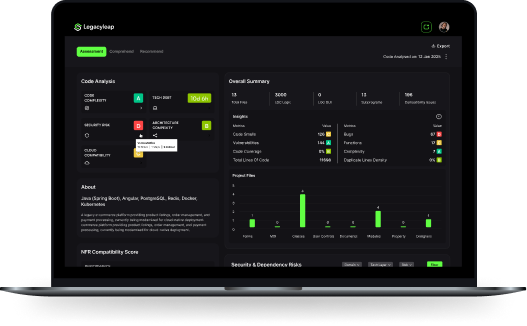
If you already know modernization is necessary and need a concrete view of scope, risk, and effort before committing to a path, start with the $0 Assessment. You get a dependency map, risk indicator report, and modernization readiness view from your actual codebase with no commitment required.
If you are still building the internal case and need to see how a platform-led engagement works against a real system, the demo walkthrough covers the Assessment, Documentation, Modernization, and QA agents against a live codebase. It gives you the language and evidence to make the case to your board.
FAQs
Start with the codebase, not with people. When institutional knowledge has walked out the door, the only reliable source of truth is the code itself, in stored procedures, batch jobs, triggers, and integration adapters. Systematic static analysis of the full codebase can reconstruct module responsibilities, data flows, and business logic dependencies without relying on engineer memory. The output becomes the documentation that should have existed from the start, and the blueprint for every transformation decision that follows.
Four things that most plans skip: a field-level audit of every table to identify schema drift and changed field meanings over time; a data ownership map that traces which modules write to which tables; a reconciliation strategy for orphaned records and duplicate entries before any migration begins; and phase-gate validation checkpoints that compare legacy and new data line by line during dual-run. Data migration on an undocumented schema is a discovery exercise first. Plans that treat it as a transfer exercise routinely run two to three times over their original timeline.
The API façade layer is the primary mechanism. Before any module is extracted, wrap the legacy ERP’s integration surface in a lightweight API layer that downstream systems connect to instead of the ERP directly. This decouples dependent systems from the extraction sequence as they continue operating against a stable interface while the underlying ERP is modernized incrementally behind it. Integration contracts are renegotiated one at a time as each module migrates, rather than all at once at cutover.
Functional parity validation requires more than a standard test suite. The test cases must be generated from the documented business logic and dependency maps produced during the comprehension stage, not written from scratch by engineers who weren’t involved in the original system. Validation should run against real historical transaction data, not synthetic test data, because edge cases in revenue recognition, discount logic, and compliance overrides only appear under actual production conditions. Any discrepancy between legacy and modernized outputs at a phase gate is a blocking issue, not a post-launch fix.
At minimum: an executive sponsor with authority to enforce scope freeze decisions, a technical lead who owns dependency mapping and transformation governance, a business analyst embedded with finance and operations to validate business logic preservation, and a QA resource dedicated to parity validation throughout dual-run. The common mistake is staffing the program entirely from the team that currently maintains the legacy system. That team’s time is already consumed keeping the legacy ERP operational, and modernization requires dedicated capacity, not shared capacity.
Scope freeze works when stakeholders understand what they are protecting, not just what they are giving up. Frame each phase boundary as a financial commitment: every module addition during live execution adds a quantifiable cost in testing, integration, and dual-run extension. Present additions as change-control requests with a documented impact assessment (timeline extension, cost increase, risk implications) and let stakeholders make the tradeoff explicitly. Most scope creep happens because additions feel free in the moment. Making the cost visible at the point of request changes the decision dynamic.
References
[1] Arthur J. Gallagher — 2026 Cyber Insurance Market Outlook. https://mycloudstar.com/cyber-insurance-2026-policy-changes/
[2] CIO.com — “18 Famous ERP Disasters, Dustups and Disappointments.”https://www.cio.com/article/278677/enterprise-resource-planning-10-famous-erp-disasters-dustups-and-disappointments.html
[3] Panorama Consulting — ERP implementation cost overrun data, via Pemeco.https://pemeco.com/two-big-reasons-erp-implementation-failure/ | Martin Fowler — StranglerFigApplication.https://martinfowler.com/bliki/StranglerFigApplication.html