TL;DR
- Billing is the one legacy system where a regression reaches customers as a wrong invoice, which is why it keeps losing the roadmap fight. It competes every quarter against lower-risk, higher-visibility projects and loses, even as EY estimates 1 to 5 percent of realized EBITA is lost to undetected revenue leakage.
- Two structural properties make billing categorically harder to modernize than other enterprise systems. An estimated 32% of billing system dependencies are undocumented pricing, tax, and discount logic, and the acceptable tolerance for behavioral discrepancy between old and new systems is effectively zero.
- A telecom consolidation shows what comprehension-first execution actually looks like at scale. The team reverse-engineered roughly 2 million lines of legacy billing code to extract regional business rules, completing the extraction in one month before any consolidation touched the code.
- Brightspeed’s migration shows parallel validation, not the platform, is what prevents billing errors on cutover. The company moved more than 2 million customer accounts across three business segments with 99.9% data accuracy, zero downtime, and a 100% pass rate across 472 business validation scenarios.
- Realistic billing migration timelines run far longer than most teams budget for. Enterprise billing system migrations typically take 12 to 36 months, and organizations running legacy billing report 15 to 20 percent higher Days Sales Outstanding than modernized counterparts.
Why Billing Modernization Keeps Getting Pushed Back
There is a straightforward reason billing modernization gets deprioritized cycle after cycle: the system collects revenue.
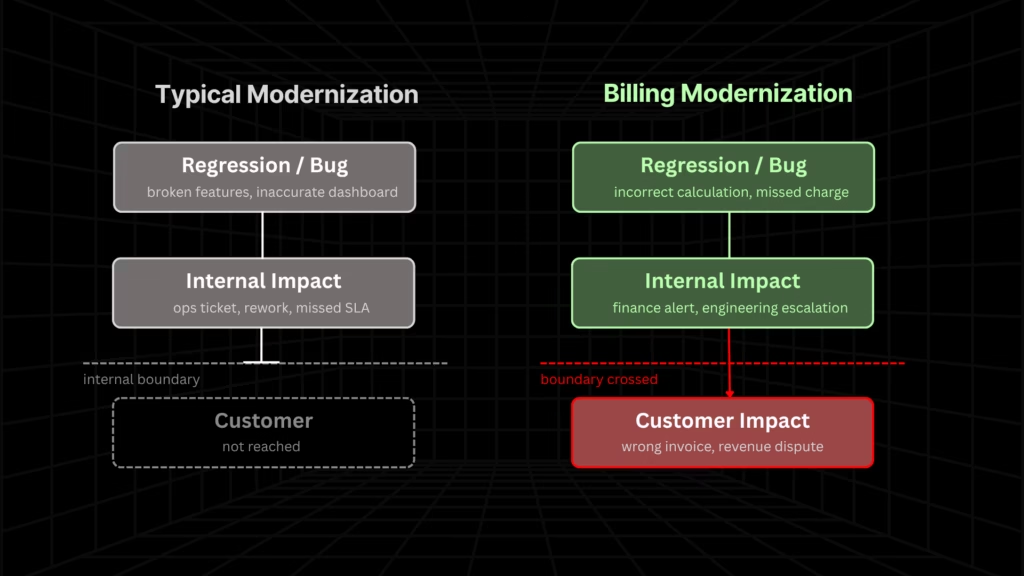
It is the one application in the enterprise where a regression reaches customers as a wrong invoice, and every engineering leader in this position knows that being the person who broke billing is a career-defining event for the wrong reasons.
So the system stays. Quarterly, the modernization initiative competes against projects with lower perceived risk and higher visibility, and quarterly, it loses. The billing system remains on a roadmap that never quite becomes an execution plan.
The problem is that “it still works” describes current function, not current cost. Legacy billing systems accumulate billing system technical debt in ways that are slow, compounding, and largely invisible until the numbers surface in the wrong meeting.
This article covers why billing is uniquely difficult to modernize, what the deferral is actually costing, and what a safe execution path looks like in practice.
What Deferred Billing Modernization Is Costing You Right Now
Most organizations that have deferred legacy billing system modernization have not calculated the cost of doing so. The cost of a legacy billing system tends to manifest in ways that don’t appear on a single line item, which is partly why the deferral keeps getting approved.
The five categories that matter for a budget conversation:
| Cost Category | What It Looks Like | Why It Compounds |
| Revenue leakage | Missed charges, unbilled usage, pricing errors legacy systems can’t detect — EY estimates 1–5% of realized EBITA [1]; at $200M revenue, 1% is $2M annually | Leakage continues undetected every billing cycle; visibility gaps mean the number is almost always higher than expected |
| DSO and working capital | Billing errors and disputes slow collections, inflating Days Sales Outstanding | Organizations with legacy billing report 15–20% higher DSO than modernized counterparts — for a $100M revenue business, that’s millions in tied-up receivables |
| Manual effort | Finance teams spend significantly more time on invoice generation, reconciliation, and error correction than those on modern systems | That labor cost is rarely attributed to the billing system in budget conversations, but it accumulates every quarter |
| Compliance exposure | Legacy billing systems frequently lack the granularity required for ASC 606 and IFRS 15 revenue recognition reporting | Manual workarounds increase audit risk and consume finance and engineering time with each reporting cycle |
| Integration fragility | Every new product, pricing change, or downstream system adds complexity to an already brittle core | Modernization cost increases with each quarter of deferral; talent who understand the system leave |



Why Billing Systems Are the Hardest Legacy Application to Modernize
The deferral is not entirely irrational. Billing systems are genuinely more difficult to modernize than most enterprise applications, and not in the generic way that all large-scale modernization is hard.
Two structural properties make billing specifically different.
Embedded, Undocumented Logic
Billing systems accumulate business logic over decades.
- Pricing rules,
- Discount structures,
- Tax calculations,
- Revenue recognition workflows, and
- Exception-handling paths
All these get hardcoded across layers in stored procedures, application code, or integration adapters, and in ways that nobody has fully documented. Most teams don’t know they are there until the new system produces a different number.
This is not a documentation problem, but an architectural problem. The logic lives in the code, accreted over years of product changes, regulatory shifts, and one-off customer arrangements that someone resolved with a direct fix.
Industry data puts 32% of billing system dependencies as undocumented [2], and that figure understates the issue, because undocumented billing logic isn’t merely missing from wikis. It lives in execution paths that only reveal themselves under specific conditions.
The practical consequence is that any transformation that begins without mapping what the system actually does is operating blind. The discrepancy surfaces at volume, in production, as a wrong invoice.
Zero Error Tolerance
Every other modernization failure is internal:
- A regression in an ERP workflow creates rework
- A bug in a reporting system produces inaccurate dashboards
- A broken integration triggers an ops ticket
That makes the acceptable threshold for behavioral discrepancy between old and new systems effectively zero. And that constraint makes standard “ship and fix” development approaches structurally incompatible with billing migration. Every cutover decision has to be made with high confidence, not reasonable confidence.
These two properties are what make billing modernization risk categorically different from other modernization work, and what make the execution approach matter more here than almost anywhere else.
Key Risks to Manage
These two structural properties translate into execution risks that need active mitigation:
- Billing errors on cutover: Caused by embedded logic that wasn’t mapped before transformation
- Data migration inaccuracies: Proration logic, credit histories, and adjustment records handled idiosyncratically by legacy systems
- Integration failures: Undocumented dependencies that break when the billing core changes
- Compliance gaps: Revenue recognition discrepancies that surface during ASC 606 audits post-migration
All four are preventable. The mitigation is the execution framework in the next section.
How to Modernize a Billing System Without Disrupting Revenue
Given those constraints, two execution principles separate billing migrations that succeed from those that don’t.
Comprehension Before Transformation
The consistent differentiator in successful billing migrations is that the team mapped what the system actually does before touching it from the code itself. That means pricing rules, discount logic, tax calculations, revenue recognition workflows, and integration touchpoints extracted systematically, not reconstructed from tribal knowledge.
Until that map exists, the transformation team cannot sequence safely. They don’t know which modules carry undocumented logic, which integrations will break on cutover, or which customer scenarios will produce different output.
One large telecom consolidation illustrates the scale: reverse-engineering approximately 2 million lines of legacy billing code to extract regional business rules before any consolidation could proceed; completed within a month, and the work that made the consolidation executable [4].
Comprehension is the prerequisite, not the first deliverable.
Parallel Validation Before Cutover
Once transformation begins, old and new systems must run simultaneously with output compared at the line-item level as an ongoing validation discipline throughout the migration. Small rating logic errors cascade into large-scale billing inconsistencies at volume [2]. A minor discrepancy in test scenarios can produce thousands of incorrect invoices in production.
Brightspeed’s migration of 2M+ customer accounts across Consumer, Enterprise, and Wholesale segments achieved 99.9% data accuracy and zero downtime, with a 100% pass rate across 472 business validation scenarios before cutover [3]. That outcome reflects parallel validation applied consistently, not a property of the platform or stack.
The practical implication is phased migration over a big-bang cutover:
- Move by customer segment or functional area
- Validate parity at each step before expanding scope
- Keep the legacy system in a production-ready state until two full billing cycles are complete without material discrepancies
How Long Does Billing System Migration Take?
For most enterprise billing systems, a realistic timeline is 12–36 months. The range is wide because the variables are significant:
- System complexity: Number of pricing models, billing entities, and revenue recognition rules
- Integration surface: How many downstream systems connect to billing and how many of those dependencies are undocumented
- Migration approach: Phased segment-by-segment migration takes longer than a big-bang cutover, but the risk profile is categorically different
Teams that attempt full replacement without a comprehension phase consistently underestimate both timeline and scope. The comprehension work done upfront is what makes the estimate reliable and what prevents the timeline from expanding mid-program.
What a Governed Billing Modernization Approach Looks Like
Executing the comprehension-first, parity-validated approach manually requires specialized effort at every stage, i.e., codebase analysis, business rule extraction, dependency mapping, parallel output comparison.
A governed modernization approach makes this process auditable and repeatable rather than dependent on individual expertise and tribal knowledge.
Legacyleap’s five-agent system operationalizes this across three phases:
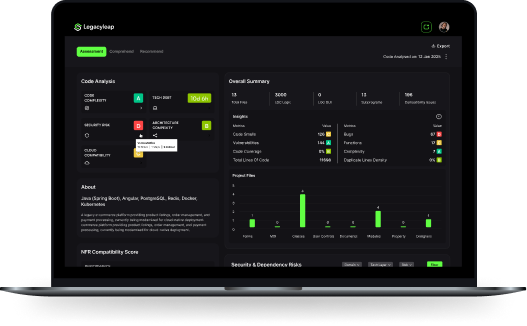
- Comprehension phase: The Assessment Agent maps every module, dependency, and integration point, including undocumented ones. The Documentation Agent then reconstructs pricing logic, discount workflows, and revenue recognition rules directly from source code, not from incomplete specs or tribal knowledge. The output is a complete dependency map and business rule inventory before any transformation begins.
- Transformation phase: The Recommendation Agent defines the modernization path based on actual system complexity. The Modernization Agent executes diff-based, human-reviewed code changes, and nothing merges or deploys without engineer approval. That constraint is architectural, not a policy that can be skipped under schedule pressure.
- Validation phase: The QA Agent runs continuous parity validation throughout the migration, not as a terminal pass. It generates regression suites from legacy system behavior and surfaces discrepancies before cutover is approved.
Everything runs inside Legacyleap with full audit trails and governance controls as a requirement, not a feature, for billing systems in regulated industries.
The First Step Doesn’t Have to Be the Whole Modernization
The internal objection to billing modernization is rarely “we don’t need to do this.” It is “we’re not ready to commit to a full replacement.” Those are different problems, and conflating them is what keeps modernization on a roadmap indefinitely.
The first step worth approving is understanding what you have: a dependency map, a business rule inventory, a characterization of the integration surface, and a modernization blueprint that gives stakeholders a concrete picture of scope, risk, and sequencing before any spend is committed.
That work makes the internal case for modernization self-evident because the picture that emerges from a serious comprehension effort is usually more actionable, and less frightening, than the vague perception of a system that is too complex to touch.
Every quarter of deferral compounds the cost. The modernization will happen. The question is whether it happens as a planned program or under pressure.
Not sure where to start?
Get your free billing system assessment to map your billing system’s dependencies, business rules, and integration points, and produce a modernization blueprint before any spend is committed.
Book a Demo to see how Legacyleap’s five-agent system handles billing system complexity, from undocumented logic extraction to parity-validated transformation.
FAQs
For most enterprise billing systems, 12–36 months is a realistic range. System complexity, integration surface, and migration approach are the primary variables. Phased segment-by-segment migration takes longer than big-bang cutover but carries a categorically different risk profile. Teams that skip the comprehension phase consistently underestimate timeline and scope because the upfront mapping work is what makes the estimate reliable and the program manageable.
The four that recur most consistently: embedded logic that wasn’t extracted before transformation begins (producing a system that calculates billing differently in edge cases), data migration inaccuracies in proration records and credit histories, undocumented integration dependencies that break on cutover, and revenue recognition discrepancies that surface during post-migration audits. All four trace back to insufficient comprehension work before transformation started.
There is no reliable industry-standard figure because cost scales with system complexity, integration surface, and the comprehension work required upfront. The more useful number to calculate first is the cost of not modernizing (revenue leakage, DSO inflation, manual reconciliation labor, and compliance exposure), which in most enterprises exceeds the modernization investment within two to three years.
Three arguments move the conversation: quantify the revenue leakage (even 1% on $200M in annual revenue is $2M recoverable), calculate the annual cost of staying in maintenance spend, manual reconciliation labor, compliance preparation time, and engineering hours consumed by integration debt, and propose a first step that doesn’t require full commitment. A comprehension phase that maps business rules and integration points is low-cost, low-risk, and produces artifacts the organization needs regardless of whether full modernization proceeds.
The most common failure mode is a system that calculates billing differently in edge cases such as incorrect invoices, missed charges, or revenue recognition discrepancies that only surface at volume. This is almost always caused by skipping the comprehension phase: the new system was built against documentation, not against what the legacy system actually does. Secondary failure modes include integration breakage on cutover and data loss during migration. All three are preventable with comprehension-first sequencing and continuous parallel validation.
References
[1] EY, via DigitalRoute —Revenue leakage estimate: 1–5% of realized EBITA lost through data management failures in quote-to-cash processes.
[3] Brightspeed / Mobolutions —SAP BRIM Migration Case Study: 2M+ customer accounts migrated across Consumer, Enterprise, and Wholesale segments with 99.9% data accuracy, zero downtime, and 100% pass rate across 472 business validation scenarios.