How Much Does Application Modernization Cost?
Application modernization costs range from $25,000 for straightforward database migrations to over $2 million for large-scale enterprise application portfolios involving complex .NET, Java EE, or multi-stack environments. The typical median falls between $450,000 and $2.3 million across all modernization types, with an average program cost of approximately $1.5 million [1].
Those numbers are directional at best. A Wakefield Research survey of 250 technology leaders found that 79% of modernization projects fail, averaging $1.5 million and 16 months per initiative [2]. Gartner data paints a similar picture: only 42% meet original budget, and 82% exceed the timeline. McKinsey puts annual migration overspend at 14%, over $100 billion in global overruns across three years [3].
Published benchmarks describe averages. They tell you nothing about the specific system in your portfolio. The variance between modernizing a VB6 desktop application with COM/ActiveX dependencies and decomposing a distributed Java EE service layer is not a difference of degree. It is a different category of work entirely.
This article walks through what a defensible ROM estimate requires, what hidden costs every estimate misses, why timelines are overrun, and how to produce project-specific inputs before committing budget.
What Actually Drives Modernization Cost: The Three ROM Input Categories
Every vague “it depends” traces back to the same gap: the organization lacks structured inputs for a defensible ROM estimate. AWS’s portfolio assessment guidance defines three input categories. They translate directly to any modernization program.
Inventory and Dependency Inputs
A complete map of modules, services, data stores, external integrations, and the dependency relationships between them. Without it, every subsequent estimate is an assumption.
For legacy stacks such as:
- VB6 with undocumented COM/ActiveX dependencies,
- Java EE with implicit EJB-to-EJB interactions,
- .NET Web Forms with tightly coupled data access layers.
…this inventory almost never exists.
It must be reconstructed from the codebase, not from architecture diagrams last updated a decade ago. This is also the input category that Legacyleap’s $0 Assessment produces, but more on that later.
Strategy and Effort Inputs
The modernization strategy (rehost, replatform, refactor, or rewrite) determines person-days, loaded rates, and tooling costs per workload. This is not a blanket decision across the portfolio.
A VB6 desktop application with Crystal Reports dependencies requires a fundamentally different strategy than a Java Servlet that can be replatformed to Spring Boot.
Get a VB6-specific migration estimate from Legacyleap.
| Strategy | Typical Cost Range | Timeline Range | Primary Cost Driver |
| Retire | Minimal (decommission only) | 1–3 months | Data migration and dependency untangling |
| Rehost | $25K–$250K per application | 2–6 months | Infrastructure provisioning and cutover |
| Replatform | $100K–$500K per application | 3–9 months | Configuration re-architecture, integration mapping |
| Refactor | $250K–$1.5M per application | 6–18 months | Domain decomposition, integration redesign, test automation |
| Rewrite | $500K–$2M+ per application | 12–36 months | Full requirements capture, new development, parity validation |
Consulting rates range from $75–$850/hr, averaging around $130/hr. Boutique firms typically charge 30–50% less than enterprise SIs. Regulated industries should apply a 20–40% compliance premium based on cross-industry data from 200+ implementations [1].
For a deeper comparison of how refactoring and replatforming differ as strategies, see our decision framework for choosing between them.
Run-Rate Inputs
Current maintenance baseline versus projected target-state operating cost. This requires honest accounting. Not just infrastructure line items, but:
- Engineer time on patching, workarounds, and incident response
- Opportunity cost of engineers tied to maintenance instead of delivery
- Licensing, compliance, and vendor support for end-of-life stacks
Most estimates fail in the first category. Teams estimate effort without completing discovery, and the system reveals its true complexity during the program, not before it.
The Hidden Costs That Every Modernization Estimate Misses
Eight cost categories routinely blow up modernization budgets. This is a diagnostic checklist to give practitioners something to hold their current estimate against.
For how modernization programs should be sequenced to manage these, see our modernization approach and process framework.
1. Comprehension and Discovery Labor
Teams spend months understanding system behavior before transformation begins. This gets budgeted as “preliminary”, but it is the primary cost driver. For undocumented legacy .NET or Java EE systems, comprehension means reconstructing actual behavior from scattered artifacts, tribal knowledge, and runtime observation.
This is the bottleneck Legacyleap’s Assessment Agent and Documentation Agent compress by replacing months of manual reverse-engineering with code-grounded dependency maps, module inventories, and reconstructed documentation.
2. Dual-Run Cost Trough
Phased modernization requires paying for both legacy and modern environments simultaneously. Every ROI model shows end-state costs; almost none show transition costs. The strangler fig pattern, by design, creates a dual-run period that can extend 12–24 months for large portfolios. Budget for the transition, not just the destination.
3. Integration Re-Engineering
Each external dependency (APIs, third-party systems, message queues, batch feeds) requires redesign, testing, and validation. These are frequently unscoped because they are undocumented.
For legacy Java EE, undocumented EJB-to-EJB calls and JNDI resource dependencies are common culprits. For legacy .NET, COM interop, and ActiveX dependencies are invisible until the transformation begins.
4. Parity Validation Labor
Proving functional equivalence manually becomes the bottleneck when test automation is absent. And in most legacy systems, it is. The effort is not just running tests: it is constructing test cases, defining equivalence criteria, and producing evidence artifacts for compliance.
In regulated industries, this drives a significant portion of the 20-40% compliance premium.
Your hidden costs start with what you can’t see. The $0 Assessment maps your dependencies, risk areas, and effort profile before you commit budget.
5. Regulatory Evidence Creation
Landing zones, security boundaries, audit documentation, data residency evidence, and access control configurations are compliance deliverables, not engineering tasks. The cost scales with each regulatory framework. HIPAA, SOX, PCI-DSS, FedRAMP, GDPR, each add a distinct evidence layer.
6. Post-Migration Cloud Cost Overruns
Lift-and-shift preserves inefficiency. On-premises sizing assumptions transfer poorly to cloud pricing, and right-sizing requires its own engineering effort after migration. This cost surfaces only after migration is “complete,” making it invisible to pre-migration budgets.
7. Organizational Change Management
Training, workflow redesign, and adoption support never appear in technical estimates. Survey data links 43% of modernization failures to misaligned expectations and 37% to required organizational changes [2].
When the system is modernized, but the team is not retrained, operational cost doesn’t decrease. It shifts.
8. Legacy Talent Scarcity Premium
Retaining legacy specialists during transition while they maintain production, document undocumented behavior, and support modernization creates a triple burden. This is acute for stacks past end-of-life (VB6, Classic ASP, EJB 2.x, Struts 1.x, Web Forms), where the talent pool is shrinking and replacement hiring is a seller’s market.
Once these hidden costs are accounted for, the next challenge is building the case that justifies the revised number.
For a framework that translates cost inputs into the ROI model your CFO needs, see our three-horizon ROI framework for application modernization.
Why Timelines Overrun: Calendar Time vs. Engineering Time
How Long Does Legacy Application Modernization Take?
The average program takes approximately 16 months, with over a quarter reporting two years or more [2]. A phased approach is the most reliable way to manage this:
- 0–6 months: Quick wins. Rehosting, low-complexity migrations, and foundational infrastructure
- 6–18 months: Complex applications. Refactoring tightly coupled systems, redesigning integrations, and validating parity
- 18–36 months: Full portfolio. Completing the long tail, decommissioning legacy environments, and stabilizing the target state
The Calendar-Time Gap
Engineering effort and calendar time diverge because real programs are governed by constraints unrelated to capacity: maintenance windows, batch dependencies, regulatory change controls, stakeholder approvals, and the overhead of keeping legacy systems running during modernization.
A module requiring 200 person-days may take 9 months of calendar time once these constraints are factored in.
Why Do Modernization Projects Go Over Budget?
The root causes converge: incomplete discovery, hidden dependencies surfacing mid-program, organizational resistance, and disconnect between business expectations and technical reality.
The GAO’s 2025 report on federal legacy IT provides a clear illustration [4]. Of the 10 most critical systems identified for modernization in 2019, only 3 had been completed by February 2025.
The defining pattern was incomplete planning in missing milestones, undefined work, and unclear system disposition. This is a program-management failure, not a technology problem.
Architecture Decisions Have Cost Consequences
The Amazon Prime Video case demonstrates this clearly [5]. The team found that a distributed microservices architecture had become a cost and scaling bottleneck for their video monitoring service. Consolidating into a single process reduced infrastructure costs by over 90%.
The lesson is not that microservices are wrong. It is that architecture decisions made during modernization have direct cost and timeline consequences, and those consequences are discoverable only through rigorous system-level analysis before transformation begins.
For a structured view of how to phase modernization to manage this risk, see our incremental modernization guide.
Incomplete planning is the top reason timelines overrun. Book a demo to see how Legacyleap produces the system-level visibility that prevents scope surprises.
How Legacyleap Turns Assessment Into a Budget You Can Defend
The estimation impasse is predictable.
The CFO needs a budget number → Engineering cannot produce one without discovery → Discovery requires budget that the CFO will not approve without a number.
The $0 Assessment breaks this loop.
What the $0 Assessment Produces
It maps directly to the three ROM input categories this article has established:
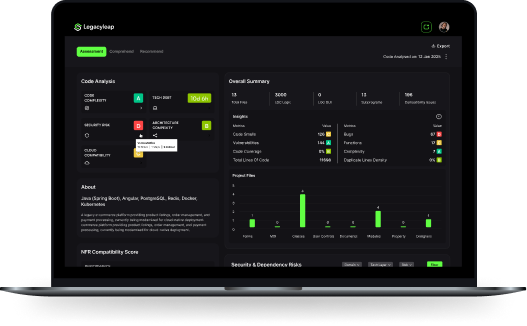
- Inventory and dependency inputs: The Assessment Agent maps systems, dependencies, and risk areas from the codebase, producing the dependency maps and module inventories that every downstream estimate depends on. Outputs come from source code, not stakeholder interviews.
- Strategy and effort inputs: Effort and timeline ranges, migration target recommendations, and a structured modernization blueprint provide workload-level clarity on what strategy applies where.
- Comprehension inputs: The Documentation Agent reconstructs missing documentation, workflows, module boundaries, and business rules directly from code. Most programs stall not because transformation is hard, but because comprehension is slow. The assessment compresses months into a structured deliverable.
How This Differs from Copilots
Copilots assist at the file level. A developer using a copilot can refactor a single file. They cannot produce a dependency map across a portfolio, reconstruct missing documentation for an undocumented system, or validate functional parity across transformation cycles.
Legacyleap operates at the system level with full codebase comprehension, multi-agent orchestration, and parity validation built in. This is the level of visibility that ROM estimation requires.
From Cost Uncertainty to a Defensible Modernization Budget
The reason modernization costs are unpredictable is that the system is not fully understood at the time of estimation. The solution is not a better benchmark, but a structured assessment that produces project-specific ROM inputs before budget commitment.
This article has established:
- What a defensible estimate requires: three ROM input categories – inventory, strategy, and run-rate
- What your estimate likely misses: eight hidden cost categories that routinely drive overruns
- Why timelines overrun structurally: calendar-time constraints, incomplete discovery, organizational gaps
- How to get project-specific inputs before committing budget: the $0 Assessment
Discovery is not a preliminary step. It is the primary investment in any modernization program.
Request a $0 Modernization Assessment. Get the dependency maps, risk profile, effort ranges, and modernization blueprint your finance leadership needs at zero cost, before committing to a program.
Book a Demo. See Legacyleap Studio in action – how the agents work, what the assessment output looks like, and how transformation and validation operate within the platform.
FAQs
Start with the applications that carry the highest maintenance burden and the highest business risk if they fail. Systems that consume disproportionate engineering time on patching, workarounds, or incident response are strong candidates, as are those running on end-of-life stacks where talent is scarce and security patches have stopped. Beyond that, factor in business criticality and dependency density. An application that six other systems depend on creates more downstream risk than an isolated tool. The $0 Assessment produces a dependency map and risk profile that makes this prioritization concrete rather than intuition-based.
It depends on whether your team has both the legacy expertise and the modern-stack skills to execute safely. In-house teams understand the system’s behavior and business context better than any outside partner, but they’re often stretched thin maintaining production while simultaneously modernizing. Outsourcing brings capacity but introduces knowledge-transfer overhead and the risk that external teams miss undocumented behavior. Many enterprise programs use a hybrid model. Internal teams own architecture decisions and validation, while external partners or platform tooling handle the labor-intensive comprehension and transformation work.
ROI comes from three sources: reduced maintenance costs (fewer engineers tied to patching and workarounds), increased delivery velocity (faster feature releases on modern stacks), and risk reduction (fewer security vulnerabilities, compliance gaps, and outage-prone components). The challenge is that ROI is difficult to quantify before discovery because you don’t know the true cost of the current state until you’ve mapped it. Most organizations that attempt ROI justification before assessment end up using generic industry benchmarks that don’t survive CFO scrutiny. A structured assessment that produces actual maintenance baselines and effort profiles gives finance leadership numbers they can defend.
Yes, significantly. Larger organizations typically have more complex dependency chains, more integrations, and more regulatory constraints, all of which increase cost. Industry matters because regulated sectors like financial services, healthcare, and government face a 20–40% compliance premium on top of base modernization costs, driven by parity validation requirements, audit documentation, and landing zone configurations. Company size also affects talent availability: larger organizations may have deeper benches but also more competing priorities for those engineers, while smaller organizations may lack the legacy expertise entirely.
The most common triggers are end-of-life announcements for frameworks or languages (VB6, Struts 1.x, older .NET frameworks), security incidents or failed compliance audits that expose legacy vulnerabilities, and rising maintenance costs that cross a threshold where the CFO starts asking questions. Beyond those, business-driven triggers include the inability to ship features fast enough on the legacy stack, failed integration attempts with modern systems or cloud services, and talent attrition, where the engineers who understand the legacy system leave and can’t be replaced. Legacyleap’s $0 Assessment helps organizations that recognize these triggers but need system-level clarity before committing to a program.
References
[1] Software Modernization Services — Cost benchmarks and compliance premium data from 200+ implementations. https://softwaremodernizationservices.com/costs/
[2] Wakefield Research / vFunction — “Why App Modernization Projects Fail.” Survey of 250 U.S. technology leaders at director level or above, companies with 5,000+ employees. https://vfunction.com/resources/report-wakefield-why-app-modernization-projects-fail/
[3] McKinsey & Company — “Cloud migration opportunity: Business value grows, but missteps abound.” https://www.mckinsey.com/industries/technology-media-and-telecommunications/our-insights/cloud-migration-opportunity-business-value-grows-but-missteps-abound
[4] U.S. Government Accountability Office — GAO-25-107795, “Information Technology: Agencies Need to Plan for Modernizing Critical Decades-Old Legacy Systems.” July 2025. https://www.gao.gov/products/gao-25-107795
[5] Amazon Prime Video Tech Blog — “Scaling up the Prime Video audio/video monitoring service and reducing costs by 90%.” https://www.aboutamazon.com/what-we-do/entertainment/