AngularJS in 2026: Operational Risk and Migration Pressure
AngularJS (1.x) reached end-of-life in December 2021. Three-plus years on, production systems built on it carry a compounding set of risks that do not resolve on their own.
The framework no longer receives security patches. Vulnerabilities discovered in the runtime, in dependencies it pulls in, or in browser compatibility layers will not be addressed by the AngularJS team. Any enterprise running AngularJS in customer-facing or data-handling contexts is operating with an unpatched attack surface.
The dependency chain compounds the problem. AngularJS was built for a different era of the JavaScript ecosystem. Its dependencies, build tooling, and browser compatibility assumptions were shaped by environments that no longer exist in the same form. Modern browser releases, security model updates, and standards changes continue to widen the behavioral gap between what AngularJS expects and what browsers now enforce.
Teams encounter these issues incrementally through broken functionality following browser updates, dependency conflicts that cannot be resolved without forking packages, and silent behavioral regressions no one anticipated.
The maintainability pressure follows a familiar curve. The pool of engineers with active AngularJS expertise has contracted steadily. Onboarding new engineers into an AngularJS codebase adds overhead that compounds across teams and projects.
Documentation for newer patterns and tooling simply does not exist for this framework at the level it once did. The institutional knowledge that kept these systems running is often concentrated in a small number of senior engineers, which is a fragile arrangement with real succession risk.
For most enterprise teams in 2026, the question is not whether to migrate from AngularJS. It is how to do so without converting a multi-year system into a high-risk sprint.
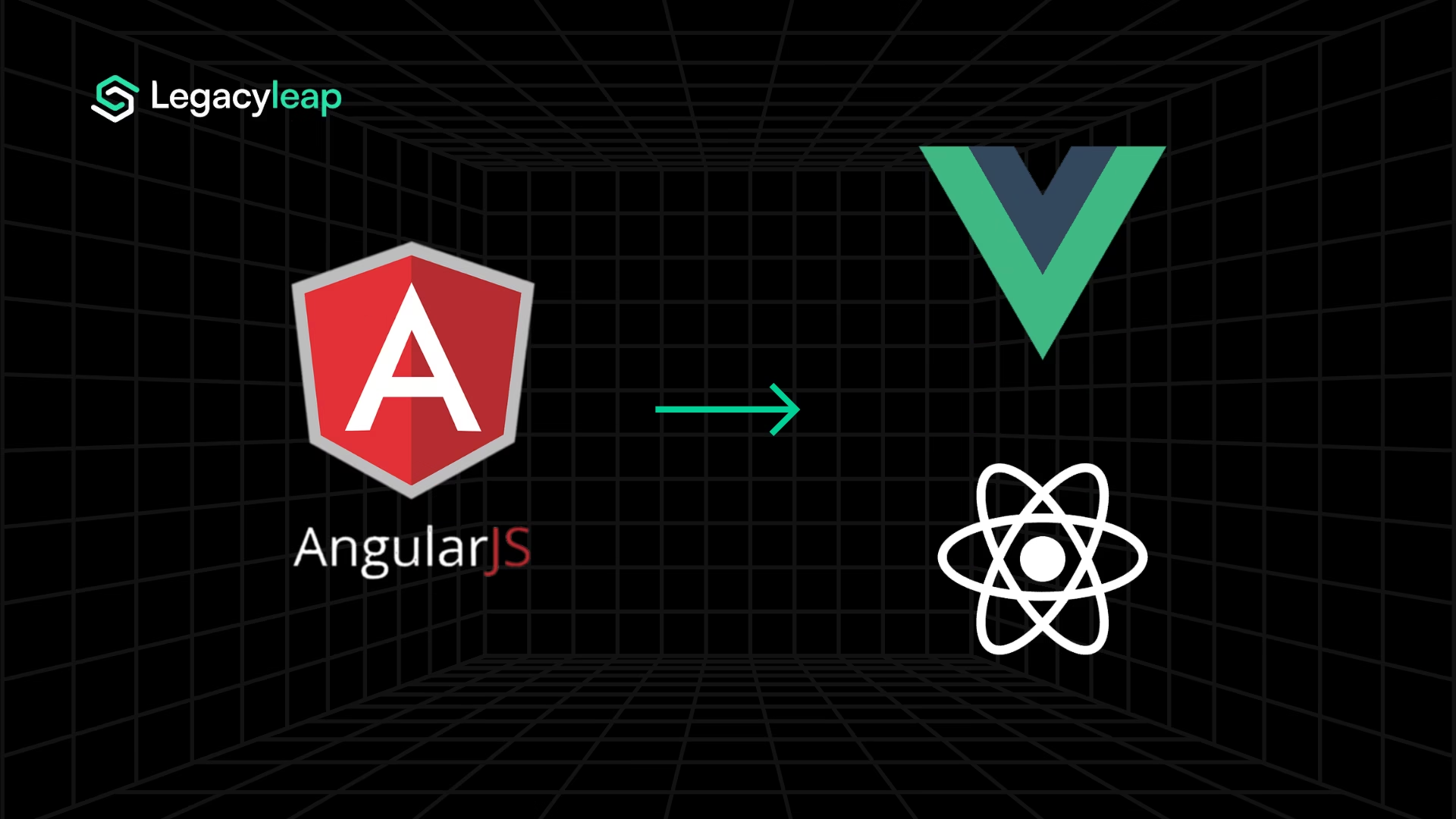
Choosing Between React and Vue for AngularJS Migration: Decision Framework for Enterprise Teams
The first architectural decision is stack selection. The wrong choice creates friction across the full duration of the migration and beyond. This is not a question to resolve by developer preference or a team vote.
A. Decision Criteria
React and Vue represent meaningfully different tradeoffs at enterprise scale.
React is a library, not a framework. It provides component primitives and a rendering model, but state management, routing, and dependency injection patterns require explicit architectural decisions. For teams migrating out of AngularJS, this means re-establishing conventions that AngularJS enforced implicitly.
The upside is ecosystem maturity, a large and deep hiring pool, and organizational backing that makes it a low-risk long-term commitment. React’s enterprise adoption is broader than Vue’s in most markets, with downstream effects on tooling, third-party integration support, and talent acquisition.
Vue offers a more opinionated structure by default, which narrows the architectural decision surface during migration. For teams with limited React experience, the cognitive shift from AngularJS to Vue is lower, as Vue’s template-first syntax is closer to AngularJS’s mental model than React’s JSX-based approach. The tradeoff is shallower hiring depth in most enterprise markets, and less established adoption in heavily regulated or large-enterprise environments.
The criteria that tend to decide the question at scale:
- Team composition and cognitive shift. Migrating to React from AngularJS requires a substantial shift in mental model, particularly for teams accustomed to AngularJS’s two-way binding and service-centric DI system. Vue’s structural proximity to AngularJS reduces initial friction but does not eliminate it.
- DI-heavy applications. Deep AngularJS service graphs do not map cleanly to either target. React requires explicit decisions about service replacement patterns. Vue presents similar challenges. Neither framework provides AngularJS-style DI natively, since the extraction strategy matters more than the target framework here.
- Hiring depth. React wins in most markets by a significant margin. If talent acquisition is a constraint over a three-to-five year horizon, React is the lower-risk choice.
- Long-term ownership model. Both frameworks are actively maintained. React’s organizational backing (Meta, broad enterprise adoption) versus Vue’s community-driven model is a relevant factor for regulated industries with long deprecation and procurement cycles.
For teams evaluating frameworks under time pressure, the choice often comes down to practical constraints around hiring, developer familiarity, and ecosystem maturity.
Choose React if:
- Hiring depth is a constraint over the next 3–5 years. React’s talent pool is significantly larger across most enterprise markets.
- Your team already has React experience or adjacent experience (React Native, Next.js, or other component-based frontend frameworks).
- The organization operates in a regulated industry where long-term framework backing and broad enterprise adoption reduce procurement risk.
- You need extensive third-party integrations and tooling ecosystem maturity.
Choose Vue if:
- Your team is predominantly AngularJS-experienced with limited React exposure. Vue’s template-first syntax and reactive model reduce the cognitive shift.
- You want a narrower architectural decision surface during migration. Vue’s opinionated defaults reduce early decisions around routing, state management, and project structure.
- The application is template-heavy and the team prefers avoiding JSX.
- Hiring availability is stable in your market, or Vue talent availability is strong in your region.
In both cases:
- Neither framework provides AngularJS-style dependency injection natively. Extracting and stabilizing the service graph matters more than the target framework.
- No framework choice compensates for skipping system mapping and business-logic extraction before migration begins.
B. Directive-Heavy and ui-router-Heavy Applications
Applications with extensive custom directive usage present the highest migration friction, regardless of the target framework.
AngularJS directives are structurally richer than what either React components or Vue single-file components absorb directly. Compilation hooks, transclusion patterns, and link functions built for direct DOM manipulation have no idiomatic equivalent in either framework. The migration path for these is extraction and reconstruction, not conversion.
ui-router-heavy applications face a parallel challenge. Nested state hierarchies, state inheritance, and resolve-based data loading are patterns that must be re-implemented in the target routing layer (React Router or Vue Router) with explicit architectural mapping before migration begins.
Attempting to migrate routing incrementally without this mapping produces a hybrid routing architecture that is difficult to stabilize and expensive to unwind.
C. When Angular (2+) May Be More Logical
For organizations already invested in TypeScript-first workflows, familiar with RxJS, or operating environments that include Angular (2+) components, migrating from AngularJS to Angular may be a more coherent path than switching to React or Vue entirely.
If you are evaluating AngularJS to Angular (2+) instead, see our detailed breakdown: Gen AI-Powered AngularJS to Angular Migration Framework for Enterprise Teams.
What Enterprise AngularJS Migration Actually Requires
Most failed AngularJS migrations share a consistent failure pattern: the team began rewriting UI components before understanding what the application actually does.
Enterprise AngularJS codebases are rarely clean. They carry years of feature additions, business rule accumulation, framework workarounds, and undocumented behavioral contracts. Migration must begin with system comprehension, not component rewriting.
A. System Mapping Before Any Rewrite
A complete system map requires understanding the following layers:
- Routing topology. ui-router state trees, nested states, abstract states, and state inheritance. Each state is a potential migration boundary and must be mapped before routes are rebuilt in the target framework.
- Directive inventory. Every custom directive, including its compilation hooks, transclusion usage, compile/link/pre/post lifecycle functions, and DOM dependencies. Directives that manipulate the DOM directly or access $element and $attrs outside template logic require dedicated reconstruction plans.
- Controller and $scope graph. How controllers are structured, which scopes are shared across component boundaries, and where $rootScope is used as an event bus. Shared scope patterns are migration blockers when unmapped, because they create implicit state dependencies that surface as regressions mid-migration.
- AngularJS service and DI graph. The complete dependency graph of services, factories, and providers, including which cross module boundaries, carry application state, or wrap third-party clients. Each of these needs an explicit migration equivalent defined before transformation begins.
- API interceptors and auth flow. $http interceptors, $resource usage, and authentication handling frequently carry security-critical logic that is invisible in component-by-component migration approaches.
- Config and run blocks. module.config() and module.run() blocks often contain initialization logic, global error handling, and third-party library setup. These are easy to overlook in UI-first rewrites and their absence in the migrated system produces hard-to-diagnose initialization failures.
Without this map, teams cannot accurately estimate migration scope, cannot define safe migration boundaries, and cannot validate that the modernized system preserves the original behavioral contract.
B. Business Logic Extraction First
AngularJS services represent the most valuable extraction target in the codebase. They contain business logic that must survive the migration intact and must be decoupled from AngularJS before any component-level transformation begins.
The extraction pattern is consistent: convert AngularJS services into plain TypeScript modules with no framework dependencies. Replace $http with the Fetch API or Axios. Replace $q promises with native Promises. Remove AngularJS-specific patterns from the extracted logic entirely before the resulting modules are handed to the target framework.
The objective is a framework-agnostic business logic layer that can be consumed by React hooks or Vue composables without modification. Bypassing this step produces two failure modes: duplicated business logic distributed across AngularJS services and target framework components, and framework-coupled logic that is difficult to test and expensive to modify later.
State ownership must be defined before migration begins. In AngularJS, $scope served as an implicit shared state mechanism across component boundaries. In the target framework, state ownership must be explicit.
Defining ownership boundaries before migration prevents the accumulation of hybrid state patterns that create behavioral inconsistencies and race conditions during the coexistence period.
C. Component Transformation Model
The mapping from AngularJS patterns to target framework equivalents follows a consistent model:
| AngularJS Pattern | React Equivalent | Vue Equivalent |
| Directive (structural) | Component | Component/slot |
| Controller | Hook/function component | Composable / script setup |
| ngModel (two-way binding) | Controlled input (value + onChange) | v-model |
| Filters | Utility functions | Computed properties/methods |
| Services (singleton) | Context/module | Provide/inject / Pinia store |
| $broadcast / $emit | Event bus / global state | Mitt / Pinia events |
Transclusion-heavy directives require the most careful handling. Slot-based patterns in Vue and render props or children composition in React are the nearest structural equivalents, but the behavioral contract is not identical. Each transclusion pattern must be mapped and validated explicitly.
Migration Strategy and Release Discipline
A. Incremental Vertical Slice
The most reliable migration approach at enterprise scale is incremental vertical slice migration: select one feature or user journey, migrate it end-to-end from routing to API call, and release it in isolation before expanding scope.
This approach keeps the production system stable at every step, limits blast radius when issues emerge, and produces learnings that improve every subsequent migration cycle. It also forces the team to confront integration seams early, before they become systemic problems that appear only at the end of the project.
The alternative (migrating all components horizontally across the application) delays integration testing to the end of the project. That is where most migration programs fail.
B. Hybrid Coexistence Architecture
Vertical slice migration requires a period of hybrid coexistence, where AngularJS and the target framework operate in the same application. This is manageable when the following conditions hold:
- A single router owns all navigation. ui-router or the target framework’s router? Choose one and enforce it. Split routing ownership produces unpredictable navigation behavior and makes rollback planning nearly impossible.
- Mount points are clean. The target framework renders into specific DOM containers that AngularJS does not modify. Cross-framework DOM manipulation breaks both frameworks’ change detection mechanisms.
- The exit plan is defined before coexistence begins. Hybrid coexistence is a transitional state, not an architecture. Teams without an explicit decommission timeline produce hybrid systems that outlast the migration by years.
C. Validation Discipline
Behavioral correctness must be established before migration begins, not after.
- Baseline testing. Document the current behavior of every system being migrated before writing a single line of target framework code. Integration tests, API contract tests, and visual regression baselines are the reference points against which the migrated system is validated. Without them, correctness is unmeasurable.
- Golden flow parity. Critical user journeys such as authentication flows, checkout flows, data submission flows must be validated end-to-end after each migration cycle. These cannot be left for a final QA pass.
- Contract tests. APIs consumed by AngularJS components must have contract tests that survive migration. If the target framework changes how an API is called or what it expects, the contract test catches it before production.
- Visual regression. For UI-intensive migrations, automated visual regression testing on key screens prevents layout and rendering regressions that functional tests do not catch.
D. Controlled Release
Migrated features should ship behind feature flags before full release. This enables real-world validation against a subset of production traffic without exposing all users to regression risk. Route-by-route rollout aligns with the vertical slice strategy and provides natural rollback boundaries at each step.
Rollback planning must be explicit for every release. If a migrated route exhibits unexpected behavior in production, the rollback path should be defined and tested before the release goes live, not drafted in response to an incident.
E. Common Enterprise Failure Patterns
| Failure Pattern | Consequence |
| Migrating UI before logic extraction | Duplicated business logic; behavioral drift between layers |
| Rebuilding the application shell first | Delayed integration testing; late-stage failures at scale |
| No baseline tests before migration | No validated reference point; correctness unmeasurable |
| Hybrid coexistence without an exit plan | Permanent hybrid system; compounding technical debt |
| Migrating by layer instead of by feature | Production instability throughout the transition period |
Predictable Execution at Scale
Why Ad-Hoc or Snippet-Based Approaches Fail
Code generation tools and general-purpose LLMs produce output at the component level. They can convert a single AngularJS directive into a React component, given sufficient context in the prompt.
They cannot do the following:
- Map the full dependency graph of an AngularJS application across hundreds of modules and services
- Identify which services carry business-critical state and which can be safely extracted or replaced
- Enforce routing boundaries across a hybrid coexistence architecture
- Generate baseline tests against which migrated behavior can be validated across the system
- Coordinate phased rollout at the feature level with rollback instrumentation
The gap between snippet generation and enterprise migration is architectural. Snippet-level tools address individual files in isolation. Enterprise migration requires system-level comprehension before any transformation begins and system-level validation before any release ships.
What a Controlled Modernization Model Looks Like
Legacyleap approaches AngularJS migration as a system-level problem, not a code generation task.
- The Assessment Agent maps the full dependency graph of the AngularJS application (routes, directives, services, controllers, interceptors, and config and run blocks) before any transformation begins. This produces the system map that defines migration sequencing, surfaces high-friction components, and identifies behavioral dependencies that would otherwise be discovered as regressions mid-project.
- The Documentation Agent reconstructs missing system documentation from code behavior, producing module summaries, state ownership maps, API interaction diagrams, and directive inventories. For legacy AngularJS systems where documentation has not kept pace with the codebase, this step replaces weeks of manual analysis.
- The Modernization Agent executes transformations against defined migration patterns, generating diff-based code changes that are reviewable before they are applied. No transformation is merged without human review. The output is a structured set of changes that engineers evaluate and approve, and not opaque generated code handed over for validation after the fact.
- The QA Agent validates behavioral parity between the original and modernized system through automated test generation, golden flow validation, and regression mapping. Correctness is validated before each release cycle, not assumed.
- Human-in-the-loop checkpoints are present throughout. Architecture decisions, boundary definitions, and release approvals remain with the engineering team. The platform accelerates execution, but it does not remove engineering judgment from the process.
For large AngularJS estates such as applications with hundreds of directives, deep service graphs, and years of accumulated state logic, this execution model is what separates predictable migration from speculative rewriting.
Wrapping Up,
AngularJS migration is a system comprehension and controlled execution problem, not a component rewrite. Teams that treat it as the latter produce hybrid codebases and stalled migrations. Teams that treat it as the former produce releasable increments with validated behavioral correctness at each step.
The execution model is consistent regardless of target framework: map the system before transforming it, extract business logic before replacing components, validate behavior before releasing features, and maintain a clear exit plan for every coexistence boundary.
React and Vue are both viable targets given the right organizational context. The stack decision matters. It matters less than the rigor applied to the migration itself.
For organizations planning the transition, our AngularJS migration services outline how system mapping, service extraction, and controlled coexistence are executed in enterprise AngularJS modernization programs.
Ready to assess your AngularJS migration scope?
Book a Demo to see how Legacyleap maps and transforms enterprise AngularJS applications before a single line of code changes.
Request a $0 Assessment to get a dependency map, risk summary, and migration blueprint for your AngularJS application at no cost.
FAQs
AngularJS migration timelines vary depending on application size, UI complexity, and the number of custom directives and integrations in the system. Smaller applications with limited dependencies may take around three to four months to migrate, while large enterprise platforms with hundreds of views and multiple backend integrations often require six to twelve months or longer. A realistic estimate typically begins with a codebase assessment that analyzes routing structure, component count, dependency depth, and integration points so teams can scope the migration and plan phased releases.
The cost of migrating an AngularJS application depends primarily on the size of the frontend codebase and the engineering effort required to rebuild UI components, routing, and state management in a modern framework. Smaller applications can often be migrated with modest engineering budgets, while large enterprise platforms may require significant investment due to the scale of UI refactoring, regression testing, and coexistence infrastructure during the transition. Most organizations control cost by prioritizing high-value modules first and executing the migration incrementally across several releases.
The cost of migrating an AngularJS application depends primarily on the size of the frontend codebase and the engineering effort required to rebuild UI components, routing, and state management in a modern framework. Smaller applications can often be migrated with modest engineering budgets, while large enterprise platforms may require significant investment due to the scale of UI refactoring, regression testing, and coexistence infrastructure during the transition. Most organizations control cost by prioritizing high-value modules first and executing the migration incrementally across several releases.
Micro frontend frameworks such as single-spa can allow AngularJS components to coexist with React or Vue during a phased migration, which can help large teams modernize portions of an application without rewriting the entire frontend at once. However, this approach introduces additional architectural complexity because routing, dependency management, and state handling must be coordinated across multiple frameworks. Many organizations adopt micro frontends only when different teams independently own large application domains, while smaller systems may benefit from a simpler hybrid coexistence strategy during migration.
Micro frontend frameworks such as single-spa can allow AngularJS components to coexist with React or Vue during a phased migration, which can help large teams modernize portions of an application without rewriting the entire frontend at once. However, this approach introduces additional architectural complexity because routing, dependency management, and state handling must be coordinated across multiple frameworks. Many organizations adopt micro frontends only when different teams independently own large application domains, while smaller systems may benefit from a simpler hybrid coexistence strategy during migration.