
Introduction: Why Enterprises Must Move Beyond ASP.NET MVC
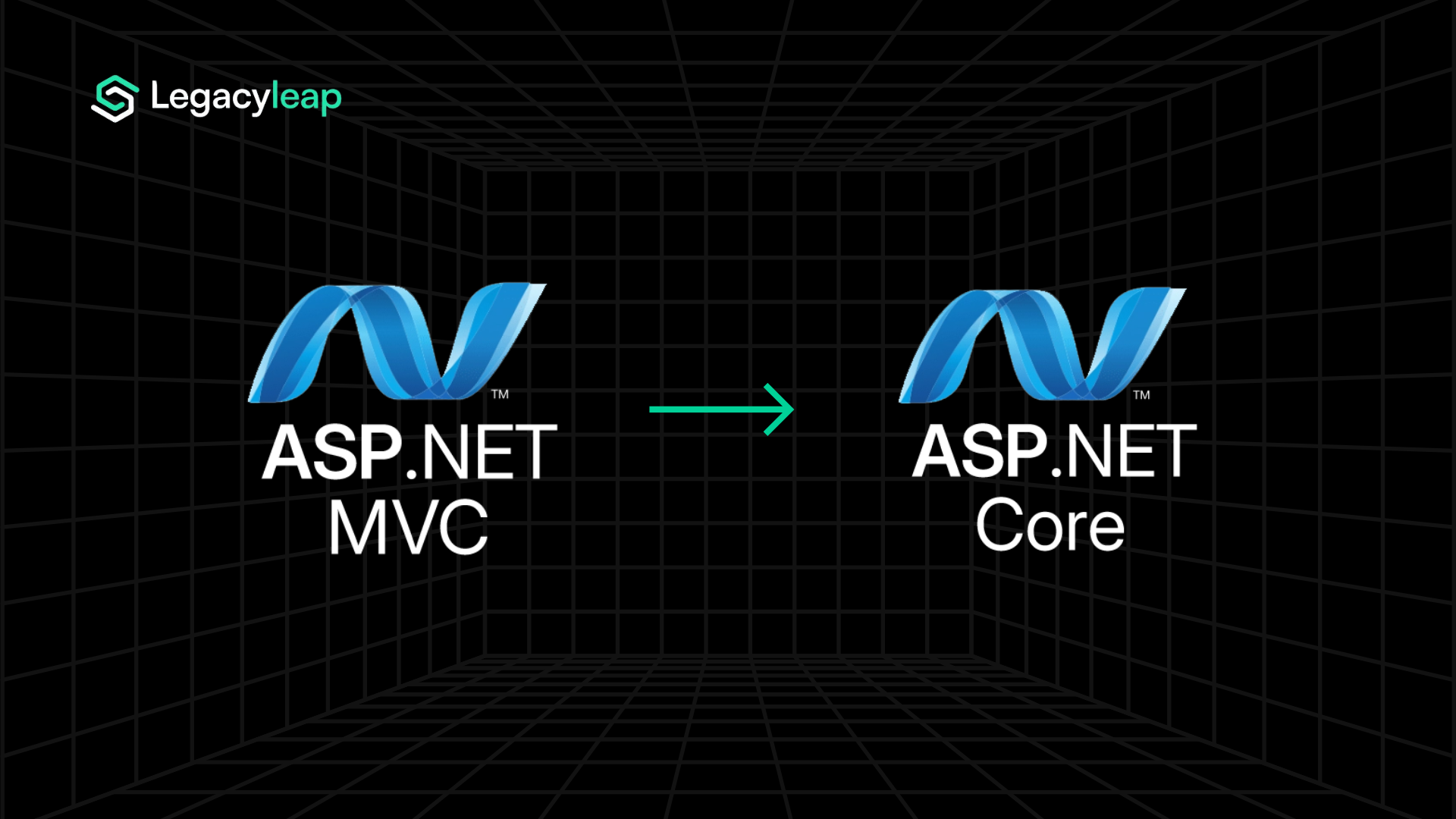
ASP.NET MVC is effectively frozen. Earlier versions are already retired (MVC 4 went out of support on July 1, 2019), and MVC 5 runs only on .NET Framework 4.8, which itself is in maintenance-only mode, tied to Windows and receiving security fixes only.
Microsoft has stated it will give 12 months’ notice before ending MVC 5 support, leaving enterprises without certainty on timelines or long-term viability.
The risks are clear. Business-critical applications are trapped on a legacy framework with no roadmap, rising compliance exposure, and a shrinking talent pool of developers willing to maintain outdated stacks. For many organizations, the decision to migrate from .NET Framework to .NET Core is no longer a question of if, but when.
Meanwhile, modern .NET has matured into the default enterprise platform, with predictable release cadences and long-term support cycles. For eg, .NET 8 and .NET 9 (both supported until November 10, 2026), and .NET 10 (current LTS, supported until November 2028). .NET 10 shipped alongside Visual Studio 2026 and is the current recommended migration target for enterprise teams.
Industry adoption confirms the shift. In Stack Overflow’s 2024 Developer Survey with over 65,000 respondents, .NET ranked as the most used non-web framework and library for the second consecutive year, while ASP.NET Core placed among the top web frameworks globally. Regulatory pressure is also mounting: several U.S. agencies already mandate migration off unsupported frameworks to maintain compliance.
For CIOs and CTOs, the conclusion is straightforward: ASP.NET MVC migration is not optional, but the question is how to execute it without disruption, cost overruns, or brittle rewrites.
Why Enterprises Choose ASP.NET Core
Migrating to ASP.NET Core delivers measurable value across performance, infrastructure, and development velocity:
| Capability | ASP.NET MVC (Legacy) | ASP.NET Core |
| Performance | IIS hosting, synchronous pipelines, XML-heavy | Kestrel server, async I/O, 2–3x higher throughput |
| Infrastructure | Windows-only, higher CPU/memory | Cross-platform, Linux-ready, 30–50% fewer servers in practice |
| Cloud readiness | Limited containerization | First-class Docker/Kubernetes support, PaaS-ready (Azure App Service, AWS Elastic Beanstalk) |
| Developer productivity | Separate MVC/Web API, web.config, fragile DI | Unified controllers, built-in DI, modular middleware, JSON-based config |
| Future-proofing | End-of-line, no innovation | .NET 10 (current LTS) is the recommended migration target, with support until November 2028 |
Key benefits for enterprises:
- Performance and cost savings: Organizations report halved CPU utilization and reduced VM counts post-migration. CoStar Group achieved up to 90% compute cost reduction by moving workloads to Core.
- Cloud-native enablement: Core applications run seamlessly in containers and scale on Kubernetes, unlocking modern DevOps and infra efficiencies.
- Developer efficiency: Unified frameworks, cleaner configuration, and modular middleware accelerate delivery and reduce technical debt.
- Long-term stability: Each LTS release secures three years of enterprise support, eliminating the uncertainty surrounding legacy frameworks.
For enterprises, the payoff is not just compliance. It’s a future-ready platform that reduces infrastructure spend, accelerates delivery, and enables cloud-scale agility.
Also read: A Complete .NET Migration Guide for Modernizing Legacy Microsoft Stacks.
Common ASP.NET MVC to ASP.NET Core Migration Challenges
Migrating ASP.NET to ASP.NET Core is rarely a straight line. The technical gaps are well-known, but at enterprise scale they translate into project risk, delays, and escalating costs:
- System.Web dependencies:
- Core no longer supports System.Web. Constructs like HttpContext.Current, HttpModules, and HttpHandlers must be redesigned as middleware.
- Risk: Large codebases often contain hundreds of scattered references that block direct upgrades.
- Core no longer supports System.Web. Constructs like HttpContext.Current, HttpModules, and HttpHandlers must be redesigned as middleware.
- Configuration overhaul:
- XML-based web.config files are replaced by JSON-based appsettings and dependency injection via the Options pattern.
- Risk: Configuration drift during incremental cutovers can break environments and slow rollouts.
- XML-based web.config files are replaced by JSON-based appsettings and dependency injection via the Options pattern.
- Authentication and authorization shifts:
- Forms Authentication and OWIN pipelines give way to ASP.NET Core Identity and cookie/JWT middleware.
- Risk: Incremental migrations often require cookie sharing and key synchronization, which can be error-prone and expose security gaps.
- Forms Authentication and OWIN pipelines give way to ASP.NET Core Identity and cookie/JWT middleware.
- EF6 vs EF Core transition:
- EF6 can run temporarily on .NET 6+, but long-term parity requires refactoring to EF Core.
- Risk: Stored procedure-heavy apps or legacy provider dependencies can stall migration progress.
- EF6 can run temporarily on .NET 6+, but long-term parity requires refactoring to EF Core.
- Third-party package gaps:
- Many NuGet libraries built for MVC 5/Framework lack Core equivalents.
- Risk: Teams must rebuild or replace functionality, adding unexpected scope.
- Many NuGet libraries built for MVC 5/Framework lack Core equivalents.
- Incremental vs big-bang strategy:
- Microsoft recommends phased migration using YARP, where new Core endpoints run side-by-side with legacy MVC routes until full cutover.
- The .NET Upgrade Assistant has since been replaced by the GitHub Copilot App Modernization agent (Visual Studio 2022 v17.14+), which supports .NET Framework-to-latest .NET migration, though this capability is currently in preview.
- Risk: Without strong governance, hybrid systems introduce complexity, duplicated effort, and unclear cutover timelines.
- Microsoft recommends phased migration using YARP, where new Core endpoints run side-by-side with legacy MVC routes until full cutover.
For CIOs, these are the reasons why projects miss deadlines, overshoot budgets, and create uncertainty about when (or if) the migration will succeed.
How to Migrate ASP.NET MVC to ASP.NET Core: Step-by-Step
Understanding the challenges is one thing. Knowing how to sequence the work is what separates a stalled migration from a successful one. Whether you convert ASP.NET MVC to ASP.NET Core in phases or as a full cutover, the core steps remain consistent.
1. Audit dependencies and map the application
Start with a full inventory of your codebase: controllers, views, services, NuGet packages, and external integrations. Identify every System.Web reference, third-party library without a Core equivalent, and any tightly coupled dependencies. The goal is a complete dependency map because without it, scope estimates are unreliable, and blockers surface mid-project instead of upfront.
2. Choose your migration strategy
Two paths are common. A phased approach uses YARP to route traffic between legacy MVC routes and new Core endpoints, allowing incremental cutover with a lower blast radius. A big-bang approach rewrites the full application before switching over, which is faster for smaller codebases but riskier at scale. The right choice depends on application size, team capacity, and tolerance for running a hybrid infrastructure.
3. Migrate configuration and dependency injection
Replace XML-based web.config files with JSON-based appsettings.json and move to ASP.NET Core’s built-in dependency injection. If your application uses custom DI containers, this is the point to evaluate whether they’re still needed or whether the native container covers your requirements.
4. Refactor authentication and authorization
Forms Authentication and OWIN middleware do not carry over to Core. Map existing auth flows to ASP.NET Core Identity with cookie or JWT middleware. For enterprises migrating from .NET Framework to .NET Core in phases, this step often requires cookie sharing and key synchronization between the legacy and modern stacks, so plan and test this carefully.
5. Address data access – EF6 to EF Core
Entity Framework 6 can run on .NET 6+ as a temporary bridge, but long-term parity requires migrating to EF Core. Applications with heavy stored procedure usage or legacy provider dependencies will need the most refactoring here. Prioritize migrating the data access layer early, since downstream testing depends on it.
6. Replace or rebuild third-party packages
Audit every NuGet dependency for a Core-compatible equivalent. Where no equivalent exists, evaluate whether the functionality can be replaced with built-in Core features, an alternative package, or a custom implementation. This is often where unexpected scope appears, so account for it in your timeline.
7. Validate functional parity
Before cutover, every critical workflow from the legacy application must be tested against the Core implementation. Auto-generated or manually authored regression tests should cover business logic, API contracts, and authentication flows. Parity validation is the gate, and nothing ships until it passes.
8. Prepare deployment artifacts and cut over
Core applications are cloud-ready by design, but deployment still requires purpose-built artifacts such as Dockerfiles, Helm charts, Terraform scripts, or platform-specific configurations for Azure App Service or AWS Elastic Beanstalk. Build and test these before cutover, not after.
The steps are well-understood. What determines success is execution discipline: accurate scoping, early identification of blockers, and rigorous parity validation. This is also where tooling can meaningfully reduce manual effort and risk, whether Microsoft’s own ASP.NET Core migration tools or Gen AI platforms.
How Gen AI Transforms ASP.NET MVC to Core Migration
When enterprises migrate framework to Core using traditional approaches, the process involves months of manual rewrites, reverse-engineering undocumented code, and hand-written regression tests. Even with Microsoft’s Upgrade Assistant, projects stretched 6–12 months with limited assurance of success.
Gen AI with compiler guardrails transforms the ASP Core migration model by automating the riskiest steps:
- Automated comprehension: Full application parsing generates dependency graphs, Swagger specs, and system-level documentation. Leaders get visibility into scope and blockers before migration begins.
- Code transformation with validation:
- System.Web references → middleware.
- web.config → Options pattern.
- Forms Auth/OWIN → Core Identity + JWT middleware.
- Outputs are compiler-constrained, ensuring structural correctness.
- System.Web references → middleware.
- Functional parity-first validation: Auto-generated test suites replicate legacy workflows against the new Core application. Regression gates wired into CI/CD confirm business logic remains intact.
- Support for phased or full cutovers: Dependency mapping and automated scaffolds make both YARP-based phased rollouts and big-bang rewrites feasible, without guesswork.
The enterprise impact:
- Predictable timelines: Clear scoping replaces uncertain project plans.
- Lower risk: Parity and security validated before cutover.
- Faster execution: Timelines compressed from 6–12 months to 2–4 months.
Gen AI isn’t about speeding up developers with snippets. It’s about turning an unpredictable, brittle migration into a structured, verifiable program that business leaders can trust.
Also read: How Can Gen AI Drive Every Step of Your Modernization Journey?
Legacyleap in Action: Streamlined ASP.NET Core Migration
The decision to migrate to .NET Core is ultimately about removing uncertainty from scope, parity, and deployment. Legacyleap was designed as a companion platform for exactly this scenario, combining compiler intelligence with Gen AI agents to make migrations predictable and verifiable.
How Legacyleap supports MVC to Core migrations:
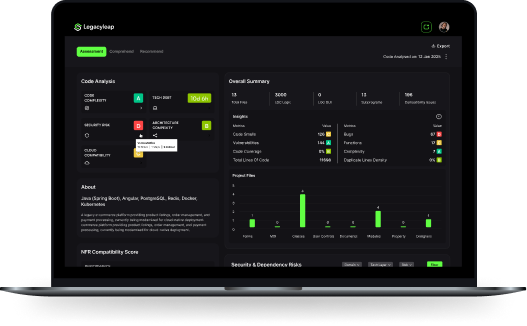
- Complete system mapping before migration: Applications are parsed into ASTs and MLIR, then stored in graph databases for a 100% dependency map across controllers, views, services, and packages. Leaders know the exact scope and blockers before execution begins.
- Enterprise-ready security alignment: Legacy Forms Auth or OWIN flows are mapped to modern cookie/JWT middleware with policy blueprints. Outputs are validated against OAuth2/OIDC standards to meet enterprise compliance requirements.
- Functional parity guarantees: Golden workflows from MVC apps are captured and replayed against Core services. Auto-generated regression tests integrate into CI/CD pipelines, ensuring 100% functional parity validated before cutover.
- Deployment artifacts built in: Helm charts, Terraform scripts, and Dockerfiles are generated automatically, making Core apps cloud-ready from day one. This accelerates rollouts to Kubernetes, Azure App Service, or AWS Elastic Beanstalk without extra scripting.
- Assurance for leadership: Predictable scope, validated parity, and secure deployment translate into faster timelines (2–4 months vs 6–12), reduced infra costs (Linux density, Kubernetes scaling), and lower compliance risk.
Legacyleap isn’t a migration script or developer tool. It’s an enterprise modernization framework that transforms MVC migration from a risky project into a structured, auditable process.
How Legacyleap Streamlines ASP.NET Core Migration
| Migration Area | Traditional Approach | With Legacyleap |
| Code transformation | 100% manual rewrite | 70% automated with guardrails |
| Test & validation | Manual test authoring | 90% auto-generated safety nets |
| Timeline | 6–12 months | 2–4 months |
| Developer effort | High manual workload | 60–80% reduced |
| Deployment readiness | Manual scripting required | Auto-generated Helm/Terraform |
Figures reflect typical ranges observed across enterprise migration engagements and may vary based on application complexity, codebase size, and existing test coverage.
Why enterprises choose a structured platform over DIY migration
For CIOs evaluating how to resource this work, the core tradeoff is straightforward. A DIY migration relies on internal teams to manually audit dependencies, rewrite code, author tests, and script deployments. This is work that scales linearly with codebase size and carries compounding risk as complexity grows. Timelines stretch, scope creeps, and parity gaps surface late.
Legacyleap shifts that equation. Automated dependency mapping replaces manual audits. Compiler-constrained code transformation replaces hand-written rewrites. Auto-generated regression suites replace months of test authoring.
The result is not just faster delivery but a migration with verifiable scope, validated parity, and deployment artifacts ready from day one. For organizations where migration speed, cost predictability, and compliance assurance matter, that structure is the difference between a managed program and an open-ended project.
Is Your Organization Ready to Migrate to ASP.NET Core?
Not every organization is in the same position to begin an ASP.NET Core migration. The following indicators suggest your team is ready to move or is overdue.
- Your application runs on .NET Framework 4.8 with no planned feature investment. If the framework is frozen and so is your roadmap for the app, you’re maintaining dead weight.
- You’re patching security vulnerabilities without upstream framework support. Maintenance-only frameworks receive security fixes, but no hardening improvements. The exposure grows over time.
- Your hosting costs are higher than they should be. Windows-only, IIS-bound deployments cost more than Linux-based alternatives. If your infrastructure budget is a pressure point, Core migration directly addresses it.
- You’re struggling to hire or retain .NET developers. The talent pool for legacy ASP.NET MVC is shrinking. Developers want to work on modern stacks. Core is where the ecosystem has moved.
- Compliance or audit requirements are flagging your stack. Regulatory bodies and internal audit teams increasingly flag unsupported or end-of-line frameworks. If you’ve already received findings, migration is no longer discretionary.
- You need containerization or Kubernetes readiness. If your infrastructure strategy depends on Docker, Kubernetes, or PaaS platforms, Core is a prerequisite. MVC applications cannot participate in those environments without significant workarounds.
- Your CI/CD pipelines are blocked by legacy dependencies. When legacy framework constraints prevent you from adopting modern build, test, and deployment tooling, the cost of staying put compounds with every release cycle.
If three or more of these apply, migration should be on your near-term roadmap. Start with a free Legacyleap assessment to get a dependency map, security scan, and feasibility view of your modernization scope, all delivered in two weeks, at no cost.
How Long Does ASP.NET MVC to Core Migration Take?
Timelines vary based on application complexity, codebase size, dependency depth, and team capacity. The following ranges reflect typical enterprise experiences:
| Application Size | Characteristics | Manual Migration | With Gen AI Tooling |
|---|---|---|---|
| Small | Under 50K lines of code, limited third-party dependencies, straightforward auth | 2-4 months | 3-6 weeks |
| Medium | 50K-200K lines, moderate NuGet dependencies, EF6 usage, Forms Auth or OWIN | 6-9 months | 2-3 months |
| Enterprise | 200K+ lines, complex dependency graphs, multiple auth schemes, stored procedure-heavy data layers | 9-18 months | 3-5 months |
Ranges are approximate and reflect typical engagements. Actual timelines depend on factors including test coverage maturity, infrastructure readiness, and team familiarity with ASP.NET Core.
Plan Your ASP.NET Core Migration with Confidence
ASP.NET MVC is stagnant, .NET Framework is frozen, and Core has become the enterprise default. The benefits are proven: 2-3x performance improvements, lower hosting costs, cross-platform deployments, and developer productivity gains. The challenge is execution, and that’s where most migrations stall.
A free Legacyleap assessment gives you the clarity to move forward with confidence. In two weeks, at no cost, you receive:
- Full dependency map of your application: controllers, services, packages, and integration points, with every blocker identified upfront.
- Security scan of known vulnerabilities in your current stack, so you know your exposure before migration begins.
- Timeline and effort estimate based on your actual codebase, not industry averages.
- Identified migration blockers: System.Web references, unsupported NuGet packages, auth pipeline gaps, and EF6 dependencies, catalogued and prioritized.
- Feasibility view of modernization scope, including recommended migration strategy (phased vs. full cutover).
No cost. No commitment. Two weeks to a clear picture of where you stand and what it takes to migrate to ASP.NET Core.
FAQs
ASP.NET MVC is a web framework that runs exclusively on .NET Framework, which is Windows-only and no longer receives feature updates. ASP.NET Core is a cross-platform, open-source framework built for modern cloud-native development. Core offers significantly better performance, built-in dependency injection, a unified programming model, and active long-term support. .NET 10, the current LTS release, is supported until November 2028.
There is no in-place upgrade path. Migrating from .NET Framework to .NET Core (now simply “.NET”) requires refactoring, replacing System.Web dependencies, updating configuration from XML to JSON, migrating authentication pipelines, and addressing any third-party packages that lack Core equivalents. The scope depends on your application’s complexity, but it is always a code-level migration, not a configuration switch.
It depends on application size and complexity. Small applications (under 50K lines of code) typically take 2-4 months manually. Medium-complexity applications with EF6 and legacy auth can take 6-9 months. Enterprise-scale applications with deep dependency graphs may take 9-18 months without tooling support. Gen AI platforms with compiler-grade validation can compress those timelines significantly, often by 50-70%.
Entity Framework 6 can run on .NET 6 and later as a temporary compatibility bridge, allowing applications to function while the data access layer is refactored. However, long-term parity requires migrating to EF Core. Applications with heavy stored procedure usage or legacy database provider dependencies typically require the most refactoring effort in this area.
Migrating from .NET Framework 4.8 to .NET 8 or later involves replacing System.Web constructs with ASP.NET Core middleware, moving from web.config to appsettings.json, refactoring authentication from Forms Auth or OWIN to Core Identity with cookie or JWT middleware, and updating data access from EF6 to EF Core. For enterprise teams, .NET 10 is the current recommended migration target, with LTS support through November 2028.
Microsoft’s .NET Upgrade Assistant has been replaced by the GitHub Copilot App Modernization agent (available in Visual Studio 2022 v17.14+), which supports .NET Framework-to-latest-.NET migration in preview. Beyond Microsoft’s tooling, Gen AI platforms like Legacyleap automate dependency mapping, code transformation, and parity validation with compiler-grade guardrails, reducing manual effort and compressing timelines for enterprise-scale migrations.