TL;DR
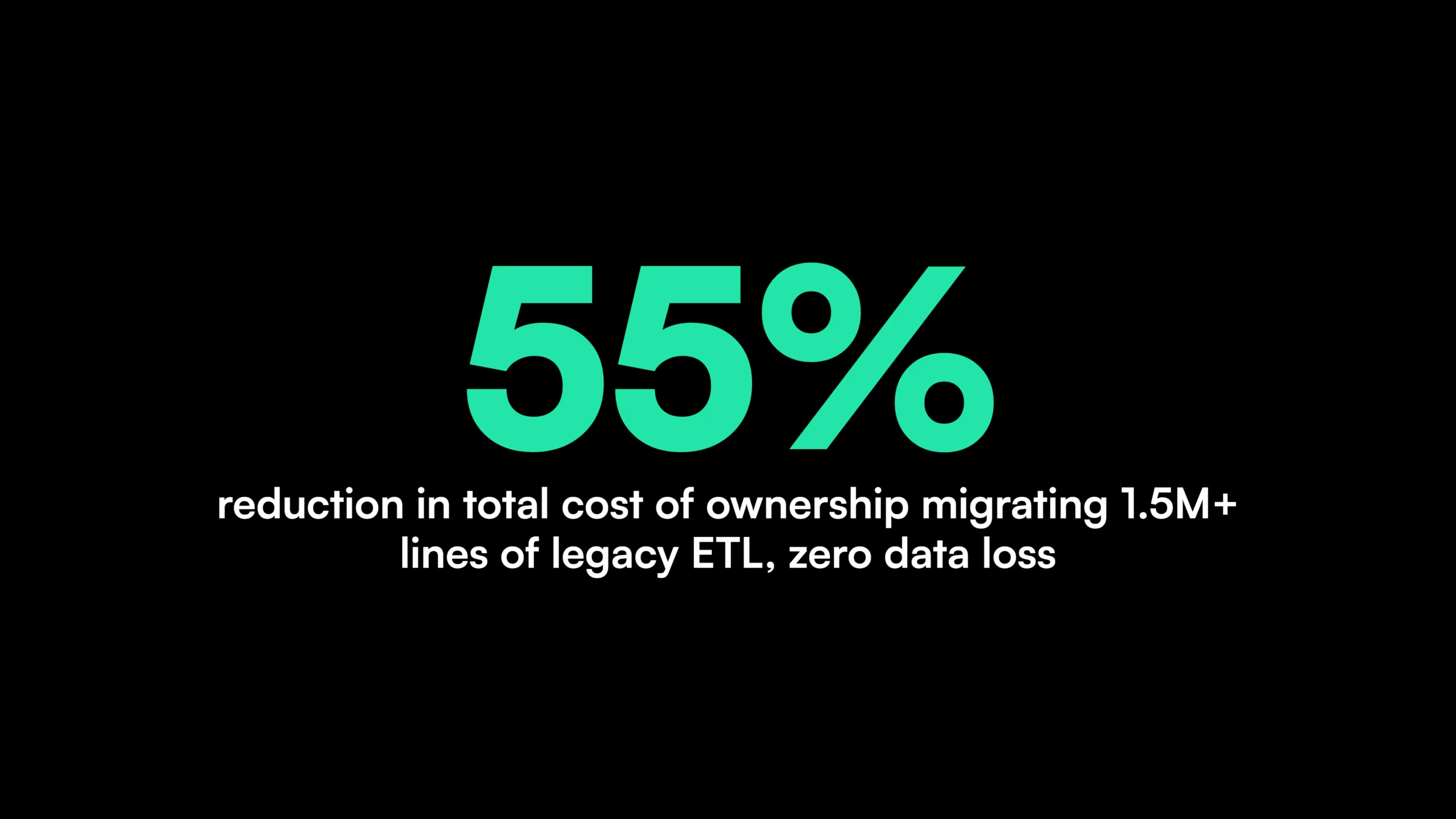
- 8090’s own founder says legacy modernization is now the fastest-growing part of the business. On X, Chamath Palihapitiya described 8090’s practice of “ripping out legacy systems for large enterprises and migrating them to pristine, new, well documented and easy to maintain alternatives” at under half the total cost of ownership.
- 8090’s Software Factory is a genuinely broad AI-native SDLC platform, not a legacy-modernization specialist. It explicitly handles new builds and existing-system modernization on the same pipeline, backed by a $135 million Series A and distribution through the EY.ai PDLC partnership.
- Nothing in 8090’s public materials describes parity validation against a legacy baseline as a structural, first-class output. The breadth that makes it strong for new builds is the same design choice that leaves legacy-specific guarantees unspecified.
- That’s a scope difference, not a flaw. A platform built to do almost anything in software, and a platform built specifically to comprehend and preserve an existing system’s exact behavior, are solving different problems.
- Legacyleap runs the narrower job, structurally. Whole-estate comprehension, functional parity validation, and governed sovereignty are default outputs of every engagement, not outcomes a customer has to specify.
8090, the AI-native Software Factory platform built by Chamath Palihapitiya and Sina Sojoodi, says its fastest-growing line of business right now is tearing out legacy systems at large enterprises and replacing them. On X, Palihapitiya put it plainly: “The fastest growing part of 8090 is our practice of ripping out legacy systems for large enterprises and migrating them to pristine, new, well-documented and easy-to-maintain alternatives. It also turns out to be less than 50% of the TCO or better as well.” [1]
In a separate interview, he positioned that work directly against traditional time-and-materials outsourcing, pointing to Infosys’s reduced revenue guidance as evidence that regulated enterprises are shifting budget from outsourced engineering hours toward AI-led modernization [2].
That’s not a hypothetical. It’s happening now, backed by a $135 million Series A led by Salesforce Ventures and distribution through the EY.ai PDLC partnership, reaching regulated enterprises through EY’s own consulting relationships.
8090’s Software Factory is a genuinely broad AI-native SDLC platform. It can define requirements, generate architecture blueprints, coordinate AI agents against production code, and it explicitly supports both new builds and existing-system modernization, backed by a real audit trail.
What it isn’t, based on everything publicly documented about it, is a platform purpose-built and proven specifically for legacy modernization at enterprise scale. Parity validation against the system being replaced isn’t described as a structural guarantee, only as a project-by-project outcome.
A reader evaluating 8090 for an existing legacy estate, not a new build, needs to know whether it’s enough on its own, or whether a modernization-specific 8090 alternative belongs in the picture too.
What 8090 AI’s Software Factory Does Well, and Where Legacy Modernization Needs a Different Guarantee
Legacy Modernization Is 8090’s Fastest-Growing Line of Business, By Its Own Account
That fastest-growing claim isn’t just a soundbite. On 8090’s own live pricing page, “Retire technical debt” is listed as a named use case under the Enterprise tier, the same page that lists cost, not a passing mention in a marketing blog post [4].
And the growth isn’t happening in a vacuum. In March 2026, EY named 8090 the founding technology partner for EY.ai PDLC, an AI-native product development approach EY is distributing across its own consulting relationships in regulated industries [3].
Modernization work reaching enterprises through a Big Four consulting channel, on a platform whose own founder calls it the fastest-growing part of the business, is real, current traction. It is not a side feature bolted onto a build platform.
What “Greenfield + Brownfield, Same Pipeline” Means in Practice
8090’s own published customer story shows the breadth in action. BISSELL, the consumer-products manufacturer, automated a manual, spreadsheet-based naming-rules approval process on the platform, cutting cost across the process by 50% and reducing manual review to seconds [5]. That’s a real, useful outcome.
It’s also evidence of what the platform is optimized for: discrete, well-scoped business processes, not the specific discipline of proving an existing, undocumented legacy system still behaves the same way after being touched.


What a Modernization Platform Purpose-Built for Legacy Systems Adds by Design
8090 is not a coding assistant, and this comparison isn’t the same shape as one against an IDE. It’s a broad platform against a specialized one, and the difference that matters is what each is built to guarantee by default. Legacyleap is built to comprehend, govern, and validate a legacy estate specifically, not to be a general-purpose system for building software of any kind.
| Category | 8090 | Legacyleap |
| Primary scope | New builds, process automation, and existing-system modernization on one general pipeline | Legacy modernization specifically, purpose-built |
| Whole-estate dependency mapping | Not described as a structural output | First-class, org-level map across repos, APIs, and shared libraries |
| Parity validation against a legacy baseline | Not described as a structural output | First-class, validated before cutover on every engagement |
| Deployment and sovereignty | Cloud-hosted, per public product and pricing materials | On-premise, private-cloud, and hybrid options, documented, built for regulated industries |
| Audit trail | Real, built around requirements-to-code traceability | Real, built around diff-based review and parity evidence |
| Legacy-specific case evidence | Broad, general-purpose case studies | Deep, stack-specific case studies across the modernization lifecycle |
Five Agents Mapped to a Lifecycle Built Around an Existing System
A legacy modernization program runs through five distinct jobs, and how the broader field of modernization platforms and providers actually breaks down usually comes down to which of these five any given offering actually owns:
- Assess the estate’s risk and dependencies
- Comprehend what the system actually does
- Modernize the code against a target architecture
- Validate that behavior didn’t change
- Deploy with a rollback plan intact
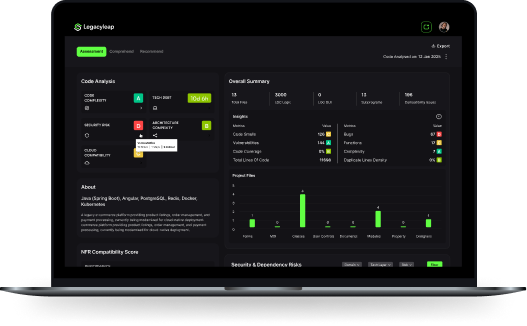
Legacyleap runs a dedicated agent against each one. The Assessment Agent produces the technical debt report, dependency map, and risk indicators. The Documentation Agent reconstructs architecture, data flows, and business logic, including for systems with no existing documentation.
The Recommendation Agent decides what to refactor, replace, or retain, and sequences the migration. The Modernization Agent generates the actual pull requests. The QA Agent generates and runs the parity tests.
A general-purpose platform can be pointed at pieces of any one of these. It isn’t structured around owning all five, in sequence, for one existing system, with the outputs of one feeding the next automatically.
Whole-Estate Comprehension Before Anything Changes
This is where the “replace” and “preserve” distinction actually shows up in practice. 8090’s own current growth story is a replace story, in its founder’s words: rip out the legacy system and migrate to a pristine, new alternative. Legacyleap runs the opposite discipline from the first step.
Its Multi-Layer Meta-Cognitive Graph reads the whole codebase, across repos and services, before any transformation begins, holding that understanding persistently rather than rebuilding it project by project. It’s proven at over 10 million lines of code.
A platform optimized to build something new against a requirements document doesn’t need that same persistent, whole-estate model of a system that already exists. Modernizing in phased, incremental steps instead of a single ground-up rewrite requires reconciling against decades of undocumented behavior first, not building around it.
Parity Validation as a Structural Output, Not a Project Outcome
Every change Legacyleap’s Modernization Agent produces ships as a diff-based pull request for human review. Nothing merges, deploys, or executes on its own. Before cutover, the QA Agent validates the modernized code against the legacy baseline through auto-generated unit, integration, regression, and end-to-end tests, targeting full functional parity between old and new behavior, on every engagement. This is the direct, structural answer to “ripping out and replacing”: preserving exactly what the system already does, not approximating it in something new built to resemble it.
Governed Sovereignty for Regulated Data, Documented Plainly
Regulated industries are exactly where this distinction sharpens further. US banking regulators flagged generative and agentic AI as novel in their 2026 model risk management guidance, explicitly outside the scope of the existing framework, with formal treatment still pending [7]. Provable review and parity checking aren’t optional there.
Legacyleap runs entirely inside the customer’s own environment, with no outbound calls required and source code that never leaves customer infrastructure. On-premise, private-cloud, and hybrid deployment are all documented options, built for finance, healthcare, and defense.
No on-premises or air-gapped option is described anywhere in 8090’s current public materials, which describe cloud-hosted delivery only, a difference in what’s documented today, not a claim about what any vendor may offer under a private agreement.
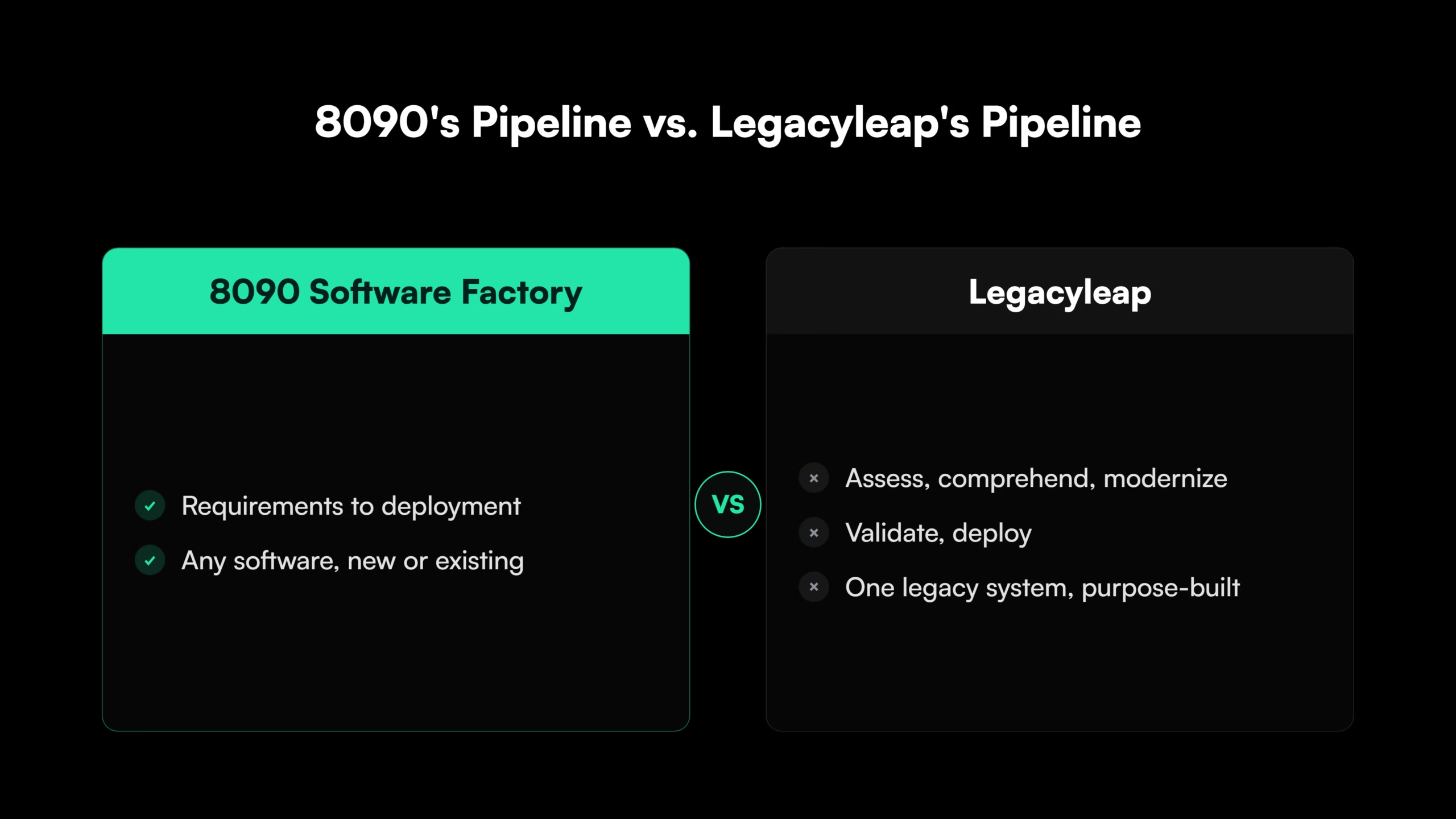
| Job | Where 8090 fits | Where Legacyleap fits |
| New product build | Strong, stated core use case | Not the focus |
| Internal process automation | Strong, stated core use case | Not the focus |
| Well-scoped brownfield update, system already understood | Available on the same pipeline | Available, lighter engagement |
| Undocumented legacy estate, parity and sovereignty required | Not described as a structural guarantee | Structural, on every engagement |
Where 8090 and a Legacy Modernization Platform Each Fit in an Enterprise SDLC
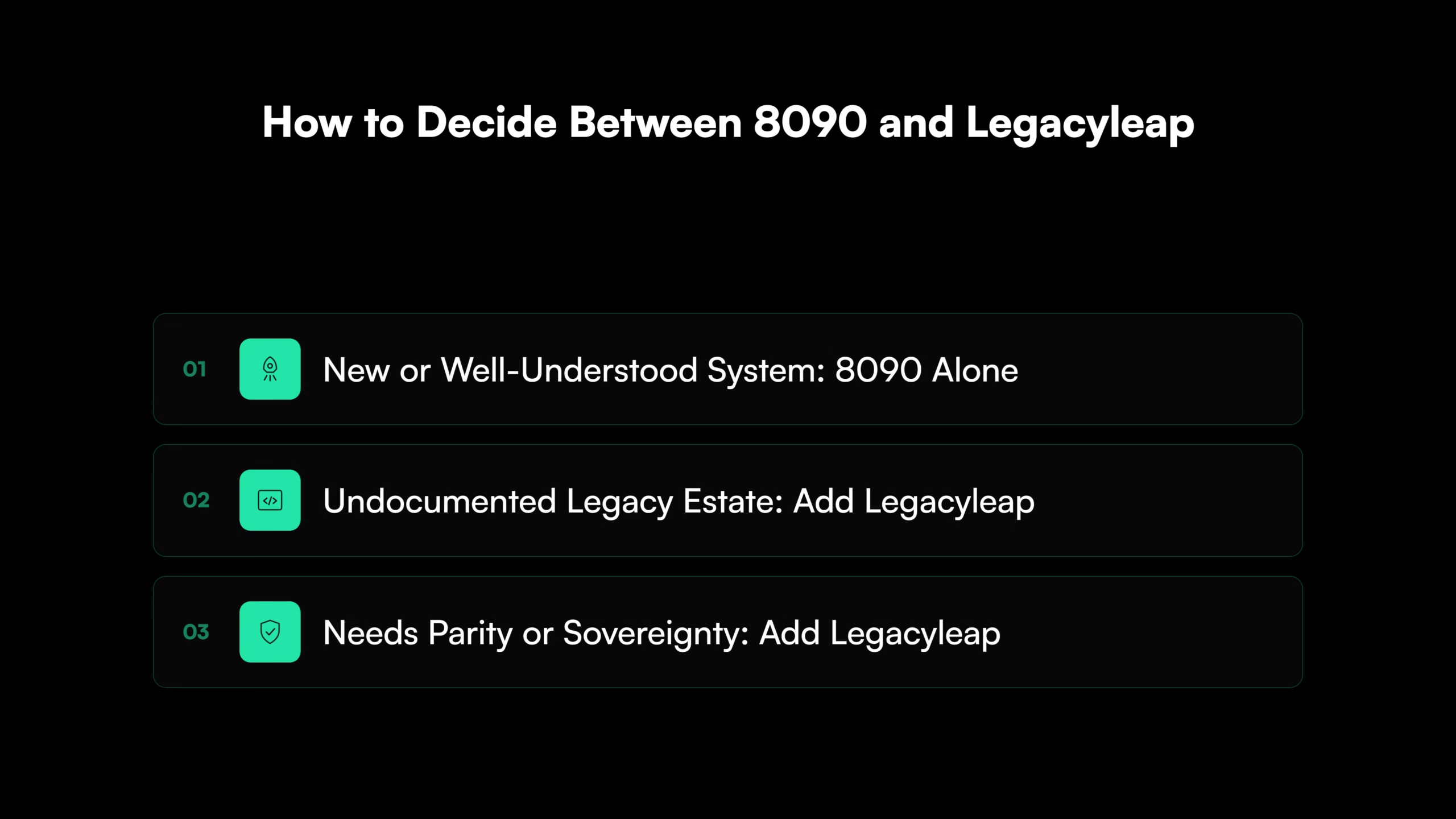
Here’s a practical way to sort it. A new product build, an internal process-automation project, or a well-scoped update on a system the team already understands is squarely 8090’s stated lane. Its own founder’s numbers say that lane now extends further into legacy work than it used to. Adding a legacy-modernization specialist on top of that work would be overhead nobody needs.
Modernizing a large, undocumented, or business-critical legacy estate, where parity, whole-estate dependency mapping, and sovereignty for regulated data are non-negotiable, is where Legacyleap earns its place. Both can run in the same enterprise SDLC, on different parts of the estate, without one replacing the other.
Cost belongs in this decision too. 8090’s Software Factory runs $200 per user per month, with token usage billed separately, moving to a fully managed enterprise track starting at $1 million a year for larger engagements [4]. That structure lines up with the managed-engagement shape described earlier in this piece, worth weighing against a fixed-scope way to size the legacy-specific work first.
Legacyleap’s $0 Modernization Assessment produces a concrete dependency map, risk heatmap, and modernization plan for a specific legacy estate in 3-5 days, at no cost, before either path requires a commitment.
Not sure which lane your legacy estate falls into?
Book a Technical Demo and see how Legacyleap’s five agents handle whole-estate comprehension and parity validation on a codebase like yours.
Two Different Jobs, Not One Winner
The question was never which platform wins. 8090 is one factory built to do almost anything in software, including a legacy-modernization practice its own founder says is now growing faster than any other part of the business. Legacyleap is one platform built specifically to take an existing, undocumented system through a governed, parity-validated path to modern, not a smaller version of what 8090 does, but a narrower job done deliberately.
Both can run in the same enterprise SDLC, on different parts of the estate. Start with a $0 Modernization Assessment to see exactly where a specific legacy estate needs that guarantee, or book a Technical Demo to see Legacyleap’s agents at work on a codebase like yours.
FAQs
8090 is an AI-native SDLC platform that moves a project from requirements through architecture, execution, and test generation on one connected pipeline, for both new software builds and existing-system modernization.
No. Cursor and Copilot are in-editor coding assistants for developers working inside an active session. 8090 is a broader platform that coordinates requirements, architecture, agents, and testing across a whole project.
It states explicitly that it supports both, on the same pipeline, and its founder says legacy modernization is currently its fastest-growing line of business. What isn’t documented is parity validation against a legacy baseline as a structural, guaranteed output of that work.
Software Factory runs $200 per user per month with token usage billed separately, moving to a fully managed enterprise track starting at $1 million a year for larger engagements.
It has a real, documented audit-trail architecture and real regulated-industry customers. What isn’t publicly documented is an on-premises or air-gapped deployment option, which is standard for Legacyleap.
References
1. X (Chamath Palihapitiya), post on 8090’s legacy-modernization practice. https://x.com/chamath/status/2046238071281328327
2. Newkerala, Time And Materials Outsourcing Model Losing Relevance In AI Era: 8090. https://www.newkerala.com/news/a/time-and-materials-outsourcing-model-losing-relevance-ai-era-8090-616.htm
3. Ernst & Young, Ernst & Young LLP and 8090 launch AI-native EY.ai Product Development Lifecycle (PDLC). https://www.ey.com/en_us/newsroom/2026/03/ernst-young-llp-and-8090-launch-ey-ai-pdlc
4. 8090, Pricing. https://www.8090.ai/pricing
5. 8090, Customer Stories. https://www.8090.ai/customer-stories
6. Ry Walker, 8090 Solutions (Software Factory) Research. https://rywalker.com/research/8090-software-factory
7. Office of the Comptroller of the Currency, Bulletin 2026-13. https://www.occ.treas.gov/news-issuances/bulletins/2026/bulletin-2026-13.html