Migrate SSIS Pipelines to Azure Data Factory, Databricks, Spark, or Snowflake Using GenAI
Legacyleap replaces years of SSIS package analysis, refactoring, re-architecture, and validation with a GenAI modernization platform that migrates legacy SSIS pipelines while preserving data logic and downstream behavior.
Unleash Unmatched Modernization Velocity with Legacyleap
Legacyleap sets new benchmarks for application modernization initiatives using Gen AI




2-5 days
to assess and document the entire legacy application
~70 %
modernization automated by Gen AI
2x
Faster modernization timelines vs. vendors or in-house
100%
functional parity, validated and compliant
PLATFORM
An Agentic Platform Built for SSIS Modernization
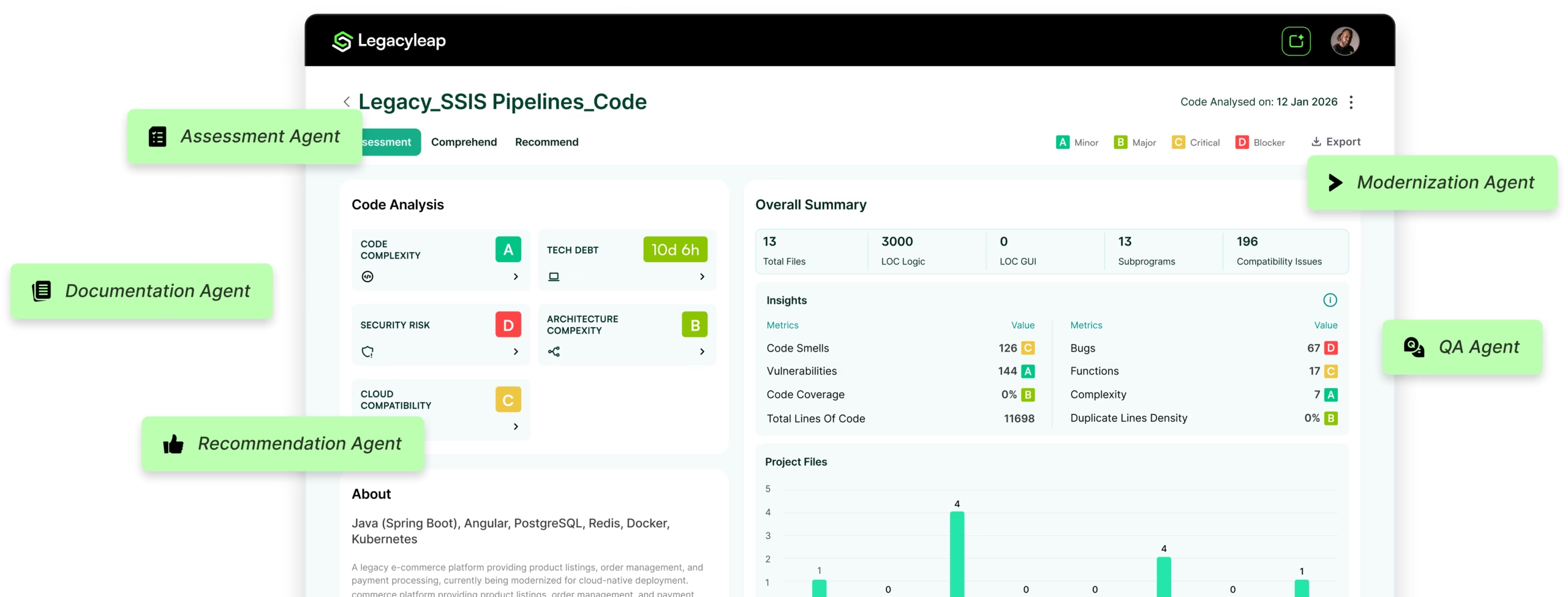
SSIS pipelines hide behavior across packages, configurations, and execution paths. Legacyleap modernizes these pipelines by separating assessment, planning, execution, and validation into specialized agents, each aligned to a specific phase of the system.
- Assessment Agent
- Documentation Agent
- Recommendation Agent
- Modernization Agent
- QA Agent
Assessment Agent
Understand SSIS pipeline complexity before migration
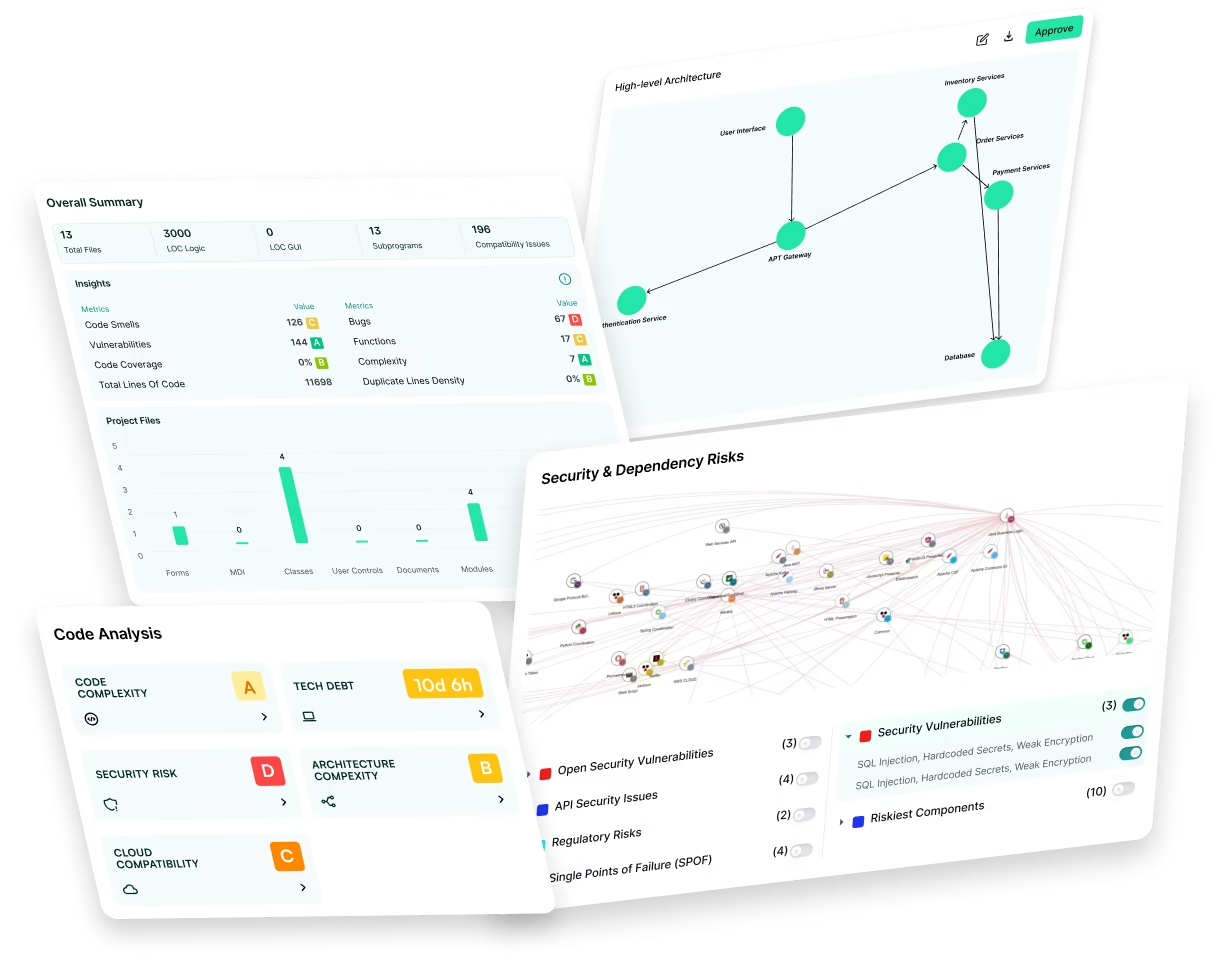
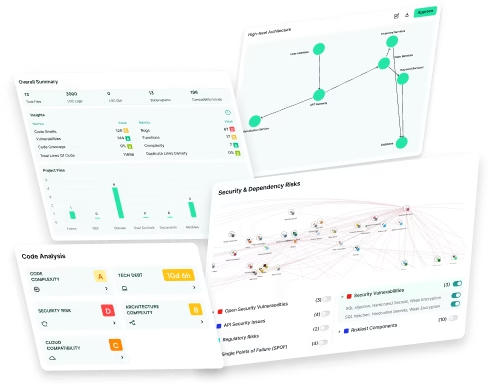
Analyzes SSIS packages to surface execution dependencies, transformation risk, and configuration coupling that affect migration feasibility.
Technical debt analysis
Pipeline architecture drift
Security and configuration risks
Modernization hotspots
Migration effort and timeline estimate
Documentation agent
Export-ready documentation from your legacy SSIS packages
Generates accurate, export-ready documentation directly from SSIS packages and execution behavior.
Complete system inventory (SBOM)
Pipeline and transformation maps
Data contracts and integrations
PRDs, BRDs, FSDs
Dependency and integration maps
Recommendation agent
Define the right SSIS migration path
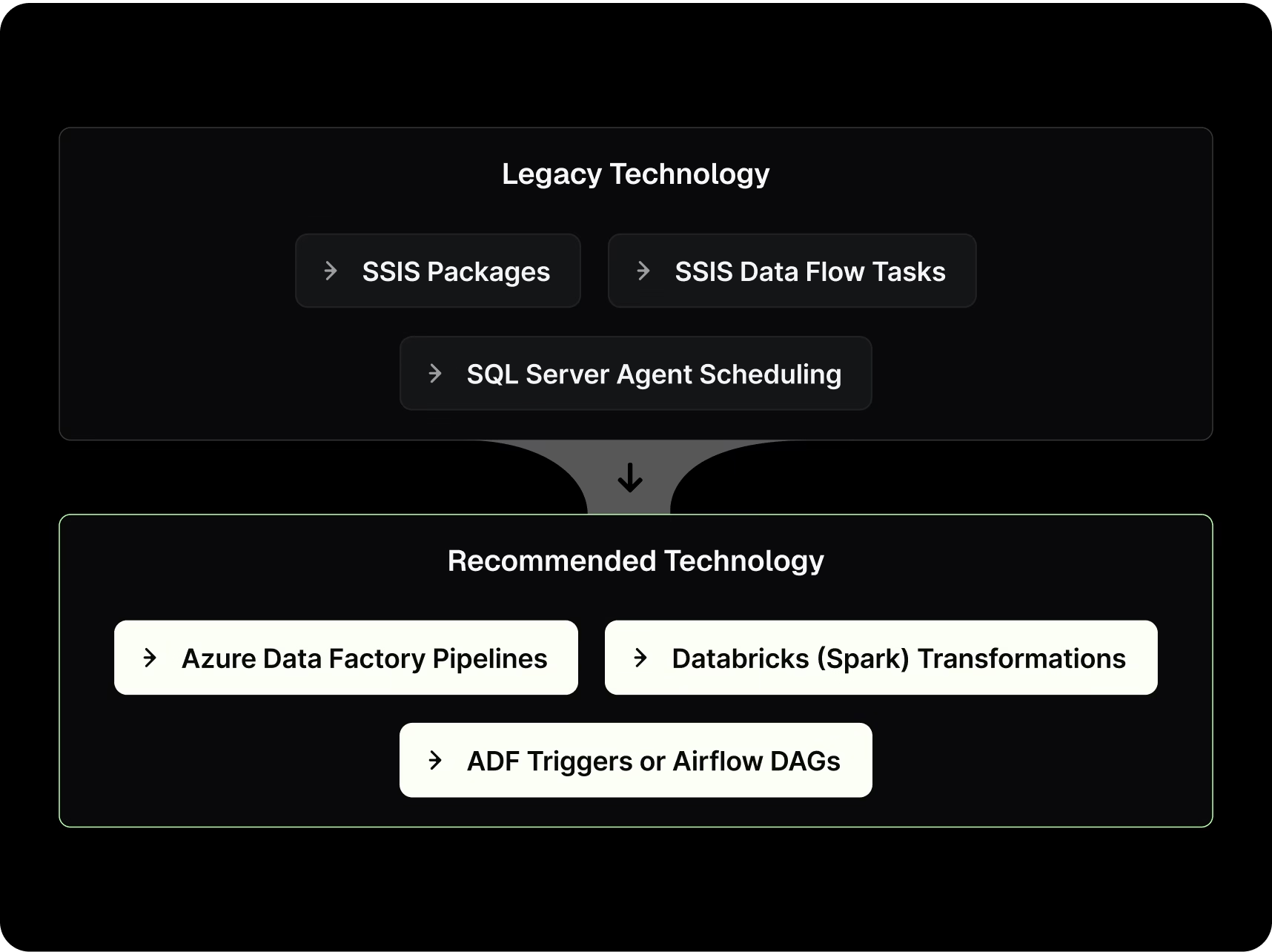
Evaluates pipeline structure and usage patterns to determine whether SSIS logic should move to Azure Data Factory, Databricks, Spark, or Snowflake.
Automated target stack recommendations
Step-by-step SSIS migration plan
Modernization agent
Migrate SSIS pipelines without disrupting production
Executes controlled migration by translating SSIS logic into cloud-native pipelines while preserving execution order and data behavior.
Converted pipeline definitions
Migration gap reports
Actionable to-do lists
Pull requests
Automated PR review
QA Agent
Validate data parity and pipeline behavior
Ensures modernized pipelines produce the same results as the original SSIS system before cutover.
Unit test cases
Regression test cases
Integration test cases
Data validation checks
Automated PR review
$0 Assessment
Test Legacyleap on Your SSIS Pipelines for $0
Run a real assessment on one SSIS system before committing to modernization.
You receive
- Pipeline risk and complexity analysis
- Modernization hotspots
- Migration effort and timeline estimate
- Execution-ready outputs
This can be used as a standalone SSIS assessment or as the starting point for a fully managed migration.
Migration Paths
SSIS Migration Paths Supported by Legacyleap
Different SSIS systems require different modernization outcomes. Legacyleap evaluates pipelines and executes the appropriate path end to end.


SSIS to Azure Data Factory
For teams standardizing on Azure-native orchestration.
SSIS control flow, scheduling, and dependencies are mapped into ADF pipelines while preserving execution order and triggers.

SSIS to Databricks
For data platforms moving toward scalable transformation frameworks.
SSIS transformations are translated into Databricks workflows optimized for distributed processing and maintainability.

SSIS to Spark
For organizations adopting open, compute-driven data architectures.
Pipeline logic is converted into Spark-based execution models while retaining transformation semantics.

SSIS to Snowflake
For analytics-first modernization.
SSIS pipelines are restructured into Snowflake-native data workflows while preserving downstream reporting and data contracts.
Each migration path is determined by the platform, executed incrementally, and validated for functional parity before production rollout.
Is Legacyleap Right for Me?
Choose between full-service delivery or platform access, both built to get you to production faster and safer.
You bring the system. We bring the outcome.
Turnkey Modernization Services
- Starts with a $0 Assessment
- Hands-off execution with full traceability
- Handles undocumented, fragile systems
- Parallel test generation + rollout planning
- Managed delivery with validation checkpoints
- Production-grade output, not POCs
Leverage your internal or SI teams with our platform.
Platform Licensing
- Full access to Studio (Web UI, IDE, CLI)
- Agent copilots tailored for legacy systems
- Reusable across multiple teams or programs
- Architecture maps and test harnesses
- Built-in human-in-the-loop controls
- Flexible enterprise pricing
Technical Demo
Book a Legacyleap Technical Demo
This session is led by the CTO and walks through how SSIS pipelines are analyzed, migrated, and validated across real production systems.
You’ll see how control flow, transformations, and data parity are handled during migration.
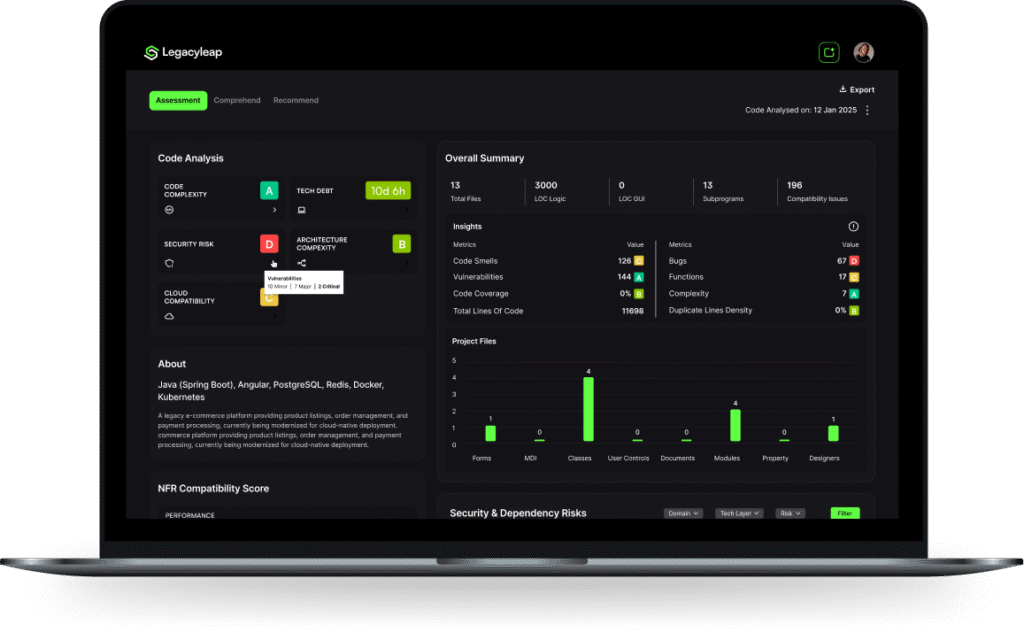
How a legacy codebase is analyzed for structure, dependencies, and risk
How documentation, architecture maps, and system inventories are generated
How migration paths to C#, .NET, or React are determined
How code conversion is executed incrementally with pull requests
How functional parity is validated before production rollout
What is the safest way to migrate SSIS pipelines to modern platforms?
The safest approach is to separate assessment, migration, and validation instead of translating SSIS packages directly. Legacyleap does this by analyzing SSIS control flow, transformations, and dependencies first, then migrating pipelines incrementally and validating data parity before cutover.
What does a GenAI-powered SSIS migration platform actually do?
A GenAI-powered SSIS migration platform analyzes package structure, control flow, data flow tasks, and configuration logic automatically. Legacyleap uses this to generate migration plans, modernized pipelines, documentation, and validation artifacts instead of relying on manual discovery.
How do I know whether SSIS should move to ADF, Databricks, Spark, or Snowflake?
The target platform depends on how SSIS pipelines behave. Orchestration-heavy pipelines map well to Azure Data Factory, transformation-heavy pipelines fit Databricks or Spark, and analytics-first pipelines often move to Snowflake. Legacyleap evaluates pipeline structure and usage patterns to recommend the right path.
How long does an SSIS migration typically take?
Timelines depend on the number of packages, transformation complexity, and dependencies. With Legacyleap, assessment and planning typically take 2-5 days, while migration proceeds incrementally over weeks or months instead of years.
How is Legacyleap different from traditional SSIS migration services?
Traditional services rely on manual analysis and rewriting. Legacyleap uses an agentic platform to automate assessment, documentation, planning, migration, and validation, reducing timelines by upto 70%.