Results at a Glance
| Metric | Result |
|---|---|
| Manual Effort Reduction | 80% less with AI automation |
| Feature Rollout Speed | 40% faster post-modernization |
| Cost Savings | 60% lower than traditional modernization |
| Users Migrated | 500–600 across multiple industries |
| System Age | 30+ years successfully modernized |
| AI Automation | 50–70% of code transformation handled by Gen AI |
Engagement Snapshot
| Industry | Fuel Distribution Software |
| Location | United Kingdom and Ireland |
| Legacy Stack | VB6 (fat-client architecture, 30+ year system) |
| Target Stack | Cloud-ready web architecture |
| Users | 500–600 active users |
| System Age | 30+ years |
| Delivery Model | Phased hybrid deployment with incremental user migration |
About the client:
A UK- and Ireland-based bulk fuel distribution software company had operated the same VB6 transaction processing system for over 30 years. The system served 500–600 users across multiple industries and remained central to daily operations, but its fat-client architecture had become a bottleneck for scalability, maintenance, and performance.
The client needed to modernize without a multi-million-pound budget and without disrupting the 500+ users who depended on the system every day.
Challenge
The client’s 30-year-old VB6 system had reached its limits across four compounding constraints:
Fat-Client Architecture Creating a Scalability Ceiling
The VB6 application was built as a fat-client desktop system. This architecture could not scale horizontally, could not support remote access, and created growing maintenance overhead with every new feature request. The system’s age meant that every enhancement was built on top of decades of accumulated complexity.
Budget Constraint: No Multi-Million Overhaul
The client did not have the budget for a ground-up rewrite. Traditional system integrator approaches (large teams, long timelines, high price tags) were not viable. Any modernization strategy had to deliver meaningful results within a constrained budget, which ruled out most conventional approaches from the start.
Highly Configurable System Complicating Functional Testing
The application was deeply configurable on a per-client basis, meaning that functional testing could not follow a single linear path. Every configuration permutation introduced a potential regression risk. Validating the system post-modernization required a testing strategy that could cover the full breadth of configuration combinations, something manual QA could not achieve at scale.
Web Transition Without Competitive Disadvantage
The client needed to move from a desktop-only model to a web-based platform to remain competitive. But the transition could not sacrifice any of the functionality, performance, or configurability that existing users relied on. The modernization had to deliver a web experience that matched or exceeded the desktop system, not a stripped-down version of it.
How Legacyleap Modernized a 30-Year-Old VB6 System Within Budget
Legacyleap executed an AI-driven modernization strategy designed around the client’s two hardest constraints: a limited budget and a highly configurable system with 500+ active users.
Phase 1: System Assessment and Dependency Mapping
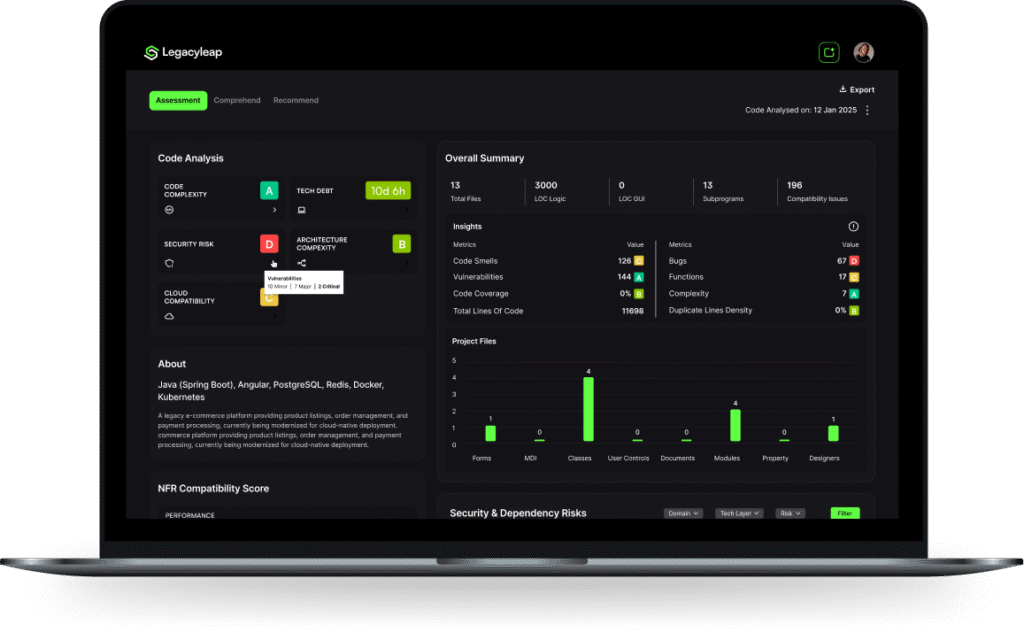
Legacyleap began with a detailed assessment of the legacy VB6 codebase to identify all dependencies, performance bottlenecks, and critical business workflows. This phase mapped 30 years of accumulated logic and configuration paths, establishing a clear modernization baseline and ensuring nothing would be missed in transformation.
Phase 2: Gen AI-Powered Code Transformation
Using Gen AI automation, Legacyleap accelerated the migration by having AI handle 50–70% of the code transformation while maintaining functional accuracy. Rather than a full rewrite, Legacyleap applied intelligent refactoring, restructuring business logic to improve maintainability and eliminate inefficiencies while preserving every essential functionality. This is what made the project viable within the client’s budget: automation replaced the large manual teams that traditional approaches require.
Phase 3: Assessment and Technical Documentation
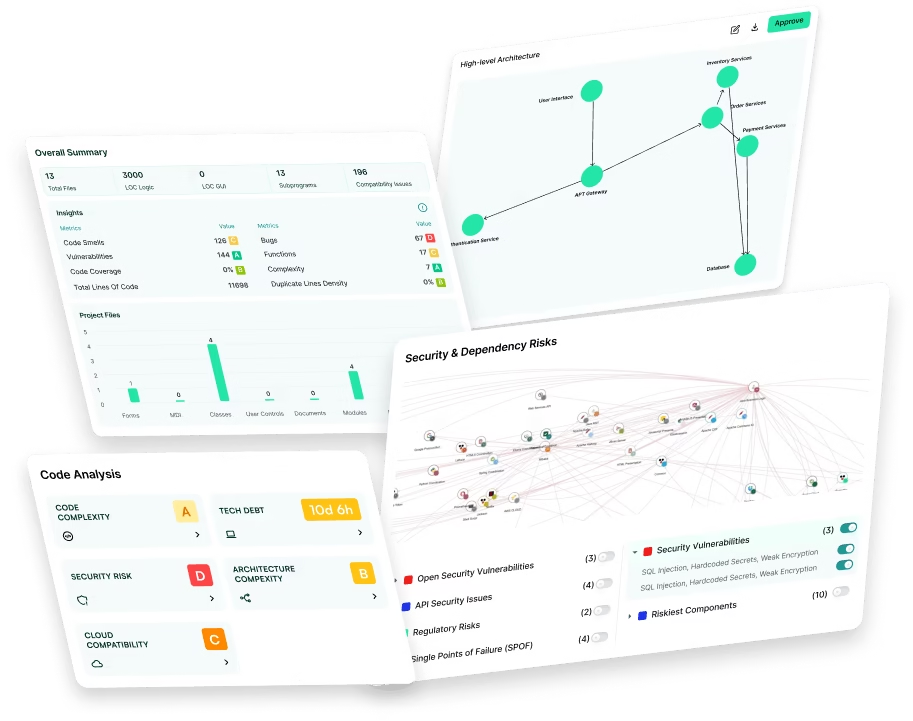
Legacyleap auto-generated detailed technical documentation including flow diagrams, data lineage reports, and component-level specifications. A technical debt and complexity assessment highlighted modernization hotspots, and a Transformation Readiness Report estimated migration effort and risk per module. This phase ensured knowledge preservation and simplified all future maintenance.
Budget-Constrained Modernization
The 60% cost reduction was not achieved by cutting scope. It was achieved by replacing manual effort with AI automation. Legacyleap’s Gen AI agents handled the repetitive, high-volume transformation work that would have required months of manual developer time. The phased delivery model spread investment across manageable increments rather than requiring a single large upfront commitment. This approach is specifically designed for organizations that cannot afford a traditional SI engagement but still need enterprise-grade modernization outcomes.
Phase 3: AI-Driven Testing for a Highly Configurable System
The client’s system was deeply configurable, meaning standard regression testing would miss critical paths. Legacyleap deployed AI-driven functional and regression testing with automated test case generation across all configuration permutations. This approach validated accuracy, stability, and compliance across the full range of system configurations — covering ground that manual QA teams could not reach within any realistic timeline or budget.
Phase 4: Hybrid Deployment and Incremental User Migration
Rather than a single big-bang cutover for 500+ users, Legacyleap used a hybrid deployment model that allowed select user groups to transition incrementally. This minimized disruption, enabled real-time feedback from early adopters, and allowed the team to resolve issues before broader rollout. Users were live on the modernized system from day one of deployment — not waiting months for a final release.
Phase 5: Cloud-Ready Architecture
The modernized system was built for scalable cloud deployment, removing the fat-client ceiling entirely. The new architecture supports future expansion without performance constraints and enables remote access, eliminating the desktop-only limitation that had blocked the client’s competitiveness.
Quantified Results
| Metric | Before | After | Validation Method |
|---|---|---|---|
| Total Cost of Ownership | Escalating Ab Initio license + hardware + talent costs | 55% reduction | TCO comparison pre/post migration |
| Time-to-Market | Manual ETL development cycles delaying credit product rollouts | 60% faster | Product release timeline comparison |
| Code Transformation | Manual rewrite required for 1.5M+ LOC | 80%+ automated by Gen AI | Automation coverage audit |
| Lines Migrated | 1.5M+ lines locked in Ab Initio | 1.5M+ lines running on Spark | Migration completion report |
| Data Processing Speed | Legacy jobs hitting horizontal scaling ceiling | 50–60% faster | Performance benchmarking pre/post |
| Data Loss | High risk from undocumented logic | Zero; full parity confirmed | Functional parity testing + lineage reports |
| Orchestration | Manual Ab Initio workflow scheduling | Airflow DAGs with CI/CD readiness | DAG monitoring + error handling validation |
Why Not a Manual Rewrite?
Many enterprises consider a manual Ab Initio-to-Spark rewrite before discovering the true cost and risk. Here is how the two approaches compare:
| Metric | Before | After | Validation Method |
|---|---|---|---|
| Manual Effort | Full manual migration required | 80% reduction via AI automation | Automation coverage audit |
| Feature Rollout Speed | Slow — constrained by legacy architecture | 40% faster post-modernization | Feature release timeline comparison |
| Modernization Cost | Traditional SI estimate (multi-million) | 60% lower than traditional methods | Cost comparison vs. SI quotes |
| User Migration | 500–600 users on legacy desktop | 500–600 users on modernized web platform | Deployment completion report |
| System Architecture | Fat-client desktop, no scalability | Cloud-ready, scalable web platform | Architecture review |
| Testing Coverage | Manual QA — unable to cover all config paths | AI-driven automated testing across all configurations | Test coverage audit |