Results at a Glance
| Metric | Result |
|---|---|
| Code Comprehension | 50% faster than manual approach |
| Business Logic Extraction | 50% faster than manual approach |
| Risk Mitigation | AI-driven risk assessment via Amazon SageMaker |
| AWS Architecture | Amazon Bedrock + Neptune + SageMaker |
Engagement Snapshot
| Industry | Transport Technologies / Logistics |
| Location | San Jose, CA |
| Legacy Stack | EJB 3 (Enterprise JavaBeans) |
| AWS Services | Amazon Bedrock, Amazon Neptune, Amazon SageMaker |
| System Criticality | Mission-critical logistics operations, zero downtime tolerance |
| Delivery Model | Gen AI-powered automation with AWS-native architecture |
About the client:
The client is a leading transport technology company based in San Jose, specializing in solutions for the logistics and transportation sectors. They develop mission-critical systems that support complex operations and streamline processes across the logistics chain.
The client’s core system was built on EJB 3, a framework that had become increasingly difficult to maintain due to its complexity and a complete lack of documentation. Traditional modernization approaches were too slow and too costly for a system that could not tolerate any operational disruption.
What Is EJB 3 and Why Is Modernization Hard?
Enterprise JavaBeans 3 (EJB 3) is a server-side Java framework used to build large-scale enterprise applications. Many organizations adopted EJB 3 for mission-critical systems in the 2000s because of its support for distributed transactions, security, and scalability within Java EE application servers.
Modernizing EJB 3 systems is difficult because the framework tightly couples business logic with container-managed services. Transactions, persistence, messaging, and security are all woven into the EJB container rather than being separable. When documentation is missing, extracting business logic from this framework requires understanding not just the code but the container behavior it depends on. This is why traditional manual approaches to EJB modernization are slow, expensive, and high-risk.
Challenge
The client’s EJB 3 system faced four constraints that made modernization both urgent and high-risk:
Undocumented EJB 3 Codebase with No Migration Map
The system had no existing documentation. Business logic, dependencies, integration points, and container-managed behaviors were all undocumented. Without a migration map, the client’s internal team could not safely plan or execute a modernization, meaning every change carried an unknown risk.
Mission-Critical Logistics System with Zero Downtime Tolerance
The EJB 3 system supported active transport and logistics operations. Any disruption during modernization would directly impact the client’s customers and operations. The modernization had to proceed without halting or degrading the live system at any point.
AI-Assessed Risk Areas Requiring Human-in-the-Loop Validation
The system’s complexity meant that some areas carried a higher modernization risk than others, but identifying which areas required special attention was impossible without automated analysis. The client needed a way to assess risk across the entire codebase before committing to transformation, so that human reviewers could focus on the highest-risk components.
Traditional Approach Too Slow and Costly
The complexity of the EJB 3 architecture and the absence of documentation made traditional manual modernization approaches prohibitively slow and expensive. The client needed an approach that could comprehend the codebase faster than manual analysis and extract business logic at a pace that made the project viable.
How Legacyleap Modernized a Mission-Critical EJB 3 System
Legacyleap used Gen AI-powered automation combined with three AWS services to comprehend, map, assess, and prepare the EJB 3 system for modernization, all without disrupting live logistics operations.
Amazon Bedrock: Automated Code Comprehension and Documentation
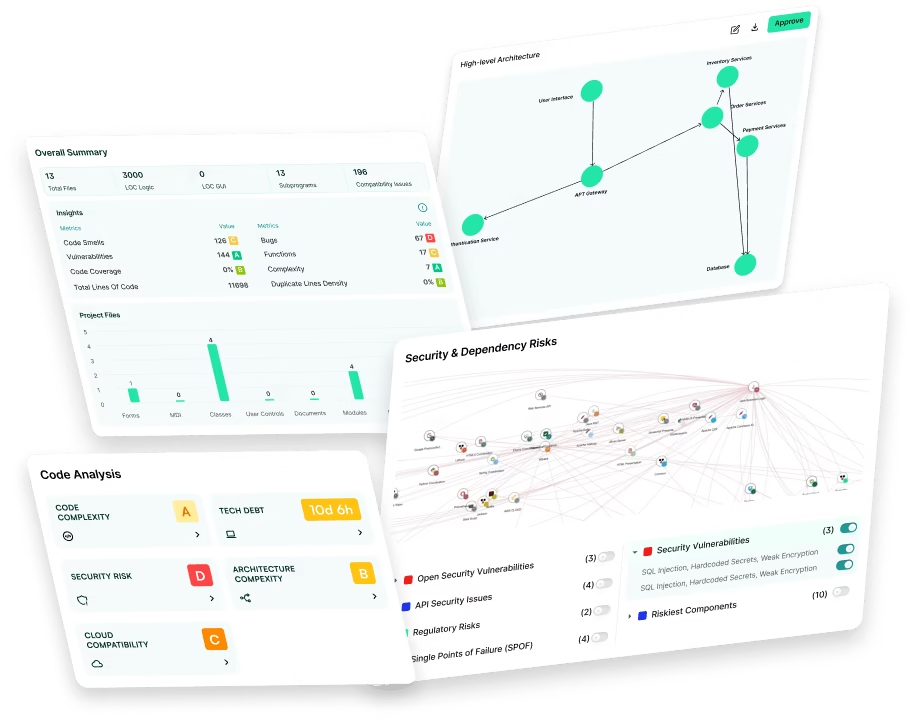
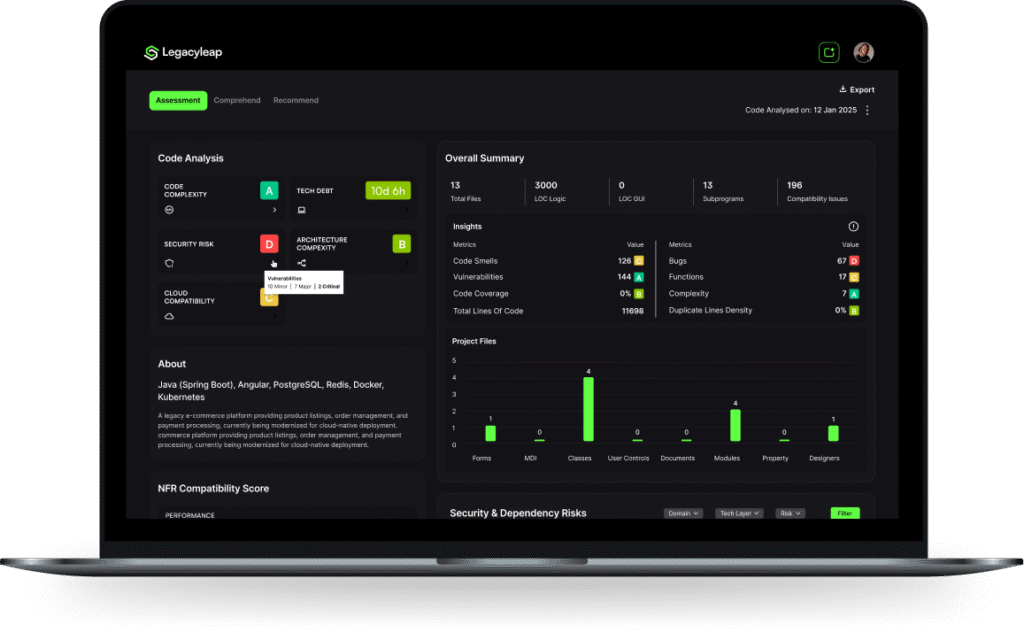
Amazon Bedrock’s Gen AI capabilities powered the analysis and documentation of the entire EJB 3 codebase. Where the client had no documentation, Bedrock’s large language models comprehended the legacy code structure, extracted business logic, and generated technical documentation automatically. This reduced the time required to understand and document the legacy codebase by 50% compared to manual analysis, transforming an undocumented system into a fully mapped one before any migration work began.
Amazon Neptune: Code Relationship Mapping
Amazon Neptune was used as a vector database to map all code relationships across the EJB 3 system. This included dependencies between EJB beans, container-managed service interactions, data flows, and integration points. The relationship map ensured that every connection in the legacy system was tracked and accounted for during modernization, preventing the orphaned logic and broken dependencies that plague manual migration efforts.
Amazon SageMaker: AI-Driven Risk Assessment
Amazon SageMaker enabled AI-driven risk assessment across the entire codebase. SageMaker identified which components carried the highest modernization risk, areas with complex business logic, deep container dependencies, or critical operational functions. This risk scoring allowed Legacyleap to prioritize human-in-the-loop validation where it mattered most, rather than applying the same level of manual review to every component. The result was enhanced risk mitigation with targeted expert attention rather than blanket manual analysis.
Business Logic Extraction
With Bedrock providing code comprehension and Neptune providing relationship mapping, Legacyleap extracted business logic from the EJB 3 system 50% faster than manual approaches. This extraction preserved the exact behavior of the legacy system, including container-managed transaction logic, persistence behavior, and security configurations, creating a complete and accurate foundation for the target architecture.
Quantified Results
| Metric | Before | After | Validation Method |
|---|---|---|---|
| Code Comprehension | Manual analysis of undocumented EJB 3 codebase | 50% faster with Amazon Bedrock | Comprehension timeline comparison |
| Business Logic Extraction | Manual extraction — slow, incomplete, high risk | 50% faster with Gen AI automation | Extraction timeline comparison |
| Risk Assessment | No visibility into which components carried highest risk | AI-driven risk scoring via SageMaker | Risk assessment report |
| Code Relationships | Undocumented dependencies and integration points | Fully mapped via Amazon Neptune | Relationship mapping audit |
| Operational Continuity | Mission-critical system — zero downtime tolerance | Zero disruption during modernization | Operations monitoring |