
TL;DR
- Legacy SSR frameworks like JSP, Struts, Razor, and Classic ASP cap what modern web delivery actually needs. Their full-page-reload model can’t support the mix of SSR, CSR, SSG, and ISR that Core Web Vitals performance and personalization now require.
- Next.js and Nuxt let each page choose its own rendering strategy instead of forcing one model everywhere. SSR fits personalized or authenticated views, SSG fits stable content-driven pages, and ISR gives static-like performance with time-based revalidation for periodically updated content.
- Most SSR migrations fail because legacy templates mix business logic, formatting, and even auth checks inside the view layer. Untangling conditional branches, master pages, and inconsistent layout or partial usage from controllers is slow and error-prone without automated comprehension.
- Implicit routing is one of the riskiest parts of moving to a file-based routing system. Reproducing SEO-sensitive URLs, redirects, and canonical paths that are spread across framework defaults and controller-view mappings risks lost search rankings if done manually.
- Manual parity verification doesn’t scale once hundreds of templates and dynamic routes are involved. Every migrated route needs validation for HTML output, SEO metadata, structured data, and accessibility, which is why teams increasingly rely on automated snapshot tests and route coverage matrices.
Introduction: Why Legacy SSR Needs a Modernization Plan
Legacy SSR frameworks (JSP/Servlets, Struts, Spring MVC server-side views, Razor, Classic ASP, older PHP templating systems) were built around assumptions that no longer hold. They rely on full-page reloads, tightly coupled controllers and views, and templates that mix logic and presentation.
That model becomes a ceiling the moment an application needs Core Web Vitals performance, personalization, experimentation, hybrid rendering, or clear API–frontend separation.
Modern web delivery now depends on a mix of SSR, CSR, SSG, and ISR. Legacy SSR stacks can only do a narrow slice of that spectrum, and retrofitting them to behave like modern meta-frameworks introduces more complexity than it removes.
Frameworks like Next.js and Nuxt offer structured routing, predictable data-fetching, flexible rendering modes, and edge-ready distribution, capabilities that address the architectural limits of older SSR systems.
Gen AI adds another layer of practicality. Large templating surfaces, mixed concerns, and implicit routing logic are difficult to unravel manually. Automated comprehension helps teams map view hierarchies, separate concerns cleanly, and identify safe modernization boundaries. We’ll go deeper into that later in the blog.
The core issue is simple: legacy SSR locks teams into an outdated rendering model that slows delivery and restricts performance gains.
Why Enterprises Move from Legacy SSR to Modern SSR/SSG/ISR Architectures
Enterprises don’t migrate away from JSP, Razor, Classic ASP, or legacy PHP templating for aesthetic reasons. The push comes from performance pressure, experimentation needs, team scalability, and the operational cost of keeping outdated rendering models alive.
- Performance pressure tied to Core Web Vitals: Legacy SSR templates ship heavy HTML, blocking scripts, and tightly coupled logic that leaves little room for caching or distribution. Modern SSR/SSG/ISR frameworks introduce pre-rendering for stable routes, incremental regeneration for content that changes, and better control over TTFB and interaction paths. This produces measurable gains without relying on constant micro-optimizations.
- Faster experimentation and personalization at scale: Experiments in legacy SSR often sit inside controllers or view logic, making A/B tests and targeted content slow to deploy and hard to isolate. Modern frameworks standardize feature flags, route-level experimentation, decoupled data layers, and server/edge functions that deliver personalized responses without reworking backend controllers.
- Clearer ownership and higher delivery velocity: Older SSR stacks place presentation inside backend ownership, forcing frontend teams to work through server-side constraints. Modern architectures flip this dynamic: frontend teams manage the application, backend teams expose APIs, and both groups move independently without stepping on each other’s release cycles.
- Alignment with the modern ecosystem: Next.js and Nuxt integrate naturally with design systems, observability pipelines, CI/CD automation, API gateways, analytics, and edge platforms. Legacy SSR systems require custom wiring for each integration, raising the cost of every new initiative.
- Lower maintenance cost and reduced operational risk: Running custom or outdated SSR engines requires niche expertise and patchwork fixes. Large ecosystems, predictable tooling, and widespread developer familiarity support modern SSR/SSG/ISR frameworks. This reduces maintenance cost while expanding the hiring pool.
Also read: Frontend Modernization in 2026: Frameworks, AI, and Governance.
Choosing the Right Modern Architecture: Next.js, Nuxt, SSG-First, and ISR
Modernizing legacy SSR isn’t a framework swap. It’s a rendering decision: React vs Vue, static vs dynamic, per-route strategies, and how your workloads behave under scale. The options below cover the most common enterprise pathways and the conditions that make each one fit.
1. Next.js (React-based SSR/SSG/ISR)
Best suited when:
- React already exists in the ecosystem or is the intended standard.
- Applications have interactive UIs, dashboards, or mixed rendering surfaces.
- You need strong ecosystem support across design systems, component libraries, analytics, and observability.
Advantages vs legacy SSR:
- File-based routing and structured data loaders reduce controller/view coupling.
- Native SSR, SSG, ISR, and server actions enable route-level rendering choices.
- Better Core Web Vitals performance through controlled hydration and caching.
- Strong TypeScript and developer tooling reduce maintenance effort.
Ideal workloads:
Complex B2B apps, authenticated dashboards, multi-step workflows, high-interactivity views.
2. Nuxt (Vue-based SSR/SSG/ISR)
Best suited when:
- Vue is already adopted or preferred for its lighter mental model.
- Teams require fast onboarding or more opinionated conventions.
- Content-heavy flows also need a degree of interactivity.
Advantages vs legacy SSR:
- Clear directory conventions for pages, layouts, and data fetching.
- Nitro provides flexible SSR/SSG/ISR deployment targets (Node, edge, serverless).
- Strong defaults reduce configuration and lower operational overhead.
- Hydration is predictable and easier to reason about than legacy templates.
Ideal workloads:
Content-heavy sites, mid-complexity apps, marketing surfaces with interactive elements.
3. SSG-First With Selective SSR/ISR
Best suited when:
- Large portions of the application are stable, content-driven, or read-heavy.
- SEO requirements are strict, and caching predictability matters.
- You want to shift complexity out of runtime and into build/distribution.
Advantages vs legacy SSR:
- Near-static hosting on CDNs improves performance and availability.
- ISR introduces “fresh enough” content without rebuilding the entire site.
- Runtime costs drop dramatically compared to server-bound rendering.
- Clear separation between content generation and dynamic routes.
Ideal workloads:
Documentation, knowledge bases, product catalogs, blogs, marketing surfaces.
4. Route-Level Rendering Decisions (SSR vs SSG vs ISR)
Enterprise workloads rarely fit a single rendering model. Modern frameworks allow each page to choose its mode:
When SSR applies:
- Highly personalized content or authenticated sessions.
- Data must always be fresh (e.g., analytics dashboards, inventory views).
When SSG applies:
- Content changes infrequently or predictably.
- Traffic is read-heavy and performance-sensitive.
When ISR applies:
- Content updates regularly but doesn’t require real-time accuracy.
- You want static-like performance with time-based revalidation.
Quick Comparison Table
| Approach | Best For | Key Advantages vs Legacy SSR | Typical Enterprise Use Cases | Technical Considerations |
| Next.js | React ecosystems, complex UIs | Route-level SSR/SSG/ISR, strong tooling, structured data loading | Dashboards, portals, multi-step workflows | Requires React familiarity; build sizes need attention |
| Nuxt | Vue ecosystems, fast onboarding | Opinionated structure, clean conventions, Nitro deployment flexibility | Content-heavy sites with interactive sections | Vue skillset required; conventions may feel rigid to some teams |
| SSG-First | Stable, content-driven surfaces | CDN distribution, low runtime cost, ISR for freshness | Docs, catalogs, marketing content | Build times for very large sites; ISR configuration matters |
| Route-Level SSR/SSG/ISR | Mixed workloads | Optimal performance per page, reduced server load, targeted personalization | Hybrid apps with variable data patterns | Requires clear workload mapping and API availability |
Challenges With Traditional SSR-to-Next/Nuxt Migration Approaches
Rewriting legacy SSR systems into Next.js or Nuxt looks straightforward on paper, but large enterprise applications rarely follow clean MVC boundaries. Most failures come from architectural assumptions baked into older frameworks that don’t translate cleanly into modern rendering models.
- Tightly coupled templates and business logic: Legacy views often contain conditional branches, data shaping, formatting, and even auth checks. Untangling this from controllers to create clean components and layouts becomes slow, error-prone, and heavily manual.
- Implicit routing and URL handling: Routes are often defined through conventions, framework defaults, or controller/view mappings spread across configs. Reproducing SEO-sensitive URLs in a file-based routing system introduces risk, especially when redirects and canonical paths are embedded implicitly.
- Inconsistent use of layouts, partials, and includes Templates mix inline markup, nested includes, master pages, and partials with no uniform structure. Extracting a coherent layout system or reusable component tree requires significant restructuring before modern frameworks can even be applied.
- Global scripts, styles, and assets: Legacy SSR stacks frequently load JavaScript and CSS globally through master pages or shared includes. Modern architectures benefit from scoped imports, page-level bundling, and modular dependencies, all of which require deliberate refactoring.
- Data-fetching refactors across controllers: Traditional controllers gather data and render views directly. Next and Nuxt expect data to flow through APIs, server functions, loaders, or route-level handlers. This demands backend adjustments or an intermediate composition layer to expose the required data.
- Manual parity verification burden: Every migrated route needs validation for HTML output, links, SEO metadata, structured data, accessibility, and user flow behavior. Manual verification becomes slow, expensive, and unreliable when hundreds of templates and dynamic routes are involved.
How Gen AI Supports SSR → Next/Nuxt/SSG/ISR Migration
Gen AI accelerates the high-friction parts of SSR modernization: understanding large templating surfaces, mapping routes, proposing structure, and generating scaffolds. It doesn’t replace architectural judgment; it removes the manual overhead that slows teams down.
- Template discovery and classification: Gen AI can scan the repository to locate every view, layout file, include, and fragment across JSP, Razor, Classic ASP, or legacy PHP stacks. It classifies them into page-level templates, layout candidates, and partials that should become components, giving teams a complete inventory before refactoring begins.
- Route and flow mapping: Legacy routing is often implicit. Gen AI can infer which URLs map to which controllers and templates, build a route hierarchy, surface dynamic parameters, and highlight SEO-sensitive paths. This provides a clear map of how the current system actually behaves.
- Suggestions for mapping into Next/Nuxt structure: Based on template patterns and routing flows, Gen AI can propose which views belong as pages, layouts, or components in modern frameworks. It can draft file structures (e.g., /products/[id].tsx, /blog/[slug].vue) and recommend likely rendering modes like SSR for personalized routes, SSG or ISR for content-heavy sections.
- Scaffolding generation: Gen AI can generate initial shells for modern pages and layouts, including the required imports, folders, and placeholders. This includes basic Next.js/Nuxt page files, layout wrappers, and starter data-fetching functions (getServerSideProps, getStaticProps, Nuxt server routes, etc.). It jumpstarts the rewrite without committing teams to final implementations.
- Inline logic extraction guidance: Templates frequently contain hidden business logic. Gen AI can identify conditional blocks, formatting logic, and lightweight validations that should move into services, utilities, or API endpoints rather than remaining inside the view layer. This reduces the risk of leaking legacy patterns into the modern codebase.
- Validation artifacts for parity: Gen AI can draft snapshot tests to compare HTML output before and after migration, create route coverage matrices for QA, and outline SEO parity checklists. These artifacts help teams verify functional continuity without manually auditing every page.
What Gen AI cannot reliably do:
- Deliver pixel-perfect UI or reproduce complex CSS behavior.
- Choose final rendering strategies without product and engineering decisions.
- Guarantee SEO parity without deliberate configuration and testing.
Gen AI supports structured modernization; it does not replace architectural judgment.
Also read: How Can Gen AI Drive Every Step of Your Modernization Journey?
How Legacyleap Modernizes Legacy SSR to Next/Nuxt/SSG/ISR
Modernizing legacy SSR isn’t a template rewrite. It’s a structured process: understand the system, map rendering decisions, scaffold the new architecture, refactor logic safely, and validate parity at scale.
Legacyleap’s Gen AI-driven pipeline is built for exactly this kind of migration: high-accuracy comprehension, controlled refactoring, and predictable delivery.
- Deep comprehension of legacy SSR applications: Legacyleap parses JSP, Razor, Classic ASP, and legacy PHP templates along with their associated controllers, helpers, and shared partials. It constructs a unified code graph that shows how routes, views, layouts, and cross-cutting concerns interact. This removes ambiguity early and provides a ground truth for modernization planning.
- Modernization blueprint for Next/Nuxt: The platform outputs a detailed mapping of the existing system into a modern file structure: route hierarchies aligned with Next.js or Nuxt conventions, page/layout breakdowns, and rendering mode recommendations (SSR, SSG, ISR, CSR) based on usage patterns and data dependencies. It also surfaces recurring concerns such as authentication, headers, and SEO tags that need consistent treatment in the target framework.
- Automated scaffolding for target frameworks: Legacyleap generates production-ready skeletons for Next.js or Nuxt, including the core folder structure, initial page and layout files, and placeholders for data fetching (getServerSideProps, getStaticProps, Nuxt server routes, etc.). Repeated UI or logic patterns from legacy templates are extracted into shared components to accelerate the rewrite.
- Assistive refactoring of business logic: Agents guide the movement of logic out of templates and controllers into service layers or API endpoints. This standardizes how data is prepared for rendering and replaces scattered helper calls with structured utilities. The result is a cleaner execution model that avoids dragging legacy patterns into the modern stack.
- Safety nets and parity validation: Legacyleap produces a suite of validation assets: functional tests for key routes, HTML/DOM comparisons where possible, SEO tag parity reports, and automated regression checks during rollout. These guardrails ensure that migrated pages behave consistently with their legacy counterparts before production adoption.
- Deployment and infrastructure integration: The platform generates Dockerfiles, Kubernetes manifests, and CI/CD pipeline definitions tailored to Next/Nuxt builds. Whether the target environment is cloud, on-prem, or hybrid, Legacyleap outputs the configuration needed to build, test, and deploy modernized workloads without reworking existing infra tooling.
- Portfolio-level scalability: The same modernization pipeline can be applied across multiple legacy SSR applications. Insights from one system inform subsequent migrations, allowing teams to build predictable, repeatable processes instead of treating each application as a one-off effort.
Conclusion: Modern SSR/SSG/ISR as a Structured Modernization Outcome
Legacy SSR frameworks eventually cap what enterprises can achieve, from Core Web Vitals performance to personalization depth and team autonomy. Modern architectures built on Next/Nuxt with SSR, SSG, and ISR introduce the flexibility older systems were never designed for: route-level rendering choices, predictable caching, and clearer separation between backend and frontend execution.
Choosing the right target depends on existing ecosystems, team strengths, workload characteristics, and how much of the application benefits from static, dynamic, or incremental rendering.
Gen AI speeds up the parts that traditionally slow these migrations down by understanding the legacy system, mapping routes, and generating initial scaffolds, but only when used inside a structured modernization pipeline.
Legacyleap provides that pipeline: comprehend → plan → scaffold → refactor → validate → deploy. This reduces uncertainty, preserves functional parity, and turns SSR modernization into a predictable process rather than a risky big-bang rewrite.
The outcome is clear: safer, faster migration from legacy SSR to modern SSR/SSG/ISR architectures, without guesswork.
Ready to Move Forward?
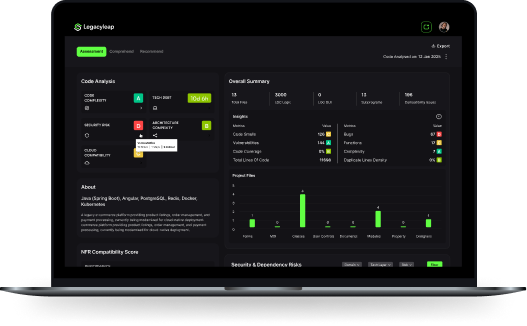
Start Your $0 Modernization Assessment to get a route-level analysis of your legacy SSR system and a clear modernization plan. Or book a demo to see how Legacyleap applies structured Gen AI to real SSR modernization projects.
FAQs
Incremental Static Regeneration (ISR) combines the performance benefits of static delivery with controlled freshness, which traditional SSR cannot offer efficiently at scale. Instead of rendering every request on the server, ISR serves pre-rendered pages from the CDN and regenerates them in the background on a schedule or trigger. This reduces server load, improves TTFB, stabilizes Core Web Vitals, and allows enterprises to balance freshness with cost, especially for catalogs, content hubs, and semi-dynamic pages where real-time accuracy isn’t mandatory.
In modern frameworks like Next.js and Nuxt, SSG and SSR are complementary rather than competing approaches. SSG pre-renders pages at build time, making it ideal for content-heavy, read-dominant workloads that benefit from CDN distribution and predictable performance. SSR, by contrast, renders per request and suits highly personalized or session-driven views. The key difference from legacy systems is that modern frameworks allow both models to coexist at a route level, enabling teams to choose the most efficient rendering strategy per page instead of defaulting to SSR everywhere.
The choice between Next.js and Nuxt depends less on feature parity and more on ecosystem alignment and team structure. Enterprises with existing React investments, complex interactive UIs, or shared component libraries typically favor Next.js, while teams standardized on Vue or seeking more opinionated conventions often prefer Nuxt. In both cases, the real decision driver is how well the framework fits existing skills, tooling, and long-term frontend ownership models.
Most migration issues stem from architectural assumptions baked into legacy SSR systems, not framework limitations. These include tightly coupled templates and business logic, implicit routing rules, inconsistent layout usage, global scripts and styles, and controller-driven data assembly. Reproducing SEO behavior, URLs, and rendering outcomes in a modern, file-based routing system requires careful mapping and validation, which is why naive “rewrite it in Next.js” efforts often stall or regress.
Effective migrations start with comprehension before conversion: inventorying templates, mapping routes and dependencies, identifying rendering candidates per page, and separating business logic from views. This is where platforms like Legacyleap add value by using GenAI to accelerate discovery, generate modernization blueprints, scaffold Next/Nuxt structures, and validate parity. Treating migration as a phased, testable process, rather than a wholesale rewrite, reduces risk and improves delivery predictability.
Optimizing ISR requires thoughtful revalidation strategies rather than aggressive freshness targets. Enterprises should group pages by update frequency, define realistic regeneration intervals, and combine ISR with edge caching and selective SSR where personalization is required. Tooling matters as well. Legacyleap helps teams identify which routes benefit from ISR versus SSG or SSR, ensuring that performance gains don’t come at the cost of stale data or operational complexity.