
Introduction: Why Microfrontends Are Now a Modernization Priority
Enterprise frontends weren’t designed for the scale they’re being forced to operate at today. Most organizations spent the last decade building large, single-page applications that grew into tightly coupled monoliths. They worked until product velocity, parallel releases, and distributed teams pushed those architectures past their limit.
Slow builds, rising cognitive load, cross-team conflicts, and release pipelines that collapse under one shared critical path are familiar symptoms. The problem isn’t the framework but the scale.
Modern delivery requirements like weekly releases, independent domain ownership, and multi-team contributions expose how fragile a frontend monolith becomes once it reaches a certain size.
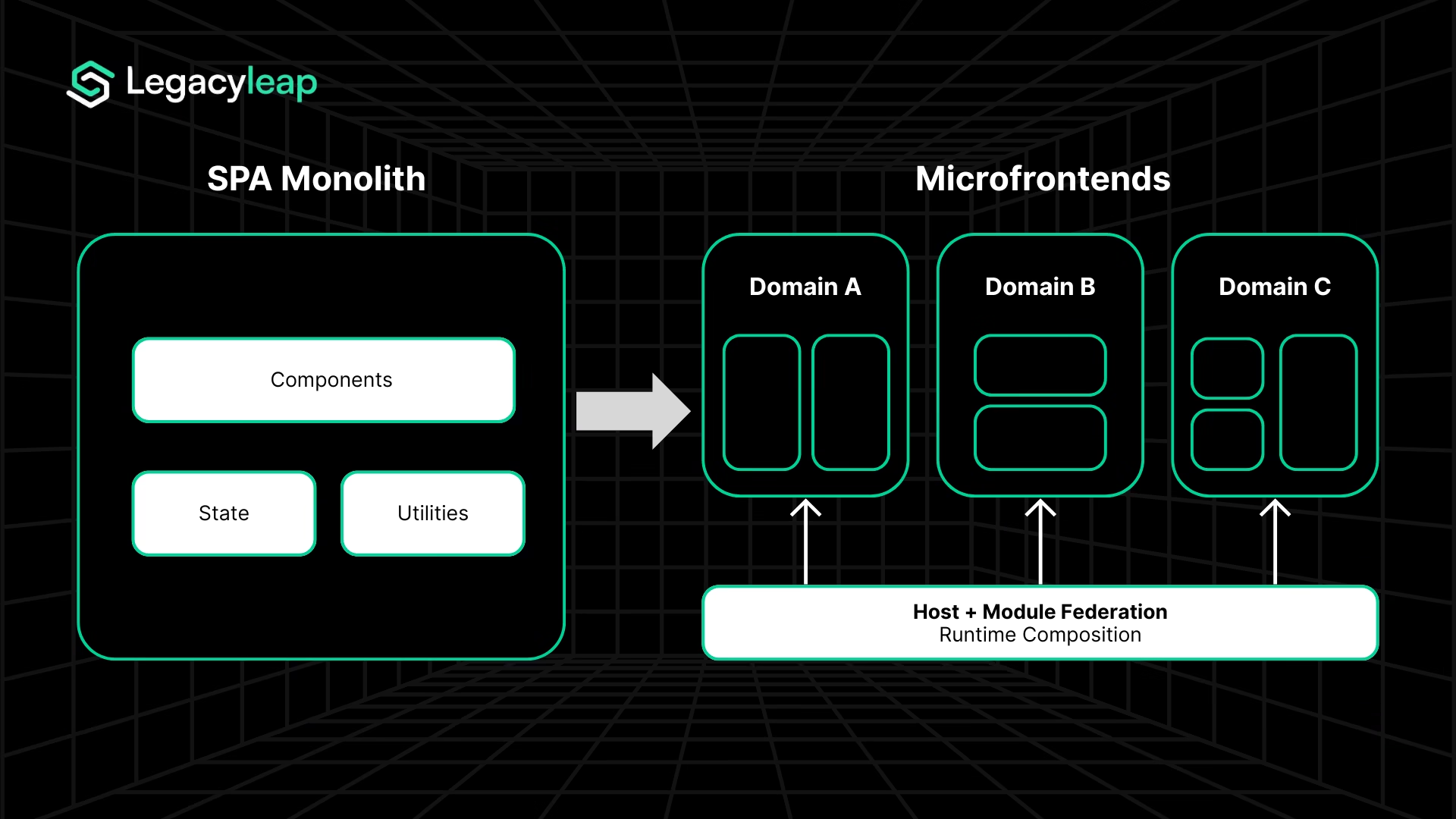
This is why microfrontend modernization and module federation migration are showing up as board-level conversations now. They offer a path to break the monolith into independently deployable slices without a Big Bang rewrite. More importantly, they enable frontends to evolve at different speeds without risking system-wide regressions.
The rest of this blog goes deeper into the architectural and operational realities of modernizing from a SPA monolith to a microfrontends architecture. It also covers where Gen AI meaningfully changes the migration playbook, so modernization becomes predictable instead of brittle.
Why Enterprises Migrate to Microfrontends
Frontend monoliths eventually hit scale limits: one build pipeline, shared dependency risks, global CSS/JS conflicts, and regression cycles that force full-system retesting. As systems grow, teams collide in the same code paths, onboarding becomes heavier, and a single change can stall multiple release streams.
Microfrontends solve this by creating clear ownership boundaries. Teams ship independently, contain failures within their domain, and reduce the blast radius of changes. The architecture finally aligns with how large product organizations actually operate.
Module Federation goes a step further. It handles shared libraries without duplication, enables runtime composition instead of compile-time coupling, and makes it possible to introduce React, Vue, Angular, or newer frameworks incrementally, without halting feature delivery.
This is why migrating to microfrontends keeps showing up in modernization roadmaps: it’s a direct response to scale, team independence, and frontend team scalability.
Also read: Frontend Modernization in 2026: Frameworks, AI, and Governance.
Monolith vs. Microfrontends vs. Module Federation
| Area | Frontend Monolith | Microfrontends | Module Federation (Runtime Composition) |
| Team Autonomy | Low; one repo, one pipeline | Medium; bounded domains | High; runtime-loaded shared modules |
| Deployments | Single, fragile | Independent per domain | Independent with decoupled shared updates |
| Regression Risk | High | Scoped | Low |
| CSS/JS Scope | Global conflicts | Scoped per microfrontend | Scoped + shared runtime assets |
| Framework Evolution | Requires rewrite | Possible but manual | Incremental, mixed frameworks supported |
| Onboarding Load | High | Scoped | Scoped with clearer shared boundaries |
Benefits of Modern Microfrontend Architecture Over Legacy Frontend Monoliths
Microfrontends are valuable because they remove the structural bottlenecks that monoliths create at scale. The gains show up directly in release speed, maintainability, performance, and operational stability.
Faster Release Cycles
- Micro-app autonomy removes pipeline contention.
- Teams ship UI updates without coordinating across the entire monolith.
- Regression scope shrinks, making weekly or even daily releases feasible.
Better Maintainability
- Codebases align to business domains instead of one shared surface.
- Dependency boundaries are explicit, reducing unpredictable regressions.
- Engineering teams spend less time tracing cross-feature side effects.
Parallel Development at Scale
- Vertical slices allow backend + frontend teams to work within the same domain.
- Teams avoid the “shared UI layer hell” that slows monolith-style coordination.
- Workstreams remain unblocked even during large feature rollouts.
Incremental Tech Upgrades
- SPA (Single-Point Application) modernization becomes manageable. Migrate one domain at a time, not the entire UI.
- Module Federation enables React, Vue, Angular, and other frameworks to coexist. However, production use requires governance to avoid duplicated runtimes and bloated bundles.
- Teams can introduce new tech without rewriting core workflows.
Performance and Load Optimization
- On-demand loading ensures users fetch only the micro-apps needed.
(Note: Performance gains depend on disciplined governance. If each micro-app loads its own runtime or duplicated design system assets, startup time can increase instead of decrease.) - Startup becomes faster with smaller, domain-focused bundles.
- Shared runtime libraries reduce total bundle size across the system.
Correctly configured shared libraries reduce bundle duplication. However, misconfigured sharing can increase bundle size, especially when teams load separate versions of the same runtime.
Risk Reduction
- Failures stay contained within a single micro-app.
- Rollbacks target one slice rather than the full UI.
- System-wide outages become significantly less likely.
Challenges With Traditional Microfrontend Modernization
Modernizing a legacy frontend into microfrontends sounds straightforward on paper, until teams confront how much coupling is buried inside a monolithic SPA.
The “old way” depends on manual comprehension, hand-drawn boundaries, and brittle refactoring cycles. That’s exactly where projects slow down, stall, or fail.
Difficult Boundary Identification
Legacy frontends rarely reflect clean business domains. Instead, logic bleeds across components and folders:
- Hidden dependencies baked into shared utility functions
- Global state that every feature touches
- Cross-component data flows that aren’t documented
- Implicit coupling created by years of incremental fixes
Creating microfrontend boundaries becomes guesswork without full visibility.
Refactoring Requires Deep Comprehension
Teams must manually map how the monolith behaves before they can split it:
- Page-level flows
- Component hierarchies
- Event handlers and shared listeners
- API dependencies spread across multiple layers
This comprehension phase is the slowest part of microfrontend refactoring, and any gap usually becomes a production regression later.
High Regression Risk
Microfrontends integrate at runtime, not compile time. That means:
- A contract mismatch can break a domain in isolation
- Shared libraries drift out of sync
- Minor refactors can cascade into runtime errors
Legacy frontends aren’t built with this level of isolation in mind, making regressions more frequent and harder to diagnose.
Parallel Modernization Complexity
Enterprises don’t modernize one slice at a time. They modernize several in parallel. That brings its own problems:
- Shared library updates must be coordinated across multiple micro-apps
- Versioning becomes a negotiation
- Teams block each other during transitional states
This slows releases even before the architecture is fully modular.
Build and Deployment Fragmentation
Moving from a single, predictable Webpack build to multiple pipelines is often underestimated. Teams struggle with:
- Fragmented CI/CD workflows
- Environment mismatches between micro-apps
- Configuration drift
- Rollouts failing because of inconsistent build outputs
This is where module federation difficulties become most visible.
How Gen AI Supports Microfrontend and Module Federation Modernization
Gen AI introduces automation and visibility that traditional microfrontend modernization workflows lack. It doesn’t replace engineering judgment, but it eliminates the slow, manual discovery work that makes microfrontend refactoring risky and unpredictable.
Automated Comprehension
Gen AI can scan large legacy frontends and surface the patterns teams usually spend weeks uncovering:
- Logical domain boundaries
- Cross-module dependencies
- Shared utilities and global state usage
- Component relationships and event flows
This establishes a baseline map before any refactoring begins.
Component and Module Mapping
Gen AI identifies natural breakpoints and highlights tangled dependencies that will complicate Module Federation setup. It can also generate relationship graphs that show how components interact across the monolith.
Migration Scaffolding
Gen AI is effective at generating boilerplate that engineers would otherwise create manually:
- Host/remote scaffolds
- Module Federation configuration
- Shared runtime libraries
- Shell applications
This speeds up early-stage setup without compromising architectural standards.
Preliminary Refactoring Assistance
Gen AI can help with foundational cleanup tasks:
- Extracting components
- Standardizing imports
- Flattening shared utility chains
These steps reduce coupling and prepare the monolith for microfrontend boundaries.
Automated Regression & Integration Tests
It can generate test cases and detect breakages that occur when boundaries shift:
- Integration mismatches
- Incorrect orchestration logic
- Missing or outdated shared contracts
This is especially valuable in runtime-composed systems like Module Federation.Note: Gen AI accelerates test generation and highlights obvious breakages, but engineers still need to validate coverage and runtime behavior, especially in distributed micro-app orchestration.
Governance Support
It assists in maintaining architectural consistency:
- Enforcing cross-team coding guidelines
- Detecting architectural drift
Ensuring consistent state management patterns
What Gen AI Cannot Reliably Do
While we’re here, it’s a good idea to keep expectations grounded:
- Pixel-level UI reconstruction
- Business-logic reengineering
- End-to-end rewrites of complex workflows
Human oversight remains essential for design, domain logic, and final integration.
Also read: How Can Gen AI Drive Every Step of Your Modernization Journey?
How Legacyleap Modernizes Frontend Monoliths Into Microfrontends
Traditional microfrontend refactoring depends on manual mapping, hand-built boundaries, and error-prone scaffolding. Legacyleap replaces that fragmented workflow with system-level comprehension, compiler-grade transformations, and agent-driven scaffolding, all under human-in-the-loop control.
This isn’t a copilot. It’s a modernization platform built for enterprise-scale frontend migration, backed by GenAI and static analysis that can process a monolithic SPA end-to-end.
1. System-Level Comprehension
Legacyleap analyzes the entire legacy frontend, not just individual components, to build a precise picture of how the monolith behaves. The platform extracts:
- Component hierarchies
- Event propagation paths
- API interaction maps
- Cross-module dependency graphs
- Shared utility usage
- State usage across Redux, MobX, Context API, or custom stores
This system view eliminates guesswork and enables accurate microfrontend boundary design before any code is changed.
2. Modernization Blueprints
Using the comprehension layer, Legacyleap generates a modernization blueprint that defines the safest path from a frontend monolith to microfrontends. This includes:
- Recommended segmentation for micro-app domains
- Shared library strategy with clear ownership rules
- Candidate hosts and remotes
- Module Federation configuration templates
- Versioning rules and contract guidelines
- Deployment model recommendations (single-repo vs multi-repo)
The blueprint becomes the north star for the entire modernization program that’s consistent, repeatable, and reviewable.
3. AI-Driven Scaffolding
Once boundaries are defined, Legacyleap generates the structural scaffolds engineers would normally spend weeks assembling:
- Host and container applications
- Remote micro-apps with prewired entry points
- Shared dependency configurations
- Webpack/Vite Module Federation configs
- Routing and navigation scaffolds
This eliminates early-stage friction and ensures every micro-app starts with a consistent, validated foundation.
4. Assistive Code Refactoring
Legacyleap’s agents help refactor the monolith in controlled, reviewable steps:
- Extracting components from oversized containers
- Rewriting brittle patterns that break under Module Federation
- Standardizing imports and folder structures
- Removing dead or unreachable code
- Breaking large pages into composable UI units
Engineers stay fully in control at every step, with human-in-the-loop governance built into the workflow.
5. Safety Nets
Frontend modernization fails when regressions slip through. Legacyleap builds safety nets directly into the process:
- Auto-generated unit and integration tests
- Behavioral parity checks against the legacy SPA
- Runtime comparison of orchestrated flows
- Contract validation between host and remote micro-apps
This is where compiler-grade precision matters most: boundaries evolve without breaking user-facing functionality.
6. Deployment Artifacts
Microfrontends require operational maturity. Legacyleap provides the deployment backbone:
- CI/CD templates for multi-app pipelines
- Kubernetes manifests for host/remote deployments
- Environment-aware builds that align with dev, staging, and production
- Versioning patterns for shared libraries under Module Federation
This reduces the operational burden of moving from a single build pipeline to a distributed deployment model.
Conclusion: Choosing a Safer, Incremental Path to Frontend Modernization
Microfrontends give enterprises a practical way to break apart monolithic frontends without halting product delivery or rewriting the entire UI at once. The architecture works, but the path to get there is messy when teams rely on manual comprehension, hand-built boundaries, and fragile refactoring.
Gen AI closes some of that gap by accelerating system understanding, mapping dependencies, and generating early scaffolds. But without guardrails, governance, and engineering oversight, it’s not enough to safely modernize a large-scale SPA.
Legacyleap provides the structure that traditional and AI-only approaches lack. System-level comprehension, boundary detection, AI-assisted refactoring, parity testing, and deployment-ready artifacts turn microfrontend migration into a controlled, reviewable modernization process rather than an open-ended rewrite.
The result is a predictable transition from a monolithic frontend to modular, scalable, independently deployable microfrontends, supported by a consistent modernization workflow rather than trial-and-error.
If you want to see what this looks like for your own legacy SPA, start with a $0 assessment to get boundary maps, dependency graphs, and an actionable modernization blueprint.
And if you’d prefer to evaluate the platform directly, book a technical demo to walk through the Gen AI agents, system comprehension engine, and safeguards on real code.
FAQs
Microfrontends make sense when team scale, release frequency, and domain complexity justify the operational overhead. If you have multiple teams shipping in parallel, frequent conflicts in a single pipeline, and domain boundaries that are already somewhat clear, microfrontend modernization is usually worth it. For a smaller product with one or two teams and relatively simple flows, a well-structured SPA modernization without microfrontends may be more pragmatic.
Microfrontends don’t inherently break UX consistency; poor governance does. In a mature setup, teams consume a shared design system (tokens, components, spacing rules) and integrate it as a versioned dependency across micro-apps. The key is enforcing a single source of truth for the design system and ensuring Module Federation or shared libraries don’t fork into multiple incompatible variants. Without that, you trade a monolithic frontend problem for a fragmented UX problem.
Module Federation introduces runtime composition, which means remote modules are loaded into a host at runtime. Security and compliance focus on three areas: where remotes are hosted, how they’re versioned and signed, and how configuration is managed across environments. You’ll need clear rules for allowed origins, artifact signing or integrity checks, and environment-specific configuration so that a misconfigured remote doesn’t become an injection or data exposure risk. This is especially important in regulated industries.
Legacyleap is designed to plug into existing pipelines rather than replace them. The platform produces CI/CD templates, Module Federation-aware build configs, and Kubernetes manifests that can be wired into your current tools (GitHub Actions, Azure DevOps, Jenkins, Argo, etc.). For observability, Legacyleap respects whatever you already use (logging, tracing, metrics) and focuses on ensuring each micro-app exposes consistent signals so your existing APM and monitoring stack can track them without a parallel setup.
No. Microfrontends are designed for incremental adoption. You can start by modernizing a single domain or feature area while the rest of the monolithic SPA continues to run unchanged. Module Federation enables new micro-apps to coexist with legacy code, making the shift gradual rather than a wholesale rewrite.
Yes. With domain-aligned boundaries, you can extract and modernize one micro-app without affecting unrelated areas of the product. The key is stable shared contracts—routing, design system components, and API interfaces—so the legacy SPA and new microfrontend communicate cleanly. This is exactly why microfrontends are chosen for incremental modernization programs.