
Intro: Why jQuery Modernization Matters for Enterprises Today
A surprising amount of enterprise UI still runs on jQuery, often written between 2010 and 2016, when the library peaked at over 90% usage across indexed sites. Even today, jQuery remains present on over 70% of the top 10 million websites.
That persistence is precisely the problem: these systems were never designed for the scale, complexity, and velocity enterprises operate with now.
jQuery-heavy frontends accumulate structural debt over time because of how they’re built:
- Direct DOM manipulation
- Procedural event chains
- No component boundaries
- Ad-hoc global state
- Limited testability
This spaghetti-style architecture slows everything that enterprises care about: release cycles, maintainability, accessibility (WCAG 2.2), CI/CD integration, and design system adoption.
Modern frameworks changed the rules by enforcing component-driven structure, predictable state management, typing, and built-in testability.
The real challenge is that migrating from jQuery isn’t a straight rewrite. It requires understanding hidden dependencies, implicit data flow, and brittle UI logic that has evolved over a decade. This is where Gen AI becomes relevant: not as a code generator, but as a way to accelerate comprehension, surface risk, and give teams clarity before touching a single line of code.
We’ll unpack that in depth later in the blog.
Why Enterprises Decide to Move Away From jQuery
Enterprises don’t move off jQuery because it’s “old.” They move because the architecture can’t support the scale, reliability, and velocity their frontend teams are expected to deliver.
- jQuery is not a scalable architecture: When the DOM becomes the source of truth, every feature depends on fragile selectors and event bindings. Without components or predictable state boundaries, logic lives across scattered handlers, making interactions increasingly unpredictable as the codebase grows.
- Maintenance slows to a crawl: Even small UI changes require touching multiple unrelated files because nothing is modular. The regression risk is disproportionately high, and onboarding new engineers becomes painful since the mental model isn’t explicit but buried in DOM manipulation and historical behavior.
- Integration and tooling limitations: Modern toolchains assume components, modules, and typing. jQuery offers none of that. It resists TypeScript-first workflows, doesn’t align with modern bundlers, and lacks standardized testing patterns, making CI/CD adoption unnecessarily difficult.
- Performance and accessibility ceilings: Re-rendering through direct DOM operations introduces avoidable performance overhead. Accessibility suffers because keyboard navigation, focus management, and consistent semantic markup require patterns that jQuery never enforced.
- Talent and cost pressures: The developer market has moved on. Maintaining jQuery-heavy systems means shrinking talent pools, difficulty scaling teams, and a long-term cost of ownership that keeps rising with every release cycle.
Also read: Frontend Modernization in 2026: Frameworks, AI, and Governance.
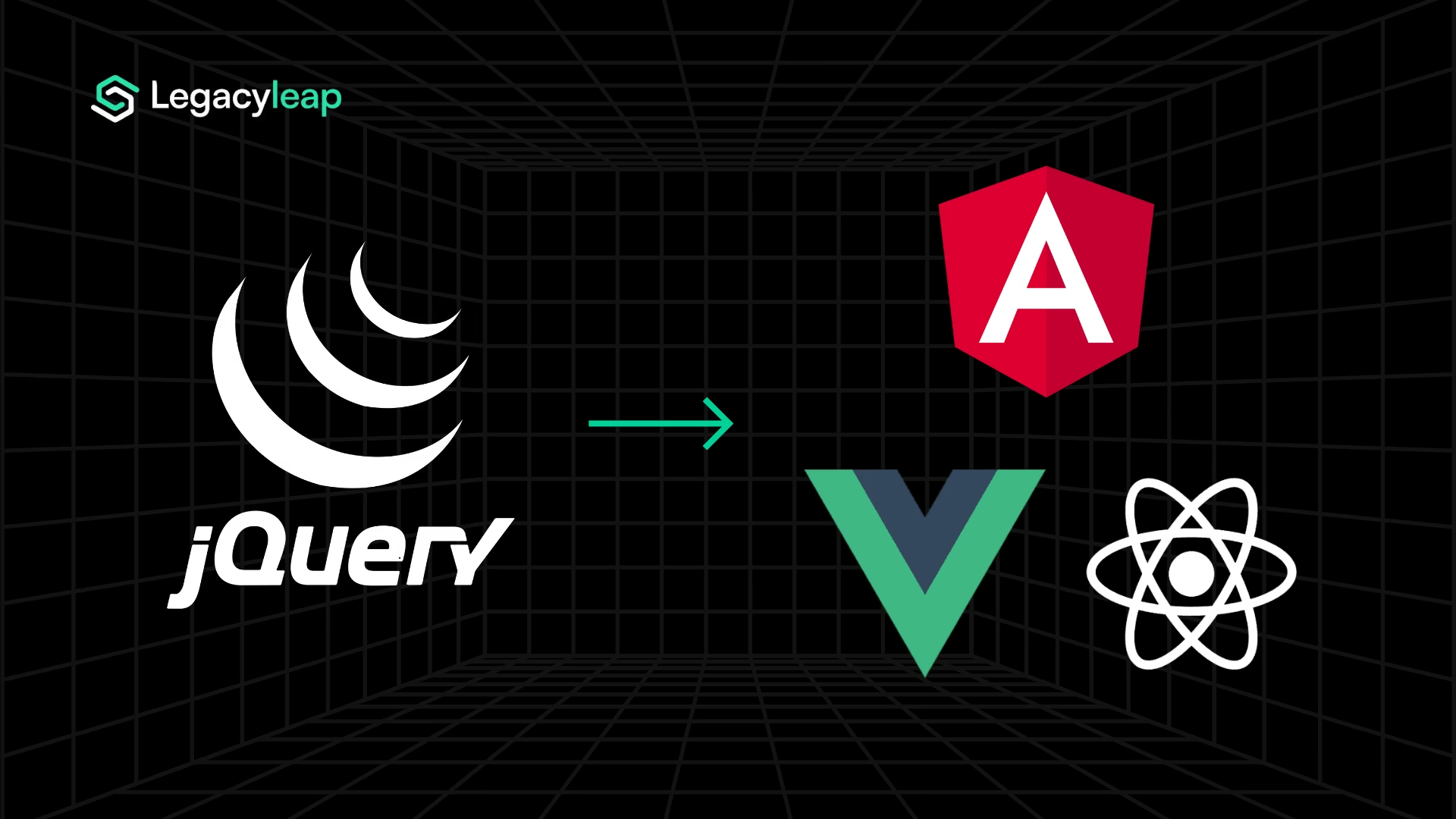
React, Angular, or Vue: Which Framework Should Replace Your jQuery Frontend?
jQuery modernization isn’t a one-path upgrade. Each target framework comes with its own architectural strengths, operational implications, and team-scale dynamics.
A good decision considers UI complexity, team maturity, governance expectations, design system plans, and how much parallel modernization the org can handle.
1. React (Most common enterprise target)
React fits enterprises that deal with complex UI flows, dashboards, multi-step journeys, and modular experiences that rely on reusable components. Its flexibility gives teams control over how to structure state, testing, routing, and data fetching, which is exactly why enterprises with strong React talent gravitate toward it.
Its advantages show up quickly in modernization projects:
- A massive ecosystem for routing, state management, testing, and performance tooling
- Strong TypeScript alignment for predictable contracts
- Straightforward integration with Module Federation for incremental jQuery migration
React is the natural choice when the org wants customization and already has developers who understand component-driven architecture.
2. Angular (Best for structure-heavy environments)
Angular makes sense when the enterprise values standardization over flexibility. It enforces a consistent mental model across all teams: components, modules, services, routing, forms, testing, everything.
This is ideal when:
- Engineering leadership wants predictable governance
- Multiple teams contribute to the same codebase
- Compliance or audit-heavy environments prefer opinionated frameworks
Angular’s CLI and built-in patterns reduce architectural decision-making and keep large teams aligned. It’s also fully TypeScript-first, which is an advantage in modernization programs needing strict typing from day one.
3. Vue (Best for cleaner, faster componentization)
Vue works extremely well for mid-complexity frontends or for teams that want to adopt component architecture without the overhead of Angular’s rigidity or React’s open-ended choices.
It’s a strong option when:
- Developer productivity is a priority
- Teams need to convert jQuery widgets/pages into clean components quickly
- The codebase benefits from a gentle learning curve
Vue’s syntax and SFC (single-file component) structure simplify refactoring, and its lightweight footprint makes it an excellent fit for modular modern apps or micro-apps.
4. Microfrontends as an alternative path
This isn’t a framework; it’s a migration strategy. It becomes relevant when the frontend is owned by multiple teams or when jQuery modernization cannot be executed as a single-track rewrite.
Microfrontends help when:
- Teams need to modernize different domains in parallel
- React, Angular, and Vue need to coexist temporarily
- You want to decouple release cycles and deployments
This path avoids the “rewrite the entire UI at once” trap and creates domain boundaries where new frameworks can be introduced without destabilizing existing jQuery screens.
React vs Angular vs Vue vs Microfrontends: jQuery Migration Comparison
| Factor | React | Angular | Vue | Microfrontends |
| Best Fit For | Complex UIs, design system alignment, flexible architecture | Large teams, strict governance, compliance-heavy orgs | Mid-complexity apps, teams prioritizing rapid adoption | Multi-team modernization, parallel migration, phased rollout |
| Learning Curve for jQuery Teams | Moderate — requires learning component patterns + state models | High — opinionated and pattern-heavy | Low–Moderate — intuitive syntax, gentle onboarding | Varies — depends on chosen frameworks inside the microfrontend shell |
| Architecture Style | Unopinionated, component-first | Highly opinionated, full-stack frontend framework | Lightweight, component-first | Domain-based boundaries, independent app shells |
| State Management Options | Redux, Zustand, Recoil; strong TS support | NgRx, Signals, built-in services; strict patterns | Vuex/Pinia; simple and intuitive | Depends on framework chosen per micro-app |
| Incremental Migration Support | Strong — easy to embed components alongside jQuery | Moderate — typically better for full sections/pages | Strong — can wrap legacy zones easily | Excellent — designed for coexistence across multiple stacks |
| TypeScript Alignment | Strong, optional | Native, mandatory | Supported, optional | Depends on framework(s) selected |
| Tooling Compatibility | Works well with Vite, Webpack, Rspack; great ecosystem | CLI-controlled builds, consistent tooling | Very compatible with lightweight modern bundlers | Independent bundling per domain; supports mixed toolchains |
| Performance Outlook | Virtual DOM, code splitting, flexible optimization | Compiler-driven rendering, heavier baseline | Lightweight runtime, fast SFC compilation | Performance varies per micro-app; isolation prevents global slowdowns |
| Accessibility Considerations | Depends on implementation; strong community patterns | Strong built-in patterns via Angular Material | Very flexible; relies on team discipline | Each micro-app enforces its own accessibility model |
| Migration Complexity for jQuery | Medium — flexible but requires strong architectural decisions | Medium–High — structure helps, but stricter initial adoption | Low–Medium — simpler component model helps refactors | Low for initial adoption; Medium overall due to orchestration |
| When to Choose | When flexibility + ecosystem depth matter | When governance + consistency trump flexibility | When faster onboarding + lightweight builds are priorities | When multiple teams must modernize simultaneously without a big bang |
Benefits of Modern Frameworks Over jQuery
Modern frameworks fix jQuery’s architectural limitations that slow enterprises down.
- Component-based structure: Components give the UI predictable DOM boundaries, consistent file organization, and a natural entry point for unit testing. Features become modular instead of scattered across selectors and handlers.
- Stronger state management: Centralized stores like Redux, Vuex, NGXS, or Angular Signals eliminate the global-variable patterns jQuery apps rely on. Data flow becomes explicit, trackable, and easier to reason about at scale.
- Performance improvements: Virtual DOM or compiler-driven rendering cuts down unnecessary DOM operations. Code splitting reduces bundle weight, and modern frameworks avoid the blocking patterns jQuery typically encourages.
- Easier accessibility compliance: Component patterns enforce semantic markup, keyboard navigation rules, and focus management, all requirements for WCAG 2.2 compliance. This removes the guesswork built into jQuery-heavy UIs.
- Testing automation becomes feasible: Jest, Testing Library, and Playwright integrate cleanly with component-driven code, making functional and regression testing viable. jQuery’s DOM-driven execution model simply doesn’t support this reliably.
- Maintainability and long-term stability: Modern architectures make refactors predictable. Behavior is isolated, regression cycles shrink, and changes no longer risk unintended side effects across distant parts of the UI.
- Talent availability: React, Angular, and Vue have significantly larger and more current enterprise talent pools. Hiring, onboarding, and scaling become far easier than maintaining decade-old jQuery stacks.
How Gen AI Supports jQuery Modernization
Gen AI strengthens the parts of jQuery modernization that are slow, ambiguous, or difficult to map manually. It accelerates comprehension, clarifies boundaries, and generates structured scaffolding, but it does not produce a fully finished migration on its own.
- Automated comprehension: Identifies event-handler chains, DOM manipulation patterns, cross-file dependencies, and implicit data flow that define how the legacy UI operates.
- Suggesting component boundaries: Highlights isolated UI zones, recurring interaction patterns, and logical segments that translate cleanly into modern component architecture.
- Migration scaffolding: Generates component skeletons, routing structure, initial state setup, API service wrappers, and other foundational elements needed for a modernized frontend.
- Refactor assistance: Simplifies nested handlers, extracts reusable logic into utilities, and proposes reactive alternatives where the legacy design relied on direct DOM operations.
- Automated test generation: Produces baseline interaction tests, regression scenarios, and form-behavior cases that help teams protect functionality during migration.
- Documentation uplift: Creates UI flow summaries, behavior explanations, and dependency outlines, essential for systems where institutional knowledge is missing.
What Gen AI cannot do:
- Produce pixel-complete React/Vue/Angular components
- Migrate custom jQuery plugins as-is
- Infer or recreate design systems
- Guarantee functional parity without human review
Also read: How Can Gen AI Drive Every Step of Your Modernization Journey?
A Practical Modernization Path for jQuery Applications with Legacyleap
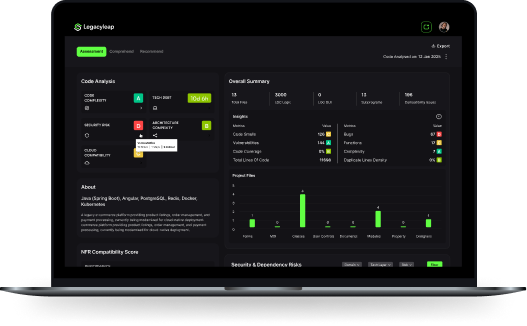
Legacyleap approaches jQuery modernization as a structured, architecture-level transformation. The platform’s agents analyze the legacy system, generate a modernization-ready blueprint, and provide scaffolded outputs that teams can build on with predictability.
System-level comprehension
The platform extracts deep application insights:
- Code graphs showing relationships across files
- DOM operation maps identifying selectors, mutations, and implicit state
- Event propagation trees map how handlers trigger each other
- API call dependencies and data flow
- Global state usage across scripts and utilities
This forms a complete picture of how the existing UI behaves and creates a reliable foundation for modernization planning.
Modernization roadmap
Legacyleap produces a target-state plan that includes:
- Boundary maps that define where components should live
- Suggested component structure for React, Angular, or Vue
- Recommended target framework based on team structure and architecture
- Plugin deprecation and replacement strategy
- State-management and API restructuring guidance
The output is a clear, sequenced path instead of a guesswork-driven rewrite.
AI-generated scaffolding
The platform creates framework-ready scaffolding:
- React, Angular, or Vue component skeletons
- Routing, module organization, and layout shells
- TypeScript-ready structures and interfaces
- Modern build tool configurations (Vite, Webpack, Rollup)
This reduces setup time and standardizes the foundation for all teams.
Assistive refactoring with human-in-the-loop
Legacyleap’s agents support developers as they rewrite:
- Complex procedural flows
- DOM-first logic that must shift to reactive patterns
- Plugin-driven behaviors that require modern equivalents
The combination of automated suggestions + human review avoids brittle or incomplete migrations.
Safety nets
The platform generates guardrails that reduce regression risk:
- Regression tests tied to legacy behavior
- Automated validation of UI flows
- Component-level interaction tests
- Parity comparisons to confirm functional equivalence
These safety nets ensure modernization doesn’t degrade the product.
Deployment and tooling upgrade
Legacyleap also prepares the modern toolchain:
- Build configs for Vite, Rollup, or Webpack
- CI/CD pipelines tailored for the target stack
- ESLint/Prettier rulesets
- Environment-aware scripts for dev/stage/prod
This completes the modernization lifecycle and ensures the new frontend is production-ready.
Conclusion: Execute jQuery Modernization With Architectural Clarity and Control
Modernizing jQuery requires addressing the underlying architecture that has grown brittle over years of procedural logic and DOM-first patterns. Modern frameworks provide the componentization, state clarity, accessibility alignment, and tooling maturity that enterprise teams need for long-term stability.
Gen AI strengthens this transition by accelerating codebase understanding, defining boundaries, generating scaffolding, and creating the tests needed to protect legacy behavior.
Legacyleap turns these capabilities into a controlled modernization process that moves jQuery applications toward modular, maintainable React, Angular, or Vue architectures with verifiable progress at every stage.
The outcome is predictable modernization velocity, reduced regression risk, and higher confidence in each release cycle.
Start with a $0 Assessment to receive a dependency map, risk scan, target-framework recommendation, and a modernization blueprint tailored for your jQuery system.
FAQs
jQuery migrations fail when teams underestimate the architectural complexity hidden inside legacy code. Most issues stem from DOM-driven logic, event chains that are hard to trace, global state scattered across files, and custom plugins that have no modern equivalent. Without a clear dependency map or component boundaries, rewrites expand unpredictably and introduce regressions. This is why successful migrations rely on upfront comprehension rather than jumping straight into refactoring.
A full rewrite isn’t mandatory. Many enterprises migrate incrementally by isolating screens or functional zones and modernizing them one domain at a time. This approach reduces risk, allows parallel development, and avoids freezing feature delivery. Microfrontends or Module Federation can also support controlled coexistence between legacy jQuery and React/Angular/Vue during the transition. The key requirement is a clear boundary map so incremental migration doesn’t create duplicated logic or inconsistent behavior.
Yes. jQuery and modern frameworks can run side-by-side if boundaries are well defined and the shared DOM surface is controlled. Techniques like microfrontends, iframe isolation, or layered containers allow teams to introduce modern components without breaking existing jQuery screens. This setup is common in large enterprises because it supports phased modernization while maintaining production stability.
The primary cost driver is complexity mapping in identifying event flows, DOM dependencies, global state, plugin behavior, and cross-file coupling. jQuery systems rarely have clean boundaries, which increases the effort needed to translate them into modular components. Additional cost factors include replacing custom plugins, establishing a modern toolchain, and generating tests to protect legacy behavior. Projects that skip early analysis typically experience scope creep and extended timelines.
Lack of documentation is common in jQuery projects and doesn’t block modernization. The solution is to reconstruct behavioral understanding from the source code itself, tracing handlers, DOM operations, data flow, and API usage. GenAI tools and static analysis can accelerate this process by generating flow summaries, dependency maps, and behavior outlines. Once the functional picture is clear, teams can plan boundaries, define components, and modernize incrementally with fewer regressions.