


Introduction: Why INP Has Become a Modernization Trigger
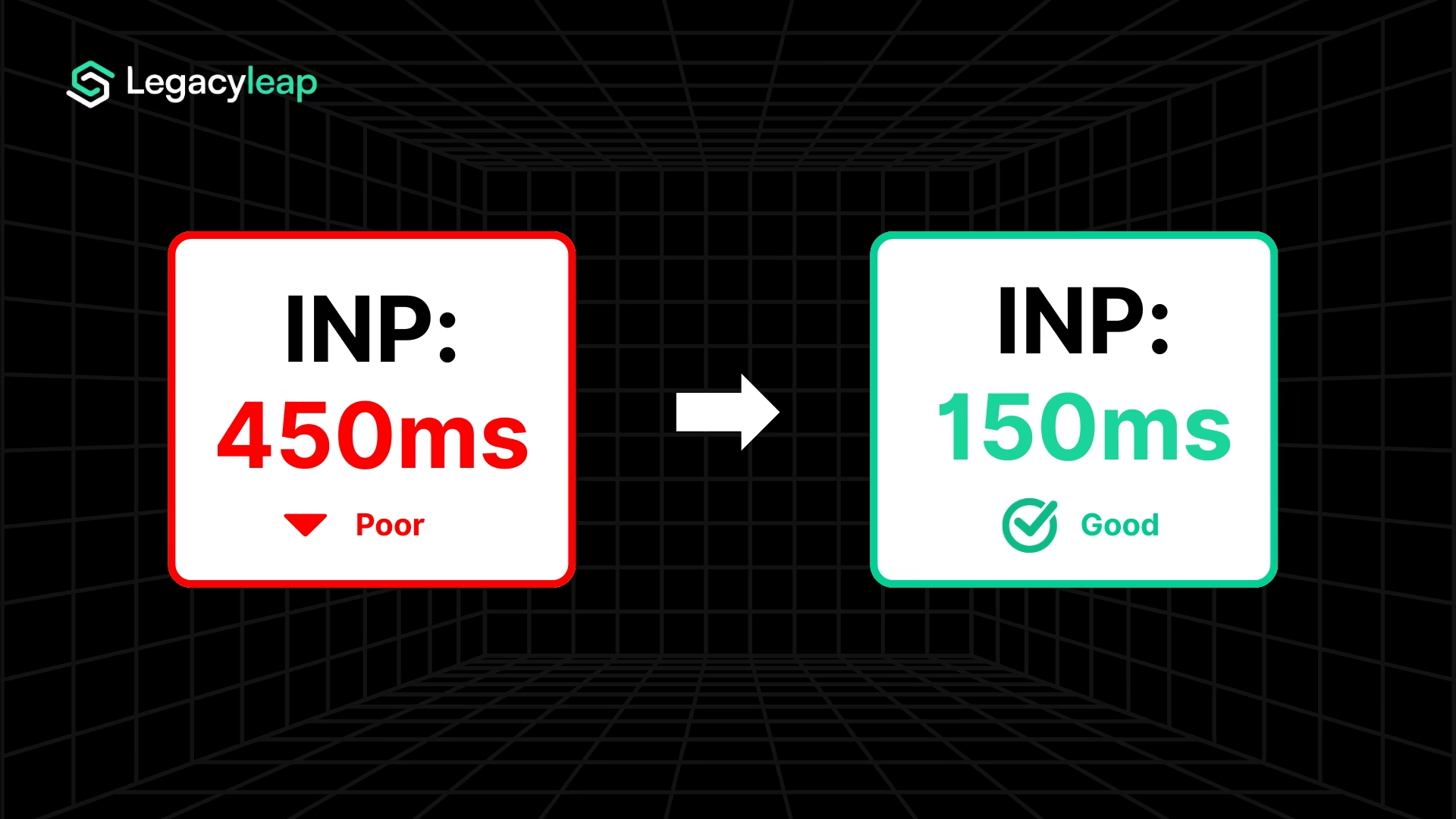
Interaction to Next Paint (INP) is now a primary Core Web Vital and a direct search ranking and quality signal. Google confirmed INP replaced First Input Delay as of March 2024.
Modern enterprise frontends built on older architectures are the ones failing this metric most consistently because the underlying systems weren’t designed for today’s interaction patterns.
Legacy frontends accumulate interaction latency for predictable reasons:
- Long tasks monopolizing the main thread
- jQuery-style DOM mutations scattered across the codebase
- Render-blocking scripts and CSS delivered through outdated build pipelines
- Legacy polyfills and framework runtimes that inflate execution time
- Bundles too large to hydrate without stalling user input
- Monolithic UI layers with no real component boundaries
Teams try the usual fixes like trimming JavaScript, deferring work, debouncing handlers, and still see INP stuck in the “Needs Improvement” range. The limitation isn’t the developer’s skill; it’s the architecture. INP degradation is a symptom of framework age, tooling debt, and structural decisions that no amount of surface-level tuning can meaningfully overcome at enterprise scale.
This is why INP modernization has become a strategic priority. Improving Core Web Vitals for legacy frontends now requires rethinking component boundaries, build systems, hydration strategies, and event flow, work that increasingly benefits from Gen AI-assisted analysis and refactoring.
This blog dives into how organizations can approach Core Web Vitals modernization, where traditional methods fall short, and how emerging Gen AI techniques help teams move beyond incremental fixes toward sustainable, architecture-level improvements.
Why Enterprises Need to Modernize for INP
Most teams sink weeks into trimming JavaScript, refactoring handlers, or deferring work, and INP barely moves. The reason is simple: the bottleneck isn’t the code in front of you, it’s the architecture underneath it.
Poor INP in enterprise frontends comes from structural patterns that no tactical fix can meaningfully correct.
- Long tasks rooted in old UI architectures: jQuery-era applications depend on synchronous DOM operations and sprawling event chains that repeatedly block the main thread. Global scripts fire on every interaction, leaving no room for input responsiveness.
- Legacy build systems that generate heavy JavaScript: Old Gulp/Grunt/Webpack pipelines inflate bundles with code that can’t be meaningfully split. Tree-shaking is unreliable or missing, and global polyfills get injected by default, adding unnecessary execution cost.
- Lack of real component boundaries: When everything lives in a global UI layer, the smallest update triggers cascading re-renders. User input competes directly with layout and script execution, pushing INP into “needs improvement.”
- Non-optimized rendering pipelines: Older frameworks rely on slow or outdated diffing strategies or skip diffing completely. DOM updates happen directly, unbatched, and without any scheduling, amplifying interaction delays under load.
- Outdated dependency stacks: Legacy libraries restrict access to modern performance APIs, event delegation patterns, and browser-level optimizations. Even small improvements become difficult without triggering regressions elsewhere.
- No path to reactive optimization: Without a component-driven architecture, interaction-level tuning becomes entirely manual. There’s no predictable way to isolate interaction hotspots, instrument them, or respond dynamically to user workloads.
You don’t fix INP by optimizing a legacy app, but by modernizing the legacy app. Most INP failures trace back to architectural constraints, not individual lines of code, which is why enterprise teams increasingly treat INP improvement as part of full Core Web Vitals modernization, not a standalone performance task.
How Modern Frontend Architectures Improve INP and Core Web Vitals
Modern frontend architectures improve INP by removing the conditions that create slow interactions in the first place. Rendering, state management, and build tooling work together to reduce long tasks, shrink JavaScript execution costs, and keep the main thread available for user input.
- Component-driven rendering: Only the affected part of the UI updates instead of entire views. Render work is batched and predictable, which keeps interaction paths short and responsive.
- Virtual DOM or compiler-optimized rendering (React, Vue, Angular, Svelte): Direct DOM mutations are minimized, re-render cycles follow a defined pattern, and long tasks are less likely to form during typical interaction flows.
- Modern build systems with smaller JavaScript footprints: Code-splitting, reliable dead code elimination, and conditional polyfills reduce bundle size and execution time, cutting down the delay before the next paint.
- Concurrent and interruptible rendering (React 18+): Rendering can be paused and resumed, allowing the browser to handle user input between chunks of work. This prevents single interactions from blocking the thread for too long.
- Smarter state management models: State updates are scoped and atomic, which prevents cascading re-renders across unrelated components and keeps interaction-related updates contained.
- Better scheduling and offloading options: Work can move to Web Workers, be deferred with requestIdleCallback, or be shifted to GPU-backed animations where applicable. Heavy computation and visual updates no longer compete directly with input handling.
- Built-in support for modern accessibility and interaction patterns: Framework-level focus management and leaner input utilities reduce the amount of custom script required for interactive elements, improving responsiveness for all users.
In these architectures, good INP emerges from the way rendering, state, and assets are structured, rather than from one-off performance fixes added later in the lifecycle.
Also read: Frontend Modernization in 2026: Frameworks, AI, and Governance.
Challenges With Traditional INP Improvement Efforts in Legacy Frontends
Teams often spend months trying to improve INP inside legacy architectures, and the results stay inconsistent. The underlying structures of older frontends create bottlenecks that performance tuning simply can’t remove.
- Legacy architecture offers no path to fine-grained optimization: Everything competes on the main thread, and UI logic, business logic, and rendering are deeply entangled. Even small changes become unpredictable because the architecture never isolated the interaction work in the first place.
- Older build systems fail to produce lean bundles: Gulp, Grunt, and early Webpack pipelines lack reliable tree-shaking, granular code splitting, or conditional polyfills. They generate large, monolithic bundles that inflame hydration cost and delay user input.
- Performance tooling becomes noisy against legacy DOM structures: Lighthouse and browser profilers highlight long tasks that cannot be isolated or addressed without structural changes. Code-level suggestions don’t map cleanly to an architecture designed around global scripts and direct DOM manipulation.
- Fixes tend to be brittle and regression-heavy: Updating a single event handler often creates unintended behavior across unrelated flows. “Localized” improvements collide with global scripts, making every performance change a potential risk.
- INP problems are frequently misdiagnosed: Teams reduce JavaScript weight but overlook rendering patterns that trigger long tasks. They adjust event handlers while ignoring architectural bottlenecks that recreate the same delays under load.
- Full rewrites introduce delays and operational risk: Rebuilds stretch timelines and divert engineering capacity from product work. Manual parity validation adds further risk, especially in large frontends with limited test coverage.
Legacy jQuery, Backbone, AngularJS, or similar architectures cannot be tuned into healthy INP ranges. Meaningful improvement requires modernization, not incremental fixes.
How Gen AI Supports INP-Focused Modernization Efforts
Gen AI doesn’t optimize INP directly. What it does is accelerate the modernization steps that meaningfully influence INP such as the analysis, mapping, refactoring guidance, and scaffold generation that would otherwise take teams weeks or months to complete manually.
- Codebase comprehension at scale: Gen AI can parse large frontends and highlight the structural sources of interaction delays. This includes long tasks and their originating components, blocking scripts that monopolize the main thread, unnecessary or outdated polyfills, DOM-heavy code paths, and areas where synchronous logic repeatedly stalls input handling.
- Architectural mapping of interaction-heavy flows: AI-driven analysis surfaces where state mutations occur, which components re-render more often than expected, how event listeners chain together across the application, and where synchronous API calls sit directly in the interaction path. These insights help teams understand why INP degrades under load.
- Suggested refactor paths for modernization: Gen AI offers guidance on breaking large global scripts into modular components, removing redundant operations, replacing direct DOM manipulation patterns inherited from jQuery-style code, and segmenting state into smaller, more predictable slices. These suggestions shorten the time to reach an architecture that supports good INP.
- Generation of modern scaffolding and migration assets: AI can produce starting templates for React/Vue/Angular components, define lazy-loading boundaries, generate code-splitting configurations, and scaffold build-tool upgrades. This reduces the upfront effort and risk associated with moving a legacy frontend into a modern architecture.
- Automated performance test generation: AI can synthesize interaction-based tests that expose long-task patterns, map pre-modernization vs. post-modernization performance behavior, and create repeatable test flows that align with Core Web Vitals expectations. This removes guesswork when validating INP improvements during refactoring.
What Gen AI cannot do:
It cannot eliminate long tasks by itself, redesign rendering architecture, guarantee immediate INP improvements, or replace the need for modernization. Its value lies in speeding up the steps that lead to sustainable performance gains.
Also read: How Can Gen AI Drive Every Step of Your Modernization Journey?
How Legacyleap Enables INP and Core Web Vitals Improvement Through Modernization
Legacyleap improves INP by modernizing the architecture, tooling, and interaction paths that determine how quickly a frontend responds to user input.
The platform focuses on the structural elements that shape Core Web Vitals – comprehension, refactoring guidance, toolchain upgrades, and validation – so that better INP becomes a natural outcome of the modernization process.
- Code graph–driven analysis of long-task patterns: Legacyleap maps the entire frontend into a semantic graph and identifies structural bottlenecks responsible for interaction delays. This includes synchronous flows buried inside UI logic, nested loops that monopolize the main thread, chains of event handlers that fire sequentially, and heavy DOM operations spread across legacy scripts. The analysis removes guesswork and shows teams exactly where INP degradation originates.
- Migration-ready modernization blueprints: The platform outputs detailed modernization plans that define component boundaries, outline data-flow decomposition, and highlight opportunities to introduce async rendering. It also flags patterns that repeatedly inject blocking scripts into the interaction path. These blueprints give teams a practical, traceable roadmap for shifting to an architecture that inherently improves responsiveness.
- Toolchain modernization built into the workflow: Legacyleap produces upgrade configurations for modern build tools such as Vite, esbuild, Rspack, and Rollup. It also rewrites polyfill strategies so the final bundle includes only what the app truly needs. This directly reduces JavaScript weight, lowers execution cost, and shortens hydration time, all of which contribute to better INP outcomes.
- Assistive refactoring agents for interaction-focused cleanup: The platform supports developers in breaking down monolithic UI files, eliminating blocking patterns, and converting synchronous flows into asynchronous ones where safe. It guides the restructuring of rendering paths and prioritizes work that reduces main-thread contention during interactions.
- Safety nets that prevent performance regressions during migration: Legacyleap generates interaction-focused tests that measure latency, compare pre- and post-modernization performance, and ensure component isolation behaves as expected. These checks protect teams from introducing new INP issues while improving old ones.
- Deployment outputs optimized for modern runtime performance: The final builds produced through Legacyleap include code-splitting, well-defined lazy-load boundaries, reliable tree-shaking, and minimized polyfill footprints. These optimizations bring the runtime environment closer to what modern frameworks expect, reducing JS cost and interaction delays across the board.
The core idea remains simple: Legacyleap doesn’t “fix INP.” It modernizes the architecture, tooling, and interaction patterns that make healthy INP achievable and repeatable. Performance improves because the system is rebuilt to support it, not because of temporary tuning.
Wrapping Up: Modernization as the Sustainable Path to INP Improvement
Enterprise INP issues originate in legacy architectures, not in isolated event handlers or surface-level code patterns. Performance tuning can reduce symptoms for a short period, but it rarely resolves the structural causes that block the main thread, inflate JavaScript weight, or stall rendering during interactions.
Consistent INP improvement comes from modern architecture, modern tooling, and clear component boundaries, the foundations that prevent long tasks from forming in the first place. Gen AI accelerates the analysis and modernization workflow, but the performance gains emerge from the upgraded system, not from AI acting on INP directly.
Legacyleap enables this shift by providing a structured, verifiable modernization path: deeper comprehension, safer refactoring, toolchain upgrades, and performance-focused validation. As the architecture evolves, Core Web Vitals (including INP) begin to reflect the benefits of a frontend built for today’s interaction patterns.
INP modernization and Core Web Vitals improvement through modernization depend on sustainable structural change, not tuning. Modernization is the durable path forward.
See how modernization accelerates when architecture, code comprehension, and refactoring are handled with precision. Book a demo to explore Legacyleap in action.
Or get a no-cost, risk-free analysis of your legacy frontend, including architectural bottlenecks that impact INP with a $0 assessment today.
FAQs
INP measures how quickly a page responds to user interactions across the entire session, making it fundamentally different from LCP (loading) and CLS (visual stability). It reflects the combined impact of JavaScript execution, rendering, and event handling on real user workflows. For enterprise frontends, INP is more revealing because it surfaces architectural and interaction-level bottlenecks that other Core Web Vitals often miss.
INP should be measured using real user monitoring rather than lab tools alone. While Lighthouse can highlight long tasks, accurate INP assessment depends on field data captured from actual user interactions in production. For enterprise applications, this data must be segmented by route and interaction type to identify where architectural constraints are degrading responsiveness.
Effective INP improvement on highly interactive pages comes from reducing main-thread contention through structural changes. Component isolation, predictable state updates, modern rendering pipelines, and smaller JavaScript execution paths prevent interactions from being blocked. Tactical optimizations may help temporarily, but sustainable gains depend on architectural patterns that avoid long tasks altogether.
INP issues require modernization when repeated tuning efforts fail to produce stable improvements. Persistent long tasks, interaction delays tied to global scripts, and fragile fixes that cause regressions are strong indicators of architectural limits. When optimization becomes manual and unpredictable, the frontend needs a structural change rather than further tuning.
INP improvement rarely requires a full rewrite, but it also cannot be achieved through isolated tuning alone. Platforms like Legacyleap support incremental modernization by identifying interaction-heavy areas, defining safe component boundaries, and guiding phased refactoring while preserving functional parity. This approach reduces risk while addressing the architectural causes of poor INP.
INP modernization timelines depend more on architectural complexity than codebase size. With platforms such as Legacyleap, enterprises can accelerate assessment, generate modernization blueprints, and validate changes continuously, allowing measurable Core Web Vitals improvements to appear within weeks rather than months. Full modernization is typically phased, enabling predictable progress without disrupting delivery.