TL;DR
- ERP migration budgets in private equity blow up for a predictable reason: the legacy code and data sitting inside and around the ERP were never scoped. Custom extensions, bolt-on legacy applications, and unclean source data routinely double or triple a re-platform’s cost once discovered mid-project, and the vendor chosen has little to do with it.
- A full ERP re-platform typically runs 2 to 4% of company revenue, with a two-to-four-year payback window, and that estimate assumes the source data and integrations feeding the ERP are already understood, an assumption technical due diligence checklists rarely test.
- ERP consolidation and ERP integration are different operating-model decisions, not interchangeable terms for the same project. One moves a portfolio company onto a shared instance; the other connects two systems while keeping them separate. A carve-out’s transition services agreement usually decides which one is even possible on time.
- Standardizing an entire portfolio on one ERP instance is rarely the right call. A shared chart-of-accounts template and a repeatable migration playbook across separate instances usually beats forcing every portfolio company into one database.
- Legacy ERP condition shows up directly in the exit multiple a buyer is willing to pay. Private equity investors expect a valuation haircut exceeding 10% more than half the time when a portfolio company’s ERP has reached end of life.
ERP migration in private equity comes down to three recurring failures: a cost estimate that assumes clean source data, a timeline that assumes the system is already documented, and a due diligence checklist that stops at confirming the ERP exists and runs rather than pricing what modernizing it actually requires.
This piece uses ERP migration, ERP integration, and ERP consolidation to describe related but distinct parts of the same underlying work, deal-driven system change inside a private equity portfolio company, whether the trigger is an add-on acquisition, a carve-out, or a pre-exit clean-up.
Existing coverage of this topic treats the ERP itself as the unit of analysis: which vendor, which implementation partner, which phased rollout plan. The costlier problem usually sits one layer below the ERP, in the custom code and unclean data that feed it, and that layer is rarely scoped before a migration budget gets approved.
What Is an ERP Migration in a Private Equity Context, and Why Does It Happen on a Compressed Timeline?
An ERP migration in a private equity context is a deal-driven system change inside a portfolio company, triggered by an add-on acquisition, a carve-out, or a pre-exit clean-up, and it runs on whatever timeline that deal sets rather than a timeline the IT team would otherwise choose. It almost never starts as an internally-initiated modernization cycle.
Three triggers account for most of these projects, and each comes with a different constraint:
| Trigger | Timeline pressure | Primary technical risk |
| Add-on / bolt-on acquisition | Weeks to months, tied to the integration plan | Two systems, two sets of undocumented customizations |
| Carve-out from a seller | Bound by the transition services agreement | A shared instance and commingled data with a contractual exit deadline |
| Pre-exit clean-up | 12 to 24 months before a sale process | The legacy state has to look clean to a buyer’s own diligence team |
A vendor-level deadline is compressing this further across the market. SAP’s ECC platform reaches end of life in 2030, and that single date now affects an estimated 726 PE-backed companies, roughly a fifth of which have not yet started the transition [1].
Only 25% of PE firms have a dedicated team managing ERP transitions across their portfolio [1], which is a large part of why a migration inside any single portfolio company still gets run as a one-off IT project instead of a program with a reusable playbook.
What Is Private Equity ERP Integration vs. ERP Consolidation?
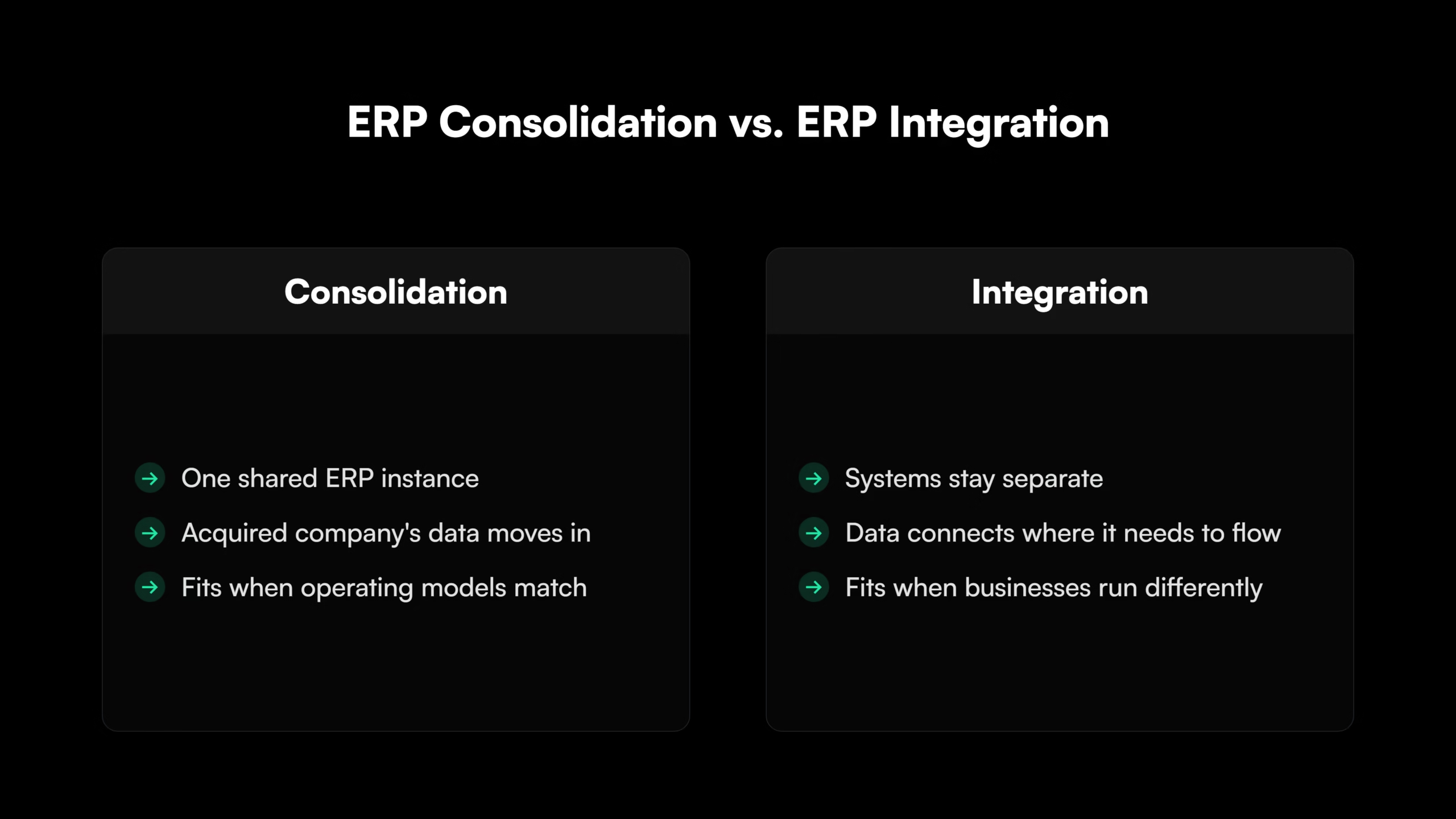
ERP consolidation means moving an acquired or portfolio company onto a shared ERP instance, usually the parent’s. ERP integration means keeping the systems separate while connecting whatever data has to flow between them for reporting or day-to-day operations. They solve different problems, and treating them as the same decision is where a lot of post-acquisition ERP planning goes wrong.
- Consolidation fits when the businesses share an operating model and the parent’s system can absorb the acquired company’s requirements.
- Integration fits when the businesses run differently enough, by product, customer base, or regulatory posture, that a shared instance would distort more than it simplifies.
The factor most published checklists underweight is the condition of the source systems themselves: how much of each ERP’s customization, integration, and data structure is actually documented. A business-similarity test can say two companies belong on one instance and still miss that one of them is running years of undocumented custom logic that has to be understood before any migration, consolidation, or integration touches it.
When the trigger is a carve-out, the decision runs against a transition services agreement, not a project plan the portfolio company controls on its own. A simple separation with minimal shared systems typically runs 6 to 9 months.
A carve-out built on a single, entangled ERP instance and commingled customer data typically runs 18 to 36 months [2], and IT is usually the workstream that gates every other function’s exit from the TSA, because finance, sales operations, and reporting cannot leave the shared system until the underlying ERP actually moves.
How Much Does an ERP Migration Cost for a PE Portfolio Company, and What’s Usually Left Out of That Estimate?
A full ERP re-platform for a PE portfolio company typically costs 2 to 4% of annual revenue, with a payback window of two to four years [1], and that estimate typically leaves out the cost of understanding the legacy code and data feeding the ERP. For a $500 million revenue company, the headline figure is a $10 to $20 million program, sized to fit inside a standard holding period.
That figure assumes the underlying source data is already understood and the integrations feeding the ERP are already mapped. Almost none of the public estimates quoting this range say so explicitly, and the gap between what the estimate assumes and what most portfolio companies can actually verify at the time the budget is set is the subject of the next section.
Why Do ERP Migration Timelines and Budgets Blow Up, and Why Is Undocumented Legacy Code and Data Usually the Real Cause?
ERP migration timelines and budgets blow up when the custom code and data sitting inside and around the ERP were never scoped before the project started, and that layer breaks more budgets and timelines than the ERP vendor chosen.
That layer is bespoke extensions written years ago, bolt-on legacy applications feeding or consuming the ERP’s data, and source data that has never been fully mapped or validated. None of that shows up on a vendor comparison sheet, and checklist-driven due diligence rarely goes looking for it.
Technical debt, the umbrella category this problem falls under, now consumes roughly 40% of the average enterprise IT balance sheet, and organizations carrying high technical debt are roughly 40% more likely to see a modernization initiative fail outright [3].
An ERP migration inherits whatever technical debt already exists in the systems around it. A migration budget built without first assessing that debt is a budget built on an assumption nobody tested.
PE portfolio companies commonly operate under exactly this constraint: a lean IT team, a fixed budget, and a legacy system extended for decades without anyone maintaining full documentation.
Start a $0 Modernization Assessment
A $0 Modernization Assessment maps the custom code and bolt-on applications feeding a portfolio company’s ERP and validates the data behind it, before the migration budget is finalized rather than after it is blown, at no cost and from inside the portfolio company’s own environment.
Should Every Portfolio Company Standardize on One ERP, or Keep Systems Separate?
Standardizing an entire portfolio on one ERP instance is rarely the right call.
A representative mid-market portfolio’s current, fragmented ERP stack can cost $210,000 to $680,000 a year in aggregate, against a per-portco re-platform onto a standardized template running roughly $50,000 to start plus around $2,000 a month in hosting [4]. The economics favor a standardized playbook and chart-of-accounts template applied instance by instance over a single mega-database that forces every entity’s legal books through one schema.
That question usually surfaces after the third add-on acquisition makes portfolio-level reporting fragmentation visible.
How much undocumented legacy code and data each portfolio company carries matters more for this decision than how similar the businesses look on paper. A standardized template only compounds savings across the portfolio if the mapping work behind it is genuinely reusable, and that is only true once each portfolio company’s underlying system has actually been assessed rather than assumed to be simple.
Roughly 40% of portfolio companies are held five years or longer, with an average exit around seven years [4], a long enough horizon that a repeatable standardization decision made early is worth getting right rather than revisiting company by company.
Readers weighing whether to upgrade, modernize, or replace a single portfolio company’s ERP outright, independent of the portfolio-wide standardization question, can work through Legacyleap’s general ERP modernization framework for that narrower decision.
What Should ERP Due Diligence Catch Before the Deal Closes, Not After?
ERP due diligence should price what it costs and how long it takes to fix the legacy code and data around the ERP. Confirming that the system exists and runs falls short of that, and most published technical due diligence checklists never go further.
The same diagnosis-without-execution gap shows up across a private equity deal’s broader technical due diligence, of which the ERP is one slice among several. A manual review of an ERP’s surrounding code and data typically takes weeks, sampling a handful of integrations and interviewing whoever is left who remembers how the system was built. A code-level assessment covering the same ground, run directly against the codebase rather than through interviews, can be produced in days instead of weeks.
That speed matters most before a letter of intent is signed. Running the assessment early means the cost of the legacy code and data layer gets priced into the offer instead of discovered during exclusivity, when the seller has already granted the buyer exclusive negotiating rights and has less leverage to renegotiate around what diligence finds.
Start a $0 Modernization Assessment
A $0 Modernization Assessment produces the same legacy code and data map a manual technical due diligence engagement takes weeks to assemble, in days, before terms are signed rather than after.
How Does ERP and Underlying Legacy System Condition Affect Private Equity Exit Valuation?
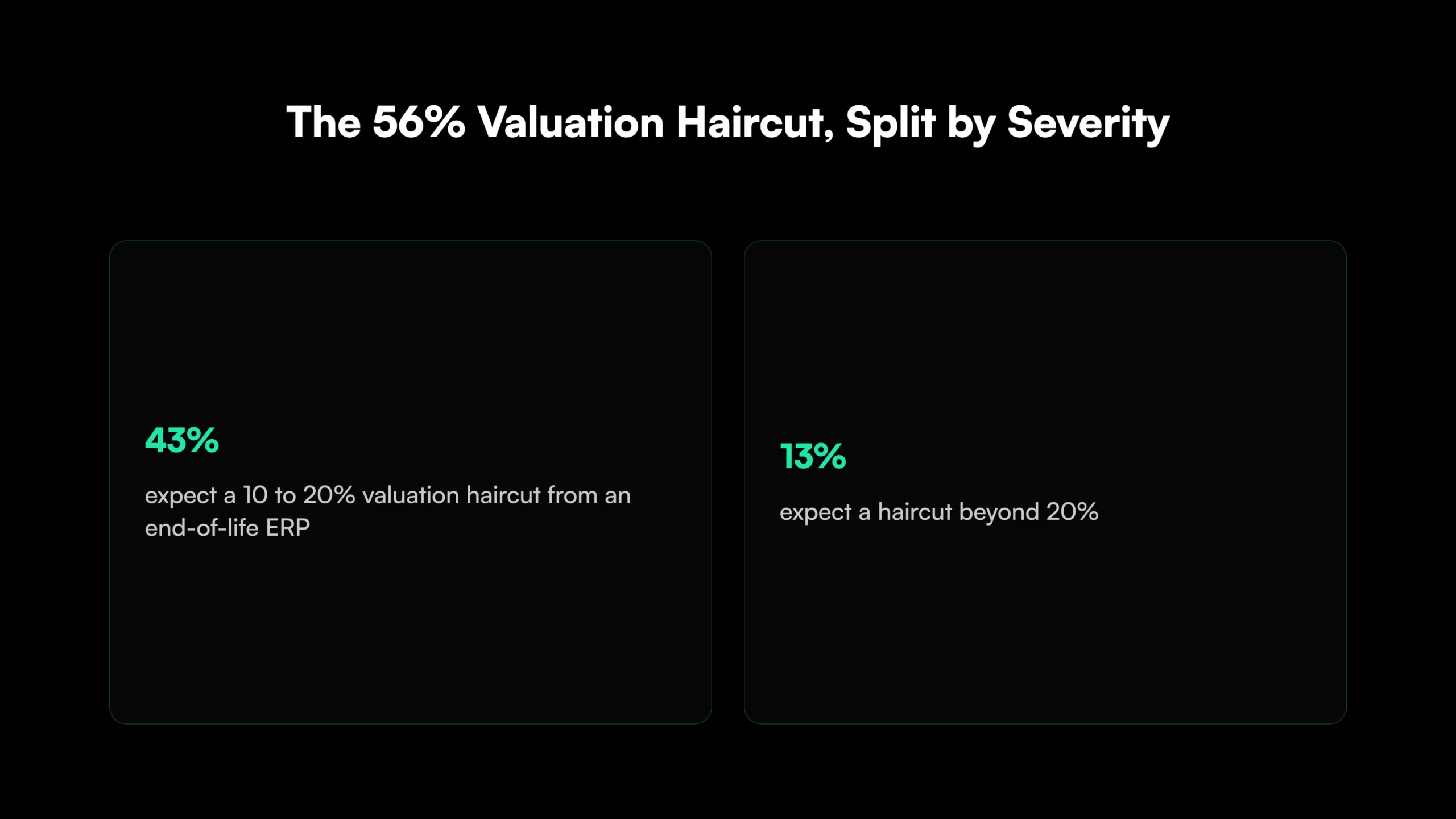
Legacy technology reduces the multiple a buyer will pay, and ERP condition specifically is priced into that discount. More than half of PE investors, 56%, expect a valuation haircut exceeding 10% when a portfolio company’s ERP has reached end of life [1]. Of that group, about 43 points expect a reduction of 10 to 20%, and about 13 points expect a reduction beyond 20%.
The haircut prices a buyer’s diligence team finding the same undocumented legacy code and unclean data this piece has been describing, discovered on the buyer’s timeline instead of disclosed on the seller’s. The fuller research on when exit-readiness preparation should start, beyond the ERP piece of it, is covered in Legacyleap’s private equity data modernization research.
How Legacyleap’s Gen AI Agents Modernize the Legacy Code and Data Behind an ERP Migration
Legacyleap does not implement or configure the ERP itself. It does not stand up NetSuite, configure Dynamics 365, or run chart-of-accounts harmonization. What it modernizes is the layer this piece has been describing: the custom code, the bolt-on legacy applications, and the data that has to be clean and mapped before any ERP migration, consolidation, or integration can proceed safely.
Legacyleap is a Gen AI-powered legacy application modernization platform built on multi-agent orchestration, running that layer through the same lifecycle discipline regardless of which ERP a portfolio company lands on:
- The Assessment Agent and Documentation Agent produce the dependency map and reconstruct the business logic, data flows, and integration behavior of the custom code and bolt-on applications feeding the ERP, in 2 to 5 days, directly from the codebase rather than from whoever is left who remembers building it.
- The Modernization Agent then executes the code and data-layer changes as diff-based, human-reviewed pull requests, roughly 70% automated, with engineering review governing the rest. No code merges, deploys, or executes on its own.
- The QA Agent validates parity against the legacy baseline before cutover: unit, integration, regression, and functional tests generated and run before anything goes live against the same financial data an ERP depends on.
| Manual, checklist-driven approach | With Legacyleap | |
| Mapping the custom code and bolt-on apps feeding the ERP | Weeks, sampled interviews and file reviews | 2 to 5 days, produced from the full codebase |
| Reconstructing undocumented data flows and business logic | Tribal knowledge, often incomplete | Extracted directly from code behavior |
| Executing the code and data-layer changes | Fully manual engineering time | Roughly 70% automated, diff-based and human-reviewed |
| Validating nothing broke before cutover | Ad hoc, often compressed under deal timelines | Unit, integration, regression, and functional tests generated and run before cutover |
The $0 Modernization Assessment is the entry point, scoped specifically to this layer rather than to the ERP project as a whole. It runs entirely inside the portfolio company’s own environment, with no source code leaving that environment, which matters in a due diligence context where source access is already one of the more sensitive asks a deal team makes.
Conclusion: Scope the Legacy Code and Data Before the ERP Vendor
ERP migration in private equity succeeds or fails on a layer most cost estimates, timelines, and due diligence checklists never actually test: the custom code and data sitting inside and around the ERP. Vendor choice, consolidation-versus-integration, and standardization all matter, but none of them hold if that layer was never scoped.
Ready for a Plan Sized to Your System?
A $0 Modernization Assessment scopes the legacy code and data behind an ERP migration before the budget, the vendor, or the standardization decision gets locked in, delivered in 2 to 5 days from inside your own environment, at no cost.
Book a Technical Demo
See how Legacyleap’s agents handle whole-estate comprehension and parity validation on a codebase like yours.
Frequently Asked Questions
Consolidation moves an acquired or portfolio company onto a shared ERP instance. Integration keeps systems separate while connecting the data that has to flow between them. The choice is an operating-model decision as much as a technical one.
No single platform fits every portfolio company. Scale, industry, and existing customizations drive the choice more than any general ranking, and vendor selection sits outside what a code and data modernization assessment evaluates.
It usually stays on the seller’s shared instance under a transition services agreement. A simple separation runs 6 to 9 months; one built on a single, entangled ERP instance typically runs 18 to 36 months.
It can, when the migration touches the same data feeding those reports without a validated parity check before cutover. That risk is why parity validation belongs in the migration plan alongside the go-live date.
Most often when nobody internally owns the technical scoping, a common gap right after an add-on acquisition or a carve-out, before incoming finance leadership has visibility into the legacy systems involved.
Yes. More than half of PE investors expect a valuation haircut exceeding 10% when a portfolio company’s ERP has reached end of life, and a meaningful share expect more than 20%.
References
[1] BCG. Learning to Love ERP Migrations in Private Equity
[2] BD Emerson. Transition Services Agreement Guide
[3] Kenway Consulting. ERP Modernization in Private Equity: A Value Creation Framework
[4] Del AI. ERP Standardization for Private Equity Portfolio Companies: The Post-Acquisition Playbook