TL;DR
- New carrier onboarding takes 6 to 8 weeks on legacy EDI systems versus hours on a modern API layer. US business logistics costs hit $2.6 trillion in 2024, 8.8% of GDP, while 15 to 20 full-time staff at a typical operation still handle manual reconciliation a modern system would eliminate.
- Ransomware has already taken down major US logistics infrastructure through exactly this kind of unpatched legacy system. Rhysida ransomware took the Port of Seattle offline for three weeks in August 2024 with legacy systems confirmed as the attack surface, impacting 90,000 individuals and demanding $6 million.
- Replacing one logistics system at a time keeps failing because the eight systems in the stack don’t talk to each other. A $3 million Oracle TMS implementation was rolled back to the legacy system after two years because it could not replicate carrier rate logic that existed only in undocumented code.
- SAP WM’s support deadline has already passed, and there’s no upgrade path to its replacement. Mainstream support ended December 31, 2025, extended maintenance runs only through December 2027, and every custom pick sequence and billing rule must be re-implemented from scratch in SAP EWM.
- Big-bang cutovers don’t work when freight is already in transit and carriers are waiting on status. A viable modernization program requires phased, parallel, validated cutovers where the new system runs alongside legacy infrastructure until parity is confirmed across the full operational surface.
The Logistics Stack Is Breaking, and Replacing One System at a Time Will Not Fix It
US business logistics costs reached $2.6 trillion in 2024, representing 8.8% of GDP [1]. The operational performance running beneath that number tells a clearer story than the dollar figure: new carrier onboarding on a legacy EDI system takes 6–8 weeks.
The same process on a modern API layer takes hours. Route planning that takes 4–8 hours on a legacy TMS is reduced to minutes on an AI-native architecture.
In most logistics operations, 15 to 20 full-time staff are performing manual reconciliation and exception handling that a modern system eliminates entirely.
The security consequences compound the operational ones. In August 2024, Rhysida ransomware took the Port of Seattle offline for three weeks. Legacy systems were confirmed as the attack surface in the port’s own post-incident investigation. Ninety thousand individuals were impacted, and $6M in ransom was demanded [2].
Seven months earlier, DragonForce ransomware hit Ward Transport and Logistics: 574GB exfiltrated, operations halted, a $350K class action settlement [3].
These are not isolated incidents. They are the documented outcome of running a logistics infrastructure that cannot be patched on a modern cadence.
The underlying problem is not that individual systems are aging. It is that US logistics companies are running an interdependent stack (TMS, WMS, freight audit, EDI, fleet management, visibility platforms, and data pipelines) where years of operational intelligence exist only in custom code.
Carrier rate logic. Pick and pack sequences. Accessorial validation rules. Dispatcher exception trees. None of it is in a system of record. Most of it was never documented.
This is why replacing one system at a time has repeatedly failed. A commercial TMS cannot replicate carrier rate complexity it has never seen. A new WMS cannot handle custom pick sequences it was never told about. The undocumented rules surface as exceptions, disputes, and manual overrides within 60 days of cutover, and the program collapses.
This article maps the complete logistics technology stack, names the failure patterns that end programs exactly like the ones US logistics operators are running today, and describes what governed full-lifecycle modernization looks like when freight cannot stop.



The Logistics Technology Stack: Eight Systems and Twenty Years of Custom Code
Most US logistics operators know they have a legacy problem. Fewer have a complete picture of where the complexity actually lives across their stack. The table below maps all eight systems, the legacy technology typically running each one, and the specific modernization challenge each carries.
| System | Function | Legacy Technology | Modernization Challenge |
| Transportation Management (TMS) | Carrier selection, rate quoting, load tendering, shipment tracking | Java EE, .NET Framework, custom-built platforms | Carrier rate logic, accessorial schedules, and dispatcher heuristics are embedded in application code, not in configuration |
| Warehouse Management (WMS) | Receiving, putaway, pick/pack/ship, inventory control | SAP WM, custom .NET, legacy Java | SAP WM mainstream support ended December 31, 2025. Custom pick sequences, FIFO/LIFO/FEFO rules, and 3PL client billing logic exist only in application code |
| Order Management (OMS) | Order ingestion, allocation, fulfillment routing | Custom .NET, older Java EE, AngularJS front-ends | Order rules and allocation logic are frequently hardcoded. AngularJS modernization is often required for customer-facing portals |
| Freight Audit and Payment | Invoice validation, carrier contract enforcement, dispute resolution | VB6, .NET Framework | The most custom-built and least-visible component in most logistics stacks. Carrier contract terms, accessorial validation rules, and disputed charge logic exist nowhere but the application code. A failed migration here breaks carrier payment accuracy across the network |
| Fleet Management | Asset tracking, driver assignment, maintenance scheduling | Delphi, older .NET | Often disconnected from the TMS entirely. Delphi modernization is a distinct workstream from the rest of the stack |
| EDI / API Integration Layer | Trading partner data exchange, carrier onboarding, document standards | ANSI X12 batch (EDI 204, 214, 856, 210) | Legacy EDI updates every 4–24 hours. New carrier onboarding via EDI takes 6–8 weeks; via API, hours. Eliminating EDI is not realistic; maintaining backward compatibility while building API-first for new partners is the operational path |
| Visibility Platforms | In-transit tracking, exception management, customer portals | AngularJS, older .NET MVC | Real-time visibility requires an event-driven data architecture that the legacy stack was not built to support |
| Analytics and ETL Pipelines | Demand forecasting, rate optimization, reporting | SSIS, Informatica, Ab Initio | ETL modernization is the prerequisite for AI-driven forecasting, rate optimization, and dynamic pricing. Migration to Azure Data Factory commonly produces a 30–50% reduction in ETL maintenance costs |
TMS: Where the Most Valuable Logic Is Buried
For a transportation management system modernization program to succeed, the rate engine must be comprehended before it is replaced. Most TMS platforms running US freight today are built on Java EE or .NET Framework, with carrier rate tables, fuel surcharge logic, and accessorial schedules that accumulated over ten to fifteen years of carrier negotiations. That logic did not come from a software vendor. It was built by operations teams, line by line, in response to actual freight contracts.
A commercial TMS is evaluated against a requirements document. The requirements document describes the rules that were documented. The undocumented ones, such as the edge cases, the heuristics the dispatch team has used for years, or the carrier-specific exceptions, are not in any requirements document. They are in the code.
For Java EE modernization patterns specific to enterprise TMS stacks, Legacyleap’s Java EE migration guide covers dependency mapping and service extraction in detail.
WMS: A Hard Deadline That Has Already Passed
SAP WM mainstream support ended December 31, 2025. The module has been degraded to Stock Room Management with no security patches and no regulatory compliance updates. Extended maintenance runs until December 2027, but that runway is shorter than it appears.
There is no upgrade path from WM to SAP EWM. It is a full new implementation. Wave management, cross-docking logic, and AS/RS integration must be re-implemented from scratch. Every custom pick sequence, FIFO/LIFO/FEFO rule, and 3PL client-specific billing workflow built on top of SAP WM must be identified, documented, and reproduced before EWM implementation begins, not during it. Running that discovery in parallel with implementation is one of the most reliable ways to produce a failed cutover.
Freight Audit and Payment: The Highest-Risk Migration in the Stack
Freight audit is the component most US logistics operators underestimate. .NET Framework migration work on freight audit systems consistently surfaces complexity that was not visible from outside the codebase: carrier contract terms encoded as conditional logic, accessorial fee tables embedded in stored procedures, and dispute resolution workflows that exist only as institutional knowledge translated into VB6.
A freight audit migration that skips the comprehension phase does not produce an isolated billing error. It produces a billing error at scale, across every carrier in the network, simultaneously.
EDI and APIs: The Hybrid Architecture Is Not Optional
The instinct to eliminate EDI entirely and move to API-first carrier integration overlooks the operational reality: established US carrier partners run on EDI, and renegotiating those data exchange agreements takes longer than a modernization program.
The correct architecture maintains backward EDI compliance for established partners and builds API-first onboarding for new carrier relationships. Those two objectives are not in conflict. They represent the current state of US logistics operations, and any modernization program that ignores it will stall at integration.
ETL and Analytics: The AI Prerequisite Nobody Wants to Acknowledge
SSIS and Informatica pipelines running logistics data warehouses are frequently 10–15 years old with no current documentation. They are also the prerequisite for every AI initiative in the logistics roadmap. A demand forecasting model cannot run on batch-updated freight data.
A dynamic pricing engine cannot respond to market conditions; it only sees every four hours. SSIS pipeline migration to Azure Data Factory or Databricks is not a data infrastructure upgrade in isolation. It is the architectural precondition for AI-enabled logistics operations.
These Systems Do Not Talk to Each Other
The stack table above describes eight systems. What it does not show is the gap between them.
The TMS does not know what the WMS has allocated. The WMS does not know what the OMS has promised. The OMS does not have visibility into what the TMS has tendered to carriers. These systems were built and procured independently, often years apart, by teams with different priorities and no shared data model.
The connective tissue between them is not an integrated architecture. It is Excel, email, and the institutional memory of staff who have been manually bridging the gaps for years.
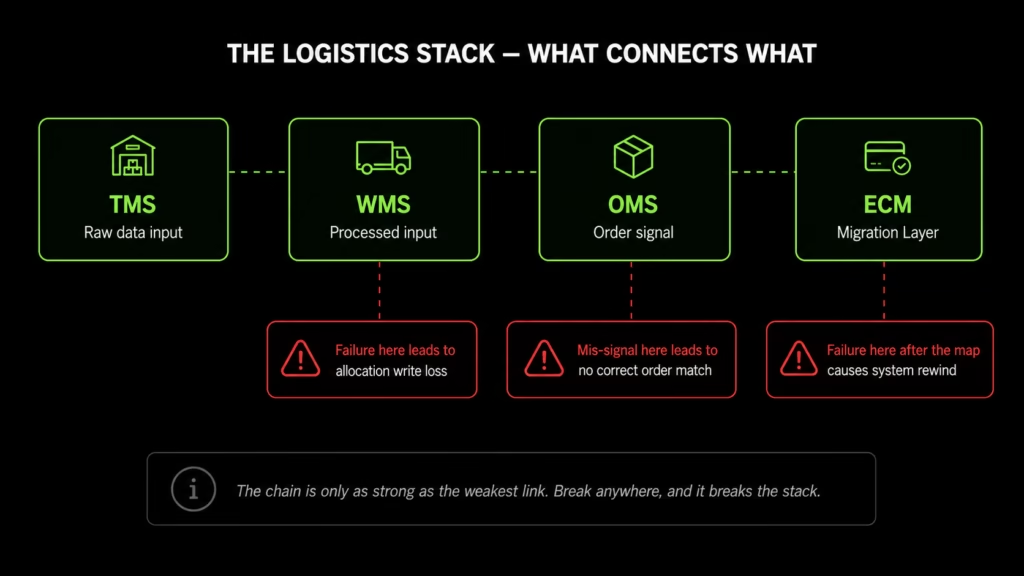
This is the structural reason single-system replacement programs fail. A new TMS is implemented correctly and still breaks within 60 days, because the allocation state it depends on from the WMS is arriving late, manually, and without the exception logic the old system had quietly handled for years. The failure looks like a TMS problem. It is an integration problem that the TMS replacement exposed.
Any modernization program that treats these systems as independent workstreams will eventually discover the dependencies the hard way, at cutover, under operational pressure, with live freight in transit.
Four Reasons US Logistics Technology Decisions Cannot Wait in 2026
The pressures below are not risks on a five-year planning horizon. Each one carries a hard date, a documented financial consequence, or a structural effect that is already compounding.
Driver 1: SAP WM Is Already Past Its Deadline
Mainstream support ended December 31, 2025. Any US warehouse operation still running SAP WM is operating on infrastructure with no security patches and no compliance updates. Extended maintenance covers the period through December 2027, but that window is closing.
An EWM migration for a mid-size operation requires 12–18 months minimum. Starting in late 2026 to meet a December 2027 deadline is not a recovery plan. Every quarter of delay narrows the margin for a governed, tested migration and increases the probability of a compressed, high-risk cutover.
Driver 2: Ransomware Is Targeting Legacy US Logistics Infrastructure
The average US data breach cost $10.22M in 2025, up 9% year-over-year. Ransomware incidents averaged $5.08M [4]. Transportation consistently ranks among the top five most-attacked sectors in the country.
The Port of Seattle incident is the clearest available case study [2]. Legacy systems were the confirmed attack surface. The operational disruption lasted three weeks. Ward Transport’s 574GB exfiltration in March 2024 followed the same structural pattern: legacy infrastructure that could not be segmented, could not be patched on a modern cadence, and could not contain an active incident [3].
According to Verizon’s 2025 Data Breach Investigations Report, 44% of breaches involved ransomware, and 60% stemmed from third-party compromises [5]. That second figure is particularly relevant for logistics networks where data flows across dozens of carrier and partner systems daily.
Legacy logistics infrastructure was not designed to defend against modern ransomware. Patching it fast enough to keep pace with current threat cadences is not operationally viable. For a closer look at how technical debt compounds this exposure, see Legacyleap’s analysis of the per-shipment cost of technical debt.
Modernization in this context is a security architecture decision.
Driver 3: AI Is Blocked by Batch Architecture
Only 35% of US logistics firms are actively deploying AI, compared to 51% in retail and 47% in financial services. The gap is not a strategy problem. It is an architecture problem.
A batch-EDI legacy system cannot feed AI decisioning. The data arrives hours after the operational event. Route planning that takes 4–8 hours on a legacy TMS is reduced to minutes with an AI-native architecture, but that capability requires real-time event streams, not batch updates. When a 3PL connects a route optimization model to a legacy TMS, integration engineering alone can consume 40–60% of the total project timeline.
Industry analysts project that 33% of enterprise software will include agentic AI by 2028. The US logistics operators positioned to capture that shift are the ones rebuilding their data architecture now, not in response to a deadline.
Driver 4: The Engineers Who Built These Systems Are Leaving
This is the least visible pressure and often the most operationally damaging. When the engineer who built the rate engine retires, the embedded logic in that system does not retire with them in a documented form. It becomes inaccessible. The pick sequence heuristics, the dispatcher exception trees, the EDI maps accumulated over 15 years of carrier negotiations – none of it transfers automatically.
The compensation market is already reflecting this scarcity. Legacy skill sets in VB6 and older Java EE have seen sustained upward compensation pressure while cloud-native talent has become more available and cost-competitive. Organizations that modernize proactively reduce operational risk by an average of 35% and reach AI-readiness two to three times faster than those that delay.
The Convergence Point
These four pressures are not sequential. A US logistics operator managing SAP WM end-of-support, a post-incident security review, a stalled AI initiative, and a pending TMS architect retirement is facing all four simultaneously. The cost of delay does not add across these pressures. It compounds.
Why US Logistics Modernization Programs Fail
Logistics modernization does not fail randomly. It fails in recognizable, repeatable patterns. Each one traces to the same structural root cause: programs begin execution before comprehension is complete.
Pattern 1: Commercial Replacement Without Comprehension
A major US logistics operator ran a $3M Oracle TMS implementation for two years. At cutover, the legacy system was restored. The commercial platform could not replicate carrier rate logic and accessorial schedules that existed only in the legacy codebase. The undocumented rules surfaced as exceptions, disputes, and manual overrides within 60 days.
This is not a vendor selection failure. The platform was implemented correctly against the requirements it was given. The requirements did not capture what no one had documented. This is the core problem with tightly coupled logistics systems: the logic is in the code, not in the specification.
Pattern 2: WMS Parallel-Run Paralysis
A warehouse operation runs 18 months of parallel run, absorbs $3M in sunk cost, and still handles live production on the old WMS because the new system cannot process custom pick/pack logic. The system was scoped correctly. The custom logic was discovered during user acceptance testing, not during assessment. That sequencing is the failure.
The discovery that should have happened in Phase 1 happens in Phase 4. The budget absorbs it until it cannot. The program is restructured or abandoned.
Pattern 3: Big-Bang Cutover in Active Freight Operations
A TMS failure at cutover does not produce a degraded user experience. It breaks active carrier tender/accept cycles and in-transit shipment tracking in real time. There is no tolerance window for a US 3PL or LTL carrier operating at volume. A 48-hour rollback is not an option when loads are in transit, and carrier partners are waiting on status updates.
Big-bang migration is not a viable path for logistics operations running live freight. Any credible modernization program must account for phased, parallel, validated cutovers where the new system runs alongside legacy infrastructure until parity is confirmed across the full operational surface.
Pattern 4: The API Integration Underestimate
A route optimization initiative is scoped with an assumption: clean data access via a modern API layer. The legacy TMS has no modern API surface. Integration engineering consumes 40–60% of the total project timeline. The AI initiative is delayed or descoped.
This is the structural barrier preventing AI adoption in US logistics. The problem is not model quality. It is that the data architecture the AI requires does not exist on top of a batch-EDI legacy system, and building it on legacy infrastructure is a more expensive problem than modernizing the infrastructure correctly in the first place.
The Common Thread
Every pattern above traces to the same root cause. Comprehension was compressed, skipped, or treated as a preliminary step rather than the condition that makes every subsequent phase reliable. The commercial platform, the new WMS, the AI initiative – none of them fail because the technology is wrong. They fail because execution began before the system was understood.
Four Logistics Modernization Paths: What Each One Actually Delivers
Before evaluating vendors or service providers, US logistics teams need clarity on what type of modernization program they are actually running. The four paths below are not equivalent. Each one addresses a different scope of problem, carries a different risk, and produces different long-term outcomes.
| Path | What It Does | What It Leaves Unresolved | Best Suited For |
| Platform Replacement | Replaces a legacy TMS, WMS, or OMS with a commercial platform | Undocumented business logic that the new platform cannot replicate without prior comprehension | Operations with well-documented, standard workflows and limited customization |
| AI / Visibility Overlay | Adds an analytics or visibility layer on top of the existing stack | Batch data architecture remains; AI models operate on stale data | Quick wins on reporting and visibility where real-time decisioning is not required |
| Integration-First | Builds an API layer or middleware to connect legacy systems | Legacy systems remain; integration debt accumulates on top of application debt | Short-term interoperability where full modernization is not yet funded |
| Comprehend-and-Modernize | Maps the full codebase, surfaces undocumented logic, then transforms with parity validation | Nothing material; this is the path that resolves the comprehension problem before execution | Operations with significant custom logic, active freight, and no tolerance for cutover failure |
Platform replacement and AI overlay are the paths most US logistics teams attempt first. They are also the paths most likely to produce the failure patterns described in the previous section. The comprehend-and-modernize path takes longer to start because the assessment phase is real work. It is also the only path that does not rediscover the undocumented logic at cutover.
How Legacyleap Modernizes the Logistics Stack Without Stopping Shipments
US logistics operators evaluating modernization vendors and service partners consistently encounter the same gap: most companies offer transformation capabilities without addressing the comprehension problem that kills logistics programs before transformation begins.
Legacyleap is built around the opposite sequence from the programs that fail. Comprehend first. Document what you find. Recommend a path grounded in what the system actually does. Then transform and validate with parity checks before a single line of code reaches production.
Assessment Agent: Comprehension Before Any Execution
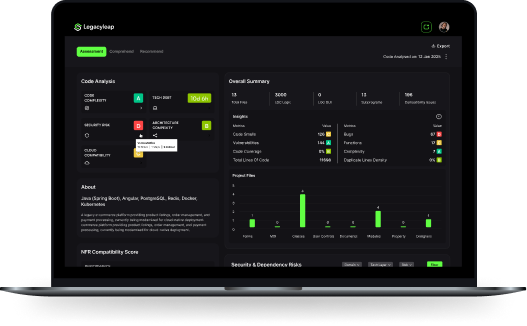
The Assessment Agent maps carrier rate logic inventories, EDI map catalogs, custom workflow dependencies, and the full TMS-to-WMS-to-OMS-to-ETL dependency chain before any transformation begins. In most Java portfolios, 25–40% of actual dependencies remain undocumented until deep codebase analysis is performed.
The $0 Modernization Assessment delivers this map, along with risk indicators, effort ranges, and a modernization blueprint. This is the structural answer to Pattern 1 and Pattern 2. The undocumented rules are surfaced in Phase 1, not at cutover.
Documentation Agent: Reconstructing What Was Never Written Down
The Documentation Agent generates carrier rule inventories, pick sequence logic maps, EDI transaction catalogs, rate table schemas, and dispatcher exception trees from the codebase itself, not from interviews with the engineer who built it twelve years ago.
This matters most when the talent retention risk from Driver 4 is already in motion. When the TMS architect retires, the embedded logic does not transfer unless it has been documented. The Documentation Agent makes that transfer possible at the system scale through code comprehension, not institutional memory.
Modernization Agent: Governed Transformation at Every Boundary
All transformations are delivered as diff-based pull requests. Nothing is merged, deployed, or executed without human review. For US logistics operations, the Modernization Agent covers:
- Rate engine extraction and modern service encapsulation
- EDI gateway modernization to an API-first surface with backward EDI compatibility maintained
- SSIS and Informatica pipeline migration to Azure Data Factory or Databricks/Spark
- SAP WM custom ABAP logic preservation into EWM
Across supported stacks, 50–70% of modernization work is automated, with human review at every architectural boundary. The automation handles mechanical and repetitive transformation. Engineers retain ownership of every architectural decision.
The platform covers the full logistics stack:
- Java EE, Struts, and EJB for enterprise TMS and carrier platforms;
- .NET Framework and VB6 for freight audit and dispatch tools;
- SSIS, Informatica, and Ab Initio for freight data pipelines;
- AngularJS for customer visibility portals; and
- Delphi for fleet management and routing platforms.
QA Agent: What Makes Phased Cutover Viable
The QA Agent runs 100% functional parity validation before any production deployment. In logistics operations, this covers:
| Parity Domain | What Is Validated |
| Rate calculation | Full carrier contract inventory, all accessorial combinations |
| Pick sequence output | All workflow conditions, exception paths, FIFO/LIFO/FEFO variants |
| EDI message format | All trading partner configurations, transaction types |
| Freight audit rules | Carrier contract terms, accessorial validation, dispute logic |
| ETL output parity | Data shape, transformation logic, aggregation results |
The new system runs in parallel until parity is confirmed across the full operational surface. Traffic migrates incrementally. The legacy system remains available until every workflow has been validated. This is the structural answer to Pattern 3 — and it is what makes the constraint that defines US logistics modernization solvable: freight does not stop.
Security and Deployment Requirements
For US logistics operators managing post-incident security reviews or regulatory requirements, all analysis and transformation run entirely within the enterprise environment. No source code leaves the customer’s firewall. No external API calls are made during transformation. This deployment model directly addresses the security posture requirements that have become standard for US carriers and 3PLs following recent ransomware incidents.
Measured Outcomes
The Fuelsoft engagement (VB6 to .NET 8) delivered a 60% reduction in modernization cost and migrated 500+ users with zero downtime. A logistics invoicing migration delivered a 30% reduction in deployment errors and a 40% acceleration in release cycles.
For more on how these outcomes translate to program economics, see modernization ROI. For US logistics teams evaluating an incremental, phased modernization approach across a multi-system estate, Legacyleap’s phased methodology guide covers sequencing, dependency ordering, and cutover architecture in detail.
How to Choose a Logistics Software Modernization Partner
Most US logistics operators evaluating modernization options are choosing between three categories: a TMS or WMS vendor replacing their own product, a general-purpose software development firm, and a modernization platform with logistics-specific experience. The criteria below are designed to surface meaningful differences between them.
- Does the vendor start with comprehension or execution? A modernization partner that begins with transformation before mapping what the legacy system actually does is the single strongest predictor of program failure. The comprehension phase (mapping carrier rate logic, EDI maps, custom workflows, and cross-system dependencies) should be a defined deliverable, not an assumption. Ask for an example of what their assessment output looks like before committing.
- Can they handle the full stack, not just one system? TMS vendors modernize TMS instances. WMS vendors modernize WMS instances. The cross-system integration problem (the connective tissue between these platforms that exists only in custom code) falls outside both scopes. A logistics modernization partner should be able to operate across Java EE, .NET, VB6, SSIS, and EDI within a single engagement.
- How do they validate behavior parity before cutover? The question to ask: what is the specific mechanism that confirms the modernized system produces the same output as the legacy system across all carrier contracts, pick sequences, and EDI configurations? An answer that references manual testing or parallel-run observation is not the same as automated parity validation with documented coverage. The difference between those two answers is the difference between Pattern 3 and a clean cutover.
- Can they operate inside your security perimeter? For US carriers, 3PLs, and regulated logistics operators, source code cannot leave the firewall. A modernization company that requires cloud-hosted code access is not a viable option for post-incident environments or organizations under compliance requirements. Confirm on-premise and VPC deployment capability before the conversation progresses.
- Do they have documented logistics outcomes, not just modernization outcomes? General application modernization experience and logistics-specific modernization experience are not equivalent. Carrier rate logic, accessorial validation, and EDI map complexity are not patterns a general-purpose modernization service encounters regularly. Ask for specific logistics engagement examples, including what undocumented logic was surfaced, how cutover was managed, and what parity validation covered.
Legacyleap’s $0 Modernization Assessment is the starting point for US logistics teams that want a clear picture of their stack before committing to a path. And if your teams are further along and ready to evaluate the platform directly, a 30-minute demo covers how Legacyleap handles rate engines, EDI maps, and custom workflows end to end.
FAQs
The failure point is almost always sequencing. Programs that begin with platform selection before completing a full codebase comprehension phase discover the same problem at cutover: undocumented business logic the new platform cannot replicate. Carrier rate exceptions, custom pick sequences, and dispatcher heuristics were never in a requirements document. They exist only in application code. Programs that treat comprehension as the first deliverable, not a preliminary step, consistently outperform those that do not.
They break unless explicitly surfaced before replacement began. Carrier rate logic in most legacy TMS environments has accumulated over 10–15 years of freight contract negotiations. Fuel surcharge tables, lane-specific accessorial schedules, and carrier exception hierarchies are embedded as conditional logic in application code. A commercial TMS replacement without a prior rate logic inventory will reproduce most configurations correctly, then encounter the remainder as operational exceptions after go-live. That tail is where program costs compound.
SAP WM handled basic warehouse operations inside SAP ERP. EWM is a separate system supporting advanced functions including wave management, cross-docking, and AS/RS integration. There is no upgrade path between them. Every warehouse process and custom logic built on WM must be re-implemented in EWM from scratch. WM mainstream support ended December 31, 2025. Extended maintenance runs through December 2027. Organizations that have not begun EWM planning are already working with less runway than that date suggests.
Through codebase-driven documentation rather than institutional memory. Automated analysis reconstructs carrier rule inventories, pick sequence logic, EDI map configurations, and cross-system dependencies directly from the source code. This is distinct from interviewing current staff, who typically know the outputs of the system but not the logic producing them. Documentation generated from the codebase is the only reliable foundation for a modernization program where the original engineering knowledge is no longer available.
A TMS or WMS vendor is modernizing their own product. Their scope ends at that system boundary. Cross-system integration logic, freight audit customizations, and the connective tissue between the TMS, WMS, and OMS fall outside it by design. A modernization partner works across the full legacy estate, including the integration layer between systems. For US logistics operations with significant custom logic across multiple platforms, that distinction determines whether the program succeeds.
References
[1] CSCMP State of Logistics Report 2025, confirmed by FreightWaves, Penske, and AASHTO Journal. https://cscmp.org
[2] Port of Seattle — Official Breach Notification and Public Statements. portseattle.org, April 2025. https://www.portseattle.org
[3] Ward Transport and Logistics — Class Action Settlement. wtldatasettlement.com; Mikolaitis v. Ward Transport filing. https://www.wtldatasettlement.com
[4] IBM Cost of a Data Breach Report 2024 and 2025. Average transportation sector breach cost: $4.4M (2024). US average breach cost: $10.22M (2025); ransomware average: $5.08M. https://www.ibm.com/reports/data-breach
[5] Verizon 2025 Data Breach Investigations Report. https://www.verizon.com/business/resources/reports/dbir/