TL;DR
- Most LIMS modernization attempts in pharma and biotech fail before they start. A 2024 Deloitte survey found 92% of genomics labs rank LIMS modernization as their top digital priority, yet 63% have suffered failed migrations or major disruptions.
- FDA’s new Computer Software Assurance guidance makes phased modernization financially viable for the first time. Finalized September 24, 2025 and updated February 2026, CSA ties validation effort to actual risk, but it does not reduce the burden on custom LIMS Basic scripting, which still requires full GAMP Category 5 validation.
- The specification library, not the software itself, is the real migration risk. Product specifications, calculation formulas, and stability protocols built by QA scientists over 15-plus years exist only in system configuration, and errors there can cause false-pass batch releases or FDA data-integrity findings under ALCOA+.
- Three modernization paths carry wildly different costs and risk profiles. Full platform replacement runs $500K to $5M-plus over 12 to 24 months, while phased modernization validated component by component under CSA is the lower-risk path preferred for complex US pharma LIMS.
- Legacyleap’s multi-agent approach starts with comprehension, not migration. Its Assessment Agent maps every specification and instrument interface before any code changes, a process the company says cuts total modernization effort by 40 to 50%, and up to 70% depending on stack complexity.
Why US Pharma and Biotech Labs Are Replacing Their LIMS Now
Lab directors at US pharma and biotech companies describe their LIMS in a particular way. Not in terms of software versions or support contracts, but in terms of workarounds:
- exports to Excel,
- instrument integrations running on CSV file drops into a network share,
- calculation logic that one senior scientist built and only that person fully understands.
A 2024 Deloitte survey cited by NonStop found that 92% of genomics labs identify LIMS modernization as their top digital transformation priority, and that 63% have experienced failed migration attempts or major disruptions [1]. That failure rate is not random.
Four pressures are converging to force the decision across US pharma and biotech organizations right now:
- Key-person retirement risk: The QA scientist who built the specification library retires in 18 months. No one else understands how 15 years of custom configurations were constructed.
- Post-M&A LIMS consolidation: Two incompatible platforms, two specification libraries, no harmonization path without first comprehending both.
- Genomics data volume: Modern sequencing platforms generate terabytes per run into a system designed for discrete sample records.
- FDA enforcement pressure: Warning letter citations for laboratory data integrity violations have risen sharply, with ALCOA+ compliance gaps as a primary cited concern.
This article covers GxP-regulated pharma and biotech LIMS specifically: LabWare, SampleManager, and custom-built systems.
LIMS, LIS, and ELN: The Scope Distinction
| LIMS | LIS | ELN | |
| Environment | Pharma, biotech, research, industrial labs | Clinical hospital and diagnostic labs | Any laboratory environment |
| Primary users | QA directors, lab directors, analytical chemists | Pathologists, clinical lab staff, clinicians | Research scientists, study directors |
| Core function | Sample lifecycle: testing workflows, specifications, CoA generation, stability studies | Specimen diagnostics: orders, results, reporting to clinicians | Experimental documentation: protocols, observations, data capture |
| Regulatory framework | GxP, 21 CFR Part 11, ALCOA+, GAMP 5 | CLIA, CAP, HIPAA | GLP, GxP (context-dependent) |
How GxP Validation Requirements Constrain Every LIMS Modernization Decision
Generic enterprise software migrations operate under IT governance frameworks. LIMS modernization in US pharma and biotech operates under GxP, and that distinction changes nearly every calculation.
Every change to a specification, calculation formula, or workflow rule requires validation under 21 CFR Part 11 before go-live. Stability studies running on ICH Q1A-mandated multi-year schedules cannot be paused. Active batch testing has open records at the moment of cutover. Instrument interfaces must remain validated and traceable throughout.
The result is a system that freezes. Traditional Computer System Validation adds 30 to 50% to implementation cost and six or more months to timelines. Labs work around problems rather than fix them, not because modernization is impossible, but because the validation cost has historically made it prohibitive.
FDA’s Computer Software Assurance guidance, finalized September 24, 2025, and updated February 2026, changes that calculus [2]. CSA inverts the traditional validation effort ratio. Testing is proportionate to actual process risk, vendor evidence can be leveraged for configured commercial functions, and each modernization phase can be validated independently. For the first time, phased LIMS modernization is financially viable for US pharma organizations.
One constraint must be stated precisely. CSA does not reduce the validation burden on custom LIMS elements.
A LabWare installation with 15 years of LIMS Basic customizations is not operating as configured commercial software in any practical sense. GAMP Category 5 software, which is what heavily customized LIMS effectively becomes, still requires full SDLC validation.
The vendor’s validation evidence does not cover the custom layer. This is the documentation gap that Legacyleap’s Documentation Agent is designed to close, generating the SDLC-appropriate documentation that the custom layer requires, directly from the codebase, before validation begins.
CSA makes phased modernization viable; it does not make the comprehension phase optional.
Why Heavily Customized LIMS Can No Longer Follow the Vendor Upgrade Path
Most enterprise pharma LIMS were implemented as standard commercial platforms. LabWare, SampleManager, STARLIMS – each ships with a validated base product and a defined upgrade path. That upgrade path assumes the system is still recognizable as the product the vendor sold.
After 15 years of custom specifications, proprietary scripting, instrument-specific integrations, and workflow logic built directly into LIMS Basic, that assumption no longer holds.
LabWare’s own documentation acknowledges the structural consequence: LIMS Basic customizations require LabWare to compile configurations in real time, and the more customizations present, the more complex future upgrades become [4].
At a certain point, the custom layer is not an extension of the commercial product. It is a bespoke application running inside the LIMS shell, with none of the vendor’s validation evidence applicable to it and none of its logic formally documented anywhere.
This is what the standard LIMS vendor upgrade path doesn’t address.
- A LabWare upgrade guide covers base product changes. But it does not cover 15 years of LIMS Basic scripts written by a QA scientist who no longer works there.
- A SampleManager migration guide covers data schema changes. But it does not cover the calculation formulas that translate raw instrument output into batch release decisions.
The implication for modernization is direct: before any transformation can begin, the custom layer has to be comprehended in full. Not sampled. Not spot-checked. Comprehended.
Legacyleap’s Assessment Agent performs this at the system level, mapping every custom specification, method logic, workflow rule, and instrument interface configuration before a single migration decision is made.
The Specification Library Is the Primary Migration Risk
There is a category of risk in LIMS modernization that doesn’t appear on project plans and doesn’t get priced into implementation contracts. It is the primary reason migrations fail.
An enterprise pharma LIMS accumulates testing intelligence across every product it has ever managed. That intelligence lives in configuration, not in documentation: product specifications with acceptance criteria and sampling plans, analytical test methods with embedded calculation formulas, ICH Q1A-compliant stability study protocols, Certificate of Analysis templates, OOS and OOT investigation triggers, instrument interface configurations, and custom calculation formulas that translate raw instrument output into reportable results.
All of it was built by QA scientists and analytical chemists over 15 years or more. None of it is formally documented outside the system itself.
When the specialist who wrote that logic retires, it becomes permanently opaque institutional knowledge. The system continues to run. No one can safely change it.
Legacyleap’s Assessment Agent maps this configuration in full (every specification, every formula, every instrument interface), producing a structured inventory that makes the comprehension phase concrete rather than theoretical before any platform decision or transformation commitment is made.
Stability studies are the hardest element to migrate. Clarkston Consulting’s practitioner guidance is direct: stability studies are often migrated or recreated in the target system, where other transactional data is archived [3]. Recreation requires a complete understanding of every protocol parameter, acceptance criterion, and calculation formula in the source configuration. When that understanding doesn’t exist, stability data migrates incompletely or fails to migrate at all.
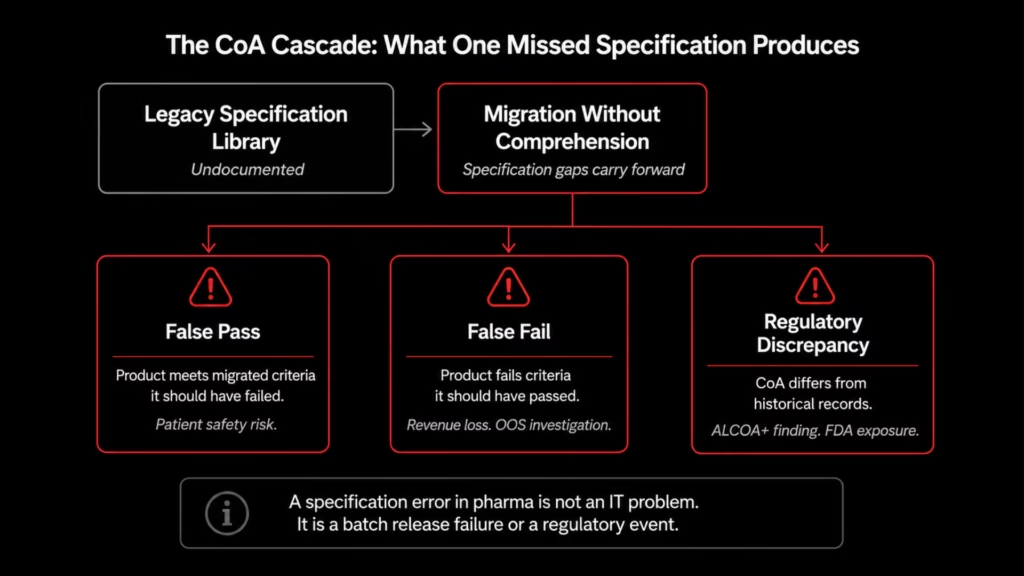
The downstream consequence is the CoA cascade. Certificate of Analysis generation is the batch release endpoint. It applies specification results to produce the document that authorizes product release. If specification configurations migrate incorrectly, three failure modes follow:
- False pass: products meet migrated criteria, they should have failed, a missed quality defect that may not surface until post-release; the highest-severity outcome, because the product has already left the facility before the error is discoverable.
- False fail: products fail migrated criteria they should have passed, triggering unnecessary batch rejection, OOS investigations, and direct revenue loss on products that were never out of specification.
- Regulatory discrepancy: CoA content differs from historical records, creating an audit trail inconsistency that constitutes a data integrity finding under ALCOA+ and direct FDA exposure.
A specification error in pharma is not an IT problem. It is a batch release failure or a regulatory event.
This is the named prerequisite step that every LIMS modernization requires and most programs skip: specification library extraction, the systematic comprehension of every custom specification, method logic, and calculation formula in the legacy configuration, before any transformation begins.
For labs whose LIMS connects to instruments, ERP systems, and QMS platforms, this configuration debt sits inside one of the most tightly coupled legacy application architectures in enterprise software. It is also the most concentrated form of technical debt in any regulated system, because, unlike code debt, specification debt carries direct regulatory consequences.


Why Legacy LIMS Architecture Cannot Handle Modern Genomics Data Volume
Legacy LIMS architecture was designed around discrete sample records: one sample, one test, one result. That model holds for traditional analytical chemistry workflows. It does not hold for next-generation sequencing.
A single NGS run generates terabytes of raw data. The downstream analysis produces variant calls, alignment files, and quality metrics that bear no structural resemblance to a traditional LIMS result record.
Most legacy LIMS platforms have no native data model for this. US genomics labs are managing the gap with file shares, Excel exports, and middleware scripts – the same workaround pattern that appears everywhere else in the legacy LIMS story, applied to data volumes the system was never designed to handle.
This is a structural mismatch, not a configuration problem. No amount of LIMS Basic scripting resolves the underlying architecture. Integration-layer modernization (API middleware connecting the legacy LIMS to a genomics data pipeline or LIMS-adjacent data lake) is the most common near-term path for labs that need to absorb NGS volume without replacing the validated core. It preserves the existing specification library and audit trail while extending the system’s data handling capacity.
The same comprehension prerequisite applies. Before an integration layer can be designed, the existing instrument interface configurations and result ingestion logic need to be mapped. Legacyleap’s Assessment Agent covers these as part of the standard configuration inventory.
Three LIMS Modernization Paths: Timelines, Costs, and Where Each One Breaks Down
US pharma and biotech labs evaluating LIMS modernization face three substantively different approaches. The choice between them is a business decision based on budget, timeline, and risk tolerance. The comprehension requirement is not a path decision. It is a prerequisite to all three.
| Path | Description | Timeline | US Cost Range | Risk |
| Platform replacement | Migrate to a modern LIMS (LabWare 8, LabVantage, Benchling, Sapio). Full capability upgrade requiring full specification migration, re-configuration, and re-validation. | 12 to 24 months plus validation | $500K to $5M+ | Highest. No standard interchange format between LIMS vendors. Translation requires full source comprehension. |
| Integration-layer modernization | API middleware connecting the legacy LIMS to modern instruments, ELN, data lakes, and genomics pipelines. Preserves the existing validated system and extends capability without full re-validation. | 3 to 9 months per layer | $100K to $500K per integration | Medium. Leaves underlying configuration debt intact. Best for labs facing immediate data volume or instrument pressure. |
| Phased modernization | Migrate by component: specification masters first, instrument interfaces second, enterprise integrations third. Each phase validated independently under CSA. | 6 to 18 months per phase | Varies by phase | Lower per phase. Modular CSA validation reduces per-cycle cost. The preferred approach for complex US pharma LIMS. |
Big Bang modernization, a single cutover with no fallback, is the approach US practitioners consistently reject for complex LIMS. One missed specification or one corrupted stability record, and the lab faces a compliance crisis with no path back.
Parallel running, where both systems operate simultaneously during validation, is the most reliable compliance posture but carries the highest resource cost. It is the right approach when active stability studies are running or batch records are open at the proposed cutover date.
The hardest migration element across all three paths is static master data: specifications, methods, product parameters. It carries version history, embeds business rules in configuration logic, and has no standard interchange format between vendors. LabWare configuration does not import into SampleManager. SampleManager does not import into LabVantage.
Clarkston Consulting puts it plainly: extracting, translating, and loading this data is the biggest effort in any LIMS migration [3]. The translation step requires understanding the source configuration in full. This is where most migrations fail, not at technical execution, but at the comprehension stage that was never completed.
For a framework on phased, CSA-aligned modernization across complex enterprise systems, see Legacyleap’s incremental modernization guide. For GxP-validated data migration covering the architecture of moving decades of stability data with audit trail continuity, see the database modernization article.
How Legacyleap Approaches Legacy LIMS Modernization
The prerequisite to any modernization path is a complete, documented understanding of the legacy configuration. For enterprise pharma LIMS, that configuration has never been formally documented. Legacyleap produces it from the codebase itself.
For US pharma and biotech organizations evaluating modernization partners and vendors, Legacyleap’s stack coverage maps directly to the systems at issue:
- LabWare with Java and .NET backends and LIMS Basic scripting,
- Thermo Fisher SampleManager’s VGL-to-C# architecture,
- STARLIMS on .NET,
- older LabVantage on Java, and
- custom LIMS built on Java, .NET, or earlier frameworks.
The platform operates as an on-premise or VPC-deployed service, so all analysis and transformation occur within the enterprise environment. No source code leaves client-controlled infrastructure, and no external API calls are made.
For US organizations subject to 21 CFR Part 11, this deployment model is a compliance requirement, not a preference.
US pharma and biotech organizations searching for a LIMS modernization partner or LIMS migration service typically reach Legacyleap at one of two points:
- before a platform decision has been made, or
- after a previous migration attempt has stalled.
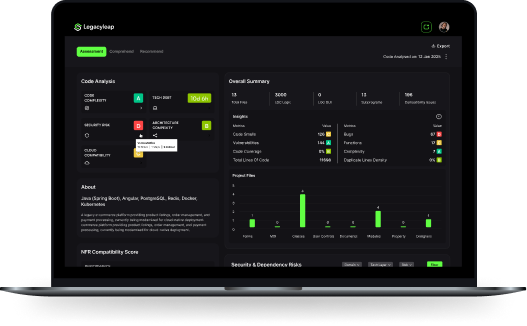
In either case, engagement begins the same way with the $0 Modernization Assessment. The Assessment Agent comprehends the legacy LIMS configuration in full and produces a dependency map, specification inventory, risk indicators, and a modernization readiness view.
No platform commitment is required. No transformation begins. The output is a concrete blueprint of what the system contains and what a modernization program needs to account for.
From there, Legacyleap operates as a pharma LIMS modernization service, executing the full transformation lifecycle inside the client’s own infrastructure under human review at every stage.
Legacyleap’s multi-agent platform moves through the modernization lifecycle in sequence:
| Agent | What It Does in a LIMS Context |
| Assessment Agent | Maps every custom specification, method logic, workflow rule, instrument interface, and calculation formula, including those buried in undocumented LIMS Basic scripts. Produces a dependency map, specification inventory, and modernization readiness view. Foundation for the $0 Assessment. For M&A scenarios, can comprehend both LIMS configurations simultaneously. |
| Documentation Agent | Generates GxP-appropriate documentation from the Assessment output: module boundaries, workflow logic, and business rules structured for CSA-aligned validation packages. Produces in weeks what previously required six or more months of manual effort from the configuration’s author. |
| Modernization Agent | Executes diff-based, human-reviewed code transformations. Nothing is merged or deployed without review at defined checkpoints. Every transformation is reversible before acceptance — the governance model that distinguishes a controlled change from an uncontrolled one under 21 CFR Part 11. |
| QA Agent | Validates that the modernized LIMS produces identical specification results, CoA content, and stability calculations to the legacy system. Parity is the pass/fail condition. A result that differs between legacy and modernized output is not a QA finding. It is a regulatory event. |
The results are as follows:
- Dependency and specification coverage: 100% of custom specifications, method logic, and instrument interfaces mapped before transformation begins
- Effort reduction: 40 to 50% reduction in total modernization effort; up to 70% depending on stack complexity
- Functional parity validation: Automated regression suites verify specification results, CoA content, and stability calculations against legacy output
- Governance and deployment: All analysis and transformation within the enterprise environment. Human review is required before any change is accepted. Full audit trail on every transformation.
- GxP documentation output: Module boundaries, workflow logic, and business rules generated from the codebase and structured for CSA-aligned validation packages
The Comprehension Phase Is What Separates Recoverable Migrations from Failed Ones
The specification library is the laboratory’s intellectual property. It took 15 years to build, it encodes the testing intelligence behind every batch release decision, and it cannot be reconstructed from scratch.
FDA’s CSA guidance makes phased modernization financially viable for the first time. But it reduces the burden only on well-understood, properly documented systems. A lab that has never formally documented its LIMS configuration cannot benefit from risk-based validation until it can demonstrate that it understands what it is validating.
The question is not whether to modernize. Key-person retirement risk, FDA enforcement pressure, and data volume have already answered that. The question is whether to begin with comprehension or without it.
The Assessment Agent maps what is there. The Documentation Agent generates what was never written down. Both happen before a single line of code is transformed.
For clinical hospital LIS modernization covering specimen tracking, auto-verification, and critical values workflows, see Legacyleap’s clinical laboratory information system modernization guide.
Request a $0 Modernization Assessment for a no-cost configuration map, specification inventory, and modernization blueprint for your legacy LIMS, before any platform decision is made.
Book a Demo to see the Assessment Agent and Documentation Agent operating against a real legacy LIMS configuration.
FAQs
Specification library extraction is the systematic comprehension of every custom product specification, analytical test method, stability protocol, and calculation formula embedded in a legacy LIMS configuration. In most enterprise pharma LIMS, this logic was built by QA scientists over many years and never documented outside the system. Without it, the static master data translation step has no source of truth. This is where migration programs consistently stall, not at technical execution.
Yes, with one qualification. CSA allows validation effort to be proportionate to actual process risk, making phased modernization financially viable for the first time. Each phase can be validated independently without a full multi-year CSV cycle. The limitation: CSA applies only to well-understood, documented systems. Heavily customized LIMS with undocumented scripting or bespoke calculation formulas still require full SDLC validation for those elements. Comprehension of the custom layer is the prerequisite to benefiting from CSA at all.
Stability studies cannot be paused. ICH Q1A-mandated schedules run continuously regardless of system status. The standard approach for high-risk cutovers is parallel running: both legacy and new LIMS operate simultaneously, with results compared across systems until the new platform has demonstrated consistent output. Active batch records are typically completed in the legacy system before cutover, or migrated with audit trail continuity preserved. Either path requires the specification library to be fully migrated and validated before any batch activity transfers.
The migration starts with comprehension, not data extraction. The legacy codebase is analyzed at the system level to produce a structured map of what the configuration contains: every specification, every formula, every workflow rule. That map becomes the source of truth for static master data translation. Without it, translation is guesswork. With it, each configuration element has a defined destination and a validation requirement attached to it.
LIMS replacement is one path within LIMS modernization, specifically the full platform swap from legacy to modern. Modernization is the broader category, which includes integration-layer work, phased component migration, and targeted upgrades that preserve the validated core. For most US pharma labs, full replacement is the highest-risk, highest-cost option and is not the default recommendation. Phased modernization, validated per phase under CSA, produces lower per-cycle risk and cost while keeping the lab operational throughout.
References
[1] NonStop, LIMS Modernization 2026 (citing Deloitte 2024 genomics lab survey).https://www.nonstopio.com/blog/lims-modernization
[2] U.S. Food and Drug Administration, Computer Software Assurance for Production and Quality System Software (finalized September 24, 2025; updated February 2026).https://www.fda.gov/regulatory-information/search-fda-guidance-documents/computer-software-assurance-production-and-quality-system-software
[3] Clarkston Consulting, LabWare LIMS Upgrade Guide: Static Data Migration and Stability Study Considerations.https://clarkstonconsulting.com/insights/labware-lims-upgrade/
[4] LabWare documentation (via Astrix Technology Group), LIMS Basic Customization and Upgrade Complexity.https://astrixinc.com/blog/lims-tips-tricks-implementation/
[5] CSols, Global Biopharma LIMS Harmonization Case Study: Compromised Legacy Data, Inflight Data, and Missing Configuration Logic.https://www.csolsinc.com/case-studies/