TL;DR
- Legacy CTMS logic exists only in the codebase, not in any document anyone can hand over. Enrollment workflows, budget logic, and integration rules built between 2003 and 2015 were often written by staff who have since left the organization.
- Migrating a CTMS mid-trial has already caused a real FDA data-integrity crisis. In one FDA workshop case, a sponsor switched databases mid-trial and lost audit trails for half its subjects, forcing thousands of pages of paper source records to salvage the primary endpoint.
- ICH E6(R3), finalized in January 2025, makes legacy CTMS platforms an active compliance liability. The guideline requires risk-based quality management and decentralized trial support, and 88% of trials now include at least one RBQM component that legacy on-premise systems cannot support.
- FDA’s Computer Software Assurance framework cuts CTMS validation time by 30 to 50%. CSA scales testing to actual patient-safety risk instead of applying uniform scripted testing to every change, replacing a validation regime that had frozen CTMS platforms in place since 2012.
- The safest modernization path never touches an active study before close-out. Legacyleap’s phased approach moves administrative functions and integrations first while active studies stay on the legacy system, a sequence the company says cuts total modernization effort by 40 to 50%.
Why Legacy CTMS Platforms Become Compliance and Operational Risks
You already know the system has to go. The problem is that replacing it means touching active studies, live audit trails, a decade of custom enrollment logic nobody documented, and integrations connecting to eight other regulated systems. That is not a migration problem. It is a sequencing problem. This article is the sequencing guide.
ICH E6(R3), finalized in January 2025 and integrated into the FDA’s GCP expectations for US-regulated trials, explicitly requires RBQM, data governance controls, and decentralized trial support [1]. Legacy systems routinely fail to produce inspection-ready audit trail reports on demand, a documented FDA 483 finding pattern with real remediation cost.
88% of clinical trials now include at least one risk-based monitoring component [2]. A legacy on-premise CTMS cannot support remote patient monitoring, virtual visit tracking, or the real-time site performance visibility that US clinical operations teams run against as a baseline.
Barrier 1: Most Legacy CTMS Logic Exists Only in the Codebase
The first barrier to CTMS modernization is not technical complexity. Legacy CTMS platforms built between 2003 and 2015 contain enrollment workflows, integration logic, and business rules that were never documented, understood only, if at all, by people who have left the organization. You cannot replace what you cannot see.
These codebases carry logic no off-the-shelf CTMS can replicate from a requirements document:
- Therapeutic-area-specific enrollment tracking rules built around protocol eligibility criteria
- Budget and payment logic tied to historical site relationships and contract structures
- Integration rules connecting to EDC, eTMF, RTSM, safety databases, LIMS, and clinical supply
- Hardcoded business rules whose original authors are no longer in the organization
Organizations that proceed with replacement before mapping this logic discover, after first use, that the modern system does not behave the way the legacy system did.
What the comprehension phase produces:
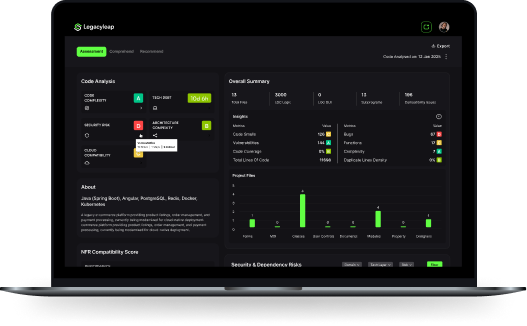
The Assessment Agent maps every integration touchpoint, custom workflow, and hardcoded rule from the codebase itself before any transformation begins.
The Documentation Agent generates functional specifications and logic maps directly from the code. Under FDA’s CSA framework, this output is simultaneously the build specification the modernization team needs and the validation baseline the quality team works from. The comprehension work and the compliance work are the same work.


Barrier 2: Active Studies Cannot Be Migrated Mid-Trial
FDA requires complete, accurate transfer of study data and audit trails when migrating a regulated system, with computational derivation methods intact. For a US pharma organization or CRO carrying 40–100 active studies, re-validating subject data mid-enrollment is not operationally feasible.
The consequence of getting this wrong is documented. In one case reviewed at an FDA workshop, a sponsor switched databases mid-trial, and audit trails for the first half of subjects were not transferred [3]. The FDA required thousands of pages of paper source records to salvage the primary efficacy endpoint.
Consider the operational reality: a sponsor running 40 active studies cuts over to a new cloud CTMS over a planned maintenance window. The integration bridge transfers enrollment records but not audit trail metadata for 1,400 subjects. The legacy system is being decommissioned. At the next FDA inspection, neither system can produce audit trail continuity for the full study period. The primary efficacy endpoint is at risk.
A top-20 biopharma consolidated five CTMS systems post-acquisition, 9 million records and 7,700 active studies, over 18 months with a major vendor during COVID [4]. That is the best-case big bang. The viable path for a live clinical program is an incremental approach, where non-active components are modernized first while active studies remain on the legacy system through close-out.
In practice, this means:
- Administrative functions, reporting layers, and system integrations move first
- Active studies stay on the legacy system through close-out
- Each module is validated under CSA’s risk-proportionate framework before the next begins
| Migration Approach | Active Study Risk | Timeline | Validation Approach |
| Big-bang cutover | High: all studies exposed simultaneously | 12–18 months (best case) | Full system revalidation required at cutover |
| Phased, module-by-module | Low: active studies isolated until close-out | 6–12 months per module | CSA-compliant incremental sign-off per module |
| Lift-and-shift, no comprehension | Very high: invisible logic not mapped | Variable; typically delayed by rework | Validation baseline unavailable before cutover |
The Recommendation Agent produces the sequencing blueprint that makes this path executable: which modules move first, which studies remain on legacy through close-out, and what integration rearchitecture is required before any cutover. The sequencing follows the codebase map, not vendor preference.
Barrier 3: The Validation Tax That Has Frozen US Clinical Systems in Place
Traditional CSV applied uniform documentation and scripted testing requirements to every system change, regardless of patient safety relevance. US clinical organizations responded by freezing their systems. The CTMS running studies in 2012 were still running them in 2024, not because it was performing well, but because changing it under CSV was cost-prohibitive.
FDA’s Computer Software Assurance guidance, published in 2022, replaces this with risk-proportionate validation:
- Low-risk functions (UI elements, administrative configuration, reporting templates): exploratory testing or a documented rationale is sufficient
- High-risk functions (clinical data calculations, enrollment logic, audit trail mechanisms): comprehensive scripted testing required
FDA’s Computer Software Assurance framework reduces CTMS validation time by 30–50% by scaling testing requirements to actual patient safety risk rather than applying uniform overhead to every system change.
| Dimension | Traditional CSV | FDA CSA (2022) |
| Validation scope | All system functions, regardless of risk | Risk-tiered: scope scales to patient safety impact |
| Documentation burden | Roughly 80% of total validation effort | Roughly 20% of total validation effort |
| Change cycle time | 6–12 months for significant changes | Weeks to months, depending on module risk level |
| Effect on modernization | Freezes systems; change cost is prohibitive | Enables phased modernization with incremental sign-off |
Every Legacyleap transformation is diff-based, requiring human engineer review and explicit approval before any code merges. For a system carrying 21 CFR Part 11-covered clinical records, this produces a governed change history an FDA inspection can follow. The QA Agent validates that enrollment logic, budget calculations, and audit trail mechanisms behave identically in the modernized system before any module progresses.
The Three Modernization Paths for a Legacy CTMS
Organizations managing legacy CTMS programs in 2026 are evaluating three distinct paths, each with different risk profiles and implications for active studies.
| Approach | Active Study Risk | Validation Method | Timeline | Best For |
| Commercial platform replacement | High: all studies exposed at cutover | Full system revalidation required | 12–24 months | Organizations with no active studies or dedicated migration budget |
| API-first extension | Medium: legacy core untouched, integration layer changes | Validation scoped to new integration layer | 6–12 months | Organizations needing DCT/RBQM capability without full replacement |
| Comprehend and modernize (phased, module-by-module) | Low: active studies isolated until close-out | CSA-compliant incremental sign-off per module | 6–12 months per module | Organizations with active studies, custom logic, and complex integrations |
The third path is the only one that begins with understanding what the legacy system actually contains. Commercial platform replacement and API-first extension both assume the logic is visible. For most custom CTMS platforms built before 2015, it is not.
Why Legacyleap Is the Right Modernization Partner for Your CTMS Program
Most CTMS modernization programs fail because the partner executing the work was not built for the specific constraints of a GxP-regulated clinical environment. A generic modernization vendor does not understand audit trail continuity. A clinical IT consultancy cannot map a decade of undocumented enrollment logic in weeks. Legacyleap was built for this intersection.
For US pharma and biotech companies, CTMS is among the most tightly coupled systems in the clinical enterprise, connecting to EDC, RTSM, eTMF, safety, LIMS, and clinical supply. Legacyleap’s five-agent architecture addresses that coupling in sequence.
- Assessment Agent. Maps every integration touchpoint, custom workflow, and hardcoded rule from the codebase itself. No requirements document needed. No institutional memory relied upon.
- Documentation Agent. Generates functional specifications and logic maps directly from the code. Under CSA, this output is the validation baseline your quality team works from. The comprehension work and the compliance work are the same work.
- Recommendation Agent. Produces the sequencing blueprint: which modules move first, which active studies stay on legacy through close-out, and what integration rearchitecture is required before cutover. Based on the codebase map, not on vendor preference.
- Modernization Agent. Every transformation is diff-based and requires explicit engineer approval before it touches the codebase. For a system carrying 21 CFR Part 11-covered records, this produces the governed change history an FDA inspection can follow.
- QA Agent. Validates functional parity before any module progresses. Enrollment logic, budget calculations, and audit trail mechanisms must behave identically in the modernized system. Behavior parity, not just code correctness.
- On-premise and VPC deployment. Legacyleap operates entirely inside the client’s firewall. No source code leaves the client’s environment. For US organizations managing HIPAA-regulated patient data and 21 CFR Part 11-covered clinical records, this is met by default.
The result: comprehension produces the compliance documentation, transformation produces the traceability record, and active studies are never touched until close-out. For US pharma and biotech organizations managing live clinical programs on legacy infrastructure, that sequence is the difference between a modernization that passes FDA inspection and one that creates new findings.
Effort reduction. The platform reduces modernization effort by 40–50% versus manual approaches, up to 70% depending on stack and scope.
Want to see the platform in action on a live CTMS codebase?
Book a Demo to walk through how the Assessment Agent maps your system and how the Documentation Agent produces the functional baseline your quality team needs.
CTMS Modernization Does Not Start With a Vendor Selection. It Starts With a Map.
The programs that fail do so because they attempt transformation before comprehension: big-bang cutover with active studies running, integration rework without a map of what connects to what.
The first decision is not “which CTMS platform do we buy?” It is “do we understand what we have?” That question, answered precisely from the code itself, is what de-risks the 18–24 months that follow.
The $0 Assessment produces the dependency map, custom logic inventory, and modernization blueprint your program needs before it can proceed safely. If you are managing active trials on a legacy CTMS and need a sequenced path that does not touch a single running study, that is exactly what the Assessment is designed for.
FAQs
Migration moves data and configurations to a new platform, typically discarding the custom enrollment logic, integration rules, and workflows built into the legacy system. Modernization transforms the underlying codebase, preserving that logic rather than replacing the system wholesale. For organizations with heavily customized CTMS platforms, the distinction is the difference between losing 15 years of institutional logic and retaining it.
Part 11 requires audit trail completeness and continuity across the full study period, not just in the post-cutover system. A phased approach that keeps active studies on the legacy system through close-out eliminates the mid-study audit trail gap. Each modernized module is validated before it handles any regulated data, and the diff-based transformation process produces a governed change history traceable to individual engineer actions.
Custom enrollment workflows in legacy CTMS platforms exist in the codebase as accumulated logic, rarely documented, built around specific protocols and therapeutic areas over years. Preserving them requires mapping the codebase directly before any replacement begins. Without that map, the new system will not replicate the behavior of the legacy system, and the gap will surface during the first active study run.
Audit trail records in a legacy CTMS are tied to its database and application layer and do not automatically transfer when a cloud platform replaces it. If the cutover happens mid-study, the new system has no record of subject activity prior to migration. The safe path is close-out first: active studies complete on the legacy system, audit trails are archived and validated for completeness, and only then does the legacy system decommission.
A full commercial platform replacement typically runs 12–24 months and requires full system revalidation at cutover, exposing all active studies simultaneously to migration risk. A phased modernization runs 6–12 months per module with CSA-compliant incremental sign-off. The total calendar time is comparable, but active studies are never touched until close-out and validation effort is distributed rather than concentrated at a single high-risk cutover event.
References
[1] ICH E6(R3) Good Clinical Practice guideline, finalized January 2025, requiring RBQM, data governance, and DCT support. https://www.ich.org/page/efficacy-guidelines
[2] Tufts Center for the Study of Drug Development / Medidata: 88% of clinical trials include at least one RBQM component (2023), up from 53% in 2019. https://www.medidata.com/en/life-science-resources/medidata-blog/the-state-of-risk-based-quality-management/
[3] FDLI / FDA workshop: mid-trial database switch case, audit trails not transferred, thousands of pages of paper records required. Referenced via FDA data integrity guidance. https://www.fda.gov/media/97005/download
[4] Veeva Systems: top-20 biopharma CTMS consolidation, 9M+ records, 7,700 active studies, 5 systems, 18-month implementation. https://www.veeva.com/resources/veeva-vault-cdms-customer-stories/