Results at a Glance
| Metric | Result |
|---|---|
| Code Conversion Speed | 60% faster (VB6 to C#) |
| DLL Consolidation | 1,700 DLLs consolidated into modular .NET architecture |
| Executables | Hundreds of executables rationalized |
| SQL Server | Backend optimized for performance |
| Infrastructure | Cloud-ready architecture established |
| Scope | Remaining 5% of system; the most complex components after 95% prior modernization |
Engagement Snapshot
| Industry | Entertainment (Sound Reinforcement / Live Touring Production) |
| Location | Lititz, Pennsylvania |
| Legacy Stack | VB6 + Windows Forms + SQL Server |
| Target Stack | .NET / Modular web-based architecture / Optimized SQL Server |
| Scale | 1,700 DLLs, hundreds of executables |
| Scope | Residual 5% of system after 95% prior modernization; highest-complexity components remaining |
| Delivery Model | Incremental phased migration with Gen AI-assisted code analysis |
About the client:
The client is a global leader in sound reinforcement and live touring production support. For decades, they have supported major entertainment events worldwide, relying on custom-built systems to manage accounting, purchasing, manufacturing, and equipment logistics.
The client had already modernized 95% of their legacy system. But the remaining VB6 and Windows Forms components, the most complex and deeply embedded parts of the architecture, had resisted previous modernization attempts. Legacyleap was brought in to finish what others could not.
Challenge
The remaining 5% of the client’s legacy system presented five compounding constraints, each of which had contributed to previous modernization efforts stalling:
1,700 DLLs Creating Maintenance Fragmentation
The legacy architecture had accumulated 1,700 DLLs and hundreds of executables over decades of development. This fragmentation made dependency tracking nearly impossible, created versioning conflicts, and meant that any change to one DLL risked breaking others in unpredictable ways. The maintenance overhead of this sprawl was a major cost driver.
Desktop-Only Architecture Blocking Remote Operations
The remaining components were built on Windows Forms – desktop-only applications that could not support remote access. As the organization’s global operations grew, the desktop-only model became an operational bottleneck. Teams in different locations could not access the systems they needed without being physically on-site.
Complex Decades-Old Customizations Complicating Migration
The remaining components contained decades of accumulated customizations built on top of customizations. These were not clean, well-documented modules. They were deeply layered business logic that had evolved organically over the years. Each customization added complexity that made automated migration harder and manual analysis slower.
Global Product Catalog Scale Requiring Elastic Architecture
The client’s product catalog had grown to serve global operations, but the legacy backend could not scale elastically to handle the increasing data volume. The SQL Server backend needed optimization, and the architecture needed to support dynamic scaling rather than the fixed-capacity model of the legacy system.
High-Risk Residual Components After 95% Prior Modernization
The 95% that had already been modernized was the relatively straightforward portion. The remaining 5% was left for last precisely because it was the hardest — the most tightly coupled, the most deeply customized, and the most fragile. Modernizing these components carried disproportionate risk because a failure here could destabilize the 95% that was already working.
How Legacyleap Finished What Others Could Not
The client had already completed 95% of their modernization. The remaining 5% had stalled because the components were too complex, too fragile, and too deeply embedded for the approaches that had worked on the rest of the system. Legacyleap was brought in specifically to complete this final phase.
Phase 1: Gen AI Code Analysis and Dependency Mapping
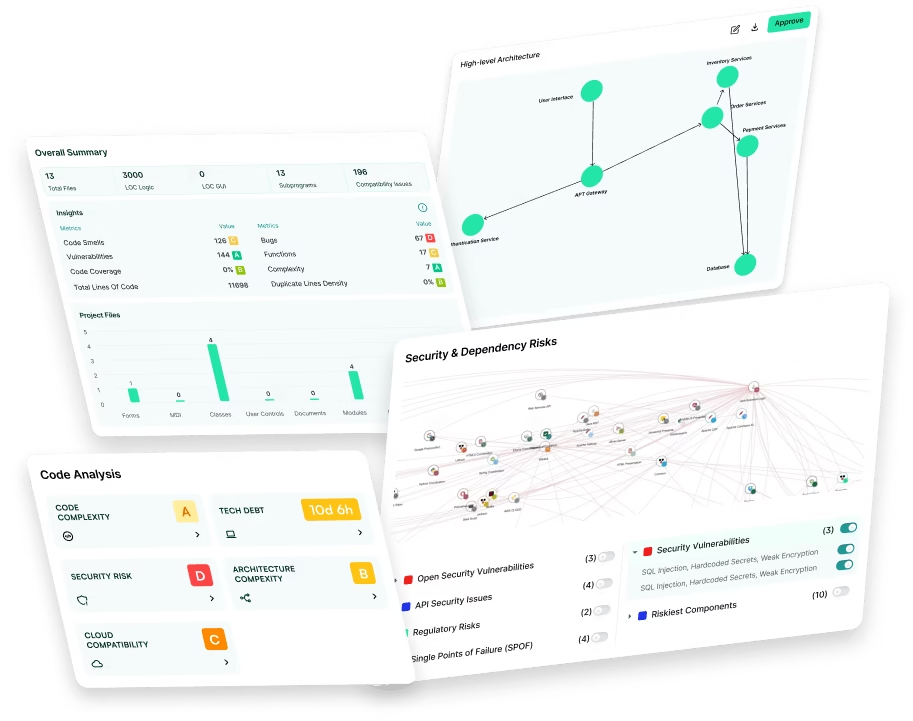
Legacyleap used large language models to analyze the legacy VB6 and Windows Forms codebase, mapping all dependencies across 1,700 DLLs and hundreds of executables. This AI-assisted analysis identified business logic, integration points, and hidden coupling that manual analysis would have taken significantly longer to surface. The dependency map became the foundation for every subsequent phase.
Phase 2: DLL Consolidation Strategy
The 1,700 DLLs and hundreds of executables were the most dramatic architectural problem. Legacyleap rationalized this sprawl into a modular .NET architecture, consolidating fragmented components into a manageable set of well-defined modules with clear boundaries, consistent interfaces, and proper versioning. This consolidation alone eliminated the majority of the maintenance fragmentation that had driven up costs for years.
Finishing a Partial Modernization
Many enterprises start a legacy modernization initiative, make progress on the straightforward components, and then stall when they reach the hardest parts. This is exactly what happened here. 95% was done, but the final 5% was the most complex and carried the highest risk. Legacyleap specializes in completing these stalled initiatives.
The approach starts with a comprehensive dependency map of what remains, identifies the specific reasons previous efforts stalled, and then designs a migration path that addresses those blockers directly.
For this client, the blockers were DLL fragmentation, decades-old customizations, and the risk of destabilizing the already-modernized 95%. Each of these was addressed as a named problem with a specific solution rather than being treated as general complexity.
Phase 3: Incremental Migration with Operational Continuity
Critical components were prioritized and migrated incrementally, each phase validated before proceeding to the next. This phased approach ensured that live entertainment production operations were never disrupted. The client continued to use the system throughout the migration, with each completed phase delivering immediate value rather than requiring a final big-bang cutover.
Phase 4: SQL Server Optimization and Cloud-Ready Infrastructure
The SQL Server backend was optimized for improved performance to handle the client’s growing product catalog and global operations. The outdated desktop-only model was restructured into a web-based framework, enabling remote access and establishing cloud-ready infrastructure. The modernized architecture supports elastic scaling, replacing the fixed-capacity model that had constrained the legacy system.
Quantified Results
| Metric | Before | After | Validation Method |
|---|---|---|---|
| Code Conversion | Manual conversion of complex residual VB6 | 60% faster with Gen AI assistance | Conversion timeline comparison |
| DLL Architecture | 1,700 DLLs with fragmented dependencies | Consolidated modular .NET architecture | Architecture review |
| Executables | Hundreds of standalone executables | Rationalized into modular components | Dependency audit |
| Security | Legacy VB6 vulnerabilities | Modern .NET security posture | Security assessment |
| Scalability | Fixed-capacity, desktop-only | Cloud-ready with elastic scaling | Infrastructure review |
| Remote Access | Desktop-only — no remote operations | Web-based framework with remote capability | Deployment validation |
| SQL Server | Performance constrained by legacy queries | Optimized for global product catalog scale | Performance benchmarking |