Struts to Spring Boot Migration Services for Legacy Java Modernization
Apache Struts limits Java upgrades, increases long-term security risk, and slows API expansion. Legacyleap is a GenAI-powered platform that orchestrates the complete migration from Struts to Spring Boot, up to 50-70% faster with full behavior parity validation.
Unleash Unmatched Modernization Velocity with Legacyleap
Legacyleap sets new benchmarks for application modernization initiatives using Gen AI





2-5 days
to assess and document the entire legacy application
~70 %
modernization automated by Gen AI
2x
Faster modernization timelines vs. vendors or in-house
100%
functional parity, validated and compliant
PLATFORM
A GenAI-Powered Modernization Platform for Struts to Spring Boot Migration
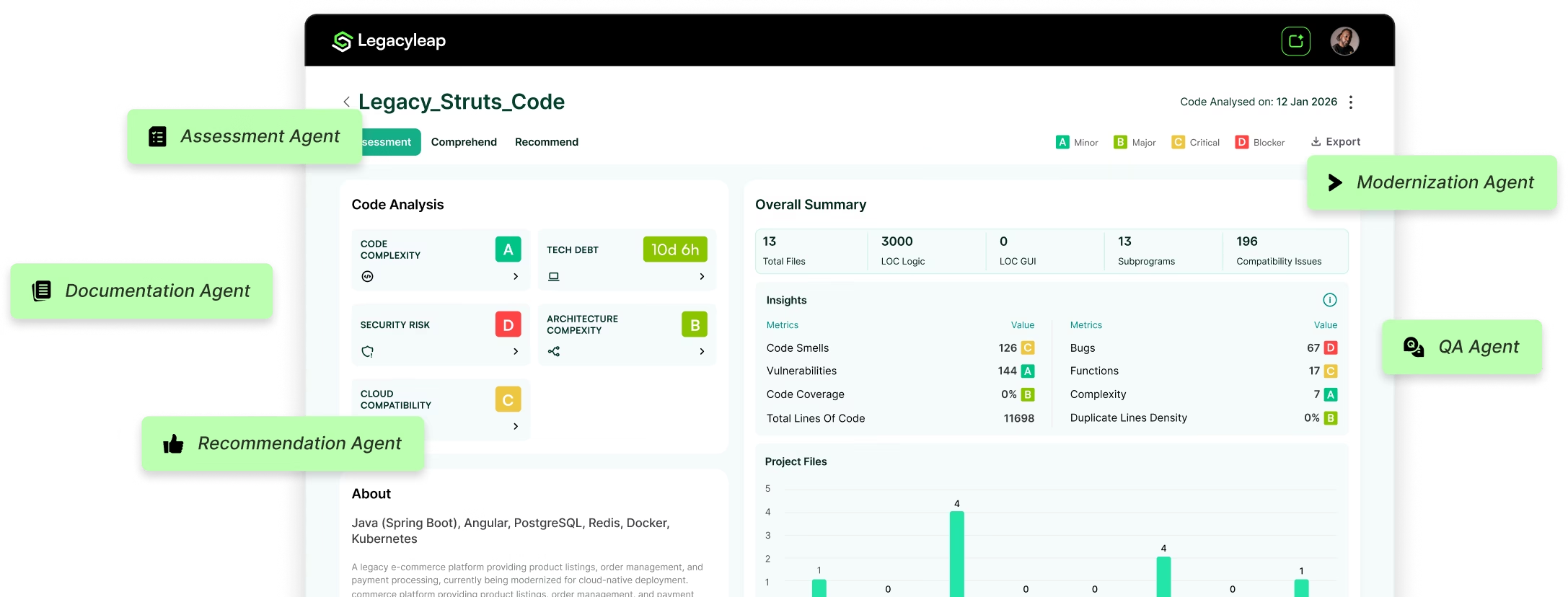
Legacyleap is an enterprise modernization platform that compresses evaluation, planning, execution, and validation for Apache Struts to Spring Boot migration using coordinated agents across every phase.
- Assessment Agent
- Documentation agent
- Recommendation Agent
- Migration Agent
- QA & Validation Agent
Assessment Agent
Understand legacy Struts app risk, scope, and effort upfront
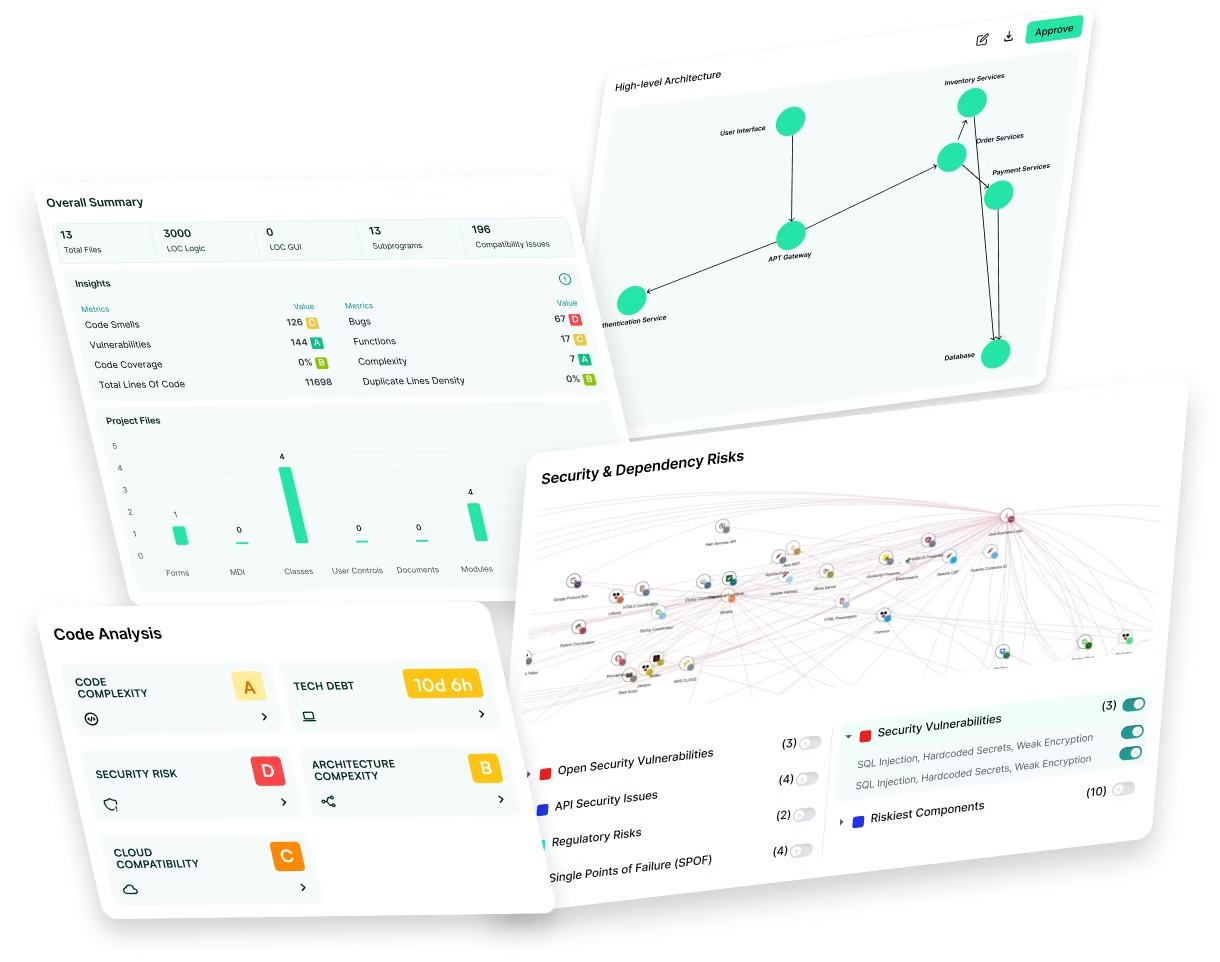
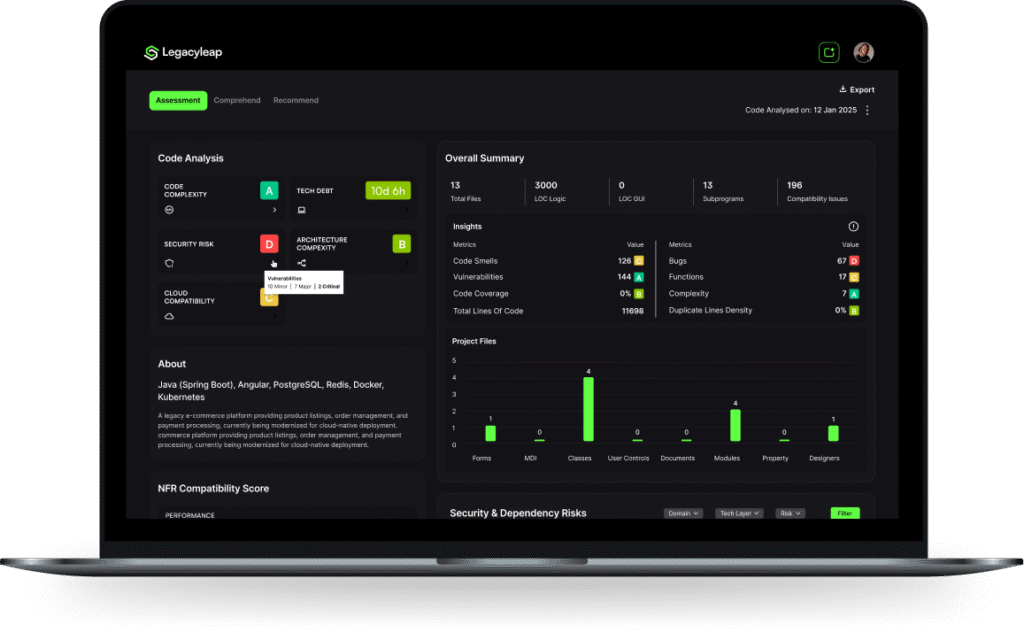
Generates a structural profile of your Struts application, identifying runtime dependencies, Java 17 and Jakarta compatibility gaps, and modernization constraints within 2-3 days.
Technical debt analysis
Architecture drift across Struts layers
Security vulnerabilities
Modernization hotspots
Migration effort and timeline estimate
Documentation Agent
Reconstruct system behavior from Struts code
Produces accurate documentation directly from Struts code and configuration, including action flows, JSP linkages, servlet routing, and integration points.
Complete system inventory (SBOM)
Action-to-service flow maps
API specifications
PRDs, BRDs, FSDs
Integration maps
Recommendation agent
Determine the right Struts migration path
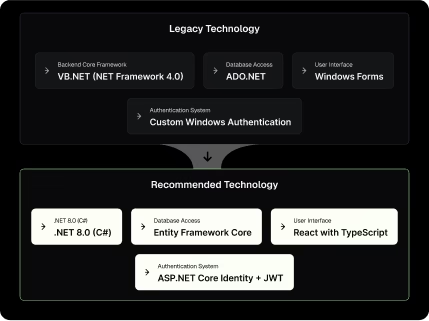
Delivers a runtime-aware modernization plan, showing whether your system fits incremental strangler migration, runtime stabilization first, module phased refactor, or a targeted Spring Boot 3 rewrite.
Complete system inventory (SBOM)
Complete system inventory (SBOM)
API specifications
PRDs, BRDs, FSDs
Integration maps
Migration Agent
Convert Struts code in controlled stages
Executes the approved modernization plan incrementally, restructuring Struts Actions into Spring Boot conventions, resolving Spring Boot 3 and Jakarta transition gaps, and aligning APIs for future extensibility.
Converted and refactored code
Gap reports
Actionable to-do lists
Pull requests
Automated PR review
QA & Validation Agent
Validate Struts migration with functional parity
Verifies functional and behavior parity with the original system, generating test cases, regression reports, and output validation to ensure production continuity.
Unit test cases
Regression test cases
Integration test cases
API test cases
$0 Assessment
Test Legacyleap on Your Legacy Struts Codebase for $0
Run a real assessment on one Struts application and see how Legacyleap works before committing to a migration.
We analyze your Struts codebase and deliver export-ready artifacts that teams typically spend months assembling manually.
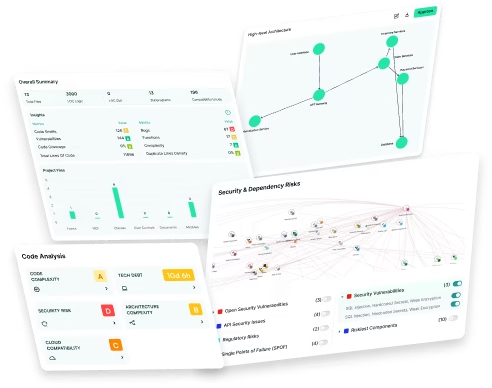
We’ve completed 150+ production-grade assessments to help teams determine whether Legacyleap is the right fit before committing.
Migration Paths
Struts to Spring Boot Migration Paths Supported by Legacyleap
Every Struts application carries different levels of coupling, UI dependency, and architectural debt. Legacyleap evaluates the codebase and executes the appropriate migration path end to end.



Struts to Spring Boot Migration
For enterprise systems requiring full legacy Java modernization and long-term platform alignment.
This path is suited for large Apache Struts applications that must:
Adopt Java 17 and Spring Boot 3
Align with Jakarta EE standards
Improve testability and modular layering
Enable container-ready deployment
Legacyleap consolidates configuration, restructures controller logic, and modernizes runtime behavior to deliver a fully aligned Spring Boot architecture.
Ideal for enterprise modernization programs where long-term maintainability and upgrade velocity are priorities.

Struts to Spring MVC Migration
For Struts applications where the core architecture remains viable but the framework itself limits flexibility.
This approach:
Preserves existing application structure
Replaces Struts controllers with Spring MVC
Reduces migration surface area
Minimizes refactoring overhead
Suitable for phased modernization where risk reduction and runtime stability are critical.

Struts to REST API Modernization
For legacy Struts systems where UI and backend logic must be decoupled to enable frontend evolution.
This path:
Extracts business logic into RESTful services
Separates presentation from application core
Enables future frontend modernization (React, Angular, etc.)
Improves API reuse and integration scalability
It is often the first step toward service-oriented or microservice-ready architecture.
Migration Paths
Struts to Spring Boot Migration Strategy: Rewrite vs Incremental vs Replatform
Legacyleap evaluates your Apache Struts architecture first and then applies the appropriate migration model with structured sequencing, Java 17 compatibility analysis, Jakarta conflict detection, and behavior parity validation built into the workflow.
01 Full Rewrite on Spring Boot 3 |
Most Common 02 Incremental Strangler Migration | 03 Replatforming | |
|---|---|---|---|
Best Suited For | Modular or lower-complexity legacy Java systems | Revenue-critical production systems requiring uptime continuity | Deeply coupled Struts architectures with upgrade blockers |
How Legacyleap Enables It | Structural assessment + dependency modeling to define clean rebuild scope | Staged endpoint replacement with parity validation before traffic shift | Java 17 + Jakarta impact analysis followed by phased module isolation |
Not sure which strategy fits your system?
Is Legacyleap Right for Me?
Choose between full-service delivery or platform access, both built to get you to production faster and safer.
You bring the system. We bring the outcome.
Turnkey Modernization Services
- Starts with a $0 Assessment
- Hands-off execution with full traceability
- Handles undocumented, fragile systems
- Parallel test generation + rollout planning
- Managed delivery with validation checkpoints
- Production-grade output, not POCs
Leverage your internal or SI teams with our platform.
Platform Licensing
- Full access to Studio (Web UI, IDE, CLI)
- Agent copilots tailored for legacy systems
- Reusable across multiple teams or programs
- Architecture maps and test harnesses
- Built-in human-in-the-loop controls
- Flexible enterprise pricing
Technical Demo
Book a Live Technical Demo of Legacyleap
This session is led by the CTO and goes deep into how Legacyleap was designed to analyze legacy code, makes migration decisions, execute conversion, and validate outcomes across real applications.
How a legacy codebase is analyzed for structure, dependencies, and risk
How documentation, architecture maps, and system inventories are generated
How migration paths to Spring boot, Spring MVC, and Rest API are determined
How code conversion is executed incrementally with pull requests
How functional parity is validated before production rollout
How long does Struts to Spring Boot modernization take?
Struts to Spring Boot migration timelines depend on architecture complexity and coupling.
Typical enterprise ranges:
- Full rewrite: 6-18 months
- Incremental migration: 6-12 months
- Runtime stabilization + phased refactor: 9-15 months
Legacyleap compresses assessment and execution through automated architecture intelligence, accelerating Struts modernization by up to 50-70%.
What is included in the $0 Struts modernization assessment?
Legacyleap runs a structured assessment on your Struts system to produce documentation, architecture visibility, risk hot spots, and a migration plan.
You get clarity on scope, blockers, strategy, timeline and budget before committing.
Is Apache Struts still viable in 2025?
Apache Struts is still maintained, but many enterprise deployments depend on outdated libraries, legacy javax.* namespaces, and shrinking ecosystem support.
For organizations planning Java 17 adoption or API-first expansion, Struts often becomes a structural constraint.
Legacyleap evaluates whether modernization is urgent or can be phased through its $0 assessment
Why not let our internal engineering team handle Struts modernization?
Internal teams can execute migration, but large Struts systems require:
- Architecture modeling before refactor
- Dependency drift analysis
- Controlled coexistence management
- Structured rollback planning
- Regression and parity validation at scale
Without dedicated orchestration, modernization projects often expand in scope and delay roadmap velocity.
Can we use Copilot or other AI coding tools for Struts migration?
AI coding tools can assist with small refactors, but they often lack full architectural context.
In large Struts systems, business logic is spread across Action classes, JSP layers, and shared utilities. Copilots operate at the file level and can misinterpret cross-module dependencies, session behavior, or integration flows.
Struts to Spring Boot migration requires system-wide modeling, controlled sequencing, and behavior parity validation.
Legacyleap analyzes the entire application structure before transformation, reducing context errors and regression risk.