What Changes When You Move from ETL to ELT
The ETL to ELT transition shifts when transformations execute and where data logic lives. In ETL, transformation occurs before load and is owned by the tool runtime. Raw data lands first, and transformation executes inside the warehouse or downstream engines. This change alters performance characteristics, failure modes, and cost attribution.
Business logic relocates from SSIS packages and Informatica mappings into SQL models, transformation frameworks, and warehouse-native execution plans. Ownership moves from tool-defined operators to database semantics, query optimizers, and versioned transformation code. The blast radius of a logic change expands from a single package to shared models and consumers.
Legacy assumptions break under this shift. Package-centric design embeds control flow, parameter resolution, and error handling inside the tool. Embedded execution semantics such as loops, branching, retries, and event handlers do not map cleanly to ELT runtimes. Tool-owned logging and row-level error outputs lose fidelity when execution moves into set-based, in-warehouse processing.
Treating ETL modernization as a one-to-one replacement produces fragile pipelines. Mechanical rewrites preserve syntax while changing semantics, leading to silent drift, inconsistent reruns, and unpredictable recovery behavior. Risk concentrates at orchestration boundaries, shared transformation layers, and downstream consumers that assume legacy timing and guarantees.
ETL modernization succeeds when these execution shifts are accounted for upfront. The consequence is clear: decisions must be made at the level of execution model, logic placement, and operational guarantees before any conversion begins.
Auditing SSIS Packages and Informatica Workflows Before Conversion
ETL modernization starts with an audit that exposes execution complexity, hidden dependencies, and operational risk. Package or mapping counts do not reflect this reality. Behavior does.
What must be reviewed before any migration
SSIS estates
- Control flow: sequence containers, loops, precedence constraints, event handlers
- Data flow: transformations, lookups, conditional splits, row-level error paths
- Configuration surface: parameters, environments, connection managers
- Operational hooks: logging providers, custom scripts, package-level error handling
Informatica estates
- Mappings and mapplets: transformation density, reuse, custom logic
- Sessions: runtime overrides, partitioning, pushdown behavior
- Workflows: scheduling logic, dependencies, conditional paths, recovery steps
These elements define execution semantics that will change during an ETL to ELT transition.
How to classify pipelines
| Category | Characteristics | Implication |
| Straightforward | Linear flows, minimal branching, standard transforms | Suitable for early conversion |
| High-risk | Heavy control flow, custom scripts, implicit dependencies | Requires staged redesign |
| Rewrite | Logic tightly coupled to tool semantics | Re-implement with ELT-native patterns |
| Retire | Low usage, duplicated outputs | Eliminate before migration |
| Consolidate | Overlapping pipelines feeding similar consumers | Reduce surface area pre-conversion |
Classification determines sequencing, resourcing, and validation scope.
Why counts mislead
- One package can encapsulate dozens of execution paths.
- Reused mapplets and shared workflows amplify blast radius.
- Operational behavior (reruns, partial failures, backfills) drives risk more than object volume.
Audit outputs that matter are execution paths, dependency graphs, and operational guarantees, not totals.
Converting Core ETL Patterns into ELT Pipelines
ETL modernization succeeds or fails at the pattern level. SSIS packages and Informatica mappings encode repeatable transformation behaviors. In an ELT model, those behaviors must be re-expressed using warehouse-native execution and explicitly managed orchestration.
Below are the patterns that matter most, and how they translate.
Joins and lookups
- ETL behavior: row-by-row lookups, cached reference tables, implicit ordering
- ELT translation: set-based joins executed inside the warehouse
- Constraint: join cardinality and null-handling semantics must remain stable
- Common failure: silent duplication or row loss due to changed join strategy or missing uniqueness guarantees
Incremental loads
- ETL behavior: package-level state, last-run timestamps, control tables
- ELT translation: watermark-based or CDC-driven models with idempotent execution
- Constraint: state must be externalized and versioned
- Common failure: inconsistent reprocessing during reruns or partial backfills
MERGE operations
- ETL behavior: procedural update/insert logic embedded in the tool
- ELT translation: declarative MERGE statements or incremental models
- Constraint: deterministic keys and conflict resolution
- Common failure: non-deterministic updates under concurrent or repeated execution
Slowly Changing Dimensions (Type 1 / Type 2)
- ETL behavior: tool-managed history logic, surrogate key handling
- ELT translation: SQL-based SCD frameworks or model-level history tracking
- Constraint: history semantics must remain query-compatible for downstream consumers
- Common failure: broken temporal joins or inflated dimension tables
Deletes and soft deletes
- ETL behavior: explicit delete steps or conditional filtering
- ELT translation: tombstone flags, validity windows, or controlled hard deletes
- Constraint: downstream expectations around record presence
- Common failure: orphaned facts or irreversible data loss during reruns
Where logic should live post-migration
- Warehouse SQL / dbt
- Deterministic transformations
- Set-based joins and aggregations
- Versioned, testable transformation logic
- Deterministic transformations
- External compute
- Heavy enrichment
- Non-relational processing
- Streaming or near–real-time use cases
- Heavy enrichment
Placement decisions affect cost, performance, and recoverability.
Failure modes of mechanical rewrites
- Syntax preserved while execution semantics change
- Implicit ordering assumptions removed
- Retry and rerun behavior altered without visibility
- Shared models introducing unintended coupling across pipelines
Pattern-aware translation reduces these risks. Treating conversion as a file-level rewrite concentrates them.
Operational Safety: Orchestration, Reruns, and Cutover Without Breakage
Operational safety determines whether ETL modernization reaches production intact. Most failures surface after pipelines are converted, when execution moves under new schedulers, new runtimes, and new recovery rules.
Moving off legacy schedulers
SQL Agent and Informatica schedulers
- Encode dependencies, retries, calendars, and failure paths implicitly
- Assume package- or workflow-level ownership of execution state
- Hide operational guarantees inside tool-specific metadata
Modern orchestration
- Requires explicit dependency graphs
- Externalizes state and execution history
- Treats pipelines as repeatable, idempotent units
The shift changes how failures propagate and how recovery is performed.
Rebuilding execution guarantees
Dependencies
- Must be declared explicitly across pipelines and shared models
- Implicit ordering in legacy tools does not carry forward
Retries
- Move from step-level retries to pipeline-level retry policies
- Require deterministic transformations to avoid data drift
SLAs
- Shift from job completion times to data availability guarantees
- Often require consumer-level validation, not just pipeline success
Calendars
- Need explicit modeling for business days, holidays, and late arrivals
- Legacy scheduler behavior rarely maps one-to-one
Handling reruns and backfills
- Reruns must be safe under partial failure and repeated execution
- Backfills require controlled scope to avoid reprocessing unaffected data
- State tracking must be centralized and auditable
Pipelines that succeed on first run but fail on rerun introduce operational risk.
Error handling and logging
- Row-level rejects are replaced by set-based failure detection
- Logging shifts from tool-managed logs to centralized observability
- Error classification must distinguish data quality issues from execution faults
Loss of visibility at this layer delays incident response.
Dual-run and reconciliation
What to validate
- Record counts and aggregates across key dimensions
- Business-critical measures, not just raw row parity
- Drift patterns over time, not single-run comparisons
Cutover sequencing
- Parallel execution with controlled consumer exposure
- Staged cutover by domain or downstream dependency
Rollback readiness
- Ability to revert without reprocessing entire histories
- Preservation of legacy execution until parity is proven
Cutover is a controlled transition, not an event.
Operational safety is where ETL modernization proves itself. Orchestration, reruns, and validation form a single risk surface. Treating them together reduces failure modes and shortens the path to stable production execution.
How Legacyleap Makes ETL Modernization Safer and Predictable
Legacyleap is applied where ETL modernization concentrates risk: system understanding, pattern translation, and production validation. It operates at the level of execution behavior, not file-level rewrites.
Where Legacyleap fits
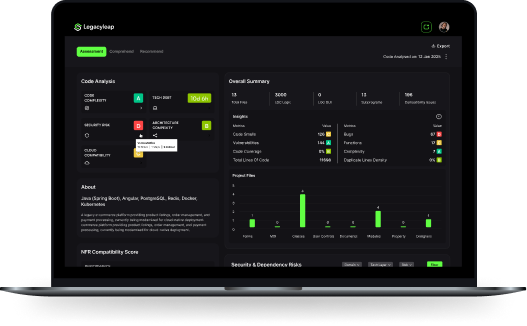
- Automated inventory of SSIS and Informatica estates: Pipelines are analyzed as execution graphs, not counted as discrete packages or mappings. Control flow, shared dependencies, and operational touchpoints are surfaced explicitly.
- Logic comprehension across packages and workflows: Transformation intent is reconstructed across data flows, mappings, and workflow boundaries. Business rules, state handling, and implicit sequencing are made visible before conversion decisions are made.
- Pattern-aware ELT transformation: Common ETL constructs such as joins, incremental loads, MERGE logic, SCD handling, deletes are translated with awareness of execution semantics. Target ELT pipelines preserve determinism under reruns and backfills.
- Validation scaffolding for dual-run: Parallel execution is supported with reconciliation hooks that focus on business-critical measures. Drift detection is treated as a first-class outcome, not a post-cutover exercise.
What Legacyleap does not claim
- No black-box rewrites that obscure execution behavior
- No blanket automation percentages detached from the validation scope
Human review remains anchored at decision points where execution guarantees change.
Resulting outcomes
- Lower risk through explicit dependency modeling and controlled execution semantics
- Shorter timelines by eliminating manual comprehension and rework cycles
- Predictable outcomes backed by measurable parity before cutover
Legacyleap functions as an ETL modernization platform by constraining where automation applies and enforcing correctness where execution shifts.
Closing Perspective for ETL Modernization Decisions
ETL modernization outcomes in 2026 are determined less by tooling choices and more by execution discipline. Programs fail when SSIS and Informatica estates are treated as collections of jobs to be replaced, rather than systems whose behavior must be preserved under a new execution model.
Successful ETL to ELT transitions share a consistent profile. Existing logic is fully understood before conversion. Core ETL patterns are translated with attention to execution semantics, not syntax. Orchestration, reruns, and cutover are engineered deliberately. Functional parity is demonstrated through controlled dual-run and reconciliation before downstream consumers are switched.
Speed and safety are not opposing forces. Faster delivery follows from reduced rework, fewer production incidents, and predictable recovery paths. Predictability follows from system-level visibility, explicit dependencies, and validation built into the modernization process rather than added after.
This frames ETL modernization as a bounded risk exercise: changing where and how data transformations execute while containing blast radius across pipelines, consumers, and operational workflows. Approaches that acknowledge this constraint scale reliably; those that bypass it do not.
Next steps
For teams evaluating ETL modernization paths, the practical starting point is visibility into execution behavior and risk concentration.
- Book a demo to review how SSIS packages and Informatica workflows are analyzed at the execution and pattern level.
- Start with a $0 ETL modernization assessment to surface dependency graphs, conversion complexity, and validation scope before committing to timelines or rewrites.
Both paths are designed to inform sequencing and execution planning, not to force early platform decisions.
FAQs
The first failures usually appear during reruns and partial backfills, not on the initial execution. Pipelines that succeed on a clean run often drift when reprocessed because execution state, ordering assumptions, or idempotency guarantees were implicit in the legacy ETL tool. These issues surface as duplicate records, missing updates, or inconsistent aggregates rather than hard failures.
Duplicate or missing records are prevented by externalizing state and enforcing idempotent execution. Incremental logic must rely on deterministic keys, explicit watermarks or CDC boundaries, and replay-safe transformations. Rerun scope should be controlled at the model or partition level rather than reprocessing entire datasets, and reconciliation checks must validate outcomes after every re-execution.
Pipelines are unsafe to mechanically convert when they contain heavy control flow, embedded scripts, implicit sequencing, or tool-managed error paths. Common signals include event handlers driving business logic, reliance on row-level rejects, session-level overrides, or undocumented dependencies between workflows. These patterns require redesign, not syntax translation. This is where Legacyleap’s assessment phase is critical, because it surfaces execution semantics and dependency risk before conversion, allowing teams to separate safe translations from pipelines that need structural rework.
Validation shifts from row-level rejection to set-based and outcome-level reconciliation. Correctness is established through aggregate comparisons, key distribution checks, and business-rule validations over time windows. Drift detection focuses on trends and deltas rather than individual bad rows, which aligns with warehouse-native execution. Legacyleap supports this by scaffolding parity checks during dual-run, ensuring validation is tied to business measures and not just record counts.
Yes, but only when backfill behavior is explicitly modeled. Legacy tools often hide backfill logic inside control flow or scheduler behavior. In ELT, backfills must be scoped, replay-safe, and isolated to prevent unintended reprocessing. Preserving behavior requires defining backfill boundaries, dependency order, and downstream impact upfront.
Downstream consumers should see stable schemas, consistent grain, and equivalent business semantics until cutover is complete. Timing guarantees and data availability SLAs must be maintained or explicitly versioned. Any change in interpretation, such as metrics, dimensions, or aggregation rules, should be treated as a separate contract change, not a side effect of modernization. Legacyleap enforces this by treating parity as a hard gate, validating modern ELT outputs against legacy behavior before consumers are switched.