
TL;DR
- IE11 has been end-of-life since 2022, but its compatibility layers are still shaping how code gets written today. ES5-only build targets, shims, and polyfills left behind by years of patches continue to inflate bundles and slow every framework or tooling migration.
- Removing IE11 isn’t a one-line config change, it’s a controlled refactor that surfaces years of hidden assumptions. IE-specific conditionals, polyfill chains, and legacy DOM assumptions are typically scattered and untracked across the codebase with no centralized record of dependencies.
- Dropping IE11 unlocks native access to modern browser APIs without expensive workarounds. Teams can adopt Fetch, IntersectionObserver, and ResizeObserver directly, while shifting to an evergreen baseline of Chrome, Edge, Firefox, and Safari under a ‘last 2 major versions’ policy.
- Gen AI can surface the full IE11 footprint but can’t safely delete the logic on its own. It can flag user-agent checks, isIE flags, and CSS hacks and categorize them by type, but removal still requires human review and can’t account for rare frozen-browser clients unless told explicitly.
- CI/CD pipelines often carry as much IE11 debt as the codebase itself. Docker images, build steps, and runtime configs frequently assume ES5 outputs or ‘legacy mode’ builds that break the moment compatibility layers are removed.
Introduction: Why IE11 Compatibility Is Now a Liability
IE11 has been end-of-life since 2022, but its footprint still lingers in many enterprise frontends. Years of patches left behind IE-specific branches, ES5-only build targets, shims, and polyfills, all of which now function as technical drag: heavier bundles, brittle CSS, and conditional logic that increases regression risk during upgrades.
Evergreen browsers like Chrome, Edge, Firefox, Safari, and modern mobile browsers are the realistic baseline today. Maintaining IE11 compatibility only blocks modern APIs, slows builds, and complicates framework and tooling migrations.
Dropping IE11 isn’t about adopting “new” tech. It’s about removing dead weight so teams can modernize cleanly with smaller bundles, cleaner code, better performance, and fewer blockers across the pipeline.
The difficulty is locating and assessing all the IE-era assumptions buried across large codebases. Gen AI can support this analysis by accelerating discovery and dependency mapping, something we’ll explore later in the blog.
Why IE11 Support Must Be Dropped, and What an Evergreen Baseline Enables
IE11 may be gone, but the compatibility layers built to support it are still embedded across many enterprise frontends. That’s the real cost: not the browser itself, but the outdated assumptions still shaping how code is written, bundled, and tested.
Migrating to an evergreen baseline is a way to remove constraints that distort performance, block upgrades, and inflate delivery timelines.
The Operational Cost of Keeping IE11 Alive
- Security and compliance exposure: An unsupported browser introduces audit risk, especially when frontends must meet rising security and privacy expectations.
- High maintenance overhead: Teams maintain duplicate codepaths, CSS branches, and ES5 fallbacks purely to avoid regressions. This increases QA cycles, edge cases, and coordination costs.
- Performance penalties across all users: Shipping shims, polyfills, and ES5 bundles adds weight to every request, hurting modern-browser users who gain nothing from this overhead.
- Blockers to modern upgrades: Framework updates, tooling migrations, and API adoption all become harder when IE11 constraints remain in the build pipeline.
- Engineering fatigue: Developers spend time supporting behaviors for a browser that isn’t part of any real user base, slowing feature delivery and eroding morale.
What An Evergreen Baseline Means
- Auto-updating browsers as the default: Chrome, Edge, Firefox, Safari, and modern mobile browsers, not frozen-at-version clients.
- A clear support matrix: Usually “last 2 major versions” or similar policies that reflect real enterprise usage patterns.
- Modern JavaScript baseline: ES2017+ output, reduced polyfills, native modules, async/await, and modern array/object utilities without IE-era fallbacks.
- Modern CSS and layout assumptions: Flexbox and grid as the foundation, removal of float/clearfix hacks, and consistent adoption of logical and custom properties.
- Consistent feature support strategy: Documented rules for progressive enhancement and API usage, not tribal knowledge buried in code comments.
The Modernization Benefits
- Smaller bundles and faster loads: Removing compatibility layers and ES5 transpilation immediately cuts JS weight.
- Simpler, more maintainable codebases: Eliminating if(isIE11) logic, conditional stylesheets, and workarounds reduces branching and regression risk.
- Better performance for real users: Less JavaScript to parse and execute means better responsiveness, improved Core Web Vitals, and smoother interaction patterns.
- Ability to adopt modern APIs safely: Native access to Fetch, IntersectionObserver, ResizeObserver, URL API, and more, without expensive polyfills.
- Unblocked modernization path: Easier movement to modern framework versions, microfrontends, and modern build systems like Vite, Rspack, or esbuild.
Also read: Frontend Modernization in 2026: Frameworks, AI, and Governance.
Challenges With Typical IE11 → Evergreen Migration Efforts
Most teams don’t delay IE11 removal because the change is technically hard. They delay it because the dependencies built around IE11 are scattered, undocumented, and risky to touch without a structured modernization workflow.
Dropping IE11 is not a one-line config change. It’s a controlled refactor that surfaces years of hidden assumptions.
Here’s where migration efforts usually break down
- IE11-specific logic is scattered and untracked: Inline conditions, utility helpers, and config flags sit across different layers of the codebase with no centralized record of what depends on what. Teams can’t confidently say which branches are safe to remove.
- Fear of regressions slows everything down: IE11-only paths often behave differently, but no one knows which components still rely on them. Removing the wrong condition can break an unrelated flow that no one tests regularly.
- Polyfill chains are more complex than expected: Enterprises load polyfills through script tags, bundler configs, conditional includes, and third-party libraries. Some overlap, some are unused, and some are still required, and it’s rarely obvious which is which.
- Old DOM and API assumptions are baked into the code: Legacy APIs or non-standard behaviors may be used without fallback strategies. Replacing them with modern equivalents risks subtle behavior shifts across large surfaces.
- Build and deployment pipelines carry legacy constraints: CI/CD workflows are often tied to ES5 outputs or “legacy mode” builds. Docker images, build steps, and runtime configs all assume compatibility layers that no longer make sense.
- Test coverage is incomplete, especially cross-browser: Manual QA fills the gaps left by weak automated coverage. When IE-era conditionals are removed, edge cases can break silently because nothing asserts their behavior.
Attempting IE11 removal without visibility is exactly why migrations stall or introduce regressions.
How Gen AI Supports IE11 → Evergreen Browser Migration
Gen AI isn’t here to “auto-fix” legacy browser hacks. Its value is in revealing the full IE11 footprint, organizing what needs to change, and accelerating the structured refactor that follows.
For large enterprise codebases, that visibility alone eliminates most of the uncertainty that stalls IE11 migration efforts.
Here’s where Gen AI materially helps:
- Discovering IE11-specific code paths: Gen AI combined with static analysis can surface patterns teams often miss: user-agent checks, feature tests, custom isIE flags, conditional imports, outdated DOM APIs, and CSS hacks. It provides a consolidated view of all IE-tied dependencies, so developers don’t have to hunt them down manually.
- Categorizing compatibility patterns: Instead of returning a flat list of “problems,” Gen AI can group legacy behaviors by type, such as JS language constraints, DOM APIs, CSS layout workarounds, or polyfill/shim usage. This produces module-level summary reports that show where the highest cleanup effort sits.
- Suggesting modernization options: For each flagged pattern, Gen AI can propose modern equivalents: replacing XHR flows with fetch, swapping float layouts for flexbox/grid, removing outdated event patterns, or replacing non-standard DOM usage. These are guidance-level suggestions, helping teams choose removal, rewrite, or replacement routes.
- Analyzing polyfills and build targets: Gen AI can map which polyfills are still required under a defined evergreen browser matrix and which can be dropped. It can also recommend updated Babel/runtime targets to eliminate unnecessary ES5 output and reduce bundler overhead.
- Generating targeted test cases: Once IE-specific branches are identified, Gen AI can draft automated tests to cover behaviors that were previously validated only through manual QA. It also helps scaffold regression tests for evergreen browsers so teams can modernize without introducing silent breakage.
What Gen AI cannot do:
- It cannot safely delete all IE-specific logic without human review.
- It cannot account for rare enterprise clients with frozen browsers unless explicitly told.
- It cannot guarantee cross-browser correctness. Testing still decides that.
Gen AI accelerates the analysis and planning side of IE11 removal. The execution still demands structured refactor work and validation, which is the right level of expectation for enterprise modernization.
Also read: How Can Gen AI Drive Every Step of Your Modernization Journey?
How Legacyleap Supports IE11 → Evergreen Migration
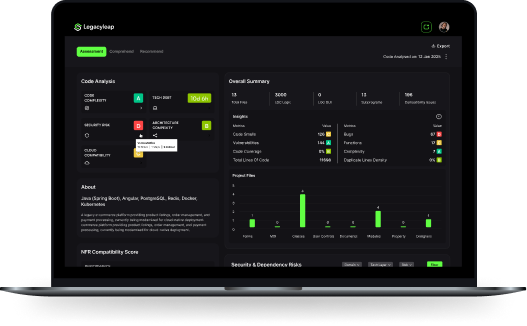
Legacyleap is designed for exactly the kind of modernization that moving away from IE11 requires: high-visibility analysis, assistive refactoring, and predictable validation without risking regression. The platform doesn’t “auto-fix” every browser hack; it gives teams the clarity, scaffolding, and safety nets they need to execute confidently.
1. Codebase-wide discovery of legacy browser dependencies
Legacyleap parses the entire application and constructs semantic dependency graphs, exposing IE11-related logic that would otherwise remain hidden. This includes:
- IE11 detection patterns
- Conditional branches and fallback code
- Utilities designed for legacy DOM behaviors
- Polyfill and shim usage across multiple loading paths
All findings are mapped back to modules, features, and real user flows, giving teams a precise view of where IE-era assumptions still shape behavior.
2. Structured remediation reports
Instead of a flat list of issues, Legacyleap generates structured, prioritized reports that outline:
- Which IE11-specific branches can be safely removed
- Which areas require targeted refactoring
- High-risk modules where IE logic affects shared UI or core workflows
- Low-risk cleanup opportunities that deliver immediate simplification
This becomes the modernization roadmap for engineering teams.
3. Assistive modernization suggestions
Legacyleap’s agents support developers by:
- Proposing modern API replacements when usage is safe and well-understood
- Suggesting ways to simplify codepaths now that IE11 constraints are gone
- Normalizing inconsistent patterns across the codebase to reduce long-term maintenance
These are assistive recommendations, where the engineer remains in control.
4. Build and configuration alignment
IE11 removal impacts the pipeline as much as the code. Legacyleap helps teams recalibrate their toolchain by:
- Updating bundler/browser targets for an evergreen matrix
- Cleaning outdated Babel or TypeScript configurations
- Recommending a leaner polyfill strategy aligned with modern browser usage
This removes the legacy overhead that slows performance and complicates upgrades.
5. Safety nets for cross-browser validation
Modernization is only complete when teams can verify behavior across current browsers. Legacyleap strengthens this step by:
- Auto-generating tests for logic that previously branched for IE11
- Supporting validation workflows across Chrome, Edge, Firefox, and Safari
- Giving teams early detection of regressions before changes reach production
The result is a predictable migration instead of trial-and-error debugging.
6. Honest limitations
Even with strong automation support, some changes require human judgment. Legacyleap makes this explicit:
- The platform does not auto-convert every browser hack.
- Certain fixes involve UX or design decisions that need manual intervention.
- Deep CSS/layout rewrites often require coordinated engineering and design review.
The platform accelerates the modernization process, but it doesn’t replace the strategic decisions that govern long-term frontend evolution.
Conclusion: IE11 Removal as a Step Toward Sustainable Frontend Modernization
Supporting IE11 today delivers almost no real-user value, yet it continues to add risk, cost, and friction across enterprise frontends. Shifting to an evergreen browser baseline is the foundation for smaller bundles, cleaner codepaths, better performance, and smoother upgrades to modern frameworks and tooling.
Gen AI helps accelerate the work by uncovering IE11 dependencies and shaping clear remediation plans, but it won’t automatically resolve every legacy pattern. That’s where a structured approach matters.
Legacyleap provides the visibility, guidance, and validation layers needed to remove IE11 constraints safely, giving teams a frontend that’s easier to evolve without dragging along a dead browser.
Ready to move forward?
Start with a $0 IE11 Compatibility Assessment to get a clear map of where IE11 assumptions still exist and what it takes to move to an evergreen baseline.
Book a Demo to see how Legacyleap streamlines discovery, refactoring, and validation for large-scale frontend modernization.
FAQs
Third-party dependencies are often where IE11 compatibility lingers longest, especially when libraries ship ES5 bundles or bundle their own polyfills. The right approach is to inventory which libraries are actually contributing IE-era constraints, evaluate whether modern builds or newer versions are available, and isolate the impact of upgrading or replacing them. Platforms like Legacyleap help by mapping where these libraries are used, identifying redundant polyfills, and highlighting low-risk upgrade paths so teams don’t blindly refactor code that isn’t the real blocker.
This is a common enterprise concern, but it’s usually solvable with a clear support strategy rather than full backward compatibility. Many teams adopt graceful degradation or controlled access for legacy clients while standardizing development and builds around evergreen browsers. The key is making this a documented exception and not something that shapes the entire frontend architecture. This approach limits risk while still allowing the primary codebase to modernize.
Effort estimation depends less on application size and more on how deeply IE11 assumptions are embedded. Teams need visibility into conditional branches, polyfills, build targets, and shared components before assigning timelines. Legacyleap supports this by generating structured discovery and remediation reports that break IE11 cleanup into removable code, refactor-required areas, and higher-risk zones, allowing teams to estimate effort based on actual dependency scope rather than guesswork.
Shared components often become significantly simpler once IE11 branches are removed. Conditional rendering logic, fallback styles, and legacy event handling can usually be consolidated into cleaner, single-path implementations. However, this simplification should be done carefully, especially in design systems used across multiple applications. The goal is consistency and predictability, not accidental behavior changes in downstream consumers.
CSS modernization should be treated as incremental refactoring, not wholesale rewrites. Teams typically replace float-based layouts and IE-specific hacks with flexbox or grid in well-scoped areas, validating visual behavior as they go. The safest approach is to modernize layout primitives first, then progressively clean up overrides and fallbacks. This reduces layout regressions while steadily removing technical debt tied to old rendering engines.
Visual validation is critical once legacy fallbacks are removed, especially across shared components and responsive layouts. Teams should combine automated visual testing with targeted manual review in evergreen browsers to catch subtle differences early. Legacyleap strengthens this step by helping teams generate tests around previously branching logic and validate behavior across Chrome, Edge, Firefox, and Safari before rollout, reducing the risk of silent UI regressions.